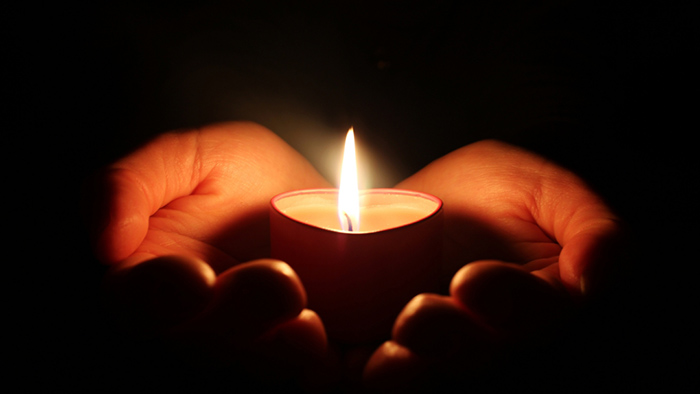
Just so, your light must shine before others, that they may see your good deeds and glorify your heavenly Father. Matthew 5:16

We’re called to live in the light, but we tend to have an overly romantic idea of what that should mean. We tend to think that to live in the light means that there should be a kind of special sunshine inside of us, a divine glow in our conscience, a sunny joy inside us that makes us constantly want to praise God, an ambience of sacredness surrounding our attitude.  But that’s unreal.  What does it mean to live in the light?

To live in the light means to live in honesty, pure and simple, to be transparent, to not have part of us hidden as a dark secret.

Spiritual health lies in honesty and transparency and so we live in the light when we are willing to lay every part of our lives open to examination by those who need to trust us.

·       To live in the light is to be able always to tell our loves ones where we are and what we are doing.

·       To live in the light is not have to worry if someone traces what websites we have visited.

·       To live in the light is to not be anxious if someone in the family finds our files unlocked.

·       To live in the light is to be able to let those we live with listen to what’s inside our cell-phones, see what’s inside our emails, and know who’s on our speed-dial.

·       To live in the light is to have a confessor and to be able to tell that person what we struggle with, without having to hide anything.

To live in the light is to live in such a way that, for those who know us, our lives are an open book. [Excerpt from Ron Rolheiser’s “To Live In The Light” April 2012]
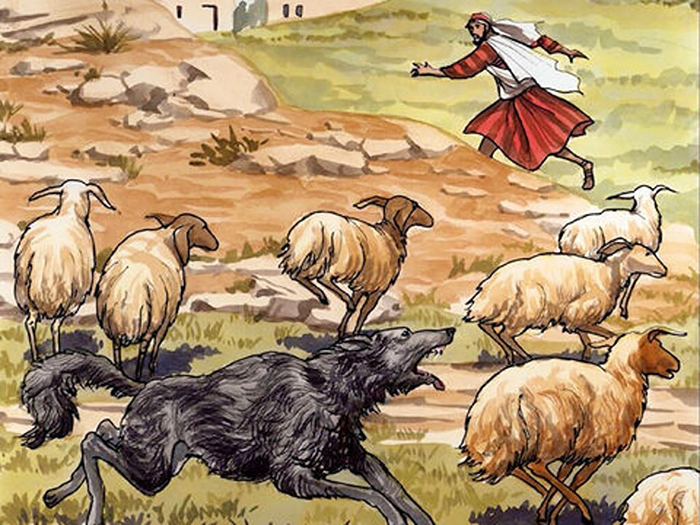

They were like sheep without a shepherd. Mark 6:34

A Jesuit friend of mine was an actual shepherd in his youth. He had spent plenty of time out in the fields, so I asked him what taking care of sheep was like. He surprised me. He said he hated being a shepherd and would never want to go near it again. Never. Why? Because today there are huge numbers of sheep in a herd and you could never know which was which, much less have names for them. Sheep-dogs, not the shepherd, could keep them more or less together. It was a cold job, uncomfortable and unrewarding, an industry now, with nothing personal about it.

What a surprise. This seemed like the exact opposite of what we hear in the Bible.

In Jesus’ day, however, the herds were much smaller. A shepherd could name each sheep and they knew their master’s voice by heart, the way the way the family dog knows your voice. Good shepherds would search and search for one lost sheep. Or if one was turned absurdly on its back, unable to roll over because of its full fleece, the shepherd would take his “crook,” and using the big curve on one end, easily maneuver that sheep back to its feet.

And if there was real danger, as for instance if wolves were ready to pounce, the shepherd would take out his “staff,” which served as a weapon, and deal with the predators.

Bad shepherds, on the other hand, would actually scatter the sheep. Sheep feared and trembled and many went missing. Sometimes the uncaring shepherds would lessen their burden by driving the sheep off. People were hired who were not shepherds at all, who simply ran away when a wolf approached.

In our reflection reading from today’s gospel, we see that Jesus was becoming very popular. Many people were coming and going, so that he and his apostles “had no opportunity even to eat.” He wisely invited them to come away with him to a quiet place for rest. They went off in a boat to a “deserted place.”

But the needy throng traced where they figured the boat was going. They formed a “vast crowd” and ran to the spot! What should Jesus do, start ministering to them again instead of resting? The Gospel says “his heart was moved with pity for them, for they were like sheep without a shepherd.” And, “he began to teach them many things.”

The question for you and me is not whether we should go without food and drink or be workaholics for the sake of others. It is whether our own hearts are ever moved even once with pity for the scattered and fear-filled sheep-folk of our own time. Can we love them and each other, with Jesus’ love? Can we be good shepherds? [Excerpt from John Foley S.J. “Good Shepherds and Bad” July 2018]

Blessed are they who have kept the word with a generous heart, and yield a harvest through perseverance. Luke 8:15

We are not created by God and put in this earth with small, narrow, and petty hearts. The opposite is true. God puts us into this world with huge hearts, hearts as deep as the Grand Canyon. The human heart in itself, when not closed off by fear, wound, and paranoia, is the antithesis of pettiness. The human heart, as Augustine describes it, is not fulfilled by anything less than infinity itself. There’s nothing small about the human heart.

The problem is not the size or the natural dynamics of the human heart, but what the heart tends to do when it is wounded, fearful, disrespected, paranoid, or self-deluded by greed and selfishness.  It’s then that it closes itself to its own depth and greatness and becomes narrow, petty, fearful, and selfish. But that behavior is anomalous, not the human heart at either its normal or its best. At its normal and at its best, the human heart is huge, generous, noble, and self-sacrificing.

The Church Fathers taught that inside of each of us there was also another heart, a magna anima, a huge, deep, big, generous, and noble heart. This is the heart we operate out of when we are at our best. This is the heart within which we feel empathy and compassion. This is the heart within which we are enflamed with noble ideals. This is the heart where we inchoately feel God’s presence in faith and hope and are able to move out to others in charity and forgiveness. Inside each of us, sadly often buried under suffocating wounds that keep if far from the surface, lies the heart of a saint, bursting to get out.

Thus on any given day, and at any given moment, we can feel like Mother Teresa or like a bitter terrorist. We can feel ready to give our lives in martyrdom or we can feel ready to welcome the sensation of sin. We can feel like the noble Don Quixote, enflamed with idealism, or we can feel like a despairing cynic, content to settle for whatever short-range compensation and pleasure life can give rather than believing in deeper, more life-giving possibilities for ourselves and others. Everything depends upon which heart we are connected to at a given moment.

If that is true then our invitation to others in terms of moving towards nobleness of heart will be most effective when, rather than emphasizing their faults and narrowness, we instead invite them to try to access what is best, highest, within themselves. [Excerpt from Ron Rolheiser’s “The Size of our Hearts” June 2011]

Lord, forgive the wrong I have done. Psalm 32

In 2015, Dylann Roof shot nine members inside an African American church in South Carolina and was publicly forgiven by the relatives of his victims. And in 2006, when a gunman shot ten Amish children in a school room in Pennsylvania and then killed himself, the Amish community there not only forgave him, they went to visit his family and expressed sympathies to them for their loss. What was the general response? Admiration for extraordinary selflessness and virtue? No, not that. More generally, these instances of forgiveness were judged as naïve fundamentalism and as unhelpful.  Why?

Timothy Keller, writing in Comment Magazine, suggests that there are a number of reasons for this, but he singles out two in particular. We are a “therapeutic culture” (where only our own truth and feelings matter) and a culture that has a “religion without grace” (its vision and virtue go no further than what echoes in our emotions and willpower).  Hence, our culture sees forgiveness more negatively than positively.  For it, forgiveness allows oppression to maintain its power and thus permits the cycle of violence and abuse to go on. Like a family refusing to stand up to an alcoholic member, it enables rather than stops the abuse and allows a sick situation to continue. Forgiveness then is a further injustice to the one who has been violated and can lead to a form of self-loathing, an acceptance of a humiliation destructive of one’s self-image, a further loss of dignity. Moreover, the moral pressure to forgive can be a further burden on the victim and an easy escape for the perpetrator. Is this logic correct?

From a purely emotional point of view, yes, it feels right; but it is wrong when scrutinized more deeply. First, it is evident that vindictiveness will only produce more vindictiveness. Vindictiveness will never soften a heart and help change it. Only forgiveness (analogous to dialysis) can take violence and hatred out of a relationship. As well, in the words of Martin Luther King, anyone devoid of the power of forgiveness is also devoid of the power of love. Why? Because each of us will get hurt by others and will hurt others in every one of our relationships. That is the price of community inside human inadequacy. Hence, relationships at every level, personal and social, can only sustain themselves long term if there is forgiveness. 

Moreover, with Jesus, forgiveness becomes singularly the most important of all virtues. It decides whether we go to heaven or not. As Jesus tells us when he gives us the Lord’s Prayer, if we cannot forgive others, God will not be able to forgive us. Why? Because the banquet table, eternal community of life, is only open to everyone who is willing to sit down with everyone. God cannot change this. Only we can open our hearts sufficiently to sit down with everyone.

That being said, it must also be said that forgiveness is not simple or easy. That is why in the Judeo-Christian spirituality of Sabbath, there is a (too-little-known) spirituality of forgiveness. As we know, the command to celebrate Sabbath asks us to honor this cycle in our lives: Work for six days – rest for one day. Work for 7 years – rest for one year.  Work of seven times seven (forty-nine) years – have a major rest (sabbatical). Work for a lifetime – and then be on sabbatical for eternity.

Well that is also the cycle for forgiveness.  In the spirituality of Sabbath: You may hold a minor grudge for six days – then you need let it go. You may hold a major grudge for seven years – then you need to let it go. You may hold a soul-searing grudge for forty-nine years – then you need to let it go. You may hold a grudge that ruined your life until your deathbed – then you need to let it go. That is the final Christian moral imperative. Desmond Tutu once said, “without forgiveness there is no future”. True – on both sides of eternity. [Excerpt from Ron Rolheiser’s “The Fading of Forgiveness” August 2021]

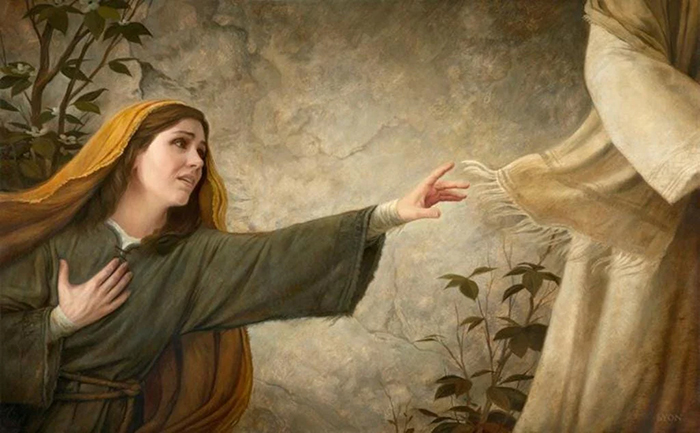
She said, “If I but touch his clothes, I shall be cured.”Immediately her flow of blood dried up. She felt in her body that she was healed of her affliction. Mark 5:28-29

By the time we reach maturity, we have also lost some vital, life-giving parts of ourselves. By the time we get to possess ourselves, all of us have been wounded, shamed in our enthusiasm, and parts of our bodies and our souls have died and turned cold. By the time we get to be more fully in possession of ourselves we are no longer whole.

And this bitterly limits how well we can love and especially how fully we can give life. In the gospels we are told, within a single story, how Jesus cured two women who, on the surface, seem to have very little in common. The story runs this way:

Jesus is approached by a man named Jairus, who asks him to come and cure his daughter who is thirteen years old. As Jesus is making his way to Jairus’ house, hemmed in by a curious crowd, a woman who, we are told, had been suffering from internal haemorrhaging for twelve years and had spent all her money on doctors without getting any better, approaches him surreptitiously, saying to herself: “If I but touch the hem of his garment, I will be healed!” She does just that and, the gospels tell us, instantly the flow of blood stopped. Touching Jesus did for her what doctors couldn’t do, it stopped her internal haemorrhaging.

Then, as Jesus is approaching Jairus’ house, he is told that the man’s daughter is already dead, but he enters the house anyway, goes to the young girl’s bed, takes her by the hand, and brings her back to life.

What these two women have in common is this: For different reasons, both are unable to get pregnant and give life; the young girl, because she dies at puberty, just as she has the radical possibility of getting pregnant, and the other woman, because the forces inside her that are meant to give life are damaged and haemorrhaging, making it impossible for her to hold a pregnancy. What Jesus does is give back to both women the possibility of giving life, in one case by stopping the flow of blood and in the other by starting it.

We all need a similar miracle: By the time we’re finally ready to give life some deep parts of us have already died and are too cold and lifeless to ever become pregnant. As well, like the woman whose internal bleeding makes it impossible for her to get pregnant, we too are wounded in ways that have us forever haemorrhaging out the life forces we need in order to give life. Parts of us have died and parts of us have been wounded and we are forever haemorrhaging in body, heart, and soul. It’s hard for us to give life.

Only by touching some higher power, and this is most easily done inside a community, can we actually change our lives. Therapy too is helpful to a point, but only to a point. In the end, the power to give life can only be restored to us through grace and community, through letting a power beyond give us something that we cannot give to ourselves. Then, and only then, will those parts of us that are dead or diseased begin again to give life. [Excerpt from Ron Rolheiser’s “Stopping the Haemorrhaging by Touching the Hem of the Garment” July 2006]

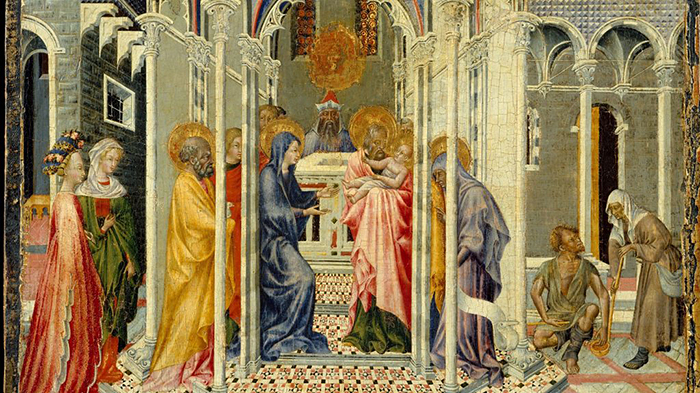
“Now, Master, you may let your servant go in peace, according to your word, for my eyes have seen your salvation, which you prepared in the sight of all the peoples: a light for revelation to the Gentiles, and glory for your people Israel.” Luke 2:22-32

Every one of us is called to “present ourselves” to God, to dedicate ourselves completely to Jesus Christ, following him in love and seeking his will for our lives and our world. That is what this great feast we celebrate today is all about.

Today’s Gospel scene is familiar to us because it is the fourth joyful mystery of the rosary. The holy man in the Temple, Simeon, recognizes that Jesus is not just any ordinary child. Inspired by the Holy Spirit, he is able to understand that Jesus is the One whom all the world has been waiting for, the living God and the true face of our humanity.

The feast of the Presentation of the Lord is another “epiphany,” another revelation of who Jesus Christ really is. And in the light of his presence, once again he manifests the beautiful possibilities of our lives as children of God.

Our God is not someone distant who doesn’t want to be involved in the lives of his creatures. Our God is the God of encounter, a God who comes from the heavens to be close to us, who comes down to join his life to our life in love. This is the beautiful reality of the Incarnation, “God with us.”

Our second reading, from the Letter to the Hebrews, tells us that Jesus came to share in our “blood and flesh,” and that he “had to become like his brothers and sisters in every way,” except for sin.

What a beautiful gift our God gives to us! Jesus comes to share in our human reality, as a brother, as a friend. And because our human reality includes pain, suffering, and death, Jesus shares in those things as well.

Jesus, who is perfect God and perfect man, loves us so much that he suffered death to set us free from our selfishness and sins.

Jesus comes into your life and mine; he comes to purify our humanity, to return our human nature to its “essence.” He comes to make holiness possible for us, to make it possible for us to offer ourselves in sacrifice to the Lord.

Our lives are made for “presentation” to the Lord. Jesus is waiting for us to love him as he loves us. Jesus is calling to each one of us personally, waiting for each one of us to offer our life to him as a “present,” to make our lives a gift to him, just as he gives his life for us.

And this is a beautiful way to live.

In a practical way, it is important for all of us to continue finding the time in our busy lives to spend more time with Jesus: reading the Gospels, contemplating his life, making ourselves ready every day to receive him in Holy Communion and, as much as possible, to try to live in the presence of God all day long.

This is the real meaning of life, this is what makes our life as beautiful as it is supposed to be — God wants to be with us and each one of us wants to be with God. – Archbishop José H. Gomez

“Blessed are you…” Matthew 5:11

Catherine de Hueck Doherty, the founder of Madonna House, once gave a wonderfully insightful interview. “Inside me,” she said, “there are three people. There’s someone I call the ‘Baroness’. The ‘Baroness’ is the one who’s spiritual, efficient, and given over to prayer and asceticism. She’s the religious person inside me. She’s the one who founded a religious community, who writes spiritual books, challenges others, and has dedicated her life to God and the poor. The ‘Baroness’ reads the gospels and is impatient with the things of this world. For her, life here and now must be sacrificed for the next world.

But, inside me too, there’s another person I call ‘Catherine’. ‘Catherine’ is, first of all and always, the woman who likes fine things, luxuries, comfort, pleasure. She enjoys idleness, long baths, fine clothes, putting on make-up, good food, and used to (while married) enjoy a healthy sex life. ‘Catherine’ enjoys this life and doesn’t like self-sacrifice. She’s not particularly religious and generally hates the ‘Baroness’. ‘Catherine’ and the ‘Baroness’ don’t get along.

However, there’s still another person inside of me, who’s neither ‘Catherine’ or the ‘Baroness’. Inside me too there’s a little girl lying on a hillside in Finland, watching the clouds and daydreaming. This little girl doesn’t particularly like either ‘Catherine’ or the ‘Baroness’.

… and, as I get older, I feel more like the ‘Baroness’, long more for ‘Catherine’, but think maybe the real person inside me is the little girl daydreaming on a hillside.”

Saints struggle and so does everyone else. It’s not a simple thing to be a human being and it’s even more complex if you’re striving to give yourself over beyond what comes naturally, morally and spiritually. Like Catherine de Hueck Doherty, all of us have multiple persons inside us.

Inside each of us there’s someone who has faith, who wants to live the Beatitudes, and who wants to be attuned to truths and realities of the gospels. Inside each of us, there’s a martyr who wants to die for others, a ‘Mother Teresa’ who wants to radically serve the poor, and a moral artist who wants to carry his or her solitude at a high level. But inside each of us there’s also someone who wants to taste life and all its pleasures here and now. Inside each of us there’s a hedonist, a sensualist, a libertine, a materialist, an agnostic, and an egoist. Beyond that, inside each of us there is also a little girl or little boy, innocent, daydreaming, watching the clouds on some hillside, not particularly enamoured of either the saint and the sinner inside us.

Our complexity is not our enemy but our friend. All those pathological opposites inside us are precisely what make up our keyboard. It’s precisely because we’re both sinner and saint, hedonist and martyr, adult and child, that we have the enough keys to play the various musical scores that life hands us. [Excerpt from Ron Rolheiser’s “Living with our own Complexities” November 2004]

HTML Snippets Powered By : XYZScripts.com