In this section, we engage in the process of learning to understand and navigate a disordered world by embracing the stories of our lives—listening to experiences, acknowledging complexity, and finding meaning through empathy, reflection, and connection rather than control or certainty. Each month, we will have stories from various faith oriented news outlets to help us pause and reflect on the challenges and opportunities available to us in embracing this disordered world we live in.
December 2025 Stories
The Ghost Sacrament – the collapse of confession in America.
‘Are They Human?’ – interview with Martin Scorsese and his newest work – ‘The Saints’.
Gen Z’s future with the Catholic Church – what new studies reveal.
Want to Love Your Neighbor? Grieve With Them – dealing with Jesus’ great commandment in times of conflict.
The Ghost Sacrament
James M. O’Toole traces the collapse of confession in America – Bernard Prusak.

“Seldom does history offer an example of a practice undertaken for so long by so many that collapsed so quickly,” writes James O’Toole of confession. “The question is why.” For I Have Sinned is his eloquent, thoroughly researched answer.
From the beginning of the twentieth century into the 1950s, regular confession was what O’Toole, a distinguished historian who taught for many years at Boston College, calls a “defining characteristic” of American Catholic religious life. If Sunday was for Communion, Saturday was for confession, and most Catholics were reluctant to take Communion if they had not gone to confession.
But in the late 1960s, seemingly all at once, regular confession became the exception, not the norm. By the end of the twentieth century, penance—rechristened reconciliation after Vatican II—had become a “ghost sacrament,” as a priest quoted by O’Toole puts it. It lingered in preparations for first Communion and confirmation, but the life had gone out of it. Whatever passing hopes there were to revive it for adults faded away with the Church’s sexual-abuse scandal. Now confession largely figures as something that practicing Catholics feel slightly guilty about not doing, if they give it any thought at all.
For I Have Sinned is both a scholarly and a deeply personal book. It opens with an evocation of O’Toole’s early religious practice in Leominster, Massachusetts, in the late 1950s and early 1960s, and concludes with “[t]he boy, grown now (he had to admit) to an old man,” visiting his childhood church in the present and noting the differences. The confessionals adults had once flooded into during O’Toole’s boyhood have now been eliminated or remodeled, and only a trickle of adults come by to speak with the one priest on hand in a brief period before Saturday evening Mass—itself an innovation. But it’s not just religious practice that has changed. The changes to what O’Toole calls the “religious consciousness” of practicing Catholics are at once more profound and much less visible. They are the book’s focus.
Confession didn’t collapse because of changes to the rite, which has remained essentially the same since the early Middle Ages. A priest listens, in strict privacy, to a penitent who recites his or her sins (ideally according to number and kind), judges the gravity of those sins, prescribes an appropriate penance, and imparts absolution. In the mid-century United States where O’Toole grew up, the crush of people lining up to confess limited the typical confession to around ninety seconds. Penitents prepared themselves through an examination of conscience, guided either by pamphlets or by lessons learned in grade school, and entered a dark confessional box, with a screen between themselves and the priest. There was usually some trepidation, but it was tempered by the certainty that justice would be served. For “[t]here was always an answer—a correct answer, a definitive answer, a The Answer,” to every moral question or problem that lay Catholics had, and they trusted priests to know it and pronounce it.
Part of what changed is that “a world of well-defined right and wrong,” in which agents’ moral responsibility was normally simple and clear, gave way to one in which moral responsibility appeared blurrier. Judgments of right and wrong had to take into account psychology to an extent that traditional moral theology never imagined. O’Toole devotes a chapter to the impact of twentieth-century psychology on Catholic attitudes toward sin. It “transform[ed] the outlook of Catholics, lay and clerical alike, and prepar[ed] the way for a steep decline in the practice of confessions.” But psychology was just one contributing factor. There was also a mismatch “between the gravity of the sacramental work the church told [people] they were doing [in confession] and the haste with which it was done.” Too much of what was confessed during those ninety seconds felt trivial, and going to confession often felt infantilizing. Yet these problems, O’Toole submits, might have festered without proving fatal.
In his telling, the decisive factor was the combination of growing lay assertiveness in the 1960s and Pope Paul VI’s appeal to authority in his 1968 encyclical Humanae vitae, which prohibited artificial contraception. In 1972, Andrew Greely suggested that the pope’s basic mistake was to appeal to authority he could no longer take for granted. O’Toole quotes the 1968 letter of a religious sister in Baltimore to her archbishop: “I do not believe that a person can be asked to sacrifice his own conscience for the beliefs of one man.” He comments, “Here was something entirely new: a formal papal encyclical reduced—by a nun, of all people—to ‘the beliefs of one man.’”
On the growing importance of conscience, O’Toole covers the same ground as Peter Cajka in Follow Your Conscience. Meanwhile, on contraception, his account is similar to Leslie Woodcock Tentler’s magisterial Catholics and Contraception. Lay dissatisfaction with and even resentment of the Church’s teaching began to build in the 1950s, but penitents continued to confess the use of artificial contraception as a sin, and, as a rule, they didn’t challenge priestly authority on family life. But by the 1960s, American Catholics had begun to vocally dissent from, in O’Toole’s words, “Father-knows-best strictures” and to assert “that they knew more about marriage and family life than the clergy.”
In part, this was because many laypeople were now college-educated professionals and no longer felt intellectually inferior to seminary-educated clerics. Feminism was also becoming a force, and Catholic women were decreasingly inclined to submit to rules devised for them by the exclusively male clergy. Finally, Vatican II emboldened laypeople to think of themselves, too, as the Church. That opened the room to think, as O’Toole’s nun did, that going against the beliefs of the pope didn’t always mean setting oneself outside of the Church. Finally, Humanae vitae both frustrated hopes—which Paul VI had himself encouraged—for changes to the teaching on contraception, and ran headlong into the burgeoning individualism of the age. The practice of confession was one victim. Priests’ standing and self-confidence as authoritative moral teachers was another.
The penultimate chapter of O’Toole’s book is a searching examination of priests’ use of confession for grooming and solicitation, and, once confession began to be practiced face-to-face in the 1970s, as an immediate opportunity for sexual abuse. Of course, as O’Toole acknowledges, “[s]exual abuse flourished in many contexts,” but “[w]hy,” he wants to know, “did it flourish in the context of the Catholic priesthood?” His answer focuses on “factors of power and authority.” Before Vatican II, priests figured as “aristocrats,” a class apart from lower “ranks” in the Church, including lay Catholics who “had been trained to obedience.” A “sense of religious obligation” made some laypeople particularly vulnerable to manipulation.
Coming at the turn of the century, the sexual-abuse scandal was not a factor in confession’s initial decline, but it was a nail in the coffin. In O’Toole’s powerful formulation: “[P]riests were the ones who had been ‘trained to make judgments in moral matters,’ and ordinary believers were supposed to have confidence in them in that capacity. This confidence was now shown, over and over, to have been tragically unwarranted.” Against that background, he wonders whether “the collapse of confession was maybe not such a bad thing after all.”For I Have Sinned isn’t an argument for or against confession. O’Toole is a highly disciplined historian who respects the boundaries of his craft. Yet he not only allows himself to wonder whether confession’s collapse wasn’t all bad; he also wonders about the good that has been lost. Confession was a means for Catholics to recognize, come to terms with, and move beyond moments when they failed morally. At its best, it was a place for Catholics to encounter the loving mercy of God. Though, as O’Toole observes, confession as it is now offered “no longer speaks to the great majority of Catholic laypeople,” it seems likely that many would welcome something living and new.
‘Are They Human?’
An interview with Martin Scorsese about filmmaking, religion, and his newest work – ‘The Saints’
Alexander Stern – December 2, 2025

Director Martin Scorsese is seen in the Basilica of St. Patrick’s Old Cathedral in New York City (CNS photo/Jon Nelson, courtesy Provenance Productions).
Martin Scorsese first considered making a television series about the saints in the 1980s after the success of Mean Streets (1973), Taxi Driver (1976), and Raging Bull (1980). He has expressed, in particular, a lifelong interest in the saints’ humanity. “As a child, you wonder about the saints,” he said in an interview. “Are they human?”
Four decades later, Scorsese is now the presenter and executive producer of The Saints, a docudrama series whose second season recently premiered on the streaming service Fox Nation. Created by Matti Leshem, the series follows the life of one saint in each episode, including early-Church figures like St. Paul and Mary Magdalene as well as more recently canonized saints like Maximilian Kolbe and Carlo Acutis. The episodes mix dramatic historical reenactments with commentary and narration from Scorsese. Each episode ends with a discussion with Scorsese, Fr. James Martin, and the writers Mary Karr and Paul Elie.
It’s not Scorsese’s first attempt to explore the intersection of the human and the divine. Jesus’ humanity was the focus of The Last Temptation of Christ (1988), Scorsese’s adaptation of the 1955 Nikos Kazantzakis novel. What drew Scorsese to the novel, as he told Commonweal in 2016, was the sense that Christ’s “temptation was not power; it was just a simple human life. The beauty and the gift of our existence, the gift of our lives, is the temptation.” The film sparked a great deal of controversy, protest, and censorship efforts from a variety of groups. The U.S. bishops declared it “morally offensive,” and Bishop Anthony G. Bosco of New York said, “Scorsese has given us an angry Christ, a bumbling Christ, a Christ more of this world than the next.”
Scorsese continued his exploration of spirituality with Kundun (1997)—based on the life of the fourteenth Dahli Lama (and also subject to censorship)—and Silence (2016), based on Shūsaku Endō’s historical novel about persecuted Jesuit priests in seventeenth-century Japan. Another film based on an Endō novel, The Life of Jesus, is in development.
Commonweal’s features editor Alexander Stern spoke with Scorsese in New York City. Their conversation has been edited for clarity and length.
Alexander Stern: I wanted to start by asking about your inspirations. You’ve talked a lot in past interviews about Pier Paolo Pasolini’s The Gospel According to Matthew (1964) and Roberto Rossellini. I’m interested in the relationship between film and religion and how you see those filmmakers best using the medium to explore these kinds of religious topics and characters.
Martin Scorsese: Well, I think in the case of the two names you mentioned, they explore it in a very provocative manner, one that is not necessarily the conventional form, having to do purely with the institution thereof.
AS: Not the orthodox form.
MS: Not orthodox, yeah. Yet they still have a truth. The truth is there, enough for Pasolini to dedicate the film to John XXIII. In the case of Rossellini, it’s Europa ’51, trying to find what a modern-day saint would be like. [In Europa ’51 (1952), Ingrid Bergman plays a wealthy woman who becomes a devout humanitarian after her son’s death, only to find herself viewed skeptically from both institutional Christian and radical left-wing points of view.]
Europe, 1951: today’s generation doesn’t understand it, but if you see the footage from that time, there was no Europe. It was all destroyed. It was a civil war, a suicidal civil war, which destroyed all of civilization, in a sense. Civilization had to be built up again. All the belief, all the permutations of different philosophies (particularly German), the great music of Germany, all this resulted in a kind of suicidal civil war, the second one in the century. And so, what would it take to make a saint out of this?
Rossellini also does The Miracle with Anna Magnani, where you see at the end that the miracle is life. [In The Miracle (1948), a devout but simple-minded woman comes across a stranger who gets her drunk and impregnates her. She takes him for St. Joseph and their encounter and her pregnancy for miracles. The film was the subject of a censorship effort by Catholic organizations and the New York Board of Regents.]
This was [deemed] offensive, and they complained about it, but, I think, the movie was provocative in that it made you engage with your actual physical and spiritual existence, rather than thinking—and this goes back to Mean Streets—you go into church on a Sunday morning for forty-five minutes and then you go back outside and everything’s fine. Just because you were in church for forty-five minutes, looking at a plaster saint. Putting it off on the church rather than putting it in yourself.
AS: And so from a filmmaking perspective, do you need that provocation?
MS: I don’t know if you need a provocation like The Miracle causing a problem, or Last Temptation causing a problem. But take a film like Lourdes, by [Jessica] Hausner, an Austrian woman. Lourdes has that power. A number of the films made by the Dardenne brothers [Belgian filmmakers Jean-Pierre and Luc Dardenne], a number of the films made by Robert Bresson. There are many.
Are there films like that made in the Western canon of Hollywood? I’m not quite sure. They tend more toward [Cecile B.] DeMille, or in the 1960s, biblical epics and that sort of thing. But there have been films made that way by Frank Borzage—films about, in his phrase, “souls made great through love and adversity.”
AS: Pasolini talks about there being some kind of affinity between the religious or spiritual and film as a medium. Do you see that?
MS: It probably is true. I always feel that the two places are kind of sacred: the church and the projection of a film. I really do believe that. The film takes you into the dream in a way, but it’s not a dream that you experience and then it disappears from your consciousness. Sometimes a film can stay with you your whole life and keep revealing itself to you.
AS: Like a kind of vision.
MS: Yeah, a vision that also teaches you more about yourself as you go on with this movie. You can do it with novels, too. But somehow something happens with the projection of the film and the light.
AS: I think Pasolini’s point was also that bare reality reveals itself in film in a way that you can’t achieve in a novel, for example, just because of the technology.
MS: That’s a good point. Of course, I don’t know if this is the place for us to engage in a major discussion of literature versus cinema, or literature and cinema. Can they both be together rather than “versus”? Is the word more important than the image?
AS: Well, you’ve put them together a few times.
MS: In the beginning was the word. Well, actually, there was light.
AS: What kind of difficulties do you confront in trying to put these religious stories on film and TV today, especially given the cultural climate?
MS: I’ve always wanted to do films on the concept of a saint, what constitutes a saint—whether in his or her real time or a couple hundred years later. There was a beautiful film about St. Vincent de Paul: Monsieur Vincent, a French film made in the forties. But I wanted to make a series on the saints since 1980, and then ended up finding flawed saints in characters in the movies I was making—and the ones I’d already made—without realizing it. And so my energy went there.
Sometimes a film can stay with you your whole life and keep revealing itself to you.
But [creator] Matti Leshem and [executive producer] Julie Yorn came to me about five years ago and said, “You always wanted to do [a show about] the saints. We have the possibility of doing the show.” Usually with these things, I think it’s going to be a fifteen-minute pitch. Instead, we talked for about an hour and a half and I realized something was there. And I said, “Okay, what’s the form?” And, “There are going to have to be people discussing it after.”
AS: Why did you particularly want to include that?
MS: Because it’s entertainment—you present it as entertainment—but at the same time, it’s knowledge. For example, on Turner Classic Movies, where they discuss a film after seeing it, I learn things about the movie, about the people who made it, about the way it was shot. The curiosity is important, and more than curiosity, the knowledge is really important. So is the idea of presenting a story, and then saying, “Hey, let’s think about that for a second.” “Think” is the key word. It doesn’t mean you have to suddenly become Rodin, and sit there all day thinking, but these ideas are going to float out there. Maybe they might take root in your mind or in your heart, and you might think about life a little differently. I asked, “What if that’s the format?” They said, “Absolutely,” and I didn’t quite believe it.
It’s on Fox Nation. The thing that is key for me, the only thing I’m interested in, is creative freedom, and that’s basically what we’ve had for the past two seasons. They wanted to do Paul. With Paul, you could do a whole two, three, four seasons. What aspect of Paul do we want to take on? And I worked with Kent Jones, who is a wonderful filmmaker and writer. He was the head of the New York Film Festival for many years. [Kent Jones, writer of The Saints, is a film scholar and critic who worked as archivist for Scorsese and later codirected documentaries with him.] We found a way in: an aspect of Paul that reflects others, we think, to concentrate on the particular, rather than the bigger picture. And in the particular, we could get the bigger picture.
AS: Do you think your approach has changed? Let’s say that you did actually start on this project right after Raging Bull. Do you think your approach now is different than it would have been then?
MS: I think so. At that time, I was curious about how to explore faith. What is it? Do I have it? Could I? And if I do have it, how does it express itself? How do I express it? Does the story of this person reflect that, or anything I could find in that? There was another aspect, too, which was curiosity about the purely anthropological legends. How a saint is portrayed with a flower of a certain kind that represents a story— myths and anthropology. But I quickly lost interest in that because it’s just…
AS: Too academic?
MS: Yeah. Really, it was really a journey of exploring faith. Faith and living according to it, a Christian faith.
AS: Would it be too personal to ask how your faith has changed over those years or how you see it now?
MS: Well, I think I can express it in terms of certain films. Let’s say you go from the relative obliqueness of Taxi Driver, through an element of redemption at the end of Raging Bull, all the way up through an exploration in Last Temptation, to an embrace of faith, true faith, in Silence.
It’s been a long road. I don’t know if I’m at the end of it. I guess I’m at the end of my life, of course, but am I at the end of the road in terms of faith? I have no idea. It’s still a question. Here we are talking about it. It’s still in my mind and more in my life.
AS: To pick up on the evolution from Last Temptation to Silence, would you say that Last Temptation represents an existential struggle of being lost in the wilderness, trying to figure things out? And Silence says, “I’m here now, but how do I deal with these different moral questions?”
MS: It could be. For one thing, with Last Temptation, I was concerned that the presentation of Jesus had become a foreign object, so to speak, like a figure that glows in the dark. He becomes something distant, even idolatrous. How do we get away from the idol?
We may like the beauty of the idol, the beauty of the Renaissance painting. What is the Renaissance painting really? A painting of Jesus taken down from the cross, or a Brunelleschi, or the Flemish painters: it’s the emaciated body of Jesus in the tomb, in the sepulcher. What do these things tell us about ourselves and suffering, and our relationship to Jesus and suffering? They’re not idolatry, but I’m talking about something that is distancing you from who Jesus is and what he wants from us.
AS: Not understanding him as a man, right?
MS: Totally. In the case of Temptation, for sure. In being both fully human and fully divine, all the aspects of humanity are there. As children, we always felt that if he was God, it was easy for him to die. Or was it?
AS: Those films are obviously trying to achieve the expression of something that’s universal but also particular to your life. Do you think that that’s also happening with The Saints or is it a different goal there?
MS: I think it’s similar. I really do. It all has to do with how the saints lead their lives. When you see the episode of Peter, let’s say, when he’s arguing with Jesus. It’s very, very strong. Or in the case of Patrick, we know that he was kind of hard-headed. We have aspects of that in the episode, where he really got into arguments with people. He was really difficult. So, for me, these are aspects of the humanity of the “sacred.”
I guess I’m at the end of my life, of course, but am I at the end of the road in terms of faith? I have no idea.
AS: So you’re trying to figure out what it actually means to go through these transformations and conversions that the saints went through.
MS: Yeah. In the case of Longinus, it’s written, and I believe it’s factual, he was martyred. He was killed by superiors. There are many Praetorian Guards who became Christian—we know that. Rome was open to many different religions. But the problem was that Christianity, for them, was atheism, because Christians didn’t believe in any of the Roman gods. And also, Christianity really weakens the Roman system by breaking up its spiritual unity, I think.
AS: It also doesn’t help with the violence, right? Becoming a Christian.
MS: Oh, of course not. It’s outrageous—I mean, to show pity was weakness. So, this was the most extraordinary revolution of all time, although the Roman gladiatorial games went on for another couple of hundred years. But still, I think that one has to understand what a gladiatorial game is, in terms of the virtue of a fighting man, what a real Roman was. That sort of thing.
AS: A completely different ideal.
MS: A completely different mindset. There’s a new book coming out by a man named Harry Sidebottom, called Those Who Are About to Die. It’s all about the gladiators, and it’s quite interesting. Because it’s about the ancient Roman mindset, as opposed to the Christian one. And so we begin to understand how these things could happen and how they could be accepted in Roman culture. The saints do change on the spot. Longinus changed after crucifying somebody.
AS: Can we go back to that St. Patrick episode? I want to ask about the discussion you have at the end of the episode. You mentioned that you were inspired [in creating a part of the narrative] by a scene from Ingmar Bergman’s Virgin Spring.
MS: That was Kent Jones and me: where she lifts her head and the spring comes out of the ground.
AS: Can you talk about how you’re drawing on film history to fill in some of the blanks with these saints, these legends? Obviously, you’re taking some artistic license, but how do you think about adding to these stories?
MS: Well in that case, the water comes out of the ground. It’s reminiscent of Ishmael in the desert or Moses striking a rock. That’s a symbolic trope that goes back to the original Old Testament: purity, water as cleansing, a baptism in a way. It’s miraculous in that sense.
We were also thinking of Carl Theodor Dreyer’s Ordet [Dreyer’s 1995 film, translated in English as The Word], movies like that, which inspired us. We try not to do a transliteration, so to speak. But for Patrick, there were elements of it that had to be part of the legend.
AS: Maybe we could end with the Carlo Acutis episode. You’ve been talking about what it would be like to be a modern-day saint, and here you have an example of that. Is that what you were thinking with him?
MS: Yeah. He has been canonized, regardless of whether he would have continued, as we point out in the discussion afterwards, or of how he would have changed in life. But he lived up to that point utilizing technology for something that was good for life, rather than negative or exploitative. And there’s no reason why that can’t be celebrated, particularly among the young who are so naturally addicted to technology.
It can be a good example of person leading a life of faith and the spirit in the most physical of all worlds. What I mean by that is the decline in attendance in churches. On every street, churches are closed up, they’ve become nightclubs. It’s been fifty or sixty years since the period I grew up in when there was a church on every corner. There’s been a move away from that. Where has it gone? Could it be in that ether [online]? In other words, can it still be explored in a different way now? And that comes out of how young people are living their lives and the example they’re given.
You try to set a good example. Me as a filmmaker, I’m just trying to do the best I can in terms of creative work—what example that sets, I’m not sure. But some people have said—for some of the films I have made, not all—they feel there is a genuine search of some kind, and they feel a connection to the films. I don’t have the answers, but I know we’re searching. That’s all. And now there’s a new way to search: through the ether.
AS: He was in a period of the internet before it became as toxic as it is now. He kind of hit at the right time.
MS: It’s so toxic. Yeah, he hit at the right time. And he was a kid, too, you know, watching South Park, having fun. His friends are going out, screwing around.
AS: Yeah, it shows that you can kind of just be a regular person to some extent.
MS: You can be a regular person, but what’s expected of a young person today? What is condoned? It’s the old story. You get a young person, particularly early teenager. How do you guide him or her away from hurting themselves or weakening their spiritual constitution without becoming a disciplinarian? By doing it with love. It’s not easy.
Gen Z’s future with the Catholic Church
The America Magazine Editors – December 11, 2025
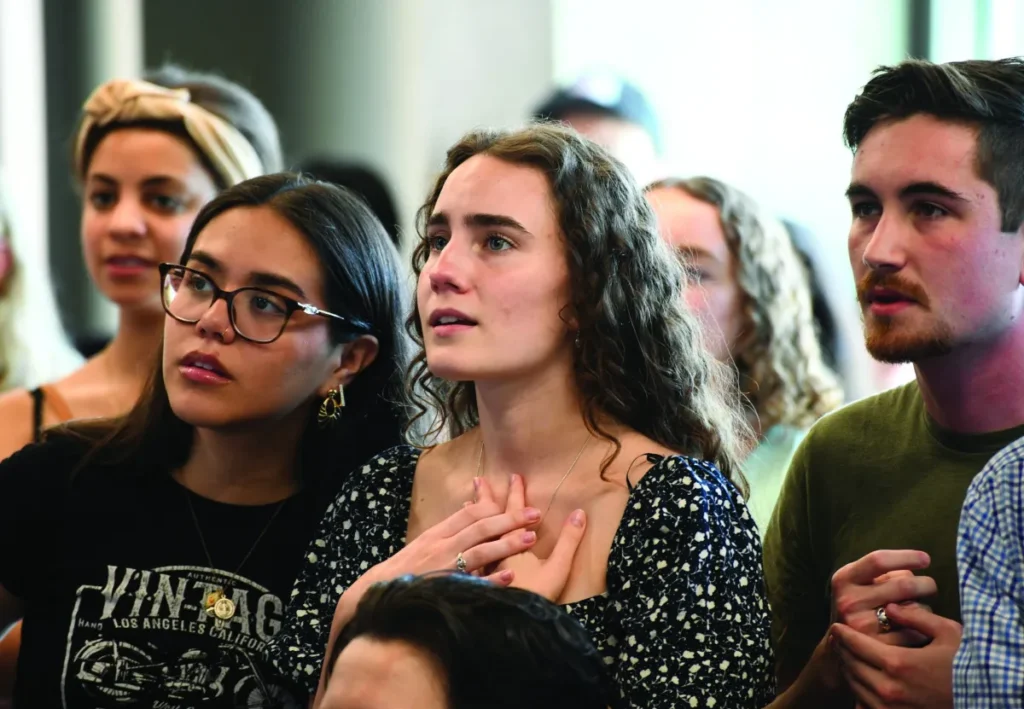
Gen Z is the least religious generation in U.S. history. And Gen Z is going to church more than any other generation. Both of these statements appear to be true.
According to the Pew Research Center’s latest Religious Landscape Study, 44 percent of 18- to 29-year-olds are religiously unaffiliated—the highest percentage of any age group—compared with a national average of 29 percent.
But studies also suggest that the 45 percent of young people who do identify as Christian today participate in the life of the church more than their elders. A report released on Nov. 4 from the Leadership Roundtable found that 18- to 29-year-old Catholics are “by far the most engaged.” These young Catholics “are more likely than any other age group to attend Mass daily, weekly, or monthly, are far more likely to engage in parish activities beyond Mass, and are more likely to go to Confession, to engage in Eucharistic Adoration, to attend social events, and more.”
This report supports new data from the Barna Group, which found that Gen Z now leads older generations in church attendance, averaging 1.9 services per month or 23 services per year. (Millennials followed closely behind with an average of 22 services per year, while boomers, the oldest of whom are now approaching 80, attend church in person just 17 times per year.)
The data also suggests that what once seemed like the irrepressible rise of the “nones”—people who identify with no religion in particular—has plateaued.
These are just a few of the data points underlying what some, in both the Christian and secular worlds, have described as a burgeoning “religious revival” in the United States. While the absolute numbers hardly paint a picture of a new Great Awakening, it is natural to ask what lies behind the surprising relative devotion of younger Americans.
Ironically, it is likely that the apparent contradiction between decreasing identification and increased religiosity among self-identified believers is attributable to the increasing social acceptability of not claiming Christian identity. In years past, even those with tenuous ties to the institutional church were likely to identify as Catholic or Christian because of family ties or cultural inertia.
Young people today, many raised in only loosely affiliated households, feel far less pressure to claim that identity. So those who remain Catholic have likely made a conscious decision to be a part of a particular community. They are becoming a version of what Pope Benedict XVI predicted decades ago: a church that is smaller but where Christian identity and practice are more strongly linked.
But in addition to a smaller but more committed cohort of cradle Catholics, there is also evidence of an uptick in interest in Catholicism among younger Americans. In an ongoing election study from Harvard University, the share of Gen Z respondents who identified as Catholic rose from 15 percent in 2022 to 21 percent in 2023 (surpassing the 20 percent among millennials), a possible sign that disaffiliation among younger generations has been reversed. Some colleges have reported record numbers of baptisms and participation in the Order of Christian Initiation of Adults in 2025. Since the Covid-19 pandemic, dioceses across the country have seen a surge in young adult converts.
Of course, while followers of Jesus are called to “make disciples of all nations,” evangelization is not at heart simply a numbers game. The number of young people turning to the Catholic Church need not be overwhelming or even statistically significant to be a cause for joy. It is always a sign of hope when people want to come into full membership in the church.
How is the church called to respond in this moment?
First, there are temptations to be avoided. In seeking to understand why young people are turning to the church, Catholics risk imposing well-worn explanations that presuppose their preferred solutions for reversing Christianity’s numerical and institutional decline. The mission of the church is not to tailor its teaching or liturgy to suit the preferences of each generation; it is to draw each person into relationship with Christ. And the best way to do that is to do what the church has been doing for 2,000 years: building communities of worship, communities of practice.
Second, the church needs to be a community of welcome—and compassion. Karl Rahner, S.J., famously wrote: “The devout Christian of the future will either be a ‘mystic’—someone who has ‘experienced something’—or will cease to be anything at all.” Today, we might say that Christians will be those who find a community of practice or nothing at all.
The church, then, should focus on welcoming those who are just beginning to put a toe in the waters of Christianity, to invite people into religious practice instead of identification with a set of doctrinal claims. That does not mean abandoning doctrine but rather avoiding a puritanism that discourages both Christian identification and practice.
In recent months, cities around the United States have witnessed what such communities can look like as Catholics have celebrated Mass and processed with the Eucharist in solidarity with their detained migrant siblings. Many a textbook and YouTube video might try to explain the real presence of Jesus; but there is the doctrine in practice.
Third, we need to listen—not just to young people who are finding themselves newly committed to religious practice and church affiliation, but to those who have left or are close to leaving. The temptation to impart one’s own wisdom is not always negative, but it can also lead to more of the same when it comes to evangelization and openness. One thing we can be sure of is that no generation wants to be told it is doing the whole thing wrong.
Finally, when thinking about evangelizing Gen Z, it is essential to recognize that a seeker’s journey to the faith may begin online. But it cannot end there. Podcasts, YouTube channels and social media personalities bring Catholic apologetics and aesthetics to millions. But, as Pope Leo XIV posted, on X no less: “The danger is that a faith discovered online is limited to individual experiences, which may be intellectually and emotionally reassuring, but never ‘embodied.’ Such experiences remain ‘disembodied,’ detached from the ‘ecclesial body.’”
Whether we are at the beginning of a religious revival is a question for social scientists to settle. But for Christians, there is always fertile ground for one. And it begins by building communities of welcome and integrity so that those without a home may look around and say: “To whom shall we go? You have the words of eternal life.”
Want to Love Your Neighbor? Grieve With Them
By Elom Tettey-Tamaklo
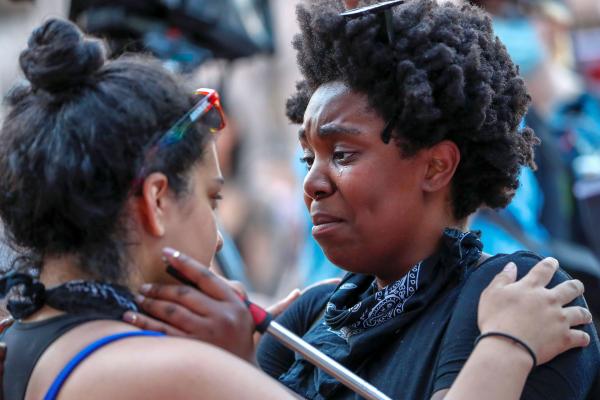
In times of great moral cacophony, I have always preferred to hear directly from Jesus because, like the apostle Peter, I often wonder: Where else might I go? After all, Jesus has the words of eternal life (John 6:68).
I have found that Jesus’ words, although comforting, can also be troubling. Recently, I ran into this reality when reading the gospel of Matthew. A scholar of the law approaches Jesus and asks him, “Teacher, which is the greatest commandment in the Law?” Jesus succinctly replies that loving God is the first and greatest commandment, and loving your neighbors as yourself is just like it (22:34-40). According to Jesus, the entirety of what we know to be the holy scriptures—“all the law and the prophets”—hang on these two commands. I had read this exchange several times growing up, but it bore a new weight when I read it this time. I interpreted Jesus as saying that how we love our neighbors is the barometer for the health of our faith. But how we love them is not just limited to affective dimensions. It also includes grief and rage when our neighbors are in pain.
In Precarious Life: The Powers of Mourning and Violence, feminist philosopher Judith Butler argues that selective grief—the choice to grieve some lives over others—produces and maintains “certain exclusionary conceptions of who is normatively human.” In other words, who we choose to grieve indicates who we consider to be human.
I cannot help but think about Gaza. For the last two years, we have had front row seats to the world’s first live-streamed genocide. Broken bones and burned bodies have filled our social media and news feeds, yet our grief over Gaza remains tenuous. If we took Jesus’ words seriously, then we should not only be asking if Palestinians are our neighbors (that is a given) but also how we can love them fully, grieving with them, and resisting their erasure.
In a country where anti-genocide student protesters are arrested, and media personalities joke about dead Gazan babies, the word ‘Palestinian’ is emptied of its humanity and is used as a slur. Grieving for Palestine is anathema.
Even some Christians seem blind to Palestinian humanity. According to a 2024 survey by the nonpartisan think tank, the Chicago Council on Global Affairs, 64% of white Protestant evangelicals believe that Israel’s military actions are justified in Gaza. How does one reconcile Israel’s systematic killing of Palestinians in Gaza seeking aid, or 50,000 Palestinian children being killed or injured—clear violations of international law—with Christ’s command to love our neighbor? If by virtue of their Palestinianness, the Palestinian is rendered ineligible of our love, then we compromise the essential tenet on which our faith rests.
Palestinian life, as Butler argues, is “either no life, a shadow-life, or a threat to life as we know it.” This framing treats Palestinian death and erasure as the natural corollary of geopolitical maneuvers. According to a June report from the Center for Media Monitoring, “Palestinian deaths are treated as less newsworthy” by the BBC. In July, Writers Against the War on Gaza—a coalition of media workers dedicated to speaking out about Palestine—released a dossier detailing how The New York Times has an explicitly pro-Israel and anti-Palestinian bias. As a September Prism investigative report shows, this bias extends beyond The New York Times to include much of Western media. This bias perpetuates the dehumanization of Palestinians, discouraging the public from grieving their suffering.
Much of the on-the-ground reporting about the genocide has come as a result of Palestinian journalists keeping the public informed through social media. However, speaking at the Washington conference of the Jewish Federations of North America in November, Sarah Hurwitz, a former speechwriter for Barack Obama, lambasted social media for “smashing young people’s brains” with images from Gaza. These images, from Hurwitz’s perspective, wrongly push young people to sympathize with Palestinians and oppose the state of Israel. Hurwitz’s outrage is not over the carnage inflicted by the Israeli army in Gaza but the fact that people are grieving with Palestinians. Hurwitz’s role as a speechwriter for Obama—a Democratic president—emphasizes the reality that Palestinian dehumanization is not a partisan issue, as even progressives engage in such dehumanization. Beyond rhetorical dehumanization, there is also the more material dehumanization that is the bipartisan support for military aid to Israel. This support is a violation of Leahy law, which is a domestic law that prohibits the United States from providing military assistance to foreign security units that violate human rights.
I have seen the effect of this dehumanization first-hand. In 2023, my friend, Hisham Awartani, along with his two friends, Kinnan Abdalhamid and Tahseen Ali Ahmad, were shot in a Vermont neighborhood while visiting Hisham’s grandmother. All three are Palestinian. Thankfully, all three of them survived, but Hisham was paralyzed from the waist down. At the time of the shooting, Awartani and Ahmad were wearing keffiyehs, and all three were speaking Arabic. Writing for The New York Times in May 2024, Hisham connected the media’s dehumanization of Palestinians with the shooting in Vermont and Israel’s continued oppression of Palestinians in the West Bank and Gaza. “It’s difficult for me to come to terms with the reality of so much loss,” he wrote. If we cannot also be grieved and enraged over the loss of Palestinian life, then we embrace a superficial understanding of Jesus’ command to love one’s neighbor.
Grief born from the acknowledgement of our neighbor’s humanity is important, but love does not end there. In All About Love, writer bell hooks describes the love ethic as the conscious choice to extend one’s self to “nurture one’s own or another’s spiritual growth” through actions like care, commitment, respect, and trust. In the face of gross dehumanization that leads to violence, the love ethic looks like active (re)humanization of people who are being erased. We must tell their stories, sing their songs, and struggle with them to realize a more just future.
Jesus’ words still trouble me. It’s no small task to love and grieve with your neighbor. Contemporary political and social wisdom loudly suggests we do otherwise, but I have come to realize that the panacea for this fusillade of grief is a stubborn love that insists on seeing everyone’s humanity, including Palestinians. No excuses.