
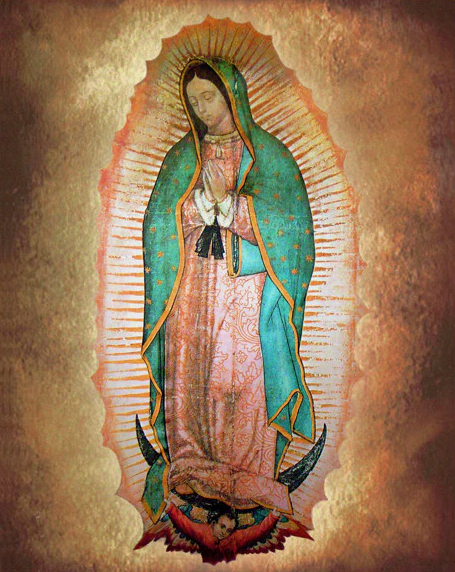
There’s an axiom that says: Roman Catholics tend to adore Mary while Protestants and Evangelicals tend to ignore Mary. Neither is ideal. Mary is pre-eminently the Mother of the poor. Karl Rahner once pointed out that when you look at all the apparitions of Mary that have been officially approved by the church you will notice that she has always appeared to a poor person – a child, an illiterate peasant, a group of children, someone without social standing. She’s never appeared to a theologian in his study, to a pope, or to a millionaire banker. She’s always been the person to whom the poor look.
We see this, for example, very powerfully in the effect that Our Lady of Guadalupe has had on much of Latin America. In all of the Americas, most of the indigenous peoples are now Christian. However, in North America, while most of the indigenous peoples are Christian, Christianity itself is not seen as a native religion, but rather as a religion brought to the native peoples from elsewhere. In Latin America, in every place where Our Lady of Guadalupe is popular, Christianity is seen to be a native religion.
At the wedding feast of Cana, Mary tells her son (who is always divine in John’s Gospel) that “they have no wine”. In John’s Gospel, this is not just a conversation between Mary and Jesus; but also a conversation between the Mother of Humanity and God. Secondly, as Eve, as universal mother, and as our mother, she stands in helplessness under human pain and within human pain when she stands under the cross. In this, she shows herself as universal mother but also as an example of how injustice must be handled, namely, by standing within it in a way that does not replicate its hatred and violence so as to give it back in kind. Mary offers us a wonderful example, not to be adored or ignored. [Excerpt from Ron Rolheiser’s “The Mary of Scripture and the Mary of Devotions” June 2018]
