G.K. Chesterton once wrote: “There comes a time, usually late in the afternoon, when the little child tires of playing policeman and robbers. It’s then that he begins to torment the cat!” Mothers, with young children, are only too familiar with this late afternoon hour and its particular dynamic. There comes an hour, usually just before supper, when a child’s energy is low, when it is tired and whining, and when the mother has exhausted both her patience and her repertoire of warnings: “Leave that alone! Don’t do that!” The child, tense and miserable, is clinging to her leg. At that point, she knows what to do. She picks up the child. Touch, not word, is what’s needed. In her arms, the child grows calm and tension leaves its body.
That’s an image for the Eucharist. We are that tense, over-wrought child, perennially tormenting the cat. There comes a point, even with God, when words aren’t enough. God has to pick us up, like a mother her child. Physical embrace is what’s needed. Skin needs to be touched. God knows that. It’s why Jesus gave us the Eucharist. Indeed that is what all sacraments are, God’s physical embrace. Words, as we know, have a relative power. In critical situations they often fail us. When this happens, we have still another language, the language of ritual. The most ancient and primal ritual of all is the ritual of physical embrace. It can say and do what words cannot.
Jesus acted on this. For most of his ministry, he used words. Through words, he tried to bring us God’s consolation, challenge, and strength. His words, like all words, had a certain power. Indeed, his words stirred hearts, healed people, and affected conversions. But at a time, powerful though they were, they too became inadequate. Something more was needed. So on the night before his death, having exhausted what he could do with words, Jesus went beyond them. He gave us the Eucharist, his physical embrace, his kiss, a ritual within which he holds us to his heart.
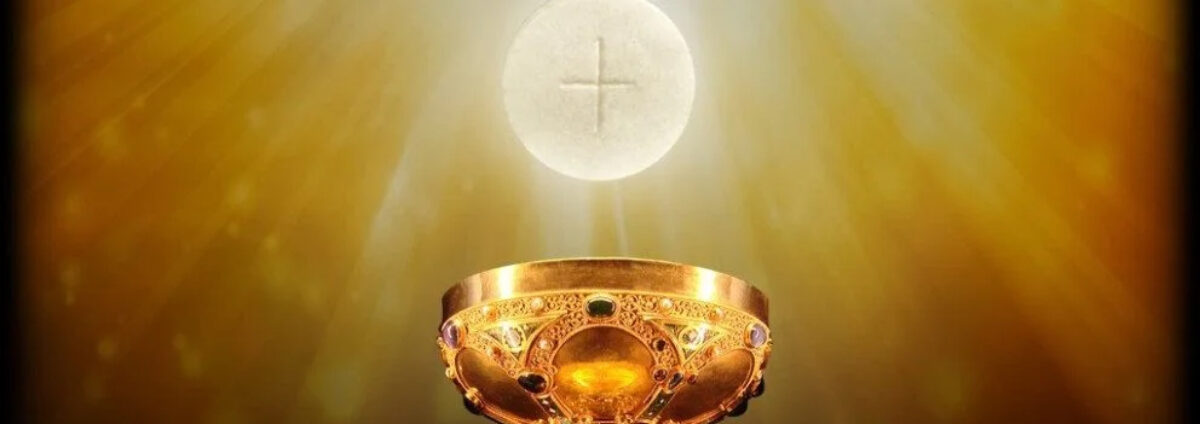
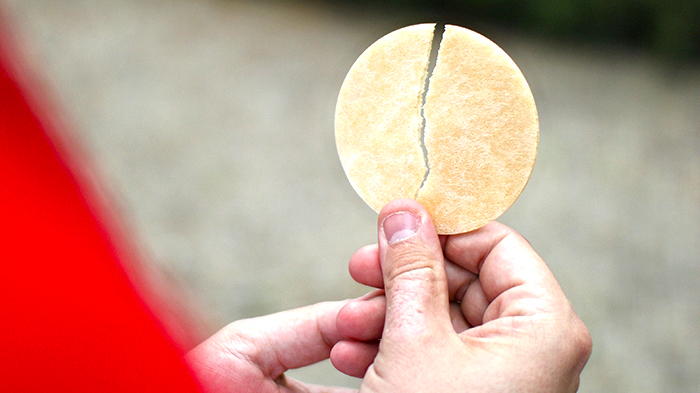
The Eucharist is God’s kiss. Andre Dubos, the Cajun novelist, used to say: “Without the Eucharist, God becomes a monologue.” Skin needs to be touched. This is what happens in the Eucharist and that is why the Eucharist, and every other Christian sacrament, always has some very tangible physical element to it – a laying on of hands, a consuming of bread and wine, an immersion into water, an anointing with oil. An embrace needs to be physical, not only something imagined.
G.K. Chesterton once wrote: “There comes a time, usually late in the afternoon, when the little child tires of playing policeman and robbers. There comes an hour, usually just before supper, when a child’s energy is low, when it is tired and whining, and when the mother has exhausted both her patience and her repertoire of warnings: “Leave that alone! Don’t do that!” The child, tense and miserable, is clinging to her leg. At that point, she knows what to do. She picks up the child. Touch, not word, is what’s needed. In her arms, the child grows calm and tension leaves its body.
That’s an image for the Eucharist. We are that tense, over-wrought child. There comes a point, even with God, when words aren’t enough. God has to pick us up, like a mother her child. Physical embrace is what’s needed. Skin needs to be touched. God knows that. It’s why Jesus gave us the Eucharist. [Excerpt from Ron Rolheiser’s “Eucharist as God’s Physical Embrace” May 2006]
