
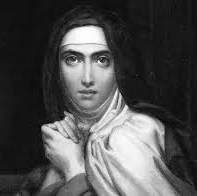
St. Teresa of Ávila (1515–1582), also known as Teresa of Jesus, was a Spanish Carmelite nun, mystic, reformer, and Doctor of the Church. She is one of the most important spiritual theologians in Christian history and a central figure of the Catholic Reformation in 16th-century Spain. In 1970, she was named the first female Doctor of the Church by Pope Paul VI in recognition of the depth and orthodoxy of her theological writings.
Historical and Personal Background
Teresa was born in 1515 in Ávila, Spain, during a time of enormous religious upheaval:
– The Protestant Reformation was spreading across Europe.
– Spain was a center of Catholic reform and renewal.
– The Inquisition closely examined mystical claims.
She entered the Carmelite convent of the Incarnation at age 20. For nearly 20 years she struggled spiritually — divided between a desire for God and attachment to comfort and social relationships.
Around age 39–40, she experienced a profound interior conversion. From that point forward, her mystical life deepened dramatically.
She went on to:
– Reform the Carmelite Order (founding the Discalced Carmelites)
– Establish 17 convents
– Write spiritual classics
– Endure suspicion and investigation
– Die in 1582 during her reform work
Her Major Works
Her theology is primarily found in:
– The Life of Teresa of Jesus
– The Way of Perfection
– The Interior Castle
– The Foundations
Among these, The Interior Castle is considered her theological masterpiece.
Core Themes in Her Theology
1. The Soul as an Interior Castle
Her most famous image describes the human soul as a castle made of diamond or crystal with many rooms (or “mansions”), at whose center dwells God.
Spiritual growth is a journey inward:
– From superficial prayer
– Through purification
– Toward transforming union with God
This structure presents a systematic theology of prayer and sanctification.
2. Prayer as Loving Friendship
Teresa defines mental prayer simply as:
“An intimate sharing between friends; it means taking time frequently to be alone with Him who we know loves us.”
Key points:
– Prayer is relational, not mechanical.
– Growth comes through love, not technique.
– Contemplation is primarily God’s action, not human achievement.
She shifts mystical theology away from speculation and toward experiential relationship.
3. The Stages of Spiritual Development
In The Interior Castle, she describes seven “mansions”:
1. Conversion and self-knowledge
2. Growth in virtue
3. Active effort in prayer
4. Beginning of infused contemplation
5. Prayer of union
6. Spiritual betrothal (deep suffering and purification)
7. Spiritual marriage (transforming union)
Theologically, she distinguishes between:
– Ascetical prayer (human effort)
– Infused contemplation (pure gift from God)
This distinction became foundational in Catholic mystical theology.
4. Mystical Union
Teresa carefully describes mystical phenomena:
– The prayer of quiet
– The prayer of union
– Ecstasies
– The “transverberation” (piercing of the heart in love)
Her account of transverberation later inspired the famous sculpture by Gian Lorenzo Bernini.
But she repeatedly warns:
– Extraordinary experiences are not the goal.
– Union produces humility, charity, and obedience.
– The test of authentic mysticism is love of neighbor.
5. Self-Knowledge and Humility
Teresa insists that self-knowledge is essential:
“Humility is walking in truth.”
The soul must recognize:
– Its weakness
– Its dependence on grace
– God’s mercy
For her, humility is not self-hatred — it is realism before God.
6. Reform and Ecclesial Fidelity
During the upheaval of the Reformation, Teresa’s theology is thoroughly Catholic:
– Strong devotion to the Eucharist
– Loyalty to the Church
– Obedience to confessors
– Emphasis on religious life and poverty
Her reform of the Carmelite order stressed:
– Enclosure
– Simplicity
– Silence
– Community life
– Prayer for the Church
Her mystical theology is never individualistic; it is ecclesial.
Theological Significance
Teresa’s contribution can be summarized in five major theological developments:
1. A Systematic Theology of Contemplation
She gave structure to mystical development without reducing it to psychology.
2. Integration of Humanity and Grace
She presents sanctity as fully human — warm, humorous, practical — not abstract or otherworldly.
3. Emphasis on Interior Transformation
Union with God results in active charity and service.
4. Female Doctor of the Church
Her recognition as Doctor of the Church confirmed that theological authority is not limited by gender but rooted in truth and sanctity.
5. Foundation for Carmelite Spirituality
Her theology shaped later Carmelites, especially:
– John of the Cross
– Thérèse of Lisieux
– Edith Stein
Teresa’s Mysticism in Context
Unlike some medieval mystics who emphasized dramatic visions, Teresa:
– Grounds everything in prayer and virtue.
– Warns against seeking mystical experiences.
– Submits experiences to Church discernment.
– Emphasizes suffering as part of transformation.
Her theology bridges:
– Medieval mysticism
– Scholastic theology
– Counter-Reformation spirituality
Why She Matters Today
Teresa offers:
– A roadmap for deep prayer
– A corrective to superficial spirituality
– A model of reform from within the Church
– A theology centered on love and friendship with Christ
Her synthesis of realism, mystical depth, and ecclesial obedience makes her one of the most balanced mystics in Christian history.