
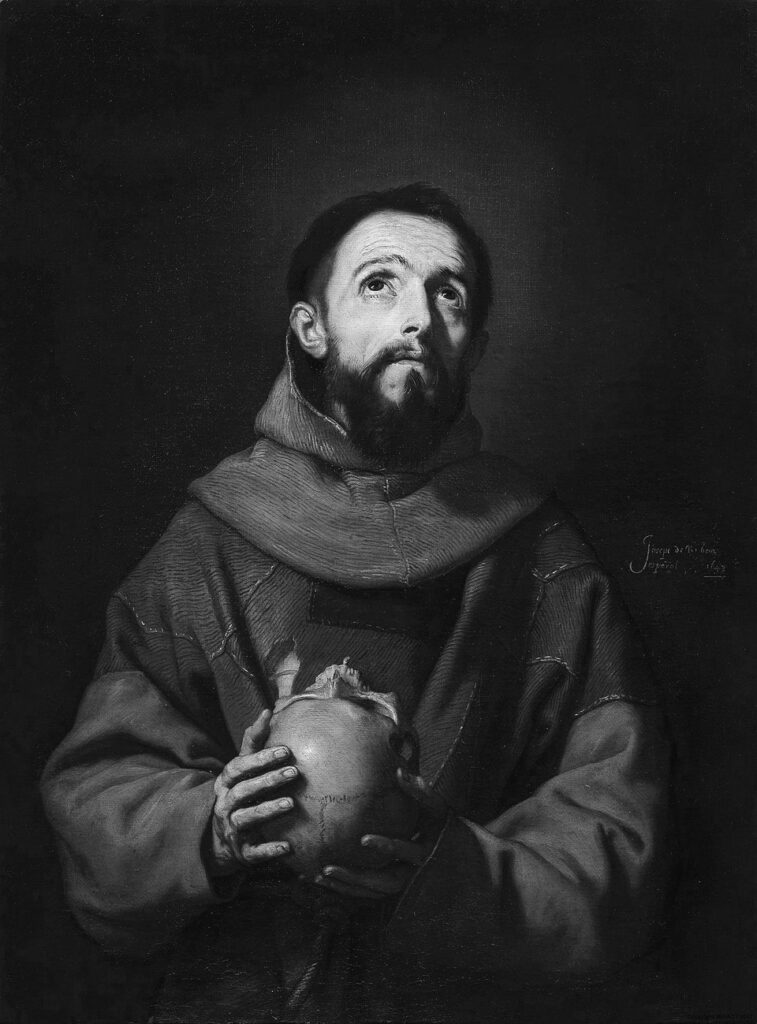
Francis of Assisi (1181/82–1226) was an Italian Catholic friar, preacher, mystic, and founder of the Franciscan Order. He is one of the most beloved saints in Christian history and is known for his radical poverty, love of creation, devotion to Christ crucified, and reforming impact on the medieval Church. While not a systematic theologian like Thomas Aquinas, Francis embodied a lived theology — one expressed through prayer, poetry, poverty, and imitation of Christ. His spirituality shaped an entire theological tradition: the Franciscan school.
Historical Context
Francis was born Giovanni di Pietro di Bernardone in Assisi, Italy, into a wealthy merchant family. As a young man, he:
– Lived extravagantly
– Sought knightly glory
– Fought in local wars
After imprisonment and illness, he experienced a gradual conversion. A decisive moment came when he prayed before the crucifix at San Damiano and heard Christ say: “Rebuild my Church.”
He initially took this literally — repairing ruined chapels — but soon understood it spiritually.
In 1209, he began recruiting followers and founded what would become the Order of Friars Minor (the Franciscans). The order was approved by Pope Innocent III.
He later founded:
– The Poor Clares (with Clare of Assisi)
– The Third Order for laypeople
Francis died in 1226 and was canonized just two years later by Pope Gregory IX.
Major Writings
Though not academically trained, Francis wrote:
– The Earlier and Later Rules (for his order)
– The Canticle of the Creatures
– Admonitions
– Letters
His theology is not speculative — it is scriptural, Christ-centered, and practical.
Core Themes in Francis’s Theology
1. Radical Imitation of Christ (Imitatio Christi)
Francis’s theology is rooted in direct imitation of Jesus.
He sought to live:
– The poverty of Christ
– The humility of Christ
– The obedience of Christ
– The suffering of Christ
For Francis, theology is not primarily intellectual reflection — it is conformity to Christ’s life.
His devotion was especially focused on:
– The Incarnation
– The Crucifixion
– The Eucharist
2. Poverty as Theological Witness
Francis embraced absolute poverty — personally and communally. But poverty for him was not merely asceticism. It was theological:
– Christ became poor in the Incarnation.
– God humbles Himself.
– Dependence on God reveals divine providence.
Francis called poverty “Lady Poverty” — almost personifying it as a spiritual bride. He believed ownership distorts love and creates violence. Poverty restores freedom and fraternity.
3. The Incarnation and Divine Humility
Francis had a profound devotion to the Incarnation. He is credited with popularizing the Christmas nativity scene (Greccio, 1223). This was not sentimentality — it was a theological proclamation:
– The infinite God becomes vulnerable.
– Divine power is revealed through humility.
– Salvation comes through nearness, not domination.
This emphasis shaped later Franciscan theology, especially in thinkers like Bonaventure and John Duns Scotus.
Scotus would later develop the idea that the Incarnation was not merely a response to sin but part of God’s eternal loving plan — a deeply Franciscan intuition.
4. Love of Creation
Francis is famous for his love of animals and nature, but this was theological rather than romantic.
In the Canticle of the Creatures, he refers to:
– Brother Sun
– Sister Moon
– Brother Fire
– Sister Water
Creation is not divine — but it is kin. Why?
Because:
– All creatures share one Creator.
– All existence reflects divine goodness.
– Humanity is not a master but a brother within creation.
This cosmic fraternity reflects a theology of participation: all beings exist through and toward God.
5. Eucharistic Devotion
Francis had intense reverence for the Eucharist. He stressed:
– The humility of Christ hidden in the Host
– The sacredness of priests who consecrate
– Care for liturgical vessels and churches
For Francis, the Eucharist was the continuation of the Incarnation — divine self-gift.
6. The Stigmata and Union with Christ Crucified
In 1224, Francis received the stigmata (wounds of Christ) on Mount La Verna — the first recorded case in Christian history.
Theologically, this represented:
– Total conformity to Christ
– Participation in divine love through suffering
– Mystical union expressed bodily
His spirituality is deeply cruciform — love expressed through sacrifice.
Franciscan Theological Legacy
Though Francis himself was not a scholastic theologian, his spirituality generated a theological tradition emphasizing:
1. Primacy of Love: God’s essence is self-giving love.
2. Goodness of Creation: Creation is fundamentally good and worthy of reverence.
3. Incarnational Theology: God’s humility is central to salvation.
4. Affective Theology: Knowledge of God comes through love and transformation, not speculation alone.
Relationship to Church Reform
Francis lived during a time of:
– Clerical corruption
– Wealth accumulation
– Growing urban poverty
Unlike later reformers, he did not break from the Church. Instead, he renewed it from within — through obedience and radical example.
His theology is ecclesial, sacramental, and obedient.
Death and Canonization
Francis died in 1226, blind and ill, singing Psalm 141. He was canonized in 1228.
In 2013, Pope Francis chose his papal name in honor of Francis of Assisi — signaling the saint’s enduring theological and moral influence.
Summary of His Theology
Francis’s theology centers on:
– Imitation of Christ
– Radical poverty
– Incarnational humility
– Eucharistic devotion
– Fraternity with creation
– Cruciform love
He teaches that:
– God is revealed not in domination, but in humility and self-giving love.
– His life itself is his greatest theological statement.