
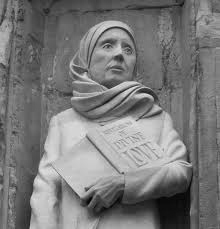
Julian of Norwich (c. 1342–after 1416) was an English anchoress, theologian, and mystic whose writings are among the most profound expressions of Christian contemplative spirituality. She is best known for her book Revelations of Divine Love, widely regarded as the earliest surviving English-language book by a woman.
Early Life and Enclosure
Julian was likely born around 1342 in Norwich. Little is known about her early life, including her birth name. By adulthood, she became an anchoress, a woman living a solitary religious life enclosed in a small cell attached to a church, dedicating herself to prayer and contemplation.
In 1373, she suffered a serious illness and reportedly experienced a series of intense visions, or shewings, which became the basis for her theological writings.
Life as an Anchoress
Julian lived in a small cell attached to the Church of St. Julian in Norwich (now St Julian’s Church). From this cell, she:
– Prayed continuously for the community and the wider world
– Received visitors seeking counsel and spiritual guidance
– Wrote down her visions and theological reflections
Her enclosure allowed her to focus entirely on contemplative life while remaining engaged with her community through prayer and counsel.
Her Theology
Julian of Norwich’s theology is best described as mystical, profoundly optimistic, and deeply centered on divine love. She is particularly known for her revolutionary understanding of God’s love, mercy, and the ultimate reconciliation of creation.
1. God as Loving Parent
Julian consistently emphasizes the absolute love of God. She uses the language of motherhood to describe God, presenting a tender, nurturing, and intimate deity:
– God is compassionate, patient, and caring
– God’s love is primary, not judgmental
= Even human sin is embraced by divine love
Her famous phrase: “All shall be well, and all shall be well, and all manner of thing shall be well” reflects this radical trust in God’s providence.
2. Optimism and Universal Reconciliation
Julian’s theology is unusually hopeful for the medieval period. She emphasizes that:
– God will ultimately reconcile all creation
– God permits suffering but redeems it
– Nothing is outside God’s loving care
This universal vision of salvation is sometimes called “apocatastasis” or the ultimate restoration of all things.
3. The Suffering of Christ as Compassionate Love
Julian’s visions emphasized Christ’s humanity and suffering. For her:
– The crucifixion is an expression of divine love, not just justice
– Suffering can be transformed by love
– Christians are called to enter into Christ’s compassionate presence
Her theology balances a realistic acknowledgment of suffering with unwavering trust in God’s mercy.
4. Sin and the Nature of Grace
Julian had a distinctive understanding of sin and grace:
– Sin is real and serious, but not a barrier to God’s love
– God uses sin to teach and draw people closer
– Grace is abundant and freely given
– Human imperfection is embraced by divine mercy
This perspective makes her theology deeply pastoral and comforting.
5. Contemplation and Inner Vision
As an anchoress, Julian’s theology is experiential and contemplative:
– The visions she received shaped her theological insights
– Spiritual truth is encountered in prayerful reflection
– She emphasizes interior growth and awareness of God’s love over purely doctrinal knowledge
Her book blends visionary narrative with theological reflection in a uniquely personal voice.
6. Emphasis on Love as the Center of Spiritual Life
For Julian, all Christian life revolves around love:
– Love of God
– Love of neighbor
– Love as the motivating principle of prayer, action, and suffering
Her theology places love above fear, punishment, and even doctrinal complexity.
Major Work
Revelations of Divine Love – Julian’s book records her 16 mystical visions and her theological reflections on them. It has influenced countless mystics, theologians, and spiritual writers over the centuries.
Death and Legacy
Julian lived at least into the early 15th century, possibly after 1416. She is remembered as:
– The first known English woman to write a theological treatise in English
– A mystic whose vision of God’s love has inspired Christians across denominations
– A teacher of contemplative prayer and hope in God’s mercy
Her writings continue to be read for spiritual guidance, comfort, and insight into the transformative power of divine love.