
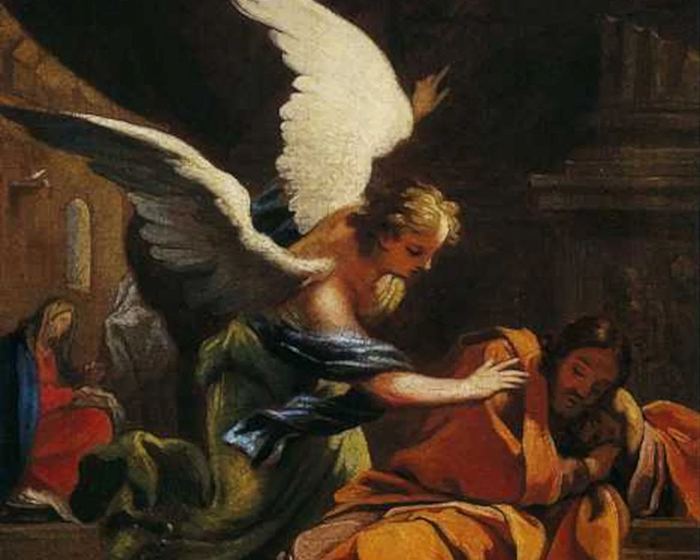
Who exactly is this Joseph? He is that quiet figure named in the Christmas story as the husband of Mary and the stepfather of Jesus, and then basically is never mentioned again. The pious conception we have of him is that of an older man, a safe protector to Mary, a carpenter by trade, chaste, holy, humble, quiet, the perfect patron for manual laborers and anonymous virtue, humility incarnate.
Joseph and Mary were at this stage of their relationship, legally married but not yet living together when Mary became pregnant. Joseph, knowing that the child was not his, had a problem. If he wasn’t the father, who was? In order to save his own reputation, he could have demanded a public inquiry and, indeed, had Mary been accused of adultery, it might have meant her death. However, he decided to “divorce her quietly”, that is, to avoid a public inquiry which would leave her in an awkward and vulnerable situation.
Then, after receiving a revelation in a dream, he agrees to take her home as his wife and to name the child as his own, thus claiming that he is the father. By doing this, he spares Mary embarrassment, perhaps even saves her life, and he provides an accepted physical, social, and religious place for the child to be born and raised. But he does something else that is not as evident. He shows how a person can be a committed believer, deeply faithful to everything within his religious tradition, and yet at the same time be open to a mystery beyond both his human and religious understanding.
And this was exactly the problem for many Christians, including Matthew himself, at the time the Gospels were written. They were committed Jews who did not know how to integrate Christ into their religious framework. What does one do when God breaks into one’s life in new, previously unimaginable ways? How does one deal with an impossible conception? Joseph is the paradigm. As Raymond Brown puts it: “The hero of Matthew’s infancy story is Joseph, a very sensitive Jewish observer of the Law. In Joseph, the evangelist was portraying what he thought a Jew [a true pious believer] should be and probably what he himself was.”
In essence, Joseph teaches us how to live in loving fidelity to all that we cling to humanly and religiously, even as we are open to a mystery of God that takes us beyond all the categories of our religious practice and imagination. And isn’t that one of the real challenges of Christmas? [Excerpt from Ron Rolheiser’s “Joseph and the Christmas Story,” December 2023]
