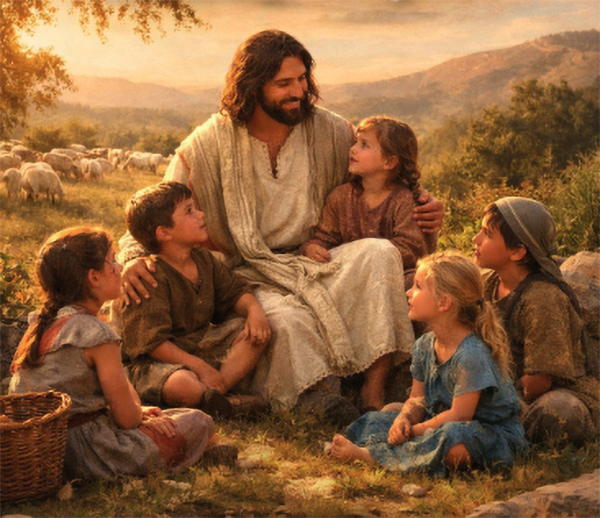

He said to them in reply, “My mother and my brothers are those who hear the word of God and act on it.” Luke 8:21

The single most important agenda item for our churches for the next fifty years will be the issue of relating to other religions, Islam, Hinduism, Buddhism, Taoism, Indigenous Religions in the Americas and Africa, and various forms, old and new, of Paganism and New Age. Simply stated, if all the violence stemming from religious extremism hasn’t woken us yet then we are dangerously asleep.  We have no choice. The world has become one village, one community, one family, and unless we begin to understand and accept each other more deeply we will never be a world at peace.

Our God calls us to recognize and welcome all sincere believers into our hearts as brothers and sisters in faith. Jesus makes this abundantly clear most everywhere in his message, and at times makes it uncomfortably explicit: Who are my brothers and sisters? It is those who hear the word of God and keep it. … It is not necessarily those who say Lord, Lord, who enter the Kingdom of Heaven but those who do the will of God on earth. Who can deny that many non-Christians do the will of God here on earth?

But what of Christ’s uniqueness? What about Christ’s claim that he is the (only) way, truth, and life and that nobody can come to God except through him? Christian theology (certainly this is true for Roman Catholic theology) has always accepted and proactively taught that the Mystery of Christ is much larger than what can be observed in the visible, historical enfolding of Christianity and the Christian churches in history. Christ is larger than our churches and operates too outside of our churches. He is still telling the church what Jesus once told his mother: “I must be about my Father’s business.”

The God whom Jesus incarnated wills the salvation of all people and is not indifferent to the sincere faith of billions of people throughout thousands of years. We dishonor our faith when we teach anything different. All of us are God’s children. There is in the end only one God and that God is the Father of all of us – and that means all of us, irrespective of religion.[Excerpt from Ron Rolheiser’s “Standing on New Borders” July 2018]

Let your light shine before others, that they may see your good deeds and glorify your heavenly Father. Matthew 5:16

We are all familiar with a refrain that echoes through many of our Christian prayers and songs, an antiphon of hope addressed to God:  Grant that we may be one with all the saints in singing your praises! But we have an over-pious notion of what that would look like. We picture ourselves spending eternity feeling grateful for having made a team whose talent level should have excluded us. But that is a fantasy, pure and simple, mostly simple.

We are one with the saints in singing God’s praises when we are one with them in the way we live our lives; when, like them, our lives are transparent, honest, grounded in personal integrity, with no skeletons in our closet.

We are one with the saints in singing God’s praises when we radiate God’s wide compassion; when we, like God, let our love embrace beyond race, creed, gender, religion, ideology, and differences of every kind. 

We are one with the saints in singing God’s praises when we tend to “widows, orphans, and strangers’, when we reach out to those most vulnerable, when we feed the hungry, give drink to the thirsty, visit the sick and imprisoned, when we work for justice.

We are one with the saints in singing God’s praises when we live in hope, when we ground our vision and our energies in the promise of God and in the power that God revealed in the resurrection of Jesus.

We are one with the saints in singing God’s praises when, rather than living inside of envy, resentment, bitterness, vengeance, impatience, anger, factionalism, idolatry, and sexual impatience, we live instead inside charity, joy, peace, patience, goodness, long-suffering, fidelity, mildness, and chastity.

We are one with the saints in singing God’s praises only when we live our lives as they lived theirs. [Excerpt from Ron Rolheiser’s “On Being One With the Saints in Praising God” March 2010]

No servant can serve two masters. He will either hate one and love the other, or be devoted to one and despise the other. You cannot serve God and mammon.” Luke 16:13

When we are rich, we have a congenital incapacity to see the poor and, in not seeing them, we never learn the wisdom of the crucified. That’s why it’s hard, as Jesus said, for a rich person to enter the kingdom of heaven.

We see – but we don’t see! We feel for the poor – but we don’t really feel for them! We reach out – but we never reach across. The gap between the rich and poor is in fact widening, not narrowing. It’s widening worldwide, between nations, and it’s widening inside of virtually every culture. The rich are becoming richer and the poor are being left ever further behind.

What principles should guide us in terms of an attitude towards wealth Underlying everything else, we must always keep in mind Jesus’ warning that the possession of wealth is dangerous, that it is hard for a rich person to enter the kingdom of heaven.

And so the challenge for all of us who are rich in any way is to continually give our wealth away. We need to do this, not because the poor need what we give them, though they do; we need to do this so that we can remain healthy. Philanthropy, of every kind, is more about the health of the one giving than the health of the one receiving. The generous rich can inherit the kingdom, the miserly rich cannot.  The poor are everyone’s ticket into heaven – and to human health.

Finally, this too must always be kept in mind as we view wealth, both our own and that of the very rich. What we have is not our own, it’s given to us in trust. God is the sole owner of all that is and the world properly belongs to everyone. What we claim as our own, private property, is what has been given to us in trust, to steward for the good of everyone. It’s not really ours.

Here’s how Bill Gates Sr. puts it: “Society has an enormous claim upon the fortunes of the wealthy. This is rooted not only in most religious traditions, but also in an honest accounting of society’s substantial investment in creating fertile ground for wealth-creation. Judaism, Christianity, and Islam all affirm the right of individual ownership and private property, but there are moral limits imposed on absolute private ownership of wealth and property. Each tradition affirms that we are not individuals alone but exist in community – a community that makes claims on us. The notion that ‘it is all mine’ is a violation of these teachings and traditions. Society’s claim on individual accumulated wealth is … rooted in the recognition of society’s direct and indirect investment in the individual’s success. In other words, we didn’t get there on our own.” Indeed, none of us did! If we remember that we will more easily be generous. [Excerpt from Ron Rolheiser’s “Our Attitude Towards Wealth” August 2012]

Blessed are they who have kept the word with a generous heart and yield a harvest through perseverance. Luke 8:15

There is a Norwegian proverb that reads: Heroism consists of hanging on one minute longer. There is a story of a young boy who had fallen through the ice while skating and was left clinging, cold and alone, to the edge of the ice with no help in sight. As he hung on in this seemingly hopeless situation he was tempted many times to simply let go since no one was going to come along to rescue him. But he held on, despite all odds. Finally, when everything seemed beyond hope, he clung on one minute longer and after that extra minute help arrived.

The story is simple as was its moral teaching: This young boy lived because he had the courage and strength to hang on one minute longer. Rescue comes just after you have given up on it, so extend your courage and waiting one minute longer.

Scripture teaches much the same thing about moral heroism: In the Second Letter to the Thessalonians, Paul ends a long, challenging admonition by stating: You must never grow weary of doing what is right. And in his letter to the Galatians, Paul virtually repeats the Norwegian proverb: Let us not become weary of doing good, for at the proper time we will reap a harvest if we do not give up.

This sounds so simple and yet it cuts to the heart of many of our moral struggles. We give up too soon, give in too soon, and don’t carry our solitude to its highest level. We simply don’t carry tension long enough. When we have to choose between giving up or holding on, carrying tension or letting it go, is a crucial moral site, one that determines character: Big-heartedness, nobility of character, deep maturity, and spiritual sanctity often manifest themselves around these questions: How much tension can we carry? How great is our patience and forbearance? How much can we put up with?

Mature parents put up with a lot of tension in raising their children. Mature teachers put up with a lot of tension in trying to open the minds and hearts of their students. Mature friends absorb a lot of tension in remaining faithful to each other. Mature young women and men put up with a lot of sexual tension while waiting for marriage. Mature Christians put up with a lot of tension in helping to absorb the immaturities and sins of their churches. Men and women are noble of character precisely when they can walk with patience, respect, graciousness, and forbearance amid crushing and unfair tensions, when they never grow weary of doing what is right.

But all of this will not be easy. It’s the way of long loneliness, with many temptations to let go and slip away. But, if you persevere and never grown weary of doing what is right, at your funeral, those who knew you will be blessed and grateful that you continued to believe in them even when for a time they had stopped believing in themselves. [Excerpt from Ron Rolheiser’s “Never Grow Weary” October 2012]

Indeed, religion with contentment is a great gain. 1 Timothy 6:6

There is such a thing as a good death, a clean one, a death that, however sad, leaves behind a sense of peace. I have been witness to it many times. Sometimes this is recognized explicitly when someone dies, sometimes unconsciously. It is known by its fruit.

I remember sitting with a man dying of cancer in his mid-fifties, leaving behind a young family, who said to me: “I don’t believe I have an enemy in the world, at least I don’t know if I do. I’ve no unfinished business.” I heard something similar from a young woman also dying of cancer and also leaving behind a young family. Her words: “I thought that I’d cried all the tears I had, but then yesterday when I saw my youngest daughter I found out that I had a lot more tears still to cry. But I’m at peace. It’s hard, but I’ve nothing left that I haven’t given.” And I’ve been at deathbeds other times when none of this was articulated in words, but all of it was clearly spoken in that loving awkwardness and silence you often witness around deathbeds. There is a way of dying that leaves peace behind.

When Jesus is giving his farewell speech in John’s Gospel, he tells us that it is better for us that he is going away because otherwise we will not be able to receive his spirit; and that his spirit, his final gift to us, is the gift of peace. Two things should be noted here: first, that the disciples couldn’t fully receive what Jesus was giving them until he had gone away; and second, that ultimately his real gift to them, his real legacy, was the peace he left behind with them.

What may seem strange at first glance is that his followers could only fully inhale his energy after he had gone away and left them his spirit. That is also true for each of us. It is only after we leave a room that the energy we left behind is most clear. Thus, it is after we die that the energy we have left behind will constitute our real legacy. If we live in anger and bitterness, in jealousy and unwillingness to affirm others, and if our lives sow chaos and instability, that will be what we ultimately leave behind and will always be part of our legacy. Conversely, if we are trustworthy and live unselfishly, morally, at peace with others, bringing sanity and affirmation into a room, then, like Jesus, we will leave behind a gift of peace. That will be our legacy, the oxygen we leave on the planet after we are gone. [Excerpt from Ron Rolheiser’s “Leaving Peace Behind as Our Farewell Gift” May 2020]

And he said to the woman, “Your faith has saved you; go in peace.” Luke 7:50

The famed and feisty psychologist, Fritz Perls, was once asked by a well-meaning Christian if he was saved. He responded by saying, I am still trying to figure out how to be spent! A personal and affective relationship to Jesus is not, for a Christian, any Christian, an unimportant or negotiable thing. in Gospels, particularly in the Gospel of John, a deep, affective, personal relationship to Jesus is the central component within Christian discipleship and is an end in itself. We develop an intimate relationship with Jesus because that is an end in itself, the ultimate reason we become Christian.

Nothing trumps a personal, affective relationship to Jesus and outside of that connection we aren’t in fact real disciples of Christ. However Jesus, himself, mitigates any fundamentalism or one-sided devotional understanding of this by linking intimacy to him with the other half of the great commandment: Love God and love neighbor. Simply put, we show our love for God, our intimacy with Jesus, by laying down our lives for our neighbor. Christian discipleship is never only about Jesus and me, even as it is always still about Jesus and me.

Theresa of Avila suggests that we’re mature in following Christ if our questions and concerns no longer have a self-focus: Am I saved? Have I met Jesus Christ? Do I love Jesus enough? These questions remain and remain valid; but they’re not meant to be our main focus. Our real question needs to be: How can I be helpful? Fritz Perls simply puts it more graphically: How can I be spent? During our adult lives that trumps the question: Have I been saved? [Excerpt from Ron Rolheiser’s “Have I Been Saved?” August 2013]

But wisdom is vindicated by all her children. Luke 7:35

It was April, but still very cold and the chapel where we had just celebrated the Eucharist and the cafeteria to which we had retired for coffee lacked somewhat both for heat and light. There were about a hundred of us present, monks and seminarians mostly, along with a few lay people. All of us were somberly drinking coffee and making small talk, except for one child, a little girl of four. She, dressed in a smart, bright little coat, was skipping smack down the middle of the cafeteria, singing to herself, letting off steam after having been forcibly silenced during the long liturgy that had just preceded.

Everything about that little girl spoke of life, while everything about the rest of us spoke of soberness, lack of color, lack of life, age, and dram duty. At that moment, for all the world, it looked like there was more real life in one little girl, who had just been released from church, than in all the rest of us, God-fearing, duty-driven, church-going, wisdom-filled persons, none of whom could skip publicly if our lives depended on it.

How often does it appear as though what is happening in our churches is dead, duty-driven and sterile? Alanis Morissette, is a bitter, ex­ Catholic who complains of the “loveless priests” who run the faith and who stifle love and energy.There is a lot that needs to be reflected upon here, although in the end it is a considerably more complex than what is spontaneously suggested when we see a little girl happily skipping among sombre monks.

We often see a wisdom that is disconnected from life that precisely lacks any real connection to energy, eroticism, color, wit, intelligence, beauty, and raw health. That is why sometimes someone can deal with the issues of meaning, pain, death, and forgiveness and yet be unable to radiate any real energy or health. You go to church for wisdom, not for fun.

It can be very helpful to know this. One should never confuse Alanis Morissette with Mother Theresa, nor Jerry Seinfeld with John of the Cross. In one, we see more the raw beauty and pulse of God’s life; in the other we see the maturity of God’s wisdom. Part of our task is to bring them together. [Excerpt from Ron Rolheiser’s “Life versus Wisdom” November 1998]

When the Lord saw her, he was moved with pity for her and said to her, “Do not weep.” He stepped forward and touched the coffin; at this the bearers halted, and he said, “Young man, I tell you, arise!” Luke 7:13-14

It’s interesting how the believers at that first Easter experienced the resurrected Christ in their lives. The Gospels tell us that they were huddled in fear and paranoia behind locked doors, wanting only to protect themselves, when Christ came through their locked doors, the doors of their fear and self-protection, and breathed peace into them.  Their huddling in fear wasn’t because of ill-will or bad faith. In their hearts they sincerely wished that they weren’t afraid, but that good will still didn’t unlock their doors. Christ entered and breathed peace into them in spite of their resistance, their fear, and their locked doors.

Things haven’t changed much in two thousand years. As a Christian community and as individuals we are still mostly huddling in fear, anxious about ourselves, distrustful, not at peace, our doors locked, even as our hearts desire peace and trust. 

At the end of the day, the image of the “locked doors of our fear” contain perhaps the most consoling truth in all religion because they reveal this about God’s grace:  When we cannot help ourselves we can still be helped and when we are powerless to reach out, grace can still come through the walls of our resistance and breathe peace into us. We need to cling to this whenever we experience irretrievable brokenness in our lives. The resurrected Christ can come through locked doors and roll back any stone that entombs us, no matter how hopeless the task is for us.

For there is one God. There is also one mediator between God and men, the man Christ Jesus, who gave himself as ransom for all. 1 Timothy 2:5

There is one Lord, one faith, one baptism, one God who is Father of us all (Ephesians 4:5-6). That’s a lot in a few words! This creedal statement, while Christian, takes in all denominations, all faiths, and all sincere persons everywhere. Everyone on the planet can pray this creed because ultimately there is only one Lord, one faith, one baptism, and one God who created and loves us all.As Christians, we believe that Christ is the unique mediator between God and ourselves. As Jesus puts it, no one goes to the Father, except through me. 

If that is true, and as Christians we hold that as dogma, then where does that leave Hindus, Buddhists, Taoists, Jews, Muslims, New Agers, Neo-Pagans, and sincere non-believers? How do they share the kingdom with us Christians since they do not believe in Christ?

As Christians, we have always had answers to that question. The Catholic catechisms of my youth spoke of a “baptism of desire” as a way of entry into the mystery of Christ. Karl Rahner spoke of sincere persons being “anonymous Christians”. Frank de Graeve spoke of a reality he called “Christ-ianity”, as a mystery wider than historical “Christianity”; and Pierre Teilhard de Chardin spoke of Christ as being the final anthropological and cosmological structure within the evolutionary process itself.

What all of these are saying is that the mystery of Christ cannot be identified simplistically with the historical Christian churches. The mystery of Christ works through the historical Christian churches but also works, and works widely, outside of our churches and outside the circles of explicit faith. Christ is God and therefore is found wherever anyone is in the presence of oneness, truth, goodness, and beauty. [Excerpt from Ron Rolheiser’s “A Universal Creed” October 2024]

For God so loved the world that he gave his only Son,so that everyone who believes in him might not perishbut might have eternal life.For God did not send his Son into the world to condemn the world,but that the world might be saved through him. John 3:16-17

Among all the religious symbols in the world none is more universal than the cross. Rene Girard, an anthropologist, once commented that “the cross of Jesus is the single most revolutionary moral event in all of history.” What is so morally revolutionary in the cross? Precisely because it such a deep mystery, the cross is not easy to grasp intellectually. The deeper things in life, love, fidelity, morality, and faith are not mathematics, but mysteries whose unfathomable depths always leave room for more still to be understood.

The cross is seen as revelation, and as being redemptive. Both concepts, even to the limited extent that we can intellectually understand them, are thoroughly morally revolutionary. Christianity is 2000 years old, but it took us nearly 1900 years to fully grasp the fact that slavery is wrong, that it goes against heart of Jesus’ teaching. The same can be said about the equality of women. Much of what Jesus revealed to us is like a time-released medicine capsule. Throughout the centuries, slowly, gradually, incrementally, Jesus’ message is dissolving more deeply into our consciousness.

There have been popes for 2000 years, beginning with Peter, but it was only Saint Pope John Paul II, who stood up and said with clarity that capital punishment is wrong. Mark, the Evangelist, speaking as a disciple of Jesus, puts it another way: For him, the cross of Jesus is the deep secret to everything. To the extent that we don’t grasp the meaning of the cross, we miss the key that opens up life’s deepest secrets. When we don’t grasp the cross, life deep mysteries become a riddle.

HTML Snippets Powered By : XYZScripts.com