
Daily Virtue Post

Wisdom is an aura of the might of God and a pure effusion of the glory of the Almighty. Wisdom 7:24-25

What’s life’s deep secret? Do we ever really understand life? Do we ever really get things right? What lies at the center of life? These are the deeper questions that gnaw away inside of us and we are never really sure how to answer them.. Do we ever really understand what our lives are all about?

Yes and no! I suspect that most of us go through life bouncing back and forth between knowing and not knowing, between feeling steady and feeling insecure, between having days when we feel we’re getting things right and having days when everything seems out of sorts. As the Sufi mystic Rumi, once put it, we live “with a secret we sometimes know, and then not know.”

And what is the secret of life itself? In the Gospel of Mark, Jesus says: “To you is given the secret of the Kingdom of God, but to those outside, everything is in riddles.” To whom is he referring? Who is “you”? What is the secret? What puts you inside? What puts you outside and makes the Gospel a riddle?

The answers to these questions are clear: You are “inside” or “outside” the true circle of understanding, not on the basis of being Jew or Gentile, of being man or woman, or of going or not going to church. Rather you are inside or outside the circle of true understanding on the basis of “getting” or “not getting” the secret. And what is the secret?

In essence, the secret to life is the cross of Christ or, as various scripture scholars and spiritual writers put it, the brokenness of Jesus on the cross, the wisdom of the cross, the invitation that lies inside the cross, and the willingness to live out the demands of the cross. How would one summarize this secret of life?

It’s living with the understanding of God’s unconditional love and forgiveness, God’s loving presence inside of human twistedness, vulnerability as the path to intimacy, God’s identification with the poor and the excluded, the necessary connection between suffering and glory, the paradoxical nature of love and life (which can only be received by giving them away), the centrality of self-sacrifice as the key to love and fidelity, and the importance of giving our lives over without resentment (of not sending the bill whenever we carry someone’s cross).

Understanding this at any level is the beginning of wisdom and living out life’s secret.[Excerpt from Ron Rolheiser’s “Getting and Not Getting the Secret” January 2007]

Then he said to him, “Stand up and go; your faith has saved you.” Luke 17:19

Kathleen Norris, commenting on her own faith-journey, makes an interesting comment regarding the ambivalent way in which faith and church have come down to us. Her words:
“As its Latin root, the word `religion’ is linked to the words ligature and ligament, words having both negative and positive connotations, offering both bondage and freedom of movement. For me, religion is the ligament that connects me to my grandmothers, who, representing so clearly the negative and positive aspects of the Christian tradition, made it impossible for me to either to reject or accept the religion wholesale. They made it unlikely that I would settle for either the easy answers of fundamentalism or the over-intellectualized banalities of a conventional liberal faith. Instead, the more deeply I’ve re-claimed what was good in their faith, the more they set me free to find my own way.” (Norris, Dakota, A Spiritual Geography, N.Y., Houghton-Mifflin, 1993, p. 133.)

That’s an excellent insight, given the struggle many have today in regards to their own religious background. This isn’t, of course, everybody’s experience. Some of us have less to resent. For myself, religiously I drew a luckier straw. Religion and church were mediated to me with less shadow. I had good parents, a good parish, a good school, good nuns who taught me, and good priests who ministered the sacraments to me.

Not everyone has been so lucky. More than a few of my friends, as well as many others that I have encountered in my ministry, have had a very different experience. They were handed the same faith that I was, but often with as much shadow as light. Sometimes what was handed them was warped by harshness, guilt, authoritarianism, or an unhealthy patriarchy. They were given the truth, but not with any balance or purity.

Hence the dilemma of many (often bitter) Christians today: “I’ve been given faith and church so strongly that it’s in my very DNA. I can never leave the church, yet I can’t simply accept wholesale the tradition that’s been handed me either. I can’t buy the whole package, no matter how I try. So I am left in this painful ambivalence – I can’t take the full plunge and I can’t walk away either!”

Thus religion is indeed a ligament, offering bondage and freedom, both at the same time. Many of us have been given the Christian tradition (faith and church) in such a way that, as Norris so aptly puts it, we now find ourselves unable either to simply reject it wholesale or to buy unqualifiedly the flawed version of it that was handed to us. Where does that leave us? Where any free, adult church or family member should want to be, stamped indelibly with the DNA of the family, yet free enough to offer criticism in the face of the family’s faults and history.[Excerpt from Ron Rolheiser’s “Receiving Our Faith Tradition” August 2001]

The souls of the just are in the hand of God. Wisdom 3:1

One sentence of consolation that I do often offer at a funeral is this one: He is now in hands safer than ours. She is now in hands much gentler than our own. Nothing can be more consoling than to believe that our loved one is now in far safer and gentler hands than our own. But is this simple wishful thinking, whistling in the dark to keep up our courage? Fudging God’s justice to console ourselves?

Not if Jesus can be believed! Everything that Jesus reveals about God assures us that God’s hands are much gentler and safer than our own. God is the father of the prodigal son and, as we see in that parable, God is more understanding and more compassionate to us than we are too ourselves. We see too in that parable how God does not wait for us to return and apologize after we stray and betray. God runs out to meet us and doesn’t ask for an apology.

Jesus gives us too the assurance that God does not give us just one chance, but seventy-seven times seven chances, infinite chances. We don’t ruin our lives forever by making a mistake or even by making that mistake inexcusably again and again and again. Finally, in St. Paul’s farewell message to us in his Letter to the Romans, he assures us that, even though we can’t ever get our lives fully right, it doesn’t matter because in the end nothing, absolutely nothing, can separate us from God’s love and forgiveness. We are, in this life and the next, in hands far safer and gentler than our own.

God is not a God of punishment, but a God of forgiveness. God is not a God who records our sins, but a God who washes them away. God is not a God who demands perfection from us, but a God who asks for a contrite heart when we can’t measure up. God is not a God who gives us only one chance, but a God who gives us infinite chances. God is not a God who waits for us to come to our senses after we have fallen, but a God who comes searching for us, full of understanding and care. God is not a God who is calculating and parsimonious in his gifts, but a prodigal God who sows seeds everywhere without regard for waste or worthiness. God not a God who is powerless before evil and death, but a God who can raise dead bodies to life and redeem what is evil and hopeless.

Ultimately, God is not a God who cannot protect us, but is a God in whose hands and in whose promise we are far safer than when we rely upon ourselves. [Excerpt from Ron Rolheiser’s “In Safer Hands than Ours” December 2012]

Things that cause sin will inevitably occur. Luke 17:1

Human nature is a curious mix. On the one hand, we’re better than we think and this beauty and goodness doesn’t just come because, deep down, we’re made in the image and likeness of God or because, as Plato and Aristotle say, we’re metaphysically good. That’s true, but our loveliness is also less abstract. We’re beautiful too, at least most of the time, in our human and moral qualities.

But generally, we are blind to our real faults. As Jesus says, we too easily see the speck on our neighbour’s eye and miss the plank in our own. There’s a real contradiction here: Where we think we’re sinners is usually not the place where others struggle the most with us and where our real faults lie. Conversely it’s in those areas where we think we’re virtuous and righteous that, most often, our real sin lies and where others struggle with us.

So where does that leave us? In better and worse shape than we think! Recognizing that we’re more lovely than we imagine and at the same time more sinful than we suppose can be helpful, both for our self-understanding and for how we understand God’s love and grace in our lives.

Aristotle used to say that “two contraries cannot exist within the same subject”. He’s right metaphysically, but two contraries do exist inside of us morally. We’re both good and bad, generous and selfish, big- hearted and petty, gracious and bitter, forgiving and resentful, hospitable and cold, full of grace and full of sin, all at the same time. Moreover we’re dangerously blind to both, too unaware of our loveliness as well as our nastiness.

To recognize this is both humbling and freeing. In essence, we’re, “loved sinners”. Both goodness and sin constitute our real identity. Not to recognize the truth of either leaves us either unhealthily depressed or dangerously inflated, too hard on ourselves or too easy on ourselves. The truth will set us free and the truth about ourselves is that we’re both better and worse than we picture ourselves to be. [Excerpt from Ron Rolheiser’s “On Being Loved Sinners” December 2002]

Do you not know that you are the temple of God, and that the Spirit of God dwells in you? 1 Corinthians 3:16

Our bodies are temples of the Holy Spirit, the food we eat is sacramental, and in our work and in sexual embrace we are co-creators with God. This is high theology, a symbolic hedge which dwarfs that found in virtually every other religion and philosophy.

When we watch the news at night our world doesn’t look like the glory of God; what we do with our bodies at times makes us wonder whether these really are temples of the Holy Spirit, the heartless and thankless way that we consume food and drink leaves little impression of sacramentality, and the symbols and language with which we surround our work and sex speak precious little of co-creation with God.

We have lost the sense that the world is holy and that our eating, working and making love are sacramental; and we’ve lost it because we no longer have the right kind of prayer and ritual in our lives. We no longer connect ourselves, our world, and our eating and our making love, to their sacred origins. It is in not making this connection that our prayer and ritual falls short.

Most of the time we consider our work as a job rather than as co-creation with God because we don’t connect it to any sacred origins­—and we don’t bless our workbenches, offices, classrooms and boardrooms. And our sex is rarely the Eucharist that it should be because the very thought of blessing a bedroom or having sacramental sex causes laughter in most contemporary circles.

I am not sure what the solution is. Our age isn’t much for the mythology of ancient cultures or for the piety of more recent generations. The ways of the past, for better and for worse, are not our ways. But we must find a way… a way to connect our eating and our drinking, our working and our making love, to their sacred origins.

Socrates once said that the unexamined life is not worth living. It is also not sacramental. Eating, working, and making love, without reflective prayer and proper ritual, are, in the end, dram and non-sacramental. The joylessness of so much that should bring us joy can tell us as much. [Excerpt from Ron Rolheiser’s “Our Whole World is Holy” January 1992]

Greet one another with a holy kiss. Romans 16:16

The phrase “Greet one another with a holy kiss” is a biblical command mentioned by the Apostle Paul in several New Testament letters (Romans 16:16, 1 Corinthians 16:20, 2 Corinthians 13:12, and 1 Thessalonians 5:26) and by Peter (1 Peter 5:14). It symbolized the unity, love, and equality within the early Christian church, adapting a common cultural practice of greeting with a kiss to a sacred, “holy” act that was to be free from romantic or sexual connotations.

Fr. Ron Rolheiser writes that the imagery of “a holy kiss” represents a deep, transformative, and purifying encounter with God’s love and grace. It is not a literal kiss, but a metaphorical one. The “kiss” is a profound spiritual experience with the power to purify the heart, melting bitterness, enlightening ignorance, and leading to genuine remorse for sin. We see this practice in the story of the Prodigal Son.

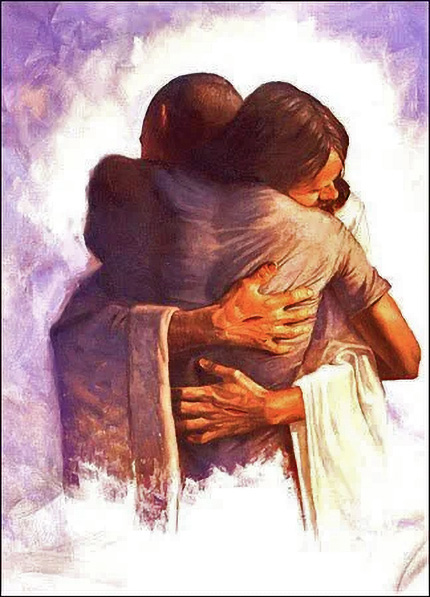
The father’s embrace of the prodigal son suggest this embrace, or kiss, that contains both agony and ecstasy. The agony is in grasping one’s own misery and distance from God, while the ecstasy is the acceptance and forgiveness. This process is the “purgative embrace” or “purgatory,” a purification by God’s love.

Inside each of us, beyond what we can picture clearly, express in words, or even feel distinctly, we have a dark memory of having once been touched and caressed by hands far gentler than our own. That caress has left a permanent mark, an imprint of a love so tender and deep that its memory becomes a prism through which we see everything else. This imprint lies beyond conscious memory but forms the center of our soul.

In a modern context, it is not meant to be taken literally, but the principle is often applied through other forms of affectionate greetings like eye contact, smiles, warm handshakes, or hugs. 

“So then each of us shall give an account of himself to God.” Romans 14:12

Hiding from God. During the last year of her life, Therese of Lisieux corresponded regularly with a young man named Maurice who was preparing to become a missionary. This man, despite being very sincere and quite pious, had some rather serious moral struggles. While he greatly admired Therese, eagerly awaited her advice on things, he was always afraid to tell her about his moral failures. Thus, for a long time, he would share with her only about the good things in his life, but never about his sins and failings. He feared that if he told her the real truth she would be shocked, lose respect for him, and turn away.

Eventually though he did muster up the courage and trust needed to share his weaknesses with her, though only after first expressing his fear: “I was afraid that in love you would take on the prerogative of justice and holiness and that everything that is sullied would then become an object of horror for you.” Therese’s response to this comment is most noteworthy: “It must be that you don’t know me well at all, if you are afraid that a detailed account of your faults would lessen the tenderness that I feel for your soul.”

God should get more press like this. The fear that this young man experienced in his relationship to Therese is the exact one that all of us perennially have in our relationship with God. We are afraid that in the sight of goodness and holiness all that is sullied in us will be an object of horror. Simply put, we are afraid that God’s good opinion of us might change should all of our darkest secrets be laid bare. Thus Therese’s words could have come right from God’s own mouth: “You don’t know me very well, if you are afraid that baring your faults before me will lessen the tenderness I feel towards you.”

I know so many people, especially young people, who because something is wrong in their lives stop going to church. They stop going to church precisely until such a time when, all on their own, they can somehow rectify the problem and then they go back to church and present their “unsullied” selves, now seemingly more at rights with holiness and goodness. “Given how I’m living, I would be a hypocrite if I went to church! I’m too honest and humble to go to church right now.” That may sound noble and humble, but it betrays a false understanding of God and ultimately does us no favors.

We do not know God very well at all when we fear coming into God’s presence replete with all that is within us, weaknesses as well as strengths. Nothing we do can ever lessen God’s tenderness towards us. [Excerpt from Ron Rolheiser’s “On Not Hiding from God” August 1999]

Owe nothing to anyone, except to love one another; for the one who loves another has fulfilled the law. Romans 13:8

You can safely assume you’ve created God in your own image when it turns out that God hates all the same people you do” – Anne Lamott.

Those are words worth contemplating, on all sides of the political and religious divide today. We live in a time of bitter division. From our government offices down to our kitchen tables there are tensions and divisions about politics, religion, and versions of truth that seem irreparable.  Sadly, these divisions have brought out the worst in us, in all of us.

Where do we go with that? I am a theologian and not a politician or social analyst so what I say here has more to do with living out Christian discipleship and basic human maturity than with any political response. So, what does it mean to love in a time like this?

Fyodor Dostoevsky famously wrote that love is a harsh and fearful thing, and our first response should be to accept that. Love’s harshness is felt most acutely in the (almost indigestible) self-righteousness we have to swallow in order to rise to a higher level of maturity where we can accept that God loves those we hate just as much as God loves us – and those we hate are just as precious and important in God’s eyes as we are.

Once we accept this, then we can speak for truth and justice. One of our contemporary prophetic figures, Daniel Berrigan, despite numerous arrests for civil disobedience, steadfastly affirmed that a prophet makes a vow of love, not of alienation. Hence, in our every attempt to defend truth, to speak for justice, and to speak truth to power, our dominant tone must be one of love, not anger or hatred.

Moreover, whether we are acting in love or alienation will always be manifest – in our civility or lack of it. No matter our anger, love still has some non-negotiables, civility and respect. Whenever we find ourselves descending to adolescent name-calling, we can be sure we have fallen out of discipleship, out of prophecy, and out of what is best inside us. [Excerpt from Ron Rolheiser’s “What is Love Asking of Us Now?” January 2021]

We, though many, are one Body in Christ and individually parts of one another. Romans 12:5

Gabriel Marcel once famously stated, To say to someone ‘I love you’ is to say, ‘you will never be lost’. As Christians, we understand this in terms of our unity inside the Body of Christ. Our love for someone links him or her to us, and since we are part of the Body of Christ, he or she too is linked to the Body of Christ, and to touch Christ is to touch grace. Thanks to the marvels of the Incarnation, every sincere Christian can say, ‘my heaven includes this or that particular person whom I love.’ We used to call this “baptism by desire”, except that in this instance the desire for “baptism” is on our part, but still equally efficacious.

A GPS, limitless in its patience, keeps ‘recalculating’, and keeps giving us a new instruction until we get to our destination. It never gives up on us. God is the same. We have an intended destination and God gives us constant instructions along the way.  Religion and the church are an excellent GPS. However, they can be ignored and frequently are. But, God’s response is never one of anger nor of a final impatience. Like a trusted GPS, God is forever saying ‘recalculating’ and giving us new instructions predicated on our failure to accept the previous instruction. Eventually, no matter our number of wrong turns and dead ends, God will get us home.

Ultimately, God is the only game in town, in that no matter how many false roads we take and how many good roads we ignore, we all end up on the one, same, last, final road. All of us: atheists, agnostics, nones, dones, searchers, procrastinators, those who don’t believe in institutionalized religion, the indifferent, the belligerent, the angry, the bitter, and the wounded, end up on the same road heading towards the same destination – death. However, the good news is that this last road, for all of us, the pious and the impious alike, leads to God. [Excerpt from Ron Rolheiser’s “One God, One Guidance System, and One Road for Us All” August 2022]

If you remain in my word, you will truly be my disciples, and you will know the truth, and the truth will set you free. John 8:31-32

In scripture, Satan is called “the prince of lies”, not the prince of sex or the prince of greed. More than anything else, it’s lying that corrupts the soul, destroys relationships, and sets itself against light. Lying is darkness, the worst form of it. Jesus tells us that all sins can be forgiven, except one: If someone should blaspheme the Holy Spirit, he says, that would constitute an “unforgivable sin”. How does one blaspheme against the Holy Spirit? Why is this unforgivable?

The unforgivable sin against the Holy Spirit begins with lying, with rationalization, with the refusal to acknowledge the truth. But we don’t commit this sin easily, overnight, the first time we tell a lie. We commit it down the line, through a sustained series of lies, long after we first told a lie to our loved ones and began to hide important parts of our lives from them. The soul warps slowly, like an old board soaked too often in the rain. It’s not the first time it gets wet that makes the warp.

We commit the sin against the Holy Spirit when we lie for so long that we believe our own lies. If we lie long enough, eventually light begins to look like darkness and darkness begins to look like light. That’s especially true of the lie of a double life, when we are no longer honest with our loved ones. If we do that long enough, eventually our betrayals begin to look like virtue, our lies like the truth, and what our families, faith, and churches stand for begins to look like falsehood, death, darkness.

Our sin then becomes unforgivable because we no longer want to be forgiven or deem any need to be forgiven. When a sin is unforgivable it’s because we don’t want to be forgiven, not because we’ve crossed some moral line in the sand beyond which God will no longer tolerate our behavior. The blockage is rather that what we once saw as truth (honesty, faith, family, fidelity, health through transparency) now looks like falsehood and the behavior we once had to hide from others and lie about now seems as virtue.

In the film, Sex, Lies, and Videotapes, which is rather simplistic and crass at times, is a lesson that could be taken from John’s gospel: The hero of the story, a young man with a bad history in the area of sexuality, resolves to make himself better by making a vow to never again tell a lie, even a very small one. Like the man who’s born blind in John’s gospel, that vow brings him to health. He gets better, much better. He then sets up a video camera and invites people to come and tell their stories. Those who tell the truth also get better, healthier, and those who lie and hide their infidelities continue to deteriorate in both health and happiness. The truth does set us free.[Excerpt from Ron Rolheiser’s “The Truth Sets Us Free” July 2005]

HTML Snippets Powered By : XYZScripts.com