
Daily Virtue Post

“Blessed are you…” Matthew 5:11

Catherine de Hueck Doherty, the founder of Madonna House, once gave a wonderfully insightful interview. “Inside me,” she said, “there are three people. There’s someone I call the ‘Baroness’. The ‘Baroness’ is the one who’s spiritual, efficient, and given over to prayer and asceticism. She’s the religious person inside me. She’s the one who founded a religious community, who writes spiritual books, challenges others, and has dedicated her life to God and the poor. The ‘Baroness’ reads the gospels and is impatient with the things of this world. For her, life here and now must be sacrificed for the next world.

But, inside me too, there’s another person I call ‘Catherine’. ‘Catherine’ is, first of all and always, the woman who likes fine things, luxuries, comfort, pleasure. She enjoys idleness, long baths, fine clothes, putting on make-up, good food, and used to (while married) enjoy a healthy sex life. ‘Catherine’ enjoys this life and doesn’t like self-sacrifice. She’s not particularly religious and generally hates the ‘Baroness’. ‘Catherine’ and the ‘Baroness’ don’t get along.

However, there’s still another person inside of me, who’s neither ‘Catherine’ or the ‘Baroness’. Inside me too there’s a little girl lying on a hillside in Finland, watching the clouds and daydreaming. This little girl doesn’t particularly like either ‘Catherine’ or the ‘Baroness’.

… and, as I get older, I feel more like the ‘Baroness’, long more for ‘Catherine’, but think maybe the real person inside me is the little girl daydreaming on a hillside.”

Saints struggle and so does everyone else. It’s not a simple thing to be a human being and it’s even more complex if you’re striving to give yourself over beyond what comes naturally, morally and spiritually. Like Catherine de Hueck Doherty, all of us have multiple persons inside us.

Inside each of us there’s someone who has faith, who wants to live the Beatitudes, and who wants to be attuned to truths and realities of the gospels. Inside each of us, there’s a martyr who wants to die for others, a ‘Mother Teresa’ who wants to radically serve the poor, and a moral artist who wants to carry his or her solitude at a high level. But inside each of us there’s also someone who wants to taste life and all its pleasures here and now. Inside each of us there’s a hedonist, a sensualist, a libertine, a materialist, an agnostic, and an egoist. Beyond that, inside each of us there is also a little girl or little boy, innocent, daydreaming, watching the clouds on some hillside, not particularly enamoured of either the saint and the sinner inside us.

Our complexity is not our enemy but our friend. All those pathological opposites inside us are precisely what make up our keyboard. It’s precisely because we’re both sinner and saint, hedonist and martyr, adult and child, that we have the enough keys to play the various musical scores that life hands us. [Excerpt from Ron Rolheiser’s “Living with our own Complexities” November 2004]


Then he asked them, “Why are you terrified? Do you not yet have faith?” Mark 4:40

Several years ago I attended a seminar on religious experience where a woman shared this story. She had been happily married, her children were grown and on their own, and she and her husband were running a successful business together. Then it all fell apart. Her husband, a recovering alcoholic, began to drink. Within two years, they had lost everything, including each other. Their business went bankrupt, they lost their house, and their marriage fell apart. She moved to a new city and took a new job, but the pain of what she had lost lingered and she found herself constantly depressed and joyless as she sought to sink new roots, meet new people, and begin over again in mid-life.

Having worked late, she was driving home and stopped for a red light. While waiting for the light to change she was hit from behind by a drunken driver. Her car was badly damaged and she, suffering from whiplash and a series of cuts and bruises, was taken to hospital by ambulance. After several hours of x-rays, examinations, and medical treatment, near midnight, she was released, to be driven home by a policeman.

As they drove up to her townhouse she noticed that the front door was wide open. Getting out of the car she realized that her home had been ransacked and vandalized. It was the last straw: All that penned up frustration, anger, loss, and grief finally burst, she lost control, began to scream hysterically, and ran across the lawn shouting curses at God and life in general – the policeman chasing her.

Her anger and her questions were about God: “Where is God in all of this? Why is God letting this happen? Why is God asleep?” Then, just as she heard her own curses as an answer, suddenly, in one instant, everything became calm. She ceased running, stopped shouting, because she felt inside of herself a flood of calm and a peace such as she had never experienced in her life before. No magic lights went on, no divine voices were heard, and she made no claims of “miracle” afterwards, but, for one second she realized that, no matter the storm, no matter the loss, and no matter death itself, God is still in charge of this universe. One second of realization was all it took. Calm returned. She sent the policeman home and began cleaning up her house. She has essentially remained in that calm since.

The Synoptic gospels record the story of Jesus calming the waters during a storm on the lake. As Mark has it: “It began to blow a gale and the waves were breaking into the boat so that it was almost swamped. But he was in the stern, his head on a cushion, asleep. They woke him and said to him, ‘Master do you not care? We are going down!’ And he woke up and rebuked the wind and said to the sea, ‘Quiet now! Be calm!’ And the wind dropped, and all was calm again. Then he said to them, ‘Why are you so frightened? How is it that you have no faith?’ They were filled with awe and said to one another: ‘Who can this be? Even the wind and sea obey him.’ ”

The parallel between these two stories is clear. In essence, both stories tell us that God is still in charge of this universe, every counter-indication notwithstanding. The first Christian creeds had only one line: Jesus is Lord! Ultimately that says enough, says it all. God still rules, even in death and darkness. But, as these stories also make clear, during the stormy moments of life, when our very souls are in fear of drowning, it will seem like God is asleep, comfortable, his head on cushion.

But, and this is the real challenge of these stories, calm is only a second of realization away. What calms the storm in life is not that all of our problems suddenly disappear but that, within them, we realize that, because God is still in charge, all will be well – whiplash, bruises, ransacked houses, alcoholic spouses, lost houses, lost jobs, loneliness, and the shadow of death itself notwithstanding. All will be well because, even asleep with his head on a cushion, God is still lord. [Excerpt from Ron Rolheiser’s The Storm on the Lake January 2000]

Things Hidden from the Learned and the Clever. Matthew 11:25

Academics, scholars, and university professors, like any segment of society, are a complex mix: In university circles you will find some of the most humble, gracious, faith-filled, and genuinely good people you will ever meet; just as you will also find some of the most arrogant, self-absorbed, amoral, and cynical people in the world. The academic world looks like the rest of the world.

Given that truth, I have long been haunted by a saying of Jesus that, often times, the deep secrets of life and of faith are hidden from the learned and the clever and revealed instead to children, to those of a less-complex mind.  I don’t doubt the truth of this; I wonder why.

Intelligence and learning are good things. God did not give us intelligence and then ask us not to use it. Naiveté is not a virtue and should never be confused with innocence. So why is being “intelligent and clever” something that can work against our understanding of the deeper secrets within life and faith?

Children are not self-sufficient even though they fiercely want to be. They need others and they know it. Consequently they more naturally reach out and take someone’s hand. They don’t have the luxury of self-sufficiency. When we are “learned and the clever” we can more easily forget that we need others and consequently don’t as naturally reach for another’s hand as does a child. It’s easier for us to isolate ourselves.

When we are less aware of our contingency we more easily lose sight of the things to which God and life are inviting us. The very strength that intelligence and learning bring into our lives can instill in us a false sense of self-sufficiency that can make us want to separate ourselves in unhealthy ways from others and understand ourselves as superior In some way. 

Superiority never enters a room alone, but always brings along a number of her children: arrogance, disdain, boredom, cynicism. All of these are occupational hazards for the “learned and the clever” and none of these helps unlock any of life’s deep secrets.

And so it’s never a bad thing to become learned and sophisticated; it’s only a bad thing is we remain there. The task is to become post-sophisticated, that is, to remain full of intelligence and learning even as we put on again to the mindset of a child. [Excerpt from Ron Rolheiser’s “Things Hidden from the Learned and the Clever” July 2011]

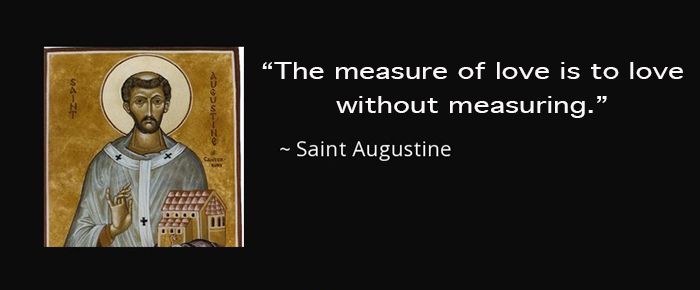
The measure with which you measure will be measured out to you. Mark 4:24

I would like comment on Jesus’ most important commandment: “Love one another as I have loved you!” We too easily read that simplistically, romantically, and in a one-sided, over-confident manner. But this command contains the most important challenge of the whole gospel and, like the deepest part of the gospel to which it is linked, the crucifixion, it is very, very difficult to imitate. Why?

It’s easy to consider ourselves as loving if we only look at one side of things, namely, how we relate to those people who are loving, warm, respectful, and gracious towards us. If we rate ourselves on how we feel about ourselves in our best moments among like-minded friends, we can easily conclude both that we are loving persons and that we are measuring up to Jesus’ command to love as he did.

But if we begin to look at the skeletons in our relational closets our naive confidence soon disappears: What about the people who hate us, whom we don’t like? What about the people whom we avoid and who avoid us? What about those people towards whom we feel resentment? What about all those people with whom we are at odds, towards whom we feel suspicion, coldness, anger? What about those people whom we haven’t been able to forgive?

Where Jesus stretches us beyond our natural instincts and beyond all self-delusion is in his command to love our enemies, to be warm to those who are cold to us, to be kind to those who are cruel to us, to do good to those who hate us, to forgive those who hurt us, to forgive those who won’t forgive us, and to ultimately love and forgive those who are trying to kill us.

That command, love and forgive your enemies, more than any creedal formula or other moral issue, is the litmus-test for Christian discipleship. We can ardently believe in and defend every item in the creed and fight passionately for justice in all its dimensions, but the real test of whether or not we are followers of Jesus is the capacity or non-capacity to forgive an enemy, to remain warm and loving towards someone who is not warm and loving to us. [Excerpt from Ron Rolheiser’s “Measuring Ourselves in Love” May 2007]

For ever I will maintain my love for my servant. Psalm 89

My sister Isabel went home to the angels thirty years ago. Isabel loved prairie lilies. About a dozen years ago, these [lilies] appeared in our planter box around the anniversary of her passing.

“There’s no reason for them to be there – we didn’t plant them or introduce new soil… the only explanation that makes sense is that Isabel put them there. They come back spectacularly every summer… every year we are grateful.”

The most important thing to take with us on our journey of life is love. Many readers will remember the story “Box full of kisses”. A man’s three-year-old daughter wrapped a box in shining gold and put it under the Christmas tree for him. When he opened it, he saw nothing in it. He berated her soundly for wasting good wrapping paper in frugal times.

Later he felt badly and tried to explain to her: “Don’t you know, when you give someone a present, there is supposed to be something inside?” The little girl looked up at him with tears in her eyes and cried; “Oh, Daddy, it’s not empty at all. I blew kisses into the box. They’re all for you, Daddy.”

The father was crushed and begged for forgiveness. A short time later his little girl died. He kept the gold box for many years, and whenever he was discouraged, he would take out an imaginary kiss and remember the love of the child who had put it there.

“Who are my mother and [my] brothers?” Mark 3:33

In John’s Gospel (10, 16), Jesus says: I have other sheep too, that are not of this sheepfold. I must bring them also. They will listen to my voice, and there will be one flock and one shepherd.

I’ve learned the truth of that statement through personal experience. Within my nearly forty years in ministry I have met, befriended, and become a faith-companion to men and women from every type of denomination and religion: Protestants, Episcopalians, Anglicans, Evangelicals,  Unitarians, small free Churches of all kinds,  Jehovah Witnesses, Hindus, Moslems, and Buddhists. In all of these denominations and religious communities, I have met men and women of deep faith and outstanding charity.

And this has caused me to ask myself the question that Jesus once asked those who approached him and told him that his mother and family were outside the circle he was talking to, asking for him: “Who is my mother? And who are my brethren? And he stretched forth his hand toward his disciples, and said, Behold my mother and my brethren! For whosoever does the will of my Father which is in heaven, is my brother, and sister, and mother. (Matthew 12:46-50)

We tend to believe that “blood is thicker than water” and so we sometimes defend our own families, ethnic groups, countries, and churches, even when they do wrong things. What Jesus affirms is that “faith is thicker than blood” and, even more deeply, that faith is also thicker than denominational or religious affiliation.

St. Paul agrees: In his Epistle to the Galatians, he asks the question: Who is living inside the Holy Spirit? Who really has genuine faith? His answer: Those whose lives manifest charity, joy, peace, patience, kindness, goodness, faithfulness, gentleness, and chastity. The presence of these virtues manifests faith and Christ. Conversely, he warns that we shouldn’t delude ourselves when our lives manifest, among other things, adultery, hatred, factionalism, strife, and envy. Our real brothers and sisters in faith are those whose lives manifest charity rather than selfishness, love rather than hatred, large hearts rather than selective sympathies, gentleness rather than hardness, and kindness rather than mean-spiritedness. Virtue trumps denominational identity.

I will always be a Roman Catholic, just as I will always be a member of my biological family, the Rolheisers, and my religious community, the Missionary Oblates of Mary Immaculate. I’ve been baptized into these families and baptism, as the old catechisms rightly teach, leaves an indelible mark on our souls. These will always be my families; but they may not be my only loyalty. I have other families too, not of these sheepfolds: non-Roman Catholics, non-Rolheisers, non-Oblates. And I don’t love the Roman Catholic Church, my biological family, or the Oblates of Mary Immaculate any less because of this. Paradoxically, I love them more.

When Jesus asks the question: “Who is mother and brother and sister to me?” he answers that whoever does the will of God is his true mother, true brother, and true sister. But, as the Gospels writers have at that point already strongly emphasized, his biological mother, Mary, was the first person who fit that description. Hence, he is not denigrating his mother, but re-establishing her worth and importance at a higher place.

The same should be true for us in our relationship to the faith families into which we have been baptized, even as we open up our hearts more and more to embrace those others who are not of our fold. Faith is thicker than blood – and thicker even than religious affiliation. [Excerpt from Ron Rolheiser’s “Other Sheep Not Of Our Flock” January 2012]

But whoever blasphemes against the holy Spirit will never have forgiveness, but is guilty of an everlasting sin. Mark 3:29

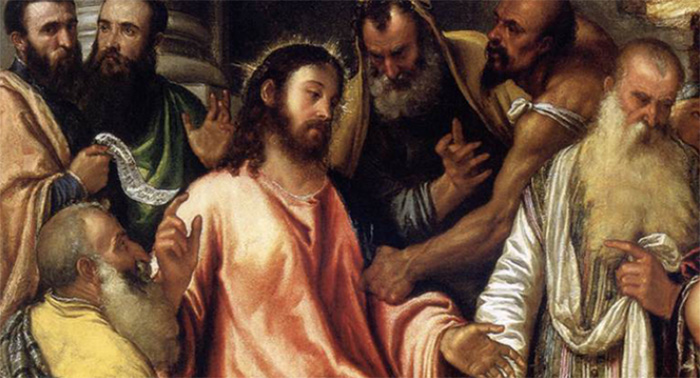
Jesus warns us that we can commit a sin that is unforgivable which (in his words) is a blaspheme against the Holy Spirit. This is the context where Jesus gives us this warning. He had just cast out a demon and some of the people who had witnessed this believed, as a hard religious doctrine, that only someone who came from God could cast out a demon. But they hated Jesus, so seeing him cast out a demon was a very inconvenient truth, so inconvenient in fact that they chose to deny what they had just seen with their own eyes. And so, against everything they knew to be true, they affirmed instead that Jesus had cast out the demon by Beelzebub, the prince of demons. They knew better. They knew that they were denying the truth.

Jesus’ first response was to try to make them see their lie. He appeals to logic, arguing that if Beelzebub, the prince of demons, is casting out demons, then Satan’s house is divided against itself and will eventually fall. But they persist in their lie. It’s then, in that specific context, that Jesus utters his warning about the danger of committing a sin that cannot be forgiven because it blasphemes the Holy Spirit.

The people whom Jesus addressed had denied a reality that they had just seen with their own eyes because it was too difficult for them to accept its truth. So, they denied its truth, fully aware that they were lying.

Well, the first lie we tell is not so dangerous because we still know we are lying. The danger is that if we persist in that lie and continue to deny (and lie) we can reach a point where we believe the lie, see it as truth, and see truth as falsehood. Perversion is then seen as virtue, and the sin becomes unforgivable, not because forgiveness is withheld, but because we no longer believe we need forgiveness, nor in fact do we want it or remain open to receive it.

Whenever we lie or in any way deny the truth, we begin to warp our conscience and if we persist in this, eventually we will (and this is not too strong a phrase) pervert our soul so that for us falsehood looks like truth, darkness looks like light, and hell looks like heaven.

And how is that a “blaspheme against the Holy Spirit”?

In his letter to the Galatians, St. Paul lays out two fundamental ways we can live our lives. We can live outside of God’s spirit. We do that whenever we are living in infidelity, idolatry, hatred, factionalism, and dishonesty. And lying is what takes us there. Conversely, we live inside God’s spirit, the Holy Spirit, whenever we are living in charity, joy, peace, patience, goodness, longsuffering, fidelity, gentleness, and chastity. And we live inside these whenever we are honest.

Thus, whenever we lie, whenever we deny reality, whenever we deny truth, we are (in effect and in reality) stepping outside of God’s spirit, blaspheming that spirit by disdaining it. [Excerpt from Ron Rolheiser’s “Lies and the Sin Against the Holy Spirit” January 2025]

I urge you, brothers, in the name of our Lord Jesus Christ, that all of you agree in what you say, and that there be no divisions among you, but that you be united in the same mind and in the same purpose. 1 Corinthians 1:10

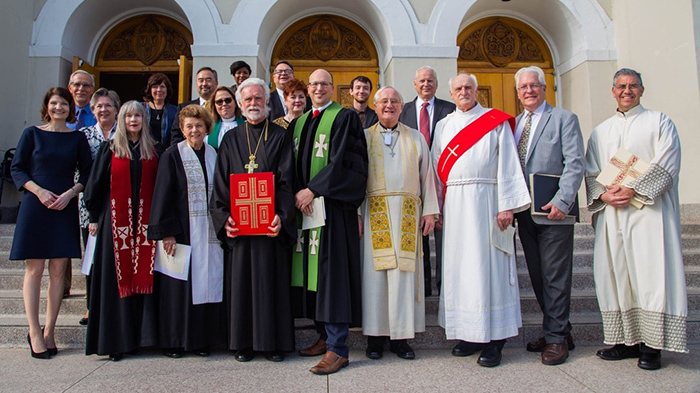
For more than a thousand years, Christians have not experienced the joy of being one family in Christ. Although there were already tensions within the earliest Christian communities, it was not until the year 1054 that there was a formal split, in effect, to establish two formal Christian communities, the Orthodox Church in the East and the Catholic Church in the West. Then, with the Protestant Reformation in the sixteenth century, there was another split within the Western Church and Christianity fragmented still further. Today there are hundreds of Christian denominations, many of whom, sadly, are not on friendly terms with each other.

Division and misunderstanding are understandable, inevitable, the price of being human. There are no communities without tension and so it is no great scandal that Christians sometimes cannot get along with each other. The scandal rather is that we have become comfortable, even smug, with the fact that we do not get along with each other, no longer hunger for wholeness, and no longer miss each other inside our separate churches.

In almost all our churches today there is little anxiety about those with whom we are not worshiping. For example, teaching Roman Catholic seminarians today, I sense a certain indifference to the issue of ecumenism. For many seminarians today this is not an issue of particular concern. Not to single out Catholic seminarians, this holds true for most of us in all denominations.

But this kind of indifference is inherently unchristian. Oneness was close to the heart of Jesus. He wants all his followers at the same table, as we see in this parable.

Sadly, today, many of us are comfortable in churches that are far, far from whole. Sometimes, in our less reflective moments, we even rejoice in it: “Those others aren’t real Christians in any case! We’re better off without them, a purer, more faithful church in their absence! We’re the one true remnant!”

But this lack of solicitude for wholeness compromises our following of Jesus as well as our basic human maturity. We are mature, loving people and true followers of Jesus, only when, like Jesus, we are in tears over those “other sheep that are not of this fold”. When, like the woman who lost one of her coins, we cannot sleep until every corner of the house has been turned upside down in a frantic search for what’s been lost. We too need to solicitously search for a lost wholeness – and may not be at peace until it is found. [Excerpt from Ron Rolheiser’s “Ecumenism: The Imperative for Wholeness Inside the Body of Christ” January 2025]

When his relatives heard of this they set out to seize him, for they said, “He is out of his mind.” Mark 3:21

In our reading today from Mark’s gospel, Jesus’ relatives try to grab him thinking that he was “out of his mind.” When we look closely at the Gospels, we see that there was no human pain, emotional or physical, from which Jesus was spared. It is safe to say, I submit, that no one, irrespective of his or her pain, can say to Jesus: You didn’t have to undergo what I had to undergo!  He underwent it all.

Given who Jesus was, given that his central message was good news for the poor, and given that he entered into human life precisely to experience all it contains, including its pains and humiliations, he could hardly have been born in a palace, enjoyed every kind of support, and been the center of love and attention. To be in real solidarity with the poor, as Merton once put it, he had to be born “outside the city”; and whether that was the case historically or not, it is a rich, far-reaching metaphor. Right from the beginning, Jesus knew both the pain and the shame of one who is excluded, who has no place in the mainstream.

During his ministry, he faced constant rejection, ridicule, and threat, sometimes having to hide away like a criminal on the run. He was also a celibate, one who slept alone, one deprived of normal human intimacy, one with no family of his own. Then in his passion and death, he experienced the extremes of both emotional and physical pain. Emotionally, he literally “sweated blood”, and physically, in his crucifixion, he endured the most extreme and humiliating pain possible for a human being to undergo.

The God who wrote the beginnings of it all with crooked lines also writes the sequence with crooked lines, and some of those lines are our own lives and witness. A God who did not hesitate to use the scheming as well as the noble, the impure as well as the pure, men to whom the world harkened and women upon whom the world frowned – this God continues to work through the same mélange.

Christianity isn’t just for the pure, the talented, the good, the humble, and the honest. The story of Jesus Christ was also written and keeps being written by the impure, by sinners, by calculating schemers, by the proud, by the dishonest, and by those without worldly talents. Nobody is so bad, so insignificant, so devoid of talent, or so outside the circle of faith, that he or she is outside the story of Christ.

God was reconciling the world to himself in Christ, and entrusting to us the message of reconciliation. 2 Corinthians 5:19

We live in a world of deep divisions. Everywhere we see polarization, people bitterly divided from each other by ideology, politics, economic theory, moral beliefs, and theology. We tend to use over-simplistic categories within which to understand these divisions: the left and the right opposing each other, liberals and conservatives at odds, pro-life vying with pro-choice.

Scripture calls this enmity, hatred, and indeed that’s its proper name. We are becoming hate-filled people who both fuel and justify our hatred on religious and moral grounds. We need only to watch the news on any night to see this. How’s this to be overcome?

At the more macro level in politics and religion, it’s hard to see how these bitter divides will ever be bridged, especially when so much of our public discourse is feeding and widening the division. What’s needed is nothing short of religious conversion, a religious change of heart, and that’s contingent on the individual. The collective heart will change only when individual hearts first do. We help save the sanity of the world by first safeguarding our own sanity, but that’s no easy task.

The real answer, I believe, lies in an understanding of how the cross and death of Jesus brings about reconciliation. The author of the Letter to the Ephesians tells us that Jesus broke down the barrier of hostility that existed between communities by creating one person where formerly there had been two – and he did it this “by reconciling both [sides] in one body through his cross, which put that enmity to death.” (Ephesians 2, 16)

What Jesus did in his passion and death was to transform bitterness and division rather than to retransmit them and give them back in kind. In the love which he showed in his passion and death Jesus did this:  He took in hatred, held it inside himself, transformed it, and gave back love. He took in bitterness, held it, transformed it, and gave back graciousness. He took in curses, held them, transformed them, and gave back blessing. He took in paranoia, held it, transformed it, and gave back big-heartedness. He took in murder, held it, transformed it, and gave back forgiveness. And he took in enmity, bitter division, held it, transformed it, and through that revealed to us the deep secret for forming community, namely, we need to take away the hatred that divides us by absorbing and holding it within ourselves and thereby transforming it. Like a water purifier which holds within itself the toxins and the poisons and gives back only pure water, we must hold within ourselves the toxins that poison community land give back only graciousness and openness to everyone. That’s the only key to overcome division. [Excerpt from Ron Rolheiser’s “Overcoming the Divisions that Divide Us” January 2018]

HTML Snippets Powered By : XYZScripts.com