
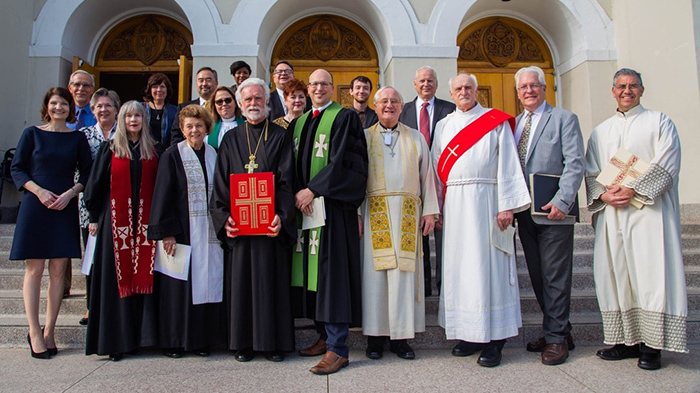
For more than a thousand years, Christians have not experienced the joy of being one family in Christ. Although there were already tensions within the earliest Christian communities, it was not until the year 1054 that there was a formal split, in effect, to establish two formal Christian communities, the Orthodox Church in the East and the Catholic Church in the West. Then, with the Protestant Reformation in the sixteenth century, there was another split within the Western Church and Christianity fragmented still further. Today there are hundreds of Christian denominations, many of whom, sadly, are not on friendly terms with each other.
Division and misunderstanding are understandable, inevitable, the price of being human. There are no communities without tension and so it is no great scandal that Christians sometimes cannot get along with each other. The scandal rather is that we have become comfortable, even smug, with the fact that we do not get along with each other, no longer hunger for wholeness, and no longer miss each other inside our separate churches.
In almost all our churches today there is little anxiety about those with whom we are not worshiping. For example, teaching Roman Catholic seminarians today, I sense a certain indifference to the issue of ecumenism. For many seminarians today this is not an issue of particular concern. Not to single out Catholic seminarians, this holds true for most of us in all denominations.
But this kind of indifference is inherently unchristian. Oneness was close to the heart of Jesus. He wants all his followers at the same table, as we see in this parable.
Sadly, today, many of us are comfortable in churches that are far, far from whole. Sometimes, in our less reflective moments, we even rejoice in it: “Those others aren’t real Christians in any case! We’re better off without them, a purer, more faithful church in their absence! We’re the one true remnant!”
But this lack of solicitude for wholeness compromises our following of Jesus as well as our basic human maturity. We are mature, loving people and true followers of Jesus, only when, like Jesus, we are in tears over those “other sheep that are not of this fold”. When, like the woman who lost one of her coins, we cannot sleep until every corner of the house has been turned upside down in a frantic search for what’s been lost. We too need to solicitously search for a lost wholeness – and may not be at peace until it is found. [Excerpt from Ron Rolheiser’s “Ecumenism: The Imperative for Wholeness Inside the Body of Christ” January 2025]
