
If you consider that God is righteous, you also know that everyone who acts in righteousness is begotten by him. 1 John 2:29

What’s right and what’s wrong? We fight a lot over moral issues, often with a self-assured righteousness. And mostly we fall into that same self-righteousness whenever we argue about sin. What constitutes a sin and what makes for a serious sin? Different Christian denominations and different schools of thought within them lean on various kinds of biblical and philosophical reasoning in trying to sort this out, often bitterly disagreeing with each other and provoking more anger than consensus.

Intending no offense to how our churches and moral thinkers have classically approached moral questions, I believe there’s a better way to approach them that, more healthily, takes into account human freedom, human limitations, and the singular existential situation of every individual. The approach isn’t my own, but one voiced by the Prophet Isaiah who offers us this question from God: What kind of house can you build for me? That question should undergird our overall discipleship and all of our moral choices.

 How do we enshrine the image and likeness of God inside our body, our intellect, our affectivity, our actions? What kind of “church” or “cathedral” is our very person? That’s the deeper question in terms of moral living. What kind of house can you build for me? At what level do I want live out my humanity and my discipleship? Do I want to be more self-serving or more generous? Do I want to be petty or noble? Do I want to be self-pitying or big of heart? Do I want to live out my commitments in a fully honest fidelity or am I comfortable betraying others and myself in hidden ways? Do I want to be a saint or am I okay being mediocre?

At a mature level of discipleship (and human maturity) the question is no longer, is this right wrong? That’s not love’s question. Love’s question is rather, how can I go deeper? At what level can I live out love, truth, light, and fidelity in my life? At what level do I want to carry my chastity, my fidelity, and my honesty? At what point in my life do I want to accept carrying more of the tension that both my discipleship and my humanity ask of me? What kind of person do I want to be? Do I want to be someone who is fully transparent or someone who has hidden goods under the counter? Do I want to live in full sobriety?” What kind of “temple” do I want to be?  What kind of house can I build for God?

This moral choice comes to us, as do all the invitations from God, as an invitation, not as a threat. It’s through love and not threat that God invites us into life and discipleship, always gently asking us: what kind of house can you build for me? [Excerpt from Ron Rolheiser’s “What Kind of House Can You Build for Me?” October 2020]
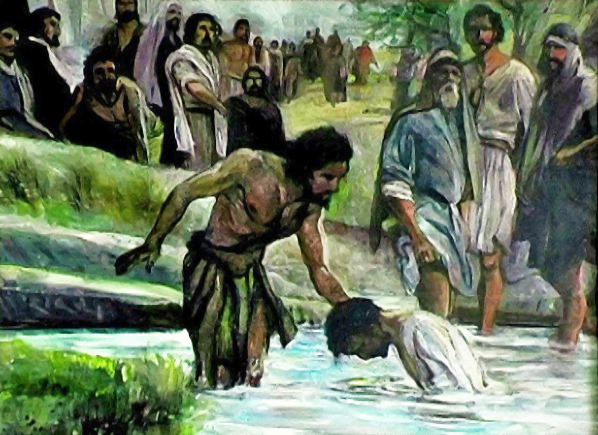
“I baptize with water” John 1:26

In his exchange with the Jewish leaders, John the Baptist is both aware of his strength and his impotency. He can point out what’s wrong and what should be done, but after that, he’s helpless, with nothing to offer in terms of the strength needed to correct the wrong.

In essence, that’s what we bring to any situation when we criticize something. We are able, often with brilliance and clarity, to show what’s wrong. That contribution, like John the Baptist’s, is not to be undervalued. The gospels tell us that, next to Jesus, there isn’t anyone more important than John the Baptist. But, like John, criticism too is only a half-job, a half-prophecy: It can denounce a king, by showing what’s wrong, and it can wash the soul in sand, by blasting off layers of accumulated rust and dirt, but ultimately it can’t empower us to correct anything. Something else is needed. What?

Anyone who has ever tried to overcome an addiction can answer that question. A clear head, a clear vision of what’s to be done, and a solid resolution to leave a bad habit behind is only a half-job, a first step, an important one, but only an initial one. The tough part is still ahead: Where to find and how to sustain the strength needed to actually change our behaviour and give up a bad habit? Anyone who has ever given up an addiction will tell you that, in the end, they didn’t do it by willpower, or at least certainly not by willpower alone. Grace and community were needed and they were what ultimately provided what willpower alone could not. 

The gospels speak of this as a baptism and they speaks of two kinds of baptisms: the baptism of John and the baptism of Jesus, adding that John’s baptism is only a preparation for Jesus’ baptism. What’s John’s baptism? It’s a baptism of repentance, a realization of what we are doing wrong and a clear resolution to correct our bad behaviour. What’s Jesus’ baptism? It’s an entry into grace and community in such a way that it empowers us internally to do what is impossible for us to do by our willpower alone.

There’s a mystery to all energy. But what we can lay out empirically is its effect: spiritual energy works. Grace works. This has been proven inside the experience of thousands of people (many of them atheists) who have been able to find an energy inside them that clearly does not come from them and yet empowers them beyond their willpower alone. Ask any addict in recovery about this. 

Sadly, many of us, who are solid believers, still haven’t grasped the lesson. We’re still trying to live out our lives by John’s baptism alone, that is, by our own willpower. That makes us wonderful critics but leaves us mostly powerless to actually change our own lives. What we are looking for, and desperately need, is a deeper immersion into the baptism of Jesus, that is, into community and grace. [Excerpt from Ron Rolheiser’s “Willpower Alone is Not Enough” September 2012]

And Mary kept all these things, reflecting on them in her heart. Luke 2:19

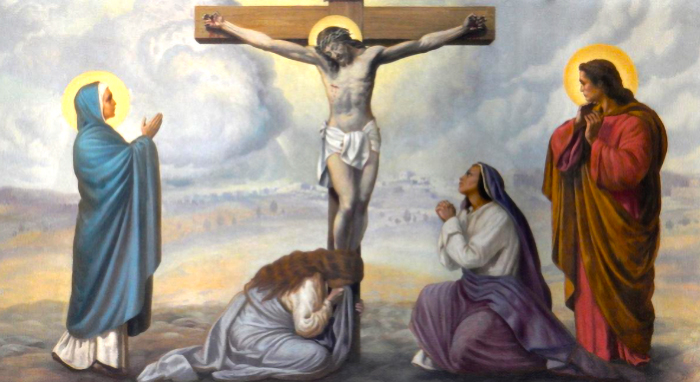
One of the most popular images in all of scripture (an icon that’s been endlessly painted, sung, put into litanies, written up into poetry, and used to triggered every kind of pious feeling) is the image of Mary, the mother of Jesus, standing silently under the cross as her son dies.

As Jesus was dying, the Gospels tell us that Mary, his mother, stood under the cross. What’s in that image? What’s in this picture that invites us to more than simple admiration, piety, or sympathy?

This is a mystical image and it is anything but pious. In the Gospels, after Jesus, Mary is the most important person to watch. She’s the model of discipleship, the only one who gets it right. And she gets it very right under the cross. What’s she doing while standing there?

In essence, what Mary was doing under the cross was this: She couldn’t stop the crucifixion (there are times when darkness has its hour) but she could stop some of the hatred, bitterness, jealousy, heartlessness, and anger that caused it and surrounded it. And she helped stop bitterness by refusing to give it back in kind, by transforming rather than transmitting it, by swallowing hard and (literally) eating bitterness rather than giving it back, as everyone else was doing.

And that’s not easy to do. Everything inside us demands justice, screams for it, and refuses to remain silent in the presence of injustice. That’s a healthy instinct and sometimes acting on it is good. We need, at times, to protest, to shout, to literally throw ourselves into the face of injustice and do everything in our power to stop the crucifixion.

Like Mary, we have to say: “I can’t stop this crucifixion, but I can stop some of the hatred, bitterness, jealousy, brute-heartlessness, and darkness that surround it. I can’t stop this, but I will not conduct its hatred.” And that’s not the same thing as despair. Our muted helplessness is not a passive resignation but the opposite. It’s a movement towards the only rays of light, love, and faith that still exist in that darkness and hatred. And, at that moment, it’s the only thing that faith and love can do.

So this is the image: Sometimes darkness has its hour and there is nothing we can do to stop it. Sometimes the blind, wounded forces of jealousy, bitterness, violence, and sin cannot, for that moment, be stopped. But, like Mary under the cross, we are asked to “stand” under them, not in passivity and weakness, but in strength, knowing that we can’t stop the crucifixion but we can help stop some of the hatred, anger, and bitterness that surrounds it. [Excerpt from Ron Rolheiser’s “Mary Under the Cross” April 2006]

But to those who did accept him he gave power to become children of God, to those who believe in his name. John 1:12

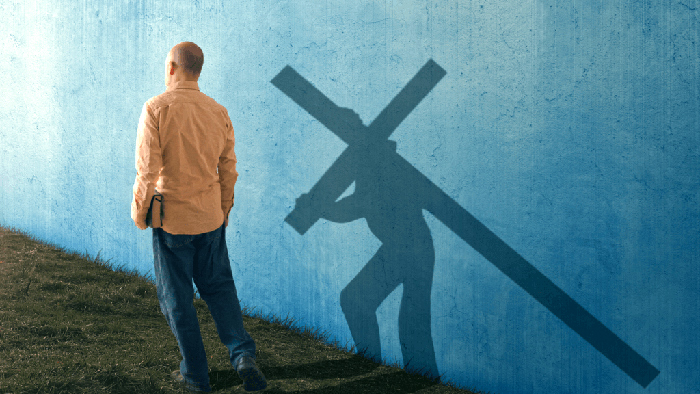
Among Jesus’ many teachings we find this, rather harsh-sounding, invitation: Whoever wants to be my disciple must deny himself, take up his cross daily, and follow me. Whoever finds his life will lose it, and whoever loses his life for my sake will find it.

I suspect that each of us has a gut-sense of what this means and what it will cost us; but, I suspect too that many of us misunderstand that Jesus is asking here and struggle unhealthily with this invitation. What, concretely, does Jesus mean by this?

  • First, it means accepting that suffering is a part of our lives.
  • Second, taking up our cross and giving up our lives, means that we may not, in our suffering, pass on any bitterness to those around us.
  • Third, walking in the footsteps of Jesus as he carries his cross means that we must accept some other deaths before our physical death, that we are invited to let some parts of ourselves die.
  • Fourth, it means that we must wait for the resurrection, that here in this life all symphonies must remain unfinished.
  • Fifth, carrying our cross daily means accepting that God’s gift to us is often not what we expect. God always answers our prayers, but often times, by giving us what we really need rather than what we think we need.
  • Finally, taking up your cross and being willing to give up your life means living in a faith that believes that nothing is impossible for God.

We can take up our cross when we begin to believe in the Resurrection. [Excerpt from Ron Rolheiser’s “Carrying Our Cross” November 2014]

Do not love the world or the things of the world. If anyone loves the world, the love of the Father is not in him. 1 John 2:15

Spiritualities of the resurrection and psychologies of self-actualization, whatever their other strengths, no longer give us permission to be in pain, to be un whole, ill, unattractive, aged, unfulfilled or even just alone on a Friday night.  The idea is all too present that we can only be happy if we somehow fulfil every hunger within us, if our lives are completely whole, consummated and we are never alone on a Friday night. Unless every pleasure that we yearn for can be tasted, we cannot be happy. Because of this we over expect. We stand before life and love in a greedy posture and with unrealistic expectations, demanding the resolution of all our eros and tension.

However, life, in this world, can never give us that. We are pilgrims on earth, exiles journeying towards home. The world is passing away. We have God’s word for it. And we need God’s word for it! Too much in our experience today militates against the fact that here in this life all symphonies remain unfinished. Somehow, we have come to believe that a final solution for the burning tensions within us lies within our present grasp. I am not sure who or what gives us this idea.

A simple example serves to illustrate: In our culture we suffer from what might be termed “Friday Night Syndrome.” Few people can stay home quietly and rest on a Friday night. Why? Is it because we are not tired and ideally could not appreciate a nice quiet time. No! We cannot stay home quietly on Friday night because inside of us moves a restless demon that assures us that everyone in the whole world is doing something exciting on Friday night. Once that voice is heard, then our homes, our families and our commitments begin to look unexciting. Peace and restfulness slip away, and we are caught up in an insatiable restlessness.

This example illustrates the basic principle: So much of our unhappiness comes from comparing our lives, our friendships, our loves, our commitments, our duties, our bodies and our sexuality to some idealized and non-Christian vision of things which falsely assures us that there is a heaven on earth. When that happens, and it does, our tensions begin to drive us mad, in this case, to a cancerous restlessness.

In a culture (and, at times, in a church) that tells us that no happiness is possible unless every ache and restlessness inside of us is fulfilled, how hard it is to be happy. How tragic it is to be alone! How tragic it is to be unmarried! How tragic it is to be married, but not completely fulfilled romantically and sexually! How tragic it is not to be good-looking! How tragic it is to be unhealthy, aged, handicapped! How tragic it is to be caught up in duties and commitments, small children and diapers and routine, which limit our freedom and relationships! How tragic it is to be poor! How tragic it is to go through life and not be able to taste every pleasure on earth! It almost isn’t worth living!

There is wisdom and, yes, even comfort, in the old “mourning and weeping in this vale of tears” philosophy. Sometimes that expression was abused, and people forgot that the Creator did not just make us for life after death…He did also intend some life after birth! But those who lived that philosophy generally did not attempt to milk life for more than it could give them. Those who lived that philosophy were a lot less restless and greedy for experience than we are today. They could much more restfully enjoy God’s great gifts – life, love, youth, health, friendship and sexuality – even as they are limitedly given in this life. Those who lived that philosophy were, I am sure, much more restful on Friday nights! [Excerpt from Ron Rolheiser’s “Staying Home on a Friday Night” February 1985]

Behold, this child is destined for the fall and rise of many in Israel, and to be a sign that will be contradicted. Luke 2:34

In this life there is no such a thing as a clear cut, pure joy. Everything comes mixed. As Henri Nouwen once put it: Every bit of life is touched by a bit of death. In every satisfaction there is limitation; in every embrace, there is distance; in every success, there is the fear of jealousy; behind every smile, there is a tear; and in all forms of light there is knowledge of the surrounding darkness. When you touch the hand of a returning friend, you already know that he or she will have to leave again, and when you are overwhelmed by the beauty of a sunset, you miss the friend who can not be there with you. Joy and pain are born at the same place within us and we can never find proper words to capture our own feelings.

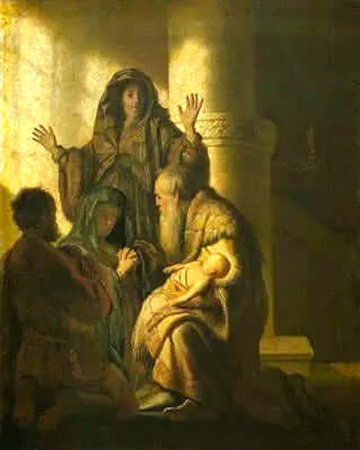
For example, when the Virgin Mary, a young mother, comes before Simeon in the temple, he looks at her and her child and says: “This child is destined for the fall and rise of many, a sign that will be contradicted … and a sword too will pierce your own heart. ” An interesting thing to say to a young mother, deep joy and deep pain will come to you because of your child! We have our own experiences of this. Many is the mother who cries at her daughter’s wedding, even though it is a joyful occasion. A sword too is piercing her heart. Sensitive people often cry in the face of joy, not just because joy is often too gracious and raw to take, but because its light sends beams into many other places. Simeon understood this; revelation reveals pain even as it brings joy.

Why does revelation, the truth, which is supposed to set us free, bring pain? Why does the gospel of Christ not bring us what we really want, joy without pain?

These are important questions because how we understand the relationship between joy and pain helps determine how we understand ourselves, happiness, and the gospel. Too often we have the false idea, very prevalent in our culture, that joy and pain are incompatible and that Christ came to rescue us from pain. Our culture tends to believe that if you are in pain you cannot be happy and to be happy you must avoid pain.

Nothing could be further from the truth. Joy and pain are not incompatible and Christ does not, as poor preaching sometimes wants us believe, promise us less pain. The reverse is closer to the truth, though any formula linking joy and pain must be very carefully worded since masochism is always a danger.

The paradoxical connection between joy and pain, ultimately, points us towards eternity. By revealing to us our limits, it points us towards something greater, God’s kingdom, a higher synthesis of love and communion, within which, as the vision of Isaiah has it, there will be satisfaction without limit, embrace without distance, success without jealousy, smiles without tears, reunions without separation, joys without missing your loved ones, and life without death.

What Christ promises us is not a life on this earth without pain, but an eventual joy that will be clear-cut, pure, and which no one or no thing can ever take from us. [Excerpt from Ron Rolheiser’s “One of Isaiah’s Visions” November 1997]

“Out of Egypt I called my son.” Matthew 2:15

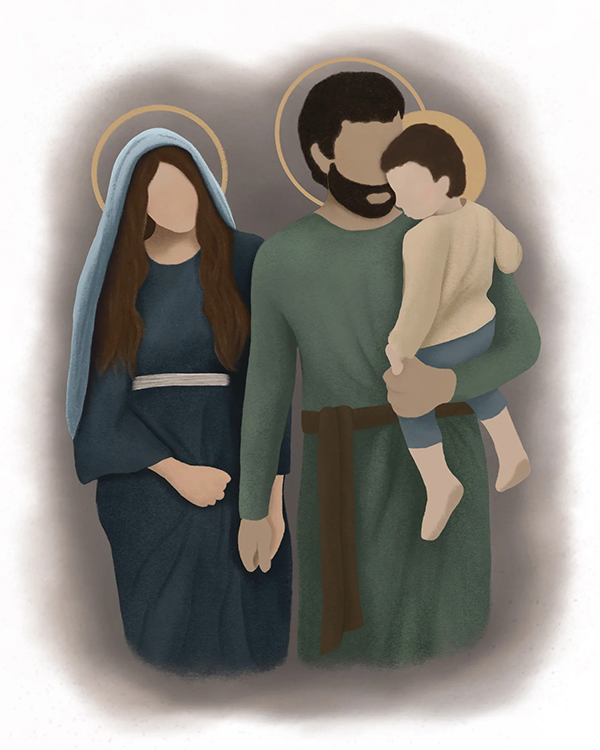
Brother Michael Moore of the Oblates of Mary Immaculate writes that we gather today around the Holy Family: Mary, Joseph, and Jesus. It is through this poor family that God’s love for each of us and the whole world is revealed and experienced. God did not come to us in power, glory, wealth, or majesty. God chose to come close to us and become one of us through Mary, who said ‘Yes’ when she was asked to be the Mother of Jesus. We often forget that Joseph was also called by God, and he, too, said ‘Yes’ when the messenger of God told him that Jesus, their Son, ‘is the one who is to save his people from their sins.

Today is a special time for us to remember and celebrate our own sacred families. It is a day to recall and acknowledge where we come from, where we first learned to love, share, and say sorry. We don’t get to choose our families; we experience them as they are. There are no perfect families, only the ones into which we are born.

Patrick Kavanagh, an Irish poet, once said that God is in the bits and pieces of everyday life. If we look and are attentive, we will find and experience God in the bits and pieces of the everyday events of our family life. In our family, despite the rough and tumble of daily life, we are surrounded by people who love us, nurture us, sustain us, and are there for us where we need them the most. There are also times when we say or do the wrong thing to those who are close to us. Challenging as it may be, these times offer us the opportunity to say sorry and offer them the healing hand of reconciliation and forgiveness. 

I recall the words of Pope Francis when we said, “If we could say Please, Sorry, and Thank You more in our families, how happier places our homes would be.”

The parents of St. Eugene de Mazenod, the Founder of the Oblates of Mary Immaculate, separated and divorced in 1802; he was 21. This was a deep wound from which he never really recovered; he carried the pain of this with him all his life. We can rightly call him the Patron Saint of Wounded Families. Today, as we celebrate the Holy Family of Nazareth, let us also remember and pray for all families that are experiencing pain and difficulties. Through our prayers, may they know and feel the loving protection of Mary, Joseph, and their Son, Jesus Christ, the Holy Family.

We are writing this so that our joy may be complete. 1 John 1:4

The last supper account in John’s gospel contains a curious picture. The evangelist describes the beloved disciple as reclining on the breast of Jesus. What is contained in this image?  A picture of how each of us should be focused as we look out at the world.

When you put your head upon the breast of another, your ear is just above that person’s heart and you are able to hear his or her heartbeat. Thus, in John’s image, we see the beloved disciple with his ear on Jesus’ heart and his eyes peering out at the world.

This is an image, a mystical one. Among other things, it is a picture of gentleness. What is shows, however, is not a  saccharine piety, a sweetness hard to swallow, but a softness that comes from being at peace, from being so rooted and centred in a love that one can look out at the world without bitterness, anger, jealousy, the sense of being cheated, and the need to blame or compete with others.

Henri Nouwen once said: “By touching the center of our solitude, we sense that we have been touched by loving hands.” Deep inside each of us, like a brand, there is a place where God has touched, caressed, and kissed us. Long before memory, long before we ever remember touching or loving or kissing anyone or anything, or being touched by anything or anybody in this world, there is a different kind of memory, the memory of being gently touched by loving hands.  When our ear is pressed to God’s heart – to the breast of all that is good, true, and beautiful – we hear a certain heartbeat and we remember, remember in some inchoate place, at a level beyond thought, that we have been gently kissed by God.

We have been touched by loving hands. The memory of that touch is a brand – warm, dark, gentle. To enter that memory is to lean on the breast of Christ, just as the beloved apostle did at the last supper. From that place, with our ear on Christ’s heart, we have the truest perspective on our world. [Excerpt from Ron Rolheiser’s “Listening to Christ’s Heartbeat” February 1997]

“You will be hated by all because of my name, but whoever endures to the end will be saved.” Matthew 10:22

An American humorist was once asked what he loved most in life. This was his reply: I love women best; whiskey next; my neighbor a little; and God hardly at all!

Our natural instincts and spontaneous desires generally seem at odds with that towards which they are supposedly directed, namely, God and eternal life.  A religious perspective, it would seem. calls us to reverse the order described by that American humorist, that is, we’re to love God first, our neighbor just as deeply, and then accord to the human pleasures we are so naturally drawn to a very subordinate role.

But that’s not what happens most of the time. Generally we are drawn, and drawn very powerfully, towards the things of this earth: other people, pleasure, beautiful objects, sex, money, comfort. These seemingly have a more-powerful grip on us than do the things of faith and religion.

Doesn’t this then put our natural feelings at odds with how God intended us to feel and act? Why are we, seemingly, built in one way and then called to live in another way? How do we reconcile the seeming incongruity between our natural make-up and God’s intent for us?

We need to understand human instinct and human desire at a deeper level. We might begin with St. Augustine’s memorable phrase: You have made us for yourself, Lord, and our hearts are restless until they rest in you. When we analyze our natural makeup, natural instincts, and natural desires more deeply, we see that all of these ultimately are drawing us beyond the more-immediate things and pleasures with which they appear to be obsessed. They are drawing us, persistently and unceasingly, towards God.

Ultimately, we are longing for the depth that grounds every person and object, God.

God didn’t make a mistake in designing human desire. God’s intent is written into very DNA of desire. Ultimately our make-up directs us towards God, no matter how obsessive, earthy, lustful, and pagan a given desire might appear on a given day. Human nature is not at odds with the call of faith, not at all.

God also put those earthy instincts in us to pressure us to enjoy life and taste its pleasures – while God, like a loving old grandparent watching her children at play, remains happy just to see her children’s delight in the moment, knowing that there will be time enough ahead when pain and frustration will force those desires to focus on some deeper things.

When we analyze more deeply God’s design for human nature and understand ourselves more deeply within that design, we realize that, at a level deeper than spontaneous feeling, and at a level deeper than the wisecracks we make about ourselves, we in fact do love God best; love our neighbor quite a bit; and, very happily, love whiskey and the pleasures of life quite a bit as well. [Excerpt from Ron Rolheiser’s “Human Nature – Is it Somehow all Wrong?” August 2015]

In the beginning was the Word, and the Word was with God, and the Word was God. John 1:1

For some, Christmas is for the children, a feast where we let their delight and freshness challenge our cynicism. For others, it’s the opposite: we insist rather that Christmas is an adult feast, something kids don’t ultimately understand, something that celebrates the greatest intellectual mystery of all time, God taking on flesh to bring justice to the earth.

And so some of us send Christmas greetings urging delight, celebration, gifts, lights, and joyous song, while some of us send more stark greetings that say: “May the peace of Christ disturb you!” What is Christmas?

Christmas is about all of these things, and more. Like a diamond turning in the sun, it gives off many sparkles. Christmas is about the monumental challenge to reform our lives, our adult lives, and become women and men of justice; but it is also about a baby being born, innocent and powerless in the straw, whose vulnerability is God’s invitation and judgment. It is too, as Karl Rahner once said, God giving us permission to be happy. Thus, Christmas is a both something to be delighted in and a peace that should disturb us, something for children and for adults.

Christmas is about much deeper things than Santa, and the birth of Jesus is not just some delightful fairy tale meant to warm the heart. We measure time by this event. Christmas is about God being born physically and historically into this world and, among many other things, we have some stunning lessons to learn from the manner in which this happened.

As virtually all of our iconography around Christmas makes clear, God is born, not as some superstar whose earthly power, beauty, and muscle dwarf us. No. God is born as helpless, vulnerable, thoroughly under-whelming baby who looks out at us quietly even as we look back at him and he judges us in that way that vulnerability judges false strength, forever, transparency judges lies, generosity judges selfishness, innocence judges over-sophistication, and a baby, gently and helplessly and disarmingly, calls forth what’s best in us.

Christmas is meant to bring us back to the crib so that our hearts can feel that freshness that wants to make us start living over again. [Excerpt from Ron Rolheiser’s “An Invitation Inside of Christmas” December 2022]

HTML Snippets Powered By : XYZScripts.com