
Laughter is such a huge part of our lives that we actively seek it out. We want to watch things that make us laugh, read things that make us laugh, and spend time with people who make us laugh.
Dr. Tod Worner, Managing Editor of Evangelization & Culture, the Journal of the Word on Fire Institute, writes, “Humor and the laughter it begets are further manifestations of God’s divine spark. “Joy and Laughter,” says G.K. Chesterton, “is the gigantic secret of the Christian. There was something that God hid from all men when He went up a mountain to pray. There was something that He constantly covered by abrupt silence or impetuous isolation. There was one thing that was too great for God to show us when He walked upon our earth, and I have sometimes fancied that it was His mirth.”
Imagine the enormity of God’s mirth. Imagine the magnitude of his wit. God left us with just a taste of the wondrous joy to come: glorious, delicious, irrepressible laughter. Fr. James Martin is a prolific author, magazine editor, and media commentator whose witty and often humourous elucidations on Church activities and teaching are sought by many. Below is a popular video of his talk at Boston College on Joy, Humor, and the Saints. Take some time and relax with the wit and humor of Fr. James Martin – it’s time to laugh with the saints!
“seek first the Kingdom of God and his righteousness” Matthew 6:33

The tension we experience between our desire to grow up and our perennial procrastination and infinite stalling in doing that reflects a tension that lies at the heart of Jesus’ message today, a tension between God’s promises as being already here and God’s promises as still coming. Everything Jesus promised is already here, and everything Jesus promised is still coming. We’re already living the new, resurrected life, even as we’re still waiting for it. Biblical scholars and theologians tell us that everything Jesus came to bring us – the Reign of God, the Kingdom of God, the New Age, the Final Age, the reign of justice on this earth, new life, the resurrection, eternal life, heaven – is already here, except that it’s also still coming. It’s here now, but not fully; a present reality, but in tension. And it’s still coming, in its fullness; still to arrive, in ecstasy. It’s already here, and it’s still yet to be realized. The followers of Jesus prefer to push everything off into the future, and the story comes to no good end. The reign of God announced by Jesus is not accepted. The ‘today’ offered by God is denied. And that, that alone, is why ‘already’ becomes ‘not yet.’ It is not only in Nazareth that the ‘today’ of the Gospel was not accepted. In the church’s history, we see that it has again and again been denied or rendered toothless. The reason was the same as in Nazareth: apparently, it goes against the human grain for God to become concrete in our lives. Then, people’s desires and favorite notions are in danger, as are their ideas about time. It can’t be today because that would mean our lives must change. Therefore, it can lie, hygienically and snugly packed, at rest, inconsequential. We’re like the guests in the Gospel parable invited to the wedding banquet. We, too, want to go to the feast and intend to go to the feast, but first, we need to attend to our marriages, our businesses, and our ambitions. We can get serious later. There’s time. We fully intend to take Jesus seriously; we just want a little more time before we do that. After converting to Christianity at age twenty-five, St. Augustine struggled for another nine years to bring his sexuality into harmony with his faith. During those nine years, he prayed this way: Lord, make me a chaste Christian, but not yet! To his credit, unlike many of us, he eventually stopped pushing things into the indefinite future.
“The lamp of the body is the eye” Matthew 6:22

It is said that the “eyes are the window to the soul.” I mention this as Jesus speaks today of good and bad eyes and their correlation to light and darkness. We can trap ourselves in the darkness of the bad eye by our actions. The characteristics of the bad eye are: It cannot see the beauty of grace; It cannot see the brightness of generosity; It cannot see unexpected blessings to others as a precious treasure. It is an eye that is blind to what is truly beautiful, bright, precious, and God-like. It is a worldly eye. It sees money and material reward as more to be desired than a beautiful display of free, gracious, God-like generosity. So, the “eye test” is relatively straightforward, and you already know its results. If your eye sees heavenly treasure as infinitely more precious than earthly material treasure, your eye is good, and you are filled with the light and love of the Lord. Therefore, we do not seek to lay up our treasures on earth but in heaven. Our hearts are centered on Christ and not the world. Let me also suggest that you do one other “eye test” from Fr. Ron Rolheiser. Take a good look in the mirror. What do you see? For most of us, what is revealed is a lifeless face that’s not really ours and dull eyes hidden beneath a lying glass. Somewhere, the fire in our eyes has gone out; our eyes and faces are devoid of wonder and innocence. How do we correct this? We need to take a good, long look at ourselves in a mirror and study our eyes, long and hard, and let what we see shock us enough to move us toward the road of wonder or renewed innocence. Here’s the suggestion: Go to the mirror and stare into your eyes long enough until you see the boy or girl who once inhabited that space again. In that, wonder will be born, a sparkle will return, and with it, a freshness that can make you young again. When your eye sees things this way, you are full of light.
“This is how you are to pray” Matthew 6:9

The Our Father or Lord’s Prayer is, without any doubt, the most commented-on passage in all of Holy Scripture. Though important, the words of Jesus’ prayer are only some of the essential things. His presence with us is the beginning of prayer; our presence with him is the goal of prayer. The early Christians, taught by the precepts of salvation and following the divine commandment, centered their prayer on this sublime and simple form of words given to them by Jesus. St. John Paul II, writing in “Go in Peace,” says, “Prayer is not simply one occupation among many, but is at the center of our life in Christ. It turns our attention away from ourselves and directs it to the Lord. Prayer fills the mind with truth and gives hope to the heart. Without a deep experience of prayer, growth in the moral life will be shallow. Prayer is the bond that most effectively unites us all. It is through prayer that believers meet one another at a level where inequalities, misunderstandings, bitterness, and hostility are overcome, namely, before God. Prayer is the authentic expression of a right relationship with God and with others.” The Our Father is a prayer that fills us with hope and consolation. Jesus fully realized how helpful this prayer would be to us. We are grateful to him for giving it to us, to the apostles for passing it on to us, and, in the case of most Christians, to our mothers for teaching it to us in our infancy. St Augustine says that the Lord’s Prayer is so perfect that it sums up everything man needs to ask God for in a few words. Let us, therefore, humbly petition the Lord with this prayer as we begin each day.
“When you fast, do not look gloomy like the hypocrites” Matthew 6:16

Unfortunately, today’s reflection verse accurately describes what I used to resemble during my yearly fasting during Lent. I thought giving up food caused the dour countenance, probably due to low sugar levels or some other “I’m not eating” related malady. I eventually learned that fasting is much more than giving up chocolate or certain foods. Fasting allows us to consciously let go of attitudes and behaviors that keep us from loving God, loving our neighbor, and loving our own dignity. I needed something in my preparation that focused on this idea of fasting. Fasting can help us “de-centralize the self,” which is crucial in making space for God. There are three aspects of de-centralizing ourselves: The first is through prayer, which de-centralizes the mind; the second is through almsgiving, which de-centralizes our heart; and the third is through fasting, which de-centralizes our body. The noted spiritual writer Richard Rohr says, “Fasting is the opportunity to surrender to the divine flow that leads us to a peaceful inner opening that keeps the conduit of living water flowing. It is a quiet willingness to trust that you are a beloved son or daughter of God.” This allows us to draw our strength from what God has deposited within our soul. The generating motor is inside us now instead of a lure or a threat from outside. We do things going forward because they are true, not because we have to or because we are afraid of punishment.
“But I say to you, love your enemies” Matthew 5:44
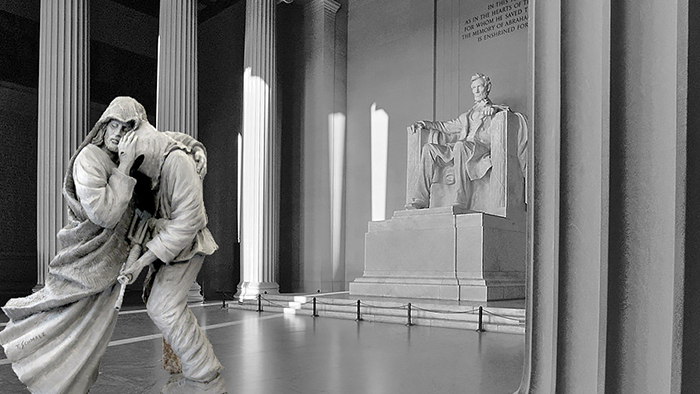
We sometimes fail to see what Jesus is saying within the context of his overall message. Jesus, tells us to “be perfect, just as your heavenly Father is perfect.” It is important to remember that he prefaces that statement with examples of loving others. What is this love that calls us to love our enemies? Could this be the perfection he is asking us to embrace, the perfection of love? Aileen O’Donoghue writes that her “enemies” are rarely true enemies; they’re just usually people who either are difficult to get along with or who annoy me. And yet, when I hear this passage, I think, Really? Jesus wants me to love that jerk? Yes, he does. It’s hard at first to even consider it. However, if someone is critical and irritable to others on the outside, chances are that he or she is also critical and irritable to themselves on the inside. Even braggarts, who seem self-satisfied and egotistical, are probably much more insecure than they will ever let on. Why else would they need to point out their apparent superiority? Thinking about this, and recognizing that happy, well-adjusted people are rarely difficult, has become my way, when I’m being difficult, of finding the compassion necessary to start transforming irritation to love and prayer–for others and for myself. Fr. James McKarns closes our reflection by noting that love implies that we respect others and even nurture a string positive attraction to them. How is this balanced with the abhorrent and repulse nature of those who kill innocent people, like Osama bin Laden. He tells us that what helped him apply Jesus teaching was the second part about praying for those who persecute us. We are not expected to totally excuse all offensive acts or invite our offenders to lunch, but if we sincerely pray for someone, then we are offering Christian love. George Watson, a famous post-Civil War evangelist, said, “When the heart is made pure, it is then in condition to be filled with the Holy Spirit, the abiding Comforter, whose presence floods the soul with unmixed love.” The perfection we are asked to pursue is all about perfecting the indwelling love of the spirit. This should be our daily effort; to empty ourselves so we can be filled with his love, to then go and share it with others.
“Give to the one who asks of you” Matthew 5:42

I recall a time when I was traveling with some business associates and stopped to give a panhandler the few dollars I had in my wallet. As we walked away, one of the associates looked at me and said, “That was a stupid thing to do. Don’t you know that you’re just feeding their drug or alcohol addiction?” I replied, “How do you know that?” His quick response was, “Everyone knows that.” I remember leaving that incident thinking that I had done something wrong. Thomas Merton said that it is hard to see what to do in these situations “because we are too distracted by our own problems and are still too caught up in our own neuroses, ambitions, woundedness and false values to be of much help to the poor.” Jesus had a heart for the least, the lost and the forgotten. In imitation of him, we should focus our lives on living a life “full of gratitude, celebration, deep friendship, and contemplative prayer.” When these elements are in our lives, graciousness automatically spills over so that when the less fortunate cry out, we know what to do.
“It is like a mustard seed” Mark 4:31

The Kingdom of God, as Jesus assures us, is about mustard seeds, about small, seemingly unimportant things, but which, in the long run, are the big things. Not much in our world today helps us to believe that. Fr. Ron Rolheiser writes that almost everything urges us to think big and to be careless about small things. We are given The impression that what is private in our lives is minor and unimportant. Likewise, what is played out on the smaller stage of life – in the more domestic areas of family, marriage, and our exchanges with our neighbors and colleagues – is also deemed to be of little consequence. The big stage is what is important. What mark have you left in the world? What have you achieved on the bigger stage? What has been your involvement in the great causes? Nobody cares about your little life! Private morality, private grudges, the little insults that we hand out, our many angers and resentments, the small infidelities within our sexual lives, the many little acts of selfishness, and, conversely, the small acts of sacrifice and selflessness that we do and the little compliments that we hand out, these are not valued much in our culture. As a song suggests: “Our little lives don’t count at all!” I remember a young man, very dedicated to social causes, once asking me: “Do you really think that God gives a damn whether you say your morning prayers, or whether you hold some small grudge, or whether or not you are always polite to your colleagues, or whether or not you are always chaste sexually? That’s petty, small, private stuff that deflects attention from the bigger moral issues.” Well, I believe that God does care and cares a great deal because, in the end, we care, and small things, as these stories illustrate, affect a great deal. Small acts of cruelty or kindness leave their effect long after the impact of events of seemingly much more significant importance has passed away. There is, I believe, a profound lesson in this. Who won the Nobel Prize for literature two years ago? Who won the Academy Awards last year? Who won the Super Bowl three years ago? Who won the World Cup 10 years ago? It’s funny how quickly we tend to forget these things. It is also curious what we do not forget. We tend to forget soon who won such or such an award, or who starred in such and such a movie or play. But we remember, and remember vividly, with all the healing and grace it brought, who was nice to us all those years ago on the playground at school. We remember who encouraged us when we felt insecure. Conversely, we also remember, and remember vividly, with all the scars it brought, who laughed at us on the playground, made fun of our clothes, or who called us stupid. Falls come, winters come, springs come, summers come and go, and sometimes, the only thing we can remember from a given year is some tiny mustard seed of cruelty or kindness.
“Let your Yes mean Yes, and your No mean No” Matthew 5:37

In today’s Gospel reading from Matthew, Jesus speaks to the importance of truth in our conversations as He lays down the criterion that his disciples must apply in this connection. It is based on re-establishing mutual trust, nobility and sincerity. Servant of God Dorothy Day writes that when she became a Catholic, it never occurred to her to question how much freedom she had or how much authority the Church had to limit that freedom. “I had reached the point where I want to obey. I was like the child in the New Yorker cartoon (I was nearly 30 years old) who said, ‘do I have to do what I want to do today?’ I was tired of following the devices and desires of my own heart, of doing what I wanted to do, what my desires told me I want to do, which always seem to lead me astray. Obedient to my conscience, I became a Catholic, was conditionally baptized and said, ‘I do believe,’ to the great and solemn and beautiful truths proposed to me. For the next five years no big problems came up of obedience. The church held up a tremendous ideal for the follower of Christ, and no matter how many times one failed, fell flat on one’s face, one might say, the church, holy mother Church, was there with her Sacraments of Penance and holy Eucharist to reassure and forgive and sustain and nourish one.”
“You have heard that it was said” Matthew 5:27

In our reading today from the Gospel of Matthew, Jesus calls us to go beyond external conformity to the requirements of the law and imitate the perfect love of the heavenly Father, who is love himself. The preeminent teaching was the commandment to love God. This is what the Jewish people often highlight as the foundation for their faith. Under the leadership of Moses, the people of ancient Israel left the oppression of slavery in Egypt. Moses led them through their long time in the wilderness to help shape them into the values of the kingdom of God; values of justice, peace, and love. Deuteronomy speaks to the freedom that is central to the identity of the people of God. This included the external freedom from the Egyptians’ tyranny and also their internal state of freedom. We can relate to that. We can be free on the outside, but our internal state could be enslaving us to thoughts, feelings, and actions that harm us. The key to the Israelite’s freedom was focusing on their deep desire for God. If other things got in the way, they would lose their freedom. If they placed their focus on power, possessions, or esteem, they would be enslaved by these false idols. Freedom is not about chaos and doing whatever comes to one’s mind. Freedom is about learning to live through an inner sense of peace, that place of deep love within the heart. As we discussed in some of the earlier posts this past week, when Jesus was asked about the most important commandment, he highlighted the command to love God and to love neighbors. All the other commandments about not stealing, killing, or cheating are rooted in one’s love for God. I want to share this fantastic quote about loving God by Fr. Pedro Arupe, the Spanish Jesuit priest who served as the twenty-eighth Superior General of the Society of Jesus. “Nothing is more practical than finding God, than falling in Love in a quite absolute, final way. What you are in love with, what seizes your imagination, will affect everything. It will decide what will get you out of bed in the morning, what you do with your evenings, how you spend your weekends, what you read, whom you know, what breaks your heart, and what amazes you with joy and gratitude. Fall in Love, stay in love, and it will decide everything.”