
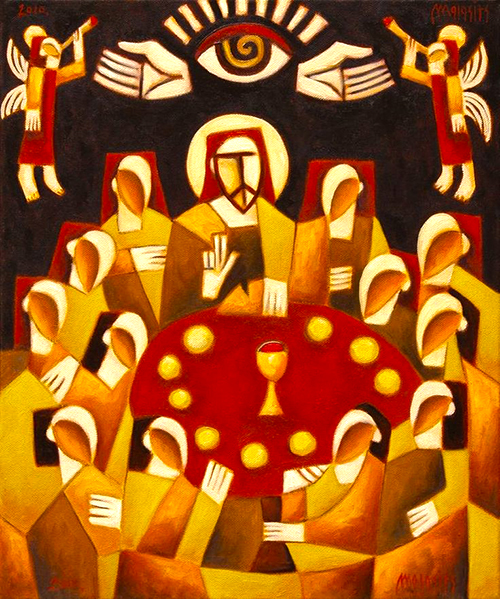
“Where is my guest room where I may eat the Passover with my disciples?” Mark 14:14

Our Gospel reading this Sunday, in which we celebrate Corpus Christi, comes from Mark, and describes the setting that established the foundation of the Eucharistic celebration. Jesus took the bread, and as he was about to break it for his disciples, he said something that they had never heard before. They must have lifted their heads and turned toward him in surprise. For he told them that this was not just bread being broken for them; it was his own body. And when he prepared to pass the cup of wine to them to be consumed, he interpreted this also as his blood, which would soon be poured out for them. Fr. Demetrius Dumm, from his Praying the Scriptures, writes that these words of Jesus are the most important words that he ever spoke to his disciples. This was the last time that he would have an opportunity to speak to them, and so he summed up all his teaching, and indeed the very meaning of his life among them, as “Body-broken-for-them” and “Blood poured out for them.” In other words, he was giving them the essence of God’s revelation, embodied in himself, that human success and happiness would come only to those who join him in “breaking” their bodies and “pouring out” their blood for others. This does not mean that the followers of Jesus must literally break or sacrifice their bodies for the sake of others. But it does mean something that may be even more difficult, and that is what Paul had in mind when he wrote in his Letter to the Philippians:

Do nothing from selfish ambition or conceit, but in humility regard others as better. Let each of you look not to your own interests but to the interests of others. Let the same mind be in you that was in Christ Jesus.

The Gospel reading makes it clear that the path to salvation, ultimate freedom, and joy for us humans is through unselfish love. There is no greater prayer than to respond to God’s love, as expressed in Jesus’ self-giving, by acknowledging that our gratitude can never be enough for what he has done for us. We must commit ourselves, to the best of our abilities, to love and serve others, knowing that this is how we will also partake in his resurrection glory.
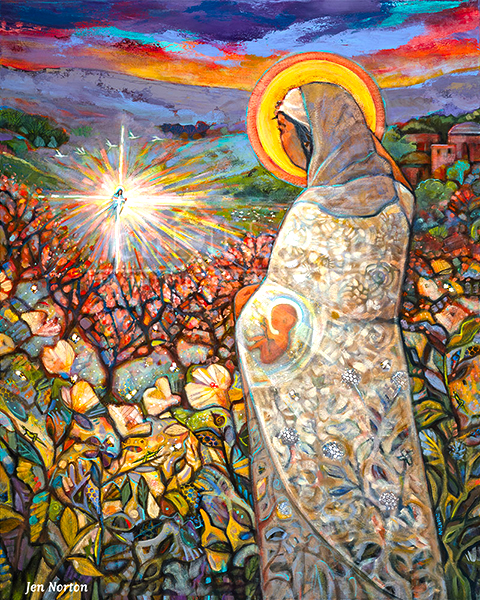
“Blessed are you who believed” Luke 1:45

To confirm something is to verify it as being true or accurate. It means putting to rest any doubts you may have about a particular matter. Looked at in this way, today’s feast of the Visitation shows three different ways that God confirmed Mary’s calling to her. First, the Visitation tells us how Mary and Elizabeth—both miraculously made pregnant—offered an emotional confirmation to each other. You can imagine these two women talking excitedly about all that has happened to them: one who conceived despite her old age and the other who conceived without human intervention. You can see them sharing their joys, concerns, and hopes for their children. Second, the Visitation describes a physical confirmation when the baby John leaped into his mother’s womb. Luke called this a leap of joy, indicating that it went far beyond a baby’s normal kicking. That leap confirmed for Mary how special her baby was. Third, the Visitation gave Mary a prophetic confirmation. Elizabeth called Mary “the mother of my Lord,” confirming that Mary’s child was more than just an ordinary baby. Luke also tells us that Elizabeth said these words because she was “filled with the Holy Spirit.” Today, Jesus wants to confirm his promises in your heart. He wants to bless you just as he blessed Elizabeth, Mary, and John at the Visitation. Perhaps his blessing will spark you to leap toward him in faith. Maybe it will confirm his presence in you. Or maybe it will move you with excitement and a desire to share your blessing with the people around you. Most of all, Jesus wants to confirm that he is working wonders in you, even if it doesn’t feel like it. He wants to let you know that he is pleased with you, and he is happy to keep working in you, doing whatever it takes to build up your faith. So, relax today and listen for his voice in your heart. Let him tell you, “Blessed are you who believed!”

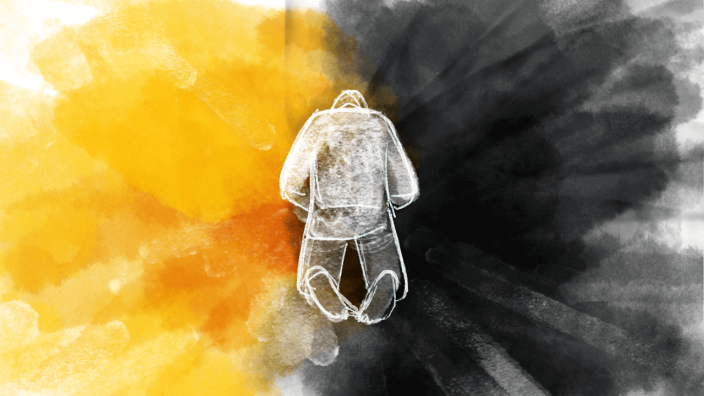
“keep away from worldly desires that wage war against the soul” 1 Peter 2:11

We need, Fr. Ron Rolheiser writes, to be given permission to accept as God-given that imperialism inside our soul, that divinely placed fire, even as we need always to be careful never to trivialize its power and meaning. Some comments that cause one to pause and think deeply about our restlessness:

St. Augustine (You have made us for yourself, Lord, and our hearts are restless until they rest in you.)

Thomas Aquinas (The adequate object of the human intellect and will is all Being); 

Iris Murdoch (The deepest of all human pains is the pain of the inadequacy of self-expression) 

Karl Rahner (In the torment of the insufficiency of everything attainable, we ultimately learn that here, in this life, there is no finished symphony) 

Sidney Callahan (We are made to ultimately sleep with the whole world, is it any wonder that we long for this along the way?)

James Hillman Neither religion nor psychology really honors the human soul. Religion is forever trying to save the soul and psychology is always trying to fix the soul. The soul needs neither to be saved nor fixed; it is already eternal, it just needs to be listened to.

Perhaps today the real struggle is not so much to accept sacred permission to befriend the wild insatiability of the soul. The greater struggle today, I suspect, is not to trivialize the soul, not to make its infinite longings something less than what they are. The soul is imperialistic because it carries divine fire, and so it struggles to breathe freely in the world. To feel and to honor that struggle is to be healthy.

“the word of the Lord remains forever” 1 Peter 1:25

Since the beginning of time, without even making a sound, the Lord has been speaking to us through his Word. God speaks to us through His creative, perfect, generous, and eternal creation. We read from the prophet Isaiah, “The grass withers, the flower fades, but the word of our God remains forever.” This Word is distinct from creation, for he is the creator and has a voice other than our own. Everything else on earth and in heaven will pass away, but the Word of the Lord will always stand. And so, this is our great comfort. For the Word is the one true thing that we can depend on. Not people, not things, not institutions, not even our own selves, but the Word, which is God’s promise of unmerited favor to us in Jesus Christ. The Word of God is powerful. Many words from the Scriptures can reshape the inner self. Henri Nouwen writes, “When I take the words that strike me during a service into the day and slowly repeat them while reading or working, more or less chewing on them, they create new life. Sometimes, when I wake up during the night, I am still saying them, and they become like wings carrying me above the moods and turbulences of the days and weeks.”

“But many that are first will be last, and the last will be first.” Mark 10:31

America first! England first! My country first! My state first! My church first! My family first! Me first! Fr. Rolheiser writes that more and more, we are making ourselves the priority and defining ourselves in ways that are not just against the Gospel but are also making us meaner in spirit and more miserly of heart. What’s to be said about this? If the Gospels are clear on anything, they are clear that all persons in this world are equal in the sight of God, that all persons in this world are our brothers and sisters, that we are asked to share the goods of this world fairly with everyone, especially the poor, and, most importantly, that we are not to put ourselves first, but are always to consider the needs of others before our own. The very definition of being big-hearted is predicated on precisely rising above self-interest and being willing to sacrifice our own interests for the good of others and the good of the larger community. The same is true for being big-minded. We are big-minded exactly to the extent that we are sensitive to the wider picture and can integrate into our thinking the needs, wounds, and ideologies of everyone, not just those of their own kind. On our best days, our hearts and minds are more open, more willing to embrace widely, more willing to accept differences, and more willing to sacrifice self-interest for the good of others. On our best days, we are gracious, big-hearted, and understanding, and on those days, it’s unthinkable for us to say: Me first! We only put ourselves first and let our concerns trump our own goodness of heart on days when our frustrations, wounds, tiredness, and ideological infections overwhelm us. Sadly almost everything in our world today tempts us away for this. We are adult children of Rene Descartes, who helped shape the modern mind with his famous dictum: “I think, therefore, I am!” Our own headaches and heartaches are what’s most real to us and we accord reality and value to others primarily in relationship to our own subjectivity.That’s why we can so easily say: “Me first! My country first! My heartaches first!” But there can be no peace, no world community, no real brother and sisterhood, and no real church community, as long as we do not define ourselves as, first, citizens of the world and only second, as members of our own tribe. Putting ourselves first goes against the Gospel. It’s also a poor strategy: Jesus tells us that, in the end, the first will be the last.

“you attain the goal of faith, the salvation of your souls” 1 Peter 1:9

How do we lose our souls? What does it mean “to lose your soul” already in this world? What is a soul, and how can it be lost? Since a soul is immaterial and spiritual, it cannot be pictured. We have to use abstract terms to try to understand it. Philosophers, going right back to Aristotle, have tended to define the soul as a double principle inside every living being: For them, the soul is both the principle of life and energy inside us as well as the principle of integration. In essence, the soul is two things: It’s the fire inside us giving us life and energy and it’s the glue that holds us together. While that sounds abstract, it’s anything but that because we have first-hand experience of what this means. And since the soul is a double principle doing two things for us, there are two corresponding ways of losing our souls. We can have our vitality and energy go dead, or we can become unglued and fall apart, petrification or dissipation; in either case, we lose our souls. What’s healthy for my soul? This is a legitimate question but also a trick one. We lose our souls in opposite ways, and thus, care of the soul is a refined alchemy that has to know when to heat things up and when to cool things down: What’s healthy for my soul on a given night depends a lot upon what I’m struggling with more on that night: Am I losing my soul because I’m losing vitality, energy, hope, and graciousness in my life? Am I growing bitter, rigid, sterile, becoming a person who’s painful to be around? Or, conversely, am I full of life and energy but so full of it that I am falling apart, dissipating, losing my sense of self? Am I petrifying or dissipating? Both are a loss of soul. In the former situation, the soul needs more fire, something to rekindle its energy. In the latter case, the soul already has too much fire; it needs some cooling down and some glue. After we die, we can go to heaven or hell. That’s one way of speaking about losing or saving our souls. But Christian theology also teaches that heaven and hell start already now. Already here in this life, we can weaken or destroy the God-given life inside us by either petrification or dissipation. We can lose our souls by not having enough fire, or we can lose them by not having enough glue.

“Go, therefore, and make disciples of all nations” Luke 28:19

This short passage, which brings to a close the Gospel of St Matthew, is of great importance. Seeing the risen Christ, the disciples adore him, worshipping him as God. This shows that at last they are fully conscious of what, from much earlier on, they felt in their heart and confessed by their words—that their Master is the Messiah, the Son of God. The Master addresses them with the majesty proper to God: “All authority in heaven and on earth has been given to me.” omnipotence, an attribute belonging exclusively to God, belongs to him: he is confirming the faith of his worshippers; and he is also telling them that the authority which he is going to give them to equip them to carry out their mission to the whole world, derives from his own divine authority. On hearing him speak these words, we should bear in mind that the authority of the Church, which is given it for the salvation of mankind, comes directly from Jesus Christ, and that this authority, in the sphere of faith and morals, is above any other authority on earth. Here Christ also passes on to the apostles and their successors the power to baptize, that is, to receive people into the Church, thereby opening up to them the way to personal salvation. The mission which the Church is definitively given here at the end of St Matthew’s Gospel is one of continuing the work of Christ—teaching men and women the truths concerning God and the duty incumbent on them to identify with these truths, to make them their own by having constant recourse to the grace of the sacraments. When Holy Scripture says that God is with someone, this means that that person will be successful in everything he undertakes. Therefore, the Church, helped in this way by the presence of its divine Founder, can be confident of never failing to fulfil its mission down the centuries until the end of time.

“Let my prayer come like incense before you” Psalm 141

There is a story told about a Jewish farmer who, through carelessness, did not get home before sunset one Sabbath and was forced to spend the day in the field, waiting for sunset the next day before being able to return home. Upon his return home, he was met by a rather perturbed rabbi who chided him for his carelessness. Finally, the rabbi asked him: “What did you do out there all day in the field? Did you at least pray?”  The farmer answered: “Rabbi, I am not a clever man. I don’t know how to pray properly. What I did was to simply recite the alphabet all day and let God form the words for himself.” Fr. Rolheiser writes that when we come to celebrate, we bring the alphabet of our lives. If our hearts and minds are full of warmth, love, enthusiasm, song, and dance, then these are the letters we bring.  If they are full of tiredness, despair, blandness, pain, and boredom, then those are our letters. Bring them. Spend them. Celebrate them. Offer them. It is God’s task to make the words!

“Do not complain, brothers and sisters, about one another, that you may not be judged” James 5:9

Fr. Ron Rolheiser writes today regarding two letters he received. The first letter from a woman said, “I suffer from emotional and mental illness and, in a society like ours, that puts me outside of life. I always feel like I am in exile. Everyone keeps their distance from me, and they seem to actually blame me for being ill as if I could make myself well just by wishing it.” The second letter was from another woman that he knew who said, “I am becoming more realistic about the attitudes that exist both inside of religious community and in the world outside, namely, that any person who has required any kind of psychiatric care is considered forever unstable, unproductive and unsuitable for a life of normal relationships and service.” Christ warns us that health and strength are gifts from beyond and that when we become complacent, smug, and self-sufficient about them, we risk missing the kingdom. The truth is that we, the healthy and strong, are too arrogant and complacent and that we are too unfeeling and too judgmental toward those who struggle. In the end, we are too calloused. We are too full of ourselves; our health and strengths are blinding us to what is a gift. We are self-preoccupied, adolescent, and narcissistic. In that, there is no place for compassion. Not only do we lack empathy and understanding toward these people, but worse still, we blame them for their poverties, as if, as the lady comments, they could get strong and well simply by their own efforts. There is compassion for an attractive personality with cancer but a judgmental attitude toward someone we live with who struggles with emotional cancer. We have compassion for helpless seal pups but callousness toward the unwanted unborn within our own wombs. How can we have become so unfeeling, smug, adolescent, selfish, and full of ourselves to have lost our childlikeness?

“If your hand causes you to sin, cut it off. It is better for you to enter into life maimed than with two hands to go into Gehenna, into the unquenchable fire.” Mark 9:43

Jesus speaks, with incredible bluntness, about cutting off one’s hand and foot and plucking out of one’s own eye. If these things are a block to your salvation, get rid of them, for it is better to enter life maimed than to enter Gehenna with all of your limbs and members. The hand is the organ by which we reach out and grasp things. The soul is meant for union with God, but we have, instead, reached out to creatures, all of our energies, grasping at finite things. The Lord also speaks of the foot. The foot is the organ by which we set ourselves on a definite path. We are meant to walk on the path which is Christ. Do we? Or have we set out down a hundred errant paths leading to glory, honor, power, or pleasure? We are designed to seek after and look for God. Have we spent much of our lives looking in all the wrong places, beguiled by the beauties and enticements of this world? And are we willing to pluck out our eye spiritually, to abandon many of the preoccupations that have given us pleasure? God’s life-giving presence is a gift that is always within us. He remains faithful to us, even when we are unfaithful to him. God leaves us totally free in our relationship with him, but the misuse of our freedom can cause us significant suffering. And so, God asks us to cut out of our lives anything that blocks our ability to receive his love.

HTML Snippets Powered By : XYZScripts.com