
“I have told you this so that my joy might be in you and your joy might be complete” John 15:11

“Joy is the gist of the Christian Good News. Yet only if we open wide our senses will we be able to drink from the source of this joy. Only then will the Good News prove truly good and ever new.” The above quote comes from a book by Benedictine monk, Brother David Steindl-Rast, The Way of Silence: Engaging the Sacred in Everyday Life. One of the takeaways from the book is the connection between the joy Jesus speaks to in today’s reading and gratefulness. Brother David makes the case that most of us go through life missing its true splendor because “We plod along half-blind, half-deaf, with all our senses throttled, and numbed by habituation. How much joy is lost on us? How many surprises do we miss? It is as if Easter eggs had been hidden under every bush and we were too lazy to look for them.” Brother David goes on to say that “joy goes beyond happiness because joy is not dependent on what happens. Joy springs from gratefulness, and gratefulness is the key to living life in its fullness. Here is a little exercise Brother David offers to help us understand gratefulness in a way that will lead to experiencing “complete” joy. Tomorrow morning, before you open your eyes, reflect on the reality that, at this very instant, there are millions of blind people in the world. Linger on that thought for a few moments. Now, open your eyes. You are most likely initially grateful that you can still see. Brother David says, “As soon as we stop taking our eyesight for granted, gifts spring into our eyes which we did not even recognize as gifts before. To recognize a gift as gift is the first step towards gratefulness.” Since gratefulness is the key to joy, we hold the key to joy in our own hands, the key to what we most desire.


“Remain in me, as I remain in you” John 15:4

Henri Nouwen writes that Jesus invites us to abide in his love, which means to dwell with all that we are in him. It is an invitation to total belonging, full intimacy, and unlimited being with him. “The anxiety that plagues me shows that a great part of me is not yet ‘abiding’ in Jesus. My mind and heart keep running away from my true dwelling place, and they explore strange lands where I end up in anger, resentment, lust, fear, and anguish. I know that living a spiritual life means bringing every part of myself home to where it belongs. Jesus describes the intimacy that he offers as the connectedness between the vine and its branches. I long to be grafted onto Jesus as a branch onto the vine so that all my life comes from the vine. In communion with Jesus, the vine, my little life can grow and bear fruit. I know it, but I do not live it. Somehow, I keep living as if there are other sources of life that I must explore outside of Jesus. But Jesus keeps saying, ‘Come back to me, give me all your burdens, all your worries, fears, and anxieties. Trust that with me, you will find rest.’ I am struggling to listen to that voice of love and to trust in its healing power. My true spiritual work is to let myself be loved, fully and completely, and to trust that in that love, I will come to the fulfillment of my vocation. I keep trying to bring my wandering, restless, anxious self home so that I can rest there in the embrace of love.”

“Peace I leave with you; my peace I give to you” John 14:27

When Christ’s story gets to his passion, the very darkness of the world seems to capture many people. This most horrific suffering, death by crucifixion, represents the worst part of our humanness. Yet, in the moments leading up to his suffering, Jesus is not sitting in fear worrying about himself; he is thinking of his disciples and his desire for them to have peace. We will read later in the Gospel of John on how the resurrected Jesus appears to the disciples who were huddled together in a locked room in fear. We know that Jesus came through the locked doors twice and stood amid them and said, “Peace be with you.” Jesus wants all of his disciples to have peace, to be deeply joyful, and to have a faith that is unshakable. Jesus’ life points to his desire for our true happiness. Time and again, he went into all the dark, taboo places and took in God’s light and love so that peace and joy would reign. He desires peace and joy for all—the kind of peace that is not of the world, the kind of joy that is not of the world, and the kind of faith that is not of the world. This Jesus gives freely to all who love and follow him. This promise of Jesus is our hope when we feel overwhelmed by life’s problems. Life offers us many joys, but it has its problematic side, too. We might have to do something that seems beyond our strength. Perhaps we’re burdened by the unrealistic expectations of others. Whatever our difficulties might be, Jesus is with us to help us through them. Our trust in his presence helps us mitigate our fear and strengthen our hope.

“The Advocate, the Holy Spirit whom the Father will send in my name – he will teach you everything and remind you of all that I told you” John 14:26

There is a reality that most Christians do not want to discuss or acknowledge, for it speaks to a topic that many find laughable or embarrassing to acknowledge. There is a great battle being fought each day for us. It is what C.S. Lewis wonderfully explored in ‘The Screwtape Letters’—being captured by the devil. The letters, written by a devil named Screwtape to his nephew, a young devil named Wormwood, are all about Wormwood’s tempting of a young man, the patient, to move away from God—the Enemy as Screwtape calls him—and embrace sin. Wormwood seeks to entice the patient [us] to live a life of sin, a life that separates us from communion with the Lord. It involves conduct on our part that could be described as impure, extravagant, idolatrous, mean-spirited, jealous, or being captured by the addictions of the world – drugs, sex, power, and the like. Wormwood’s secret is that he does this softly, with distraction, doubt, and fear. This is a real battle that Christ intimately knew of and is why he said the Father would send ‘The Advocate’ to be our guide, comforter, and warrior with the Evil One. The Advocate seeks to have our lives permeated with the light of love that is known by charity, joy, peace, patience, endurance, kindness, generosity, faith, mildness, and chastity. This dwelling in spirit is like, as Fr. Ron Rolheiser says, “the movement of giving and receiving in gratitude between two people that creates a warm hearth where others spontaneously come to seek the warmth in a world which offers too little peace, patience, joy, and the like.” The battle is real, and I pray that your life will be intimately connected to the power of the Advocate to fight the distractions of sin. 

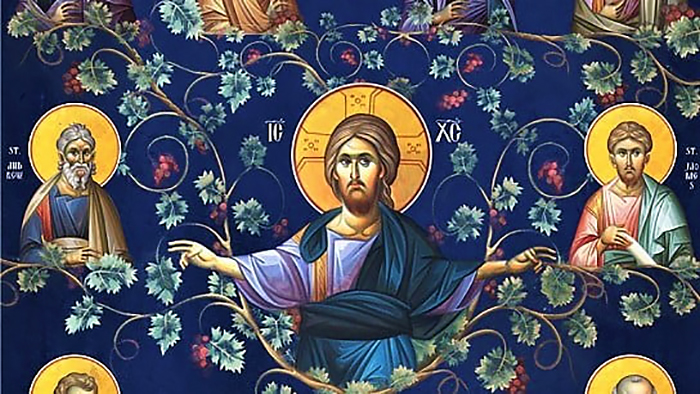
“I am the vine, you are the branches” John 15:5

In our readings this Sunday from Acts, First John, and the Gospel of John, the Church calls us to absolute faith in, and deep love for, God, in Jesus, risen to life after dying on the cross. Jesus is the cornerstone of our faith and our lives. “Let us love, not in word or speech, but in truth and action.” At first glance, human speech is absent from the holiness equation for disciples of Jesus. However, we know that our manner of speech can be a loving expression of our faith and the spirit that dwells within us. Love is expressed in deeds, and speech must never be a substitute for doing the right and often difficult thing. The only way to live out this truth is to be spiritually transformed by abiding in Jesus. The Greek word that John uses means to dwell or remain, and it becomes a metaphor for life in Christ. To abide in Christ throughout your life means doing so, not snippets of time like Sunday morning. The disciple must dwell continually in Christ’s heart, mind, and consciousness. That is how we are nourished spiritually and how we are transformed. John expressed this in the metaphor of the vine. Christ is the vine, providing spiritual sustenance; we are the branches fed continuously through this vine. Our words, thoughts, and actions will flow from this dwelling in Christ, for He is the source of our transformation and holiness. This is not religiosity or piety but a way of life. It is essential to remain connected, for our nourishment ceases once we sever that connection through laziness, sin, inattention, or any other reason. This is not punishment but the consequence of failing to remain connected to our divine source. Only when we abide in Him can we ask and receive whatever is needed to do His will, for in that state, we are not separate or distant from the Lord. The Lord is only as distant as we wish Him to be. The image of the vine also reveals that since we all drink from the same well and are nourished from the same source, we are not separate from one another. When we abide in Him, we become an extension of Christ Himself.

“For so the Lord has commanded us, ‘I have made you a light to the Gentiles, that you may be an instrument of salvation to the ends of the earth.’” Acts 13:47

For centuries, the Israelites had been taught that the Gentiles were unclean. Just entering the house of a Gentile would render a Jew unclean, and he would have to go through a series of steps to become purified again. So, imagine the apostles’ shock when they realized that the Holy Spirit was also calling the Gentiles into the Church. Suddenly, for the first time in history, God was asking them to put aside the traditions of avoiding contact with Gentiles. He told them to embrace the “unclean” new believers and call them brothers and sisters in Christ. That must have been a lot for the Christians to work through, and it’s a testament to the power of the Holy Spirit that the merging of these two peoples went as smoothly as it did. Today, the ideal of a universal Church comprised of people from all over the earth has come to pass. Still, people sometimes complain that Catholics can be overly exclusive. Perhaps we subtly look down on Christians from other traditions. Maybe we avoid making friends with non-Christians. Or perhaps we emphasize the things that separate us from the rest of the world instead of the things that unite us. Pope Francis has made very bold steps to help overcome this division. When he travels, he is often accompanied by two old friends: a Jewish rabbi and a Muslim, both of whom he came to know while he was living in Argentina. These friendships are important to him because they help him keep his horizons wide and welcoming. Just as Pope Francis has made it a point to develop friendships with people of other faiths—or people who have no faith at all—he encourages us to do the same. Consider how you can open your life to people from other backgrounds or traditions today. Approach them with friendship, not the goal of converting them. Appreciate the unique person God has created each of them to be, and let the Holy Spirit bind you together in love.

“I am the way and the truth and the life” John 14:6

The Apostles did not understand what Jesus told them, which is the reason behind Thomas’ question in today’s Gospel reading. St Augustine wrote that the Lord explains that he is the way to the Father because “He needed to say ‘I am the Way’ to show them that they really knew what they thought they were ignorant of because they knew him.” Jesus is the way to the Father through what he teaches, for by keeping to his teaching, we will reach heaven through faith, which he inspires because he came to this world so “that whoever believes in him may have eternal life.” St Francis de Sales, in his book, “Introduction to the Devout Life,” writes that: “Just as children by listening to their mothers, and prattling with them, learn to speak their language, so we, by keeping close to the Savior in mediation, and observing his words, his actions, and his affections, shall learn, with the help of his grace, to speak, to act, and to will like him. Diana Gaillardetz recounts her journey with her son on the ancient pilgrimage across Spain, the Camino de Santiago, and the challenge they often faced in finding the route markers. Missing a sign meant miles of unnecessary travel. But she says they were blessed to find a local town elder when these occasions arose who would simply tell them, “Follow me, and I will take you there.” And so it was that in answering Thomas’s very human question, he provided all of us with our own pilgrimage path. Early Christianity was called “The Way” before it was a church or a formal religion. This ‘Way” is founded upon a deep, trusting relationship with Jesus. Today, we find it too easy to think of the “truth” of Jesus only in the language of formal, doctrinal statements that often say little about the challenges of daily living. Only in our decision to follow Jesus, who is “way” and “life” can the “truth” of Jesus be discovered.

“Cast all your worries upon him because he cares for you” 1 Peter 5:7

Anxiety, like all tensions, eats at us at various levels. More superficially, we worry about many things. Deep down though we are anxious in a way that colors almost everything we do. We nurse the secret belief that if we have the right combination of these in our lives, we will have the substance we need to feel secure and non-anxious. But experience soon teaches us that these things, though good in themselves, are not our cure. We are forever trying to give ourselves wholeness, but we cannot. We cannot self-justify. We cannot make ourselves immortal. We cannot write our own names into heaven. Only love casts out anxiety and, indeed, only a certain kind of love can give us substance. Only God’s love can write our names into heaven. What’s the algebra here? Some years ago, I went on a weeklong retreat directed by Fr. Robert Michel, a French-Canadian, Oblate missionary. He began the retreat with these words: “I want to make this a very simple retreat for you. I want to teach you how to pray in a particular way. I want to teach you how to pray so that in your prayer, perhaps not this week, perhaps not even this year, but sometime, you will open yourself so that in your deepest self you will hear God say to you: ‘I love you!’ Because before you hear this inside you, nothing will be enough for you. You’ll be searching for this and for that, running here and running there, trying every kind of thing, but nothing will ever be quite right. After you hear this from God, you will have substance; you will have found the thing you’ve been looking for so long. Only after you have heard these words will you finally be free of your anxiety. In the Gospel of John, Jesus exhibits very little humanity. Near the end of the Gospel, we have that poignant, post-resurrection meeting between Jesus and Mary of Magdala. Mary, carrying spices to embalm his dead body, goes searching for Jesus on Easter Sunday morning. She meets him but doesn’t recognize him. Supposing him to be the gardener, she asks him where she might find the body of the dead Jesus. Jesus replies by repeating the question with which he opened the Gospel. Then, before she can answer, he gives the deepest answer to that question: He pronounces her name in love: “Mary”.  In that very particularized affirmation of love, he writes her name into heaven. He gives her substance, and he cures her of her anxiety.

“I came into the world as light, so that everyone who believes in me might not remain in darkness” John 12:46

For the eyes, the light of the resurrection is a radically new physical phenomenon. At the resurrection of Jesus, the atoms of the planet were shaken up from their normal physical workings. A dead body rose from the grave to a life from which it would never again die. That had never happened before. Moreover, the resurrection of Jesus was also a radically new light for the soul, the light of hope. Can life be raised back up when it’s in defeat? Can a dead body come out of its grave? Can a violated body again become whole? Can lost innocence ever be restored? Can a broken heart ever be mended? Can a crushed hope ever again lift up a soul?  Doesn’t darkness extinguish all light? What hope was there for Jesus’ followers as they witnessed his humiliation and death on Good Friday? When goodness itself gets crucified, what’s the basis for any hope? In two words, the resurrection. When darkness enveloped the earth a second time, God made light a second time, and that light, unlike the physical light created at the dawn of time, can never be extinguished. That’s the difference between the resuscitation of Lazarus and the resurrection of Jesus, between physical light and the light of the resurrection. Lazarus was restored to his self-same body from which he had to die again. Jesus was given a radically new body that would never die again. The renowned biblical scholar Raymond E. Brown tells us that the darkness that beset the world as Jesus hung dying would last until we believe in the resurrection. Until we believe that God has a live-giving response for all death and until we believe God will roll back the stone from any grave, no matter how deeply goodness is buried under hatred and violence, the darkness of Good Friday will continue to darken our planet. Mohandas K. Gandhi once observed that we can see the truth of God always creating new light simply by looking at history: “When I despair, I remember that all through history, the way of truth and love has always won. There have been murderers and tyrants, and for a time, they can seem invincible. But in the end, they always fall. Think of it, always.”

“The Father and I are one” John 10:30

Fr. Ron Rolheiser writes that “perspective is everything.” When it’s lost, headaches and heartaches set in, take root and begin to dominate our lives. When we lose perspective, everything is reduced: the wide horizon, the depth of our minds, the compassion of our hearts, the enjoyment of our lives, and the consolation of our God. When perspective is lost, the world turns upside down: contentment gives way to restlessness, humility to ambition, and patience to a hopeless pursuit of a consummation, renown, and immortality that this life can never give. To have perspective, I must be praying, mystically feeling the other world, and content enough in my anonymity to take my place, but no more than that, among others, as one small but integral member of the billions of men and women who have walked, and will walk, the earth and will, one day, be presented by Christ to his Father. It is not easy to keep perspective and to claim no more, and no less, than my true place in history. When my own prayer and mysticism are too weak for me to properly do this, one of the things I can still do is to stay in touch with those who have kept things in perspective. One of the people who helped me with this is Pierre Teilhard de Chardin, the French scientist/priest/mystic/philosopher who died on Easter Sunday in 1955. Like the rest of us, his life, too, had its share of hurts, ambitions, cold, lonely seasons, and obsessions. He spent most of his life unsure that anyone really understood him. But, this is where he is rare; he invariably was able to put things into perspective, to regain the wide horizon, and to see things, no matter how bad they appeared on the surface, as making sense in Christ. Because of this perspective, he was a gifted man, gifted not just with extraordinary insight but also with exceptional joy. He could see God in a stone. A chip of rock in the desert or an opera in Paris or New York—both held equal potential for delight. The simple pleasures of life, the elementary act of looking at the world and feeling its elements—the weather, the soil, the sun, the very dust could give him a joy bordering on ecstasy. He could love deeply, and he could also let go, and this letting go was what saved him from the always-present fear, ambition, and loneliness that so often asphyxiates me. He was able to keep things in perspective, so he didn’t need to dwell on past hurts, on present loneliness, and on future fears.

HTML Snippets Powered By : XYZScripts.com