
“For if this endeavor or this activity is of human origin, it will destroy itself.” Acts 5:38

In Walker Percy’s 1971 novel “Love Among the Ruins,” the central character is a psychiatrist named Tom More. More is a Roman Catholic who no longer practices his faith, although he still believes. He describes his situation as follows: “I believe in God and the whole business, but I love women best. Music and science are next, whiskey is next, God is fourth, and my fellowman hardly at all. Nevertheless, I still believe.” Fr. Rolheiser writes that the First Commandment and an overall theology of God teach that God is primary, always. This may never be ignored, but we also know that God is wise and trustworthy. Yet God did not make us with powerful proclivities that instinctually and habitually focus us on the things of this world and then demand that we give him the center of attention all the time. I know a man, a writer, who has been lovingly and scrupulously faithful to his wife through more than forty years who, by his own admission, has a crush on a different person every other day. This hasn’t threatened his marriage. Admittedly though, but for a strong spirituality and morality, it could. God gave us a nature that is affectively wild and promiscuous. God expects us to be responsible for how we act inside that nature, but, given how we are made, the First Commandment may not be interpreted in such a way that we should feel guilty whenever God is not consciously or affectively number one in our lives. God doesn’t demand to be the center of our conscious attention all the time. Like a good spouse, what God asks is fidelity. There are times when we are called to make God the conscious center of our attention; love and faith demand this. However, there will be times when, affectively and consciously, God will take fourth place in our lives – and God is mature and understanding enough to live with that. But the more deeply needed understanding is the question we must ask ourselves: what ultimately are we infatuated with and longing for when our focus is on other things rather than on God, knowing in the depth of our soul that even in that, it is God we seek?


“The one who comes from above is above all” John 3:31

The story of a priest and his mother draws us closer to understanding how being born from above can free our lives. The priest’s mother, widowed sometime before his ordination, lived in the same parish where he had been assigned to minister. It was a mixed blessing; it was nice to see her every day in church, but she, widowed and alone, began to lean heavily upon him in terms of wanting his time. He, the dutiful son, now had to spend all his free time with his mother, taking her for meals, taking her for drives, and being her one vital contact with the world outside the narrow confines of the seniors’ home within which she lived. During their time together she reminisced a lot and not infrequently complained about being alone and lonely. But one day, on a drive with her, after a period of silence, she said something that surprised him and caught his deeper attention: “I’ve given up on fear!” she said, “I’m no longer afraid of anything. I’ve spent my whole life living in fear. But now, I’ve given up on it because I’ve nothing to lose! I’ve already lost everything: my husband, my youthful body, my health, my place in the world, and much of my pride and dignity. Now I’m free! I’m no longer afraid!” Her son, who had only been half-listening to her for a long time, began to listen. He began to spend longer hours with her, recognizing that she had something important to teach him. After a couple of more years, she died. But, by then, she had been able to impart to her son some things that helped him understand his life more deeply. “My mother gave me birth twice; once from below, and once from above,” he says. He now understands something that Nicodemus couldn’t quite grasp. We are not self-sufficient, which means genuinely recognizing and living out our human dependence upon the gratuitous providence of God. To do that is to be born from above. Fr. Raymond E. Brown puts it this way: To be born again from above means we must, at some point in our lives, come to understand that our life comes from beyond this world, from a place and source beyond our mother’s womb, and that deeper life and deeper meaning lie there. And so we must have two births, one that gives us biological life and another that provides us with eschatological life. Nicodemus couldn’t quite get past his instinctual empiricism. In the end, he didn’t get it. Do we?

“God did not send his Son into the world to condemn the world, but that the world might be saved through him” John 3:17

There’s a question about God’s goodness as old as religion itself: How can an all-good God send someone to hell for all eternity? How can God be all-merciful and all-loving if there is eternal punishment? It’s a false question. God doesn’t send anyone to hell, and God doesn’t deal out eternal punishment. God offers us life, and the choice is ours as to whether we accept that or not. These words of truth and clarity come from Fr. Ron Rolheiser and are terribly important to understand as we witness our belief in all that Jesus Christ came to bring into this world. God, Jesus tells us, doesn’t judge anyone. We judge ourselves. God doesn’t create hell, and God doesn’t send anyone to hell. But that doesn’t mean that hell doesn’t exist and that it isn’t a possibility for us. What is hell? The images the bible chooses for hell are arbitrary and vary greatly. Hell is the pain and bitterness, the fire, we experience when we culpably put ourselves outside of the community of life. And it is always self-inflicted. It is never imposed by God. God doesn’t deal with death, and God sends nobody to hell. When Jesus speaks of God, he never speaks of God as dealing with both life and death, but only as dealing with life. Death has its origins elsewhere, as does lying, rationalization, bitterness, hardness of heart, and hell. To say that God does not create hell or send anyone there does not downplay the existence of evil and sin or the danger of eternal punishment; it only pinpoints their origins and makes clear who it is who makes the judgment and who it is who does the sentencing. God does neither; he neither creates hell nor sends anyone to it. We do both. As Jesus tells us in John’s Gospel: “God did not send the Son into the world to condemn the world, but in order that the world might be saved through him. Those who believe in him are not condemned, but those who do not believe are condemned already because they have not believed in the name of the only Son of God. And this is the judgment, the light has come into the world, and the people loved darkness rather than light…I judge no one.” He doesn’t need to.

“so must the Son of Man be lifted up, so that everyone who believes in him may have eternal life” John 3:15

It’s easy to miss the deeper meanings of many texts in John’s Gospel if we’re unaware of the multiple meanings of key words and phrases. So much of what Jesus says has both an earthly and a heavenly level of interpretation. When Jesus speaks, the Gospel characters often first misinterpret his words by assuming an ordinary/physical sense, while Jesus is trying to convey a more profound truth on a religious and spiritual level. Today’s brief Gospel contains four examples of this. When Jesus says, “You must be born from above,” Nicodemus initially thinks Jesus means being “born again” (physical rebirth), while Jesus really means being “born anew” (reborn spiritually). Fr. Felix Just writes that both are possible meanings of the Greek preposition anothen, but Jesus tries to move us beyond the physical to the spiritual level. Similarly, the Greek word pneuma can refer to the “wind” blowing through the trees and the “spirit” moving within us. Moreover, the verb “lifted up” can refer to Jesus’ being physically “hoisted up” onto the cross, but more importantly, it also refers to his being spiritually “exalted” in glory. Finally, “eternal life” is not just a prolongation of “life-without-end,” but more importantly, it refers to a “life with God” that transcends the death of our mortal bodies. The words of Jesus throughout this Easter season will continue to prod us to look beyond our physical lives on this earth and recognize our spiritual destiny, our eternal life with God, as the source of our everlasting joy and gladness.

“But these are written that you may come to believe that Jesus is the Christ, the Son of God” John 20:31

Thomas Merton, in “New Seeds of Contemplation,” writes that it is in the deepest darkness that we most fully possess God on earth because it is then that our minds are most truly liberated from the weak, created lights that are darkness in comparison to Him; it is then that we are filled with His infinite Light which seems pure darkness to our reason. In this greatest perfection of faith, the infinite God Himself becomes the Light of the darkened soul and possesses it entirely with His Truth. And at this inexplicable moment, the deepest night becomes day, and faith turns into understanding. It often happens that where there is deep faith, accompanied by true consent of love to God and to His truth, difficulties may persist in the imagination and in the intellect. In a certain sense, we may say that there are still “doubts,” if by that we mean not that we hesitate to accept the truth of revealed doctrine but that we feel the weakness and instability of our spirit in the presence of the awful mystery of God. This is not so much an objective doubt as a subjective sense of our own helplessness, which is perfectly compatible with true faith. Indeed, as we grow in faith, we also tend to grow in this sense of our own helplessness so that a man who believes much may, at the same time, in this improper sense, seem to “doubt” more than ever before. This is no indication of theological doubt at all but merely the perfectly normal awareness of natural insecurity and the anguish that comes with it. It is in the deepest darkness that we most fully possess God on earth because it is then that our minds are most truly liberated from the weak, created lights that are darkness in comparison to Him; it is then that we are filled with His infinite Light which seems pure darkness to our reason. In this greatest perfection of faith, the infinite God Himself becomes the Light of the darkened soul and possesses it entirely with His Truth. And at this inexplicable moment, the deepest night becomes day, and faith turns into understanding.

“Go into the whole world and proclaim the Gospel to every creature” Mark 16:15

In today’s Gospel, we hear Jesus’ last words to His apostles before His Ascension into Heaven, completing His mission on this earth. As He’s about to return to the Father, Jesus tells His apostles to “go into the whole world and proclaim the gospel to every creature.” How important must this be to Jesus and His plan, since these are the words on His mind before He ascends into Heaven! Jesus speaks the same words to us today. The same words He spoke to His apostles before His Ascension, He says to us today: “Go into the whole world and proclaim the Gospel to every creature.” Most of the time, this happens in a subtle way in our everyday lives. Rather than standing on a soapbox on a street corner, we spread the Gospel by using the “most personal gifts that God has placed in our hearts, rather than hopelessly trying to imitate something not meant for us.” We spread the Gospel in our workplaces, in our schools, in our homes, and in our families through our words and actions. In a word, we spread the Gospel through our example, through our Christlikeness. We always spread the Gospel, only using words when necessary. Take a moment today to reflect on this command of the Lord to spread the Gospel to all parts of the world. How are we doing in fulfilling this desire of Jesus? How can we spread the Gospel in our daily lives? How can we show the face of Christ to a hurting world? While we’re reflecting on these questions, let’s take comfort in the fact that Jesus is with us through the whole process of evangelization, as He promised. Take comfort in the Holy Spirit’s presence in the midst of our efforts to spread the Good News. With them at our sides, nothing is impossible.

“Jesus revealed himself again to his disciples at the Sea of Tiberias” John 21:1

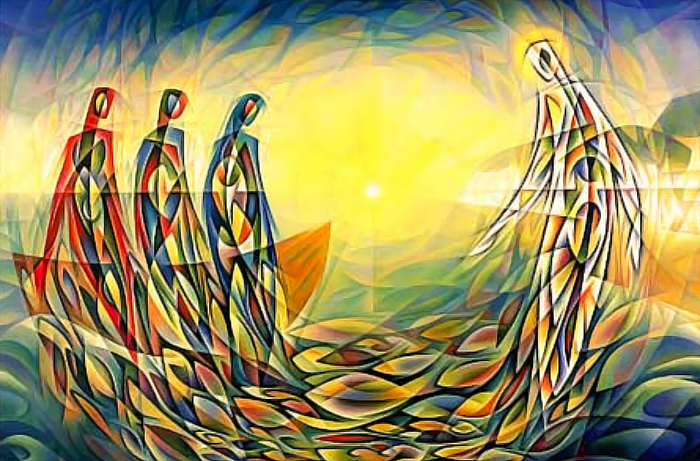
The Risen Jesus appears to seven disciples on the shore of the Sea of Tiberias. Jesus rose bodily from the dead. This is the eminently surprising and unexpected fact that gives birth to Christianity. Bishop Barron writes that the excitement that you can sense on every page of the New Testament comes from this novelty. Why did the Risen Jesus appear only to a few? Why didn’t he make himself readily apparent to anyone who wanted to see? Cardinal Newman commented on this. If Jesus had appeared publicly and indiscriminately to all, the power of the resurrection would have been lessened. Some would believe; others wouldn’t. Some would get it; others wouldn’t. Some would be fascinated, others indifferent. But now we turn to the selected disciples who were invited to breakfast with Jesus at a beach on the Sea of Tiberias. It sounds like the start of a good day. The apostles are out on the water all night and have nothing to show for their efforts. As they row in, someone beckons from the shore. He calls them “children.” He inquires about the fishing. They tell him that it has not been good. He tells them to drop a net. Presto! The net is filled with fish, and they realize that Jesus has called them. He has a fire ready to cook the fish and intends to serve these apostles, whom he has chosen as fishers of souls. This meeting after the resurrection is a lot more than breakfast. It is Jesus assuring his unsteady apostles and us that without God, our nets will be empty; with God, they will be filled, as all things are possible. The Lord knows that sometimes we all need a little reassurance.  

“You are witnesses of these things” Luke 24:48

Jesus rose for every human being, for the whole family of God, from the first Adam to the last Antichrist. He rose not simply for the good and the “nice.” He rose not only for the Virgin Mary, who mothered him, but also for Judas, who betrayed him, and for Peter, who denied him thrice. Importantly, for our presence here today, Jesus rose to life for each of us and for those yet to come. Sr. Bridget Haase writes that we perhaps base our faith on “if only.” If only I had been there when Jesus fed the multitude, I would believe in his power. If only I had seen Jesus heal, I would believe that I could be cured of my spiritual paralysis. If only I could have heard his words of forgiveness, I would accept my own. If only I could have been a witness to these things. Let’s not miss the point. There are people making sandwiches for the homeless on a golfing day, stocking shelves in food pantries on a weekend, and preparing family meals after a day’s work. There are nurses ministering on double shifts, caretakers sacrificing for the elderly, and researchers laboring to find cures for diseases. There are parents forgiving children for past hurts, priests offering absolution in the name of God, and broken relationships being mended. It’s in the real world, not the “if only” one, that we find the presence of the Risen Christ. What a blessing to be witnesses of these things!

“That very day, the first day of the week, two of Jesus’ disciples were going to a village seven miles from Jerusalem called Emmaus” Luke 24:13

Nearly 2,000 years ago, two disillusioned youths consoled each other as they walked that seven-mile stretch of road separating Jerusalem from Emmaus. Fr. Rolheiser writes that they moved slowly, depression having taken the spring from their steps. A double feeling clung to their hearts that day. They were hurting, and there was reason. Their messiah and their dreams had just been crucified. A deep, dark disappointment dampened their spirits. And there was fear. Most of all, there was fear. Not fear that they themselves might be crucified. That prospect loomed more welcome than the thought of going on. Theirs was that more horrible fear, the fear that comes from the realization that perhaps nothing makes a difference after all; maybe our dreams and our hopes point to nothing more real than Santa and the Easter Bunny. The uncrucified Christ had filled them with a dream. With that dream had come a new innocence, freshness, energy, and a feeling absent since they had been children, which, prior to meeting Jesus, they had, long ago, unconsciously despaired of ever feeling again. Dreams are giving way before the caveat of the cynic; faith is daily being displaced by doubt; and perseverance and long-suffering are all but extinct in culture and church of release and enjoyment. Worst of all, there is fear, an unconscious fear whose tentacles are beginning to color every facet of life. It is the fear that perhaps our Christian hopes and dreams point to nothing beyond our own hopes and dreams. Perhaps faith is, after all, only a naiveté. Isn’t Christ as dead as he was on Good Friday? Who, save perhaps for a few good thieves, is still turning to a cross for salvation? Yet there is something else: The dream still clings to us, refusing to let us go. It burns holes in us still, hanging on to us, even when in infidelity and despair, we can no longer hang on to it. Hope is still more real than death. In our hurt, we are struggling for words and grasping for trust. We need to remain on the road to Emmaus. The stranger still stalks that same road. In his company, we need to discuss our doubts, discuss the scriptures, and continually offer each other bread and consolation. At some moment, our eyes will be opened, too. We will understand, and we will recognize the risen Lord. Then, the dream will explode anew like a flower bursting in bloom after a long winter. We will be full of a new innocence. Easter Sunday will happen again.

“I have seen the Lord” John 20:18

When Mary fell on Jesus’ feet, he resisted her embrace, “do not cling to me.” Every time I read these words, my heart breaks for Mary. She had been through so much, having witnessed the betrayal of her dear rabbi, followed by the mock trial and the horrific scourging, the long walk to Golgotha, and the brutal hours at the foot of the cross. Could she not be allowed to embrace her resurrected Lord? Scholars and commentators have mused over this strange scene, but Fr. Ronald Rolheiser sees the Paschal mystery in play. The process of transformation is available to all of us who are willing to die to our ideas and certainties, what we might experience as physical realities, and enter the mysterious new life of the resurrected Jesus. If we review our lives, most of us can name some painful losses along the way. Whether it comes in the form of death or disease, we endure broken dreams and disappointments, each of which is a genuine loss. Will we find resurrection and new life on the other side? Only if we refuse to cling to the life we knew before. If Mary were to receive her Lord and his resurrection, she would need to release the physical presence of Jesus of Nazareth. She could not cling to Jesus as she had known him. She had to let him go. Only then could she embrace her own calling. Empowered by the call of her master, she left the garden for a final time that day to tell the disciples that she had seen Jesus alive! Jesus commissioned her as the first preacher and proclaimer of the Good News of his resurrection.

HTML Snippets Powered By : XYZScripts.com