
“The Lord is kind and merciful” Psalm 103

Fr. Ron Rolheiser writes that all around us, we can see nature teeming with everything: prodigal, fertile, overabundant, wasteful. Why else do we have 90% more brain cells than we need, and why else is nature scattering billions of seeds of virtually everything all over the planet every second? And if life is so extravagant, what does this say about God, its author? Dictionaries define “prodigal” as “wastefully extravagant and lavishly abundant.” That certainly describes the God that Jesus incarnates and reveals. God, as we see in both nature and in scripture and know from experience, is over-generous, over-lavish, over-extravagant, over-prodigious, over-rich, and over-patient. If nature, scripture, and experience are to be believed, God is the absolute antithesis of everything that is stingy, miserly, frugal, narrowly calculating, or sparing in what it doles out. God is prodigal, and so are the chances God gives us. Sr. Margaret Halaska once captured this wonderfully in a poem she entitled Covenant:

The Father knocks at my door, seeking a home for his son:
Rent is cheap, I say
I don’t want to rent. I want to buy, says God.
I’m not sure I want to sell,
but you might come in to look around.
I think I will, says God.
I might let you have a room or two.
I like it, says God. I’ll take the two.
You might decide to give me more some day.
I can wait, says God.
I’d like to give you more,
but it’s a bit difficult. I need some space for me.
I know, says God, but I’ll wait. I like what I see.
Hmm, maybe I can let you have another room.
I really don’t need that much.
Thanks, says God, I’ll take it. I like what I see.
I’d like to give you the whole house
but I’m not sure –
Think on it, says God. I wouldn’t put you out.
Your house would be mine and my son would live in it.
You’d have more space than you’d ever had before.
I don’t understand at all.
I know, says God, but I can’t tell you about that.
You’ll have to discover it for yourself.
That can only happen if you let him have the whole house.
A bit risky, I say.
Yes, says God, but try me.
I’m not sure –
I’ll let you know.
I can wait, says God. I like what I see.


“The stone that the builders rejected has become the cornerstone” Matthew 21:42

The parable in today’s gospel of the wealthy landowner who sends his servants out to collect the produce from his tenant farmers is a cautionary tale about what can go wrong when we try to build things on our own— even the kingdom of God. At the same time, it is a great consolation to know that the Lord is not stymied by our rejections. One might think this is just another example of Jesus facing off against the scribes and Pharisees, the religious authorities of his day. But there is something there for all of us, regardless of our canonical station in life. We, too, can get it wrong, can reject what should be embraced, can drive off messengers whose messages we don’t like. Our hope, finally, is only in the Lord, who makes a firm foundation for our lives, even out of something we initially rejected. The father in the story fails to fathom the deep resentment his tenants hold against his family. “They will respect my son,” he assumes, but they do not. The greedy tenants kill the man’s beloved son to gain his inheritance. Bishop Robert Barron notes that when God sent his son to us, we killed him. “This is the insane resistance to God’s intentions, which is called sin. One of the most fundamental spiritual mistakes we can make is to think that we own the world. We are tenants, entrusted with the responsibility of caring for it, but everything that we have and are is on loan.” That brings us appropriately back to our Lenten journey and the sobering reality that our lives are not about us.

“I, the Lord, alone probe the mind and test the heart” Jeremiah 17:10

Sister Joyce Rupp writes that this past year, she has become more aware of the scenarios that crowd and clutter her mind, whose imaginary settings she conceives of what someone might be thinking, feeling, or planning to do. “These scenarios waste a lot of my energy that could be spent on something worthwhile. The more I intentionally send those mental judgments on their way, the more quickly I become alert to them when they zoom into my mind. It becomes increasingly easy to boot them out with an inner smile as I say to myself, ‘Oh, here is my six thousand and five hundredth scenario.’ The word spoken to Jeremiah strengthens my resolve to recognize that I have neither the ability nor the right to ‘probe the mind and test the heart’ of another with my mental ruminations.” Fr. Rolheiser reminds us that in these times of mental ruminations, God alone seeks to know what is in the deepest depth of our hearts and minds through prayer. Lifting mind and heart to God means lifting up, at any given moment, exactly what’s there and not what, ideally, might be there. When you go to pray, lift up what’s inside of you at that moment. If you are bored, lift up that boredom; if you are angry, lift up your anger; if you are tired, lift up that tiredness; if you feel selfish, don’t be afraid to let God see that. We need to “pray always” by doing everything out of that kind of awareness. Rabbi Abraham Heschel points out how, in prayer, the great figures of scripture did not always easily acquiesce to God and say: “Thy will be done!” They sometimes fought bitterly and said: “Thy will be changed!” That can be a good prayer. It lifts the mind and heart to God.

“The Son of Man did not come to be served but to serve and to give his life as a ransom for many” Matthew 20:28

Thomas Kempis writes in The Imitation of Christ that there will always be many who love Christ’s heavenly kingdom, but few who will bear his cross. Jesus has many who desire consolation but few who care for adversity. He finds many to share his table, but few who will join him in fasting. Many are eager to be happy with him; few wish to suffer anything for him. Many will follow him as far as the breaking of bread, but few will remain to drink from his passion. Many are awed by his miracles, and few accept the shame of his cross…Decide then, like a good and faithful servant of Christ, to bear bravely the cross of your Lord. It was out of love that he was crucified for you. Drink freely from the Lord’s cup if you wish to be his friend. Leave your need for consolation to God. Let him do as he wills. On your part, be ready to bear sufferings and consider how in these sufferings lies your greatest consolation. The sufferings of this life are not worthy to be compared with the glory to come…Realize that to know Christ you must lead a dying life. The more you die to yourself, the more you will live unto God. You will never enjoy heavenly things unless you are ready to suffer hardship for Christ. Nothing is more acceptable to God, nothing more helpful for you on this earth. When there is a choice to be made, take the narrow way. This alone will make you more like Christ.

“Whoever exalts himself will be humbled; but whoever humbles himself will be exalted” Matthew 23:12

Millions of people, particularly in the Western world, are Christian in name, come from Christian backgrounds, are familiar with Christianity, and believe that they know and understand Christianity but no longer practice that faith in a meaningful way. They’ve heard of Christ and the Gospel, even though they may be overrating themselves in their belief that they know and understand what these mean. No matter. Whatever their shortcomings in understanding a faith they no longer practice, they believe they’ve already been evangelized and that their non-practice is an examined decision. Their attitude toward Christianity, in essence, is: I know what it is. I’ve tried it. And it’s not for me! And so it no longer makes sense to speak of trying to evangelize such persons in the same way as we intend that term when speaking of taking the Gospel to someone for the first time. It’s more accurate precisely to speak of a new evangelization, of an attempt to bring the Gospel to individuals and to a culture that has already largely been shaped by it, is in a sense over-familiar with it, but hasn’t really, in fact, examined it. The new evangelization tries to take the Gospel to people who are already Christian but no longer practicing as Christians. How to do that? How do we make the Gospel fresh for those who it has become stale? How do we, as G. K. Chesterton put it, help people to look at the familiar until it looks unfamiliar again? How do we try to Christianize someone who is already Christian? Fr. Ron Rolheiser writes that there are no simple answers. We have already been trying to do that for more than a generation. Anxious parents have been trying to do this with their children. Anxious pastors have been trying to do that with their parishioners. Anxious bishops have been trying to do that with their dioceses. Anxious spiritual writers, including this one, have attempted to do that with their readership. And an anxious church has been trying to do that with the world. What more might we be doing? In my view, we are in for a long, uphill struggle that demands faith in the power and truth of what we believe in and a long, difficult patience. Christ, the faith, and the church will survive. They always do. The stone always eventually rolls away from the tomb, and Christ always eventually re-emerges, but we, too, must do our parts. Let’s start by working at winning over hearts, not hardening them.

“For the measure with which you measure will, in return, be measured out to you.” Luke 6:38

Dr. Carolyn Y. Woo writes that getting older has the benefit of letting time and experience help us better understand certain things that puzzled us earlier. “Today’s Gospel used to trouble me in the way it seems to set a condition for God’s unconditional love and boundless mercy. Worse is that the condition is us: our own capacity to forgive and give to others. We all know how limited that is. From an unlikely place, I picked up an insight that helped me approach these three verses differently. In management literature, there is a concept called absorptive capacity. Organizations have different capacities—prior experiences, skills of their people, culture, attitude, commitment, and discipline—to absorb learning and undertake improvement. God’s gifts are, of course, boundless and unconditional. But our capacity to receive and absorb needs cultivation. When our life is cluttered with things, worries, resentment, bitterness, and busyness, there is not much room to receive. More importantly, God does not give us things, even if our blessings often lead us to acquire badges, buildings, and bling. God does give us power: the power to accept our own sinfulness, to acknowledge this in others. Still, we believe in the inexhaustible goodness in us and others because this is what it means to be made in God’s image. God’s power within us is like a current that, when turned on, illuminates and energizes. When we unplug from others in negative judgment and self-centeredness, we disconnect ourselves from God’s power. When we plug in to give and forgive, we invite the flow of God’s love and mercy into us. What I take away from today’s Gospel: Give to others, take from God.”

“I will walk before the Lord, in the land of the living” Psalm 116

If Christ was born into the world to redeem it, why doesn’t our world look more redeemed? Why is our world still full of loneliness, anxiety, betrayals, sickness, poverty, violence, war, and death? What did Christ’s birth into our world change? Fr. Ron Rolheiser writes that these aren’t irreverent questions but the right ones. Only in struggling to answer them do we begin to understand the mystery of Christ more deeply. The fact that Christ is born into our world does not mean that those who believe in him will be spared the pain, loneliness, seasons of sickness, heartaches, betrayals, anxieties, fears, and humiliations that afflict everyone else. Faith offers no one an escape from pain. Moreover, believers, like unbelievers, will suffer too the darkness of doubt, the painful fear that the heavens are empty. Faith in Christ doesn’t remove any of the pains inherent within the human condition, including the pain of doubting God’s existence. Faith promises no magic pass-cards. So how can we say that “God is with us” when mostly it feels like God isn’t there for us? Generally, we struggle to feel God in the present moment, to see God’s face in the here and now. In the present, God often seems absent. Yet, when we turn around and look back on our lives, when we look back on our story, we more easily see how God has been there all along and how we have walked in a divine presence, protection, guidance, and love that were imperceptible at the time but are apparent in retrospect. We see God more clearly in our past than in our present. This can help us understand how Christ is present to us, even when it doesn’t always feel like it. Faith doesn’t promise us a ladder to crawl out of the pains of life; it promises a friend to walk with us through those pains. Mostly, though, it’s only when we look back on our lives that we see that this friend has always been there.

“Blessed are they whose way is blameless, who walk in the law of the LORD” Psalm 119:1

Our first reading today comes from Deuteronomy, which is written and edited in the form of a covenant treaty between God and the people but is also a speech by Moses in which he recalls all the covenant benefits that God has done for Israel in the desert. On their part the people promise to observe YHWH’s statutes and edicts with all their heart and with all their soul, and to “walk in his ways, to keep his statutes, his commandments, and his edicts, and to obey him.” YHWH’s offer is unconditional and will never be retracted. They, however, must welcome the offering for it cannot and will not be forced upon them. God is love. God has chosen them. But they must choose “to love” God. Fr. Ron Rolheiser writes: “Inside each of us there’s a deep place, a virginal center, where all that’s tender, sacred, cherished, and precious is held and guarded. …It’s where we unconsciously remember that once, long before consciousness, we were caressed by hands far gentler than our own. It’s where we still sense the primordial kiss of God.” As Christian we have the advantage of living our lives in Christ’s love. This love provides a filter through which we approach the world. We are constantly in the love of Christ, and we extend his grace to the world. Jesus wants to walk with us so we might learn from him to be humble. Jesus promises us rest and an easier burden. Even our hardest burdens become bearable with Christ’s shoulders taking some of the weight. We need the God who knows our pain, meets us in our pain, and redeems our pain. We can live in the presence of the Lord, loving others and sharing God’s grace. That is our mandate every Sunday morning as we go forth from our churches to love and serve the Lord. We can choose to accept Jesus as a companion in life. We can share our burdens and our joys with the one who suffered for us. “Come to me,” he invites us.

“Out of the depths I cry to you, O LORD; LORD, hear my voice!” Psalm 130:1-2

In the musical Les Miserables, there’s a particularly haunting song, sung by a dying woman (Fantine) who has been crushed by virtually every unfairness that life can deal a person.

But there are dreams that cannot be
And there are storms we cannot weather
I had a dream my life would be
So much different from this hell I’m living
So different now from what it seemed
Now life has killed
The dream I dreamed.

Fr. Rolheiser writes that despair has all too often been understood as the one unforgivable sin, the absolute worst state within which one could die. The Psalms tell us that God is particularly close to those who are crushed in spirit and that God will save them. Jesus makes this central to his teaching and ministry. Not only does he have a special affection for those who are broken in spirit, he identifies his presence with their brokenness and assures us that they will enter the Kingdom of Heaven before the rich, the strong, and the powerful. For Jesus, the broken are God’s specially loved little ones. Given that truth, do we really believe that God will send someone to hell who dies crushed in spirit, seemingly without hope? Do we really believe that God would send Fantine to hell? What kind of God would do this? n Mark’s Gospel, just before he dies on the cross, Jesus cries out, My God, My God, why have you forsaken me? Then he hands over his spirit to his Father. In our classic understanding of this text, we generally explain what happened there in this way. Jesus was tempted towards despair, but he found the strength to resist and instead, in hope, surrendered himself to God’s mercy. I suspect that in the end this is what most people who die (seemingly having given up hope) also do, that is, crushed in spirit, they surrender to the unknown – which is God’s embrace. We need to be far more understanding in the judgments we make vis-a-vis despair.

“But who do you say that I am?” Matthew 16:15

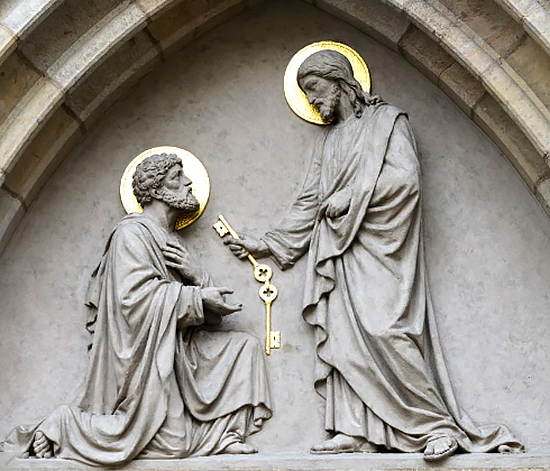
The Catholic Church makes an extraordinary claim that it is through a special charism of the Spirit that Peter and his successors govern the Church. Bishop Barron writes that this has been the cause of division between Catholics and Protestants. What is the focus of Peter’s confession? It has to do with who Jesus is. This is the rock upon which the Church is built. We don’t say for a moment that all of Peter’s practical decisions are right, that everything he says is right. But we are saying that he is right about who Jesus is a man who is also the Son of the living God. And this is the source and ground of the whole operation. Fr. Kenneth E. Grabner writes that the question Jesus asks the disciples, and the one Peter answers is so important that Jesus addresses it to each one of us. The way we answer it reveals what kind of relationship we have with God. Imagine Jesus standing before you now and asking, “Who do you say I am?” How would you answer? For me, Jesus is the One who shows by his words and actions how our lives can be meaningful, full of joy and open to the divine presence that dwells inside of us. Jesus not only shows us, but he is also within us, giving us the ability to imitate what he has shown. No mere human being can do this for us. Such a gift can only be given by God.

HTML Snippets Powered By : XYZScripts.com