“there is something greater than Solomon here… and there is something greater than Jonah here” Luke 11:31-32

Fr. Rolheiser writes that many people think of the name “Jesus Christ” as we think of names like “Susan Parker” or “Jack Smith.”  But that’s an unhealthy confusion. Jesus didn’t have a second name. The word “Christ” is a title which, while it includes the person of Jesus, speaks of something broader than Jesus alone. What’s the difference between “Jesus” and “Christ”? Jesus refers to a concrete person who, though the Second Person within the Godhead, walked this earth for 33 years and is still today someone whom we understand and relate to as an individual person. Christ refers to something more significant, namely, the vast mystery of both creation and salvation of which Jesus, as the Christ, plays the foundational role but which includes the Eucharist, the Christian community, the historic Christian churches, the community of all sincere people who walk this planet, and physical creation itself. Jesus is a person we seek to be in a relationship, in friendship and intimacy with, while Christ is a mystery of which we and all creation are part and within which we participate. So, should we be focused on the teaching of Jesus or the person of Jesus? Are we more focused on Jesus or Christ? In terms of a large over-generalization, we might say that Roman Catholicism and mainline Protestantism have tended to focus more on the teachings of Jesus and the demands of discipleship that flow from those teachings than they have on the person of Jesus himself. In the Evangelical tradition, the emphasis has been and continues to be on the person of Jesus and our individual relationship with him. In fairness, both traditions also include the other dimension. Roman Catholics and mainline Protestants haven’t ignored the person of Jesus, and Evangelicals haven’t neglected the teachings of Jesus, but, in both cases, one has been more central than the other. But Christian discipleship clearly asks for both intimacy with Jesus and attention to what he taught, personal piety and social justice, firm loyalty to one’s own ecclesial family, and the capacity to embrace all others of sincere heart as one’s faith family. Soren Kierkegaard once suggested that Jesus really wants followers, not admirers. That’s spoken as a true mainline Protestant. Evangelicals wouldn’t disagree but would argue that Jesus really wants an intimate relationship with us. The earliest preachers of the Gospel would agree with both Kierkegaard and the Evangelicals. We need to proclaim both the message of Jesus and Jesus himself.

“So shall my word be . . . It shall not return to me void, but shall do my will, achieving the end for which I sent it.” Isaiah 55:11

Fr. George Maloney writes that Christ has called Christians to see him everywhere as the light of God’s loving presence. We have been made in His image and likeness to grasp boldly the sun in all its brightness so that we may image his light fully to the world. We become God’s creative power as His word tumbles forth from the lips of the Almighty. That word, spoken in the flowers, the trees, birds, animals, the beauties of each new season, the sun, moon, stars, mountains, lakes, and oceans, goes forth. Archbishop Oscar Romero notes that it is very easy to be a servant of the word without disturbing the world by using words that can sound in any part of the world because they belong to no part of the world. A word like that creates no problems and starts no conflicts. What starts conflicts and persecutions, what marks the genuine church, is the word that burning like the word of the prophets proclaims and accuses: declares to the people God’s wonders to be believed and venerated, and accuses of sin those who oppose God’s reign, so that they may tear that sin out of their hearts, out of their societies, out of their laws—out of the structures that oppress, that imprison, that violate the rights of God and humanity. This is the hard service of the word. But God’s Spirit goes with the prophet, with the preacher, for he is Christ, who keeps on proclaiming his reign to the people of all times. Nothing exists or moves toward perfection except by God’s creative power immanently present in all things. “In God, we live, move, and have our being.”

“When did we . . .” Matthew 25:37-39

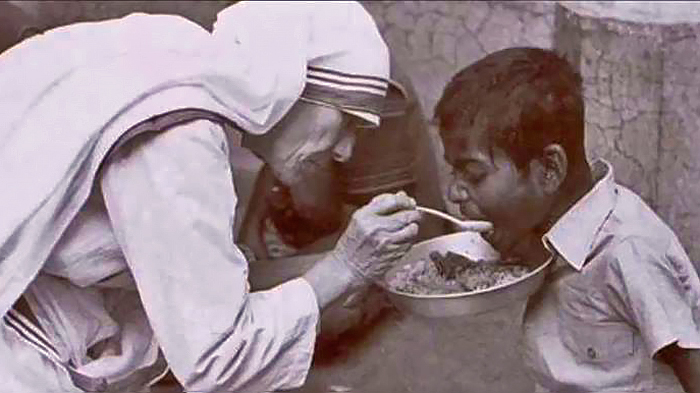
What is our commitment to works of mercy? Ministering to our fellow human beings means ministering to the Lord Jesus himself, whose image we can see in the faces of the poor. Today’s passage from the Gospel of Matthew records speaking to his disciples on the nature of their actions as his followers. Saint Teresa of Calcutta (Mother Teresa) speaks to having the commitment to works of mercy. “In order to help us deserve heaven, Christ set a condition: that at the moment of our death you and I, whoever we might have been and wherever we have lived, Christians and non-Christians alike, every human being who has been created by the loving hand of God in his own image shall stand in his presence and be judged according to what we have been for the poor, what we have done for them.… Christ said, ‘I was hungry and you gave me food.’ He was hungry not only for bread but for the understanding love of being loved, of being known, of being someone to someone. He was naked not only of clothing but of human dignity and of respect, through the injustice that is done to the poor, who are looked down upon simply because they are poor. He was dispossessed not only of a house made of bricks but because of the dispossession of those who are locked up, of those who are unwanted and unloved, of those who walk through the world with no one to care for them.… Do we go out to meet those? Do we know them? Do we try to find them?”

“This is the time of fulfillment. The kingdom of God is at hand. Repent, and believe in the gospel.” Mark 1:15

Christianity is not primarily about ethics, “being a nice person,” or, to use Flannery O’Connor’s wry formula, “having a heart of gold.” Bishop Robert Barron writes that when Christians grant that Christianity’s ultimate purpose is to make us ethically better people, they cannot convincingly defend against the insinuation that if some other system makes human beings just as good or better, Christianity has lost its purpose. Immanuel Kant argued that, at its best, religion is not about dogma or doctrine or liturgy but about ethics. In the measure that the Scriptures, prayer, and belief make one morally good, they are admissible, but in the measure that they lead to moral corruption, they should be dispensed with. The problem with this old and new Kantianism is that it runs dramatically counter to the witness of the first Christians, who were concerned, above all, not with an ethical program but with the explosive emergence of a new world. We can read the letters of St. Paul, the earliest Christian texts we have, and are particularly instructive on this score. The central motif of all of Paul’s letters is Jesus Christ risen from the dead. For Paul, the resurrection of Jesus is the sign that the world as we know it—a world marked by death and the fear of death—is passing and that a new order of things is emerging. The inaugural speech of Jesus, as reported in the Gospel of Mark, commences with the announcement of the kingdom of God and then the exhortation to “repent and believe the good news.” We tend automatically to interpret repentance as a summons to moral conversion, but the Greek word that Mark employs is metanoiete, which literally means “go beyond the mind you have.” In Mark’s telling, Jesus urges his listeners to change their thinking to see the new world that is coming into existence. Anyone with any theological persuasion or no persuasion can be “good people.” But only followers of the risen Christ can witness to an earthquake that has shaken the foundations of the world and turned every expectation upside down.

“Teach me your way, O Lord, that I may walk in your truth” Psalm 86

Fear not; you are inadequate! Fr. Ron Rolheiser writes that that little saying has a deceptive depth. Whether you are a parent, a teacher, a minister, a priest, an advocate for justice, or simply a friend to someone in need, there are countless times when you come face to face with your own inadequacy, when you are helpless in the face of all that you should be doing. At times like that, it is essential to remember that God alone is adequate, that you are not God, and that God is more parent, teacher, minister, priest, advocate for justice, and friend than you are. Obvious as this is, it is not always evident to us, as our history of needless worry, being angry, feeling overly self-important, living with ulcers, and being chronically overextended give ample testimony to. We are instruments, mere instruments, albeit important ones, and, unlike God, we are not adequate to the task. Knowing this should give us some consolation at those times when it seems that, somehow, we should be doing better than we are. Healthy prayer functions paradoxically: On the one hand, it connects us to God and divine energy. Conversely, at the same time, it dissociates us from God by making it clear to us that we are not God. Hence, a good prayer life is paradoxical, too, in its effect. Namely, it connects us to God and thus saves us from depression even as it dissociates us from God and thereby saves us from inflation and self-righteousness. Simply put, if someone does not pray, in some way, they are forever falling either into depression or infantile grandiosity; either there is a lack of connection to God, or there is an over-identification with God. Both have adverse effects. Accepting our inadequacy can help bring us to prayer. Fear not; you are inadequate! To admit the truth of that is to be making a little prayer. It is both healthily humbling and uplifting to accept that we are not God and are not asked to try to be. When we are overly discouraged, it is because we have forgotten that truth. When we are overly inflated, it is for the same reason.

“A heart contrite and humbled, O God, you will not spurn” Psalm 51

In The Return of the Prodigal Son, Henri Nouwen suggests that one of the main things that has to happen for us to come to conversion and purity of heart is that we must move from being a judge to being a repentant sinner. From judge to repentant sinner, what is being suggested here? Psalm 51 haunts the heart with the refrain: “A humbled and contrite heart you (God) will not spurn.” Fr. Rolheiser writes that our problem is that, despite considerable sincerity, our hearts are rarely humble and contrite. The norm is the judgment of others, anger at them, and a certain moral smugness and self-righteousness. Seldom are we on our knees with our heads against the breast of a forgiving God, contrite about what we’ve done and left undone—our betrayals, our sins, our inadequacies. Most of the time, our posture is that of the judge. Our faults are rarely at issue as we adjudicate others’ need for repentance and pronounce judgment on them. Most of the time, our own judgmental attitude and self-righteousness are hidden from us. In our own eyes, we are never the hypocrite, the one sitting in judgment on somebody else’s life. No. We are the honest ones, the compassionate ones, the humble ones. It is strange how each of us so clearly sees the judgmental attitude in the other and yet is unaware of how brutally judgmental we are. One man’s prophet is another man’s fanatic; one woman’s freedom fighter is another woman’s terrorist; and one person’s pro-life struggle is, for another person, the dealing of death! What is true here regarding the self-righteousness and self-blindness that exists within our ideological circles is perhaps even more true within the ordinary give and take of our daily lives. We are invariably judges, never repentant sinners. Conversion begins when we stop standing as a judge in order to kneel as a sinner. When we are humble and contrite of heart, we will not be spurned by God or each other.

“What profit is there for one to gain the whole world yet lose or forfeit himself?” Luke 9:25

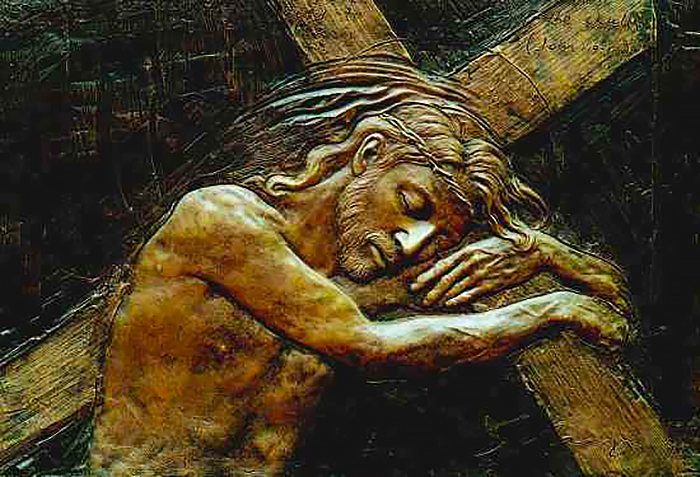
Take up his cross daily and follow me.” Lent has begun, and we already get a hint of the cross that awaits us on Good Friday. While some may see the cross as a sign of defeat, faithful Christians see the cross as a sign of Jesus’ love for us. Jesus came to bring justice, peace, and love. His mission ultimately led him to the cross, from where His faithful love brought us life. Jesus did not seek to be glorified: he chose to come without glory to undergo suffering, and you, who have been born without glory, do you wish to be glorified? The route you must take is the one Jesus took. That means recognizing and imitating Him both in His humiliation and good name; in this way, you will glory in the cross, which was his path to glory. That was what St. Paul did, and therefore, he was able to rejoice in saying, “Far be it from me to glory except in the cross of our Lord Jesus Christ.” Lent is an excellent time to reflect on our daily life in the light of today’s reading. This will hopefully lead to a determination to rejoice as St. Paul did by taking up your cross each day. Make this Lent your 40-day walk with Jesus!

“Even now, says the LORD, return to me with your whole heart” Joel 2:12

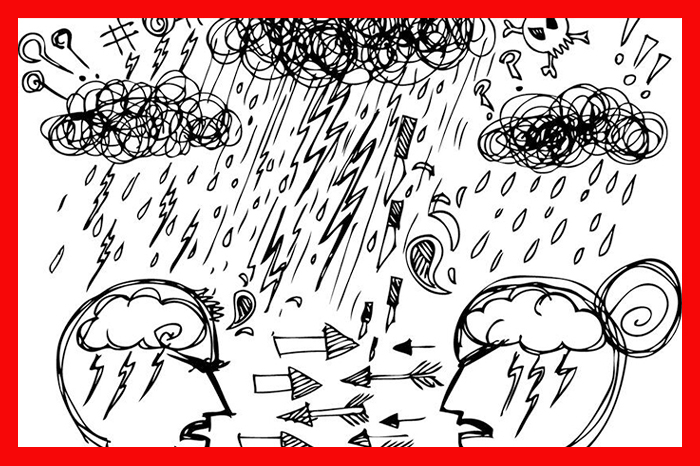
How about for Lent this year we do our very best to stop hating each other. Hatred and contempt are everywhere. Is this new or are we just more aware of it? Why is this happening and intensifying? Why do we justify this hatred on moral grounds, even biblical grounds, claiming that the Gospel itself gives us grounds for our disrespect – My truth is so right and you are so wrong that I can disrespect you and I have biblical grounds to hate you! Well, even a cursory look at scripture should be enough to enable us to see this for what it is; rationalization, self-interest, and the farthest thing from Jesus. He asks us to do something else: “You have heard that it was said, ‘Love your neighbor and hate your enemy.’ But I tell you, love your enemies and pray for those who persecute you, that you may be children of your Father in heaven. … If you love those who love you, what reward will you get? Are not even the tax collectors doing that? And if you greet only your own people, what are you doing more than others? Do not even pagans do that? Be perfect, therefore, as your heavenly Father is perfect.” This is the very essence of Christian morality. Can you love someone who hates you? Can you do good to someone who wishes you evil? Can you forgive someone who has wronged you? Can you forgive a murderer? Can you move beyond your natural proclivity for vengeance? Sadly, today we are failing that test on both sides of the ideological and religious spectrum. People are openly espousing disrespect, division, hatred, and vengeance – and trying to claim the moral high ground in doing this. Worse still, churches and church leaders of every kind are lining up behind them and giving them “Gospel” support for their espousal of hatred and vengeance. This needs to be named and challenged: anyone who is advocating division, disrespect, hatred, or revenge is antithetical to Jesus and the Gospels. As well, anyone supporting such a person by an appeal to Jesus, the Gospels, or authentic morality, is also antithetical to Jesus and the Gospels. God is love. Jesus is love enfleshed. Disrespect, hatred, division, and revenge may never be preached in God’s or Jesus’ name, no matter the cause, no matter the anger, no matter the wrong. This doesn’t mean that we cannot have disagreements, spirited discussions, and bitter debates. But disrespect, hatred, division, and revenge may not be advocated in the name of goodness and Jesus. Division, disrespect, hatred, and vengeance are the Anti-Christ. (Adapted from Fr. Ron Rolheiser’s article: Breaking Faith With Each Other).

“Do you have eyes and not see, ears and not hear? And do you not remember” Mark 8:18

Jesus uses the simile of the leaven to show the vitality of his teaching. Here, “leaven” is used in the sense of bad disposition. In the making of bread, leaven is what causes the dough to rise; the Pharisees’ hypocrisy and Herod’s dissolute life, stemming from their personal ambition, were the “leaven” which was poisoning from within the “dough” of Israel, and which would eventually corrupt it. Jesus seeks to warn his disciples about these dangers and to have them understand that if they are to take in his teaching, they need a pure and simple heart. Sr. Chris Koellhoffer says, “I suspect that if my mother had been present for the multiplication of the loaves and fishes, Jesus would not have had to remind her of the fragments. With a large family, she honed her skills at bringing leftovers to life in a new and appealing form. So vigilant and careful was she that hardly a crumb in our home ever went to waste under her thoughtful planning of meals.” In Jesus’ question to the disciples, we can hear his frustration at their difficulty in “getting it.” Beyond that, perhaps his question to them, “Do you not remember?” also reminded them that he left nothing behind. When it came to the significance and dignity of the human person, Jesus was forever mindful of what others might deem useless, forgotten, and leftover. Jesus, as we enter this Lenten season, help us to savor your words.

“Why does this generation seek a sign?” Mark 8:12

Human beings tend to look for signs that will interpret various experiences or affirm plans and decisions. In their faith lives, there are any number of people who ask for signs from God, and God seems to come through for them frequently and generously. Sr. Ephrem Hollermann writes that she sometimes envies them because she has never been a good “reader of signs” in her spiritual life. When God breaks into my life, it seems more like a fleeting moment of intensified divine presence, unaccompanied by the concreteness of a sign. I wonder if I am too much like the Pharisees in today’s Gospel, who seem to have missed concrete signs all along the way. But it’s not just the Pharisees who miss this. In the scene immediately preceding today’s text, Jesus miraculously fed four thousand with just seven loaves and several fish. Within the ten verses that follow today’s Gospel, Jesus addresses his disciples with a barrage of questions: “Do you still not perceive or understand? Are your hearts hardened? Do you have eyes and fail to see? Do you have ears and fail to hear? And do you remember when I broke the seven loaves for the four thousand? Do you not yet understand?” Small wonder Jesus’ frustration gets the best of him: “Why does this generation seek a sign? Amen, I say to you, no sign will be given to this generation.” It seems a sign “on demand” will not be forthcoming. Whether we are sign readers or caught off guard by jolts of the divine, we face the same challenge to be continually alert to the workings of God in our lives. No sign, after all, will be given to a faithless generation.

HTML Snippets Powered By : XYZScripts.com