
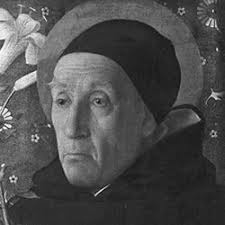
Meister Eckhart (c. 1260–c. 1328) was a German Dominican friar, philosopher, and mystic whose profound teachings on the soul’s union with God made him one of the most influential—and controversial—figures in Christian mystical theology. His sermons and treatises deeply shaped later Western spirituality and continue to be widely studied today.
Early Life and Formation
Meister Eckhart (born Eckhart von Hochheim) was likely born around 1260 near Erfurt. He entered the Dominican Order as a young man and received extensive theological and philosophical training.
He studied and later taught at the University of Paris, one of the premier theological centers of medieval Europe, and held important leadership roles within the Dominican Order in Germany.
Eckhart earned the academic title “Meister” (Master) because of his distinguished teaching position at the University of Paris.
Ministry and Teaching Career
Eckhart served in several major roles:
– Prior in Erfurt
– Vicar General for Bohemia
– Professor of theology in Paris
– .Preacher throughout German-speaking regions
Unlike many scholastic theologians, Eckhart preached frequently in the German vernacular, making advanced mystical theology accessible to ordinary believers, including many women’s religious communities.
Controversy and Condemnation
Late in his life, some of Eckhart’s teachings were investigated for possible heresy. In 1329, after his death, Pope John XXII (Avignon Pope) issued a bull condemning certain propositions drawn from his works.
Importantly:
– Some statements were condemned as heretical
– Others were judged “suspect”
– Eckhart himself had already expressed submission to the Church
Today, most scholars view him as fundamentally orthodox but ackowledge he expressed in bold, paradoxical mystical language that was easily misunderstood.
His Theology
Meister Eckhart’s theology is best described as apophatic, mystical, and radically interior. He stands within the Christian contemplative tradition but pushes its language to remarkable depth and daring.
1. The Birth of God in the Soul
Eckhart’s central teaching is the “birth of God in the soul.”
He taught that the eternal Word (Logos) is continually born in the deepest ground of the human soul. The spiritual life, therefore, is not primarily about reaching God externally but awakening to this interior divine birth.
Key implications:
– God is intimately present within
– The soul has a profound capacity for union
– Contemplation is awakening to what is already occurring
This theme profoundly influenced later mystics.
2. The Ground of the Soul (Seelengrund)
One of Eckhart’s most distinctive ideas is the ground of the soul, the deepest center of the human person where God and the soul meet.
He sometimes spoke in startling language suggesting:
– A point of unity between God and the soul
– A divine spark within
= A depth beyond images and concepts
Importantly, he did not mean the soul becomes God by nature, but that in the deepest contemplative union, there is an intimate participation in divine life.
3. Detachment (Gelassenheit)
Perhaps Eckhart’s most famous spiritual teaching is detachment (Gelassenheit). For Eckhart, true spiritual freedom requires letting go of:
– Ego
– Possessiveness
– Self-will
– Attachment to spiritual consolations
Radical detachment creates the interior space where God can act freely in the soul. This theme later influenced both Christian mystics and modern contemplative writers.
4. Apophatic Theology (God Beyond Concepts)
Eckhart strongly emphasized the unknowability of God.
He taught that:
– God ultimately transcends all images
– Concepts about God are limited
– True contemplation moves into silent unknowing
– God is best approached through interior poverty
This places him firmly in the apophatic (negative theology) tradition alongside figures like Pseudo-Dionysius.
5. Breakthrough (Durchbruch)
Eckhart sometimes spoke of a spiritual “breakthrough” in which the soul passes beyond dualistic awareness into profound union with God.
This language can sound very bold, but within his framework it means: a radical surrender; transcendence of ego-centered identity; awakening to divine ground; and living from God rather than from self.
This teaching has drawn both admiration and controversy.
6. Action Flowing from Contemplation
Despite his mystical depth, Eckhart did not advocate withdrawal from the world. He insisted that the truly united person can act freely and compassionately in ordinary life.
Famous Eckhart theme: The person united with God finds God equally in the kitchen and the chapel. Thus, contemplation and action are not opposed.
Major Works and Sermons
Eckhart did not write a single systematic masterpiece; his influence comes largely through: German sermons; Latin theological treatises; and spiritual conferences
Among the best-known modern collections is:
– Meister Eckhart: Selected Writings
Death and Legacy
Meister Eckhart likely died around 1328, probably in Avignon.
Today he is regarded as:
– one of the greatest Christian mystics
– a pioneer of Western contemplative theology
– a major influence on later figures including Thomas Merton, modern contemplatives, and even some interfaith dialogue
His writings continue to be studied in theology, philosophy, and spirituality worldwide.