
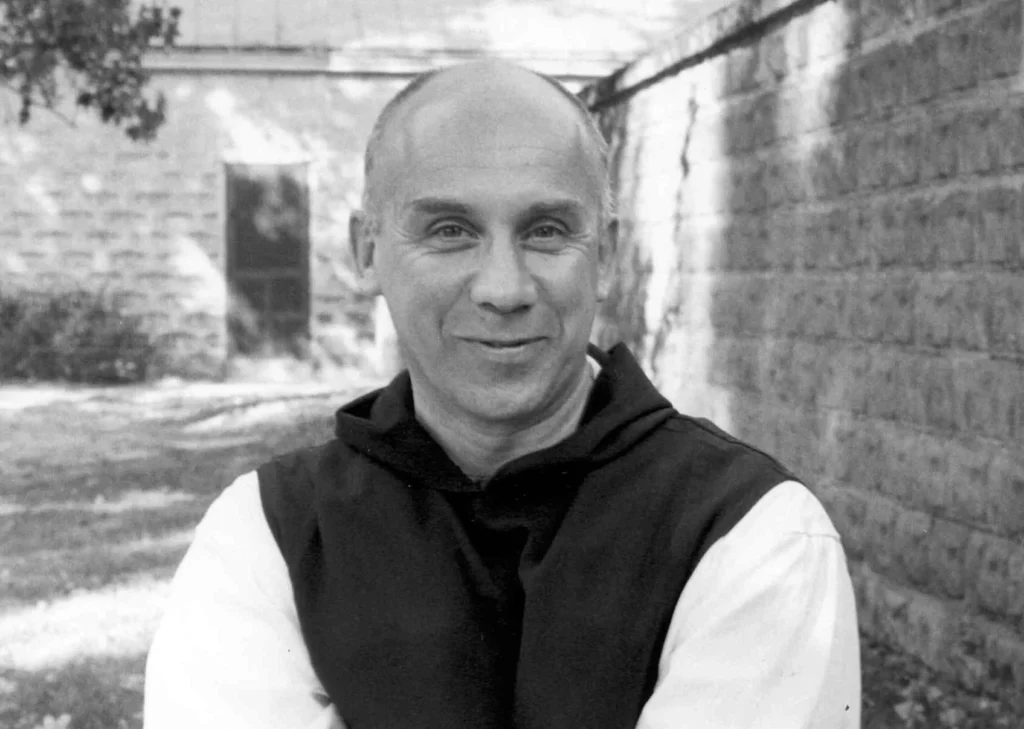
Thomas Merton (1915–1968) was an American Trappist monk, writer, mystic, and social critic whose works profoundly shaped 20th-century Christian spirituality. Widely known for his autobiography The Seven Storey Mountain, Merton helped renew interest in contemplative prayer, monastic life, and interfaith dialogue.
Early Life and Education
Thomas Merton was born January 31, 1915, in Prades to artist parents. His mother was American and his father was a New Zealand painter. After his mother’s death and a somewhat unsettled childhood in Europe and the United States, Merton attended Columbia University in New York City.
While at Columbia, Merton experienced a deep intellectual and spiritual awakening that culminated in his conversion to Roman Catholicism in 1938.
Monastic Vocation
In 1941, Merton entered the Abbey of Our Lady of Gethsemani in Bardstown, a Trappist monastery belonging to the Order of Cistercians of the Strict Observance. He was ordained a priest in 1949.
Although Trappist life is marked by silence and enclosure, Merton’s superiors permitted him to write. His 1948 autobiography, The Seven Storey Mountain, became an international bestseller and inspired thousands to explore monastic and spiritual life.
His Theology and Spiritual Vision
Merton’s theology is often described as contemplative, mystical, and dialogical. He sought to recover the depth of the Christian contemplative tradition while engaging the modern world.
1. Contemplation at the Center
For Merton, contemplation was the heart of the Christian life—not reserved for monks but essential for all believers. He taught that true contemplation is a direct, loving awareness of God beyond mere concepts.
2. The True Self
A central theme in his writings is the distinction between the false self (the ego constructed by social pressures and sin) and the true self (the person hidden in God). Spiritual growth involves dying to the false self so the true self in Christ may emerge.
3. Solitude and Compassion
Although he championed solitude, Merton insisted that authentic contemplation leads to deeper solidarity with humanity. His famous insight: the more one is united with God, the more one is united with all people.
4. Interfaith Dialogue
In his later years, Merton became a pioneer in dialogue between Christianity and Eastern religions, especially Buddhism. He corresponded with and met the Dalai Lama and engaged deeply with Zen teachers, helping open respectful theological exchange between traditions.
5. Prophetic Social Concern
Unlike many cloistered monks, Merton wrote boldly about nuclear war, racism, and peace. His contemplative life fueled a strong public moral voice.
Major Works
Among Merton’s most influential books are:
– The Seven Storey Mountain (1948)
– No Man Is an Island (1955)
– Thoughts in Solitude (1958)
– New Seeds of Contemplation (1961)
– Conjectures of a Guilty Bystander (1966)
– Contemplative Prayer (1969)
His writings range from autobiography and spiritual theology to poetry and social criticism.
Death and Legacy
Thomas Merton died on December 10, 1968, in Bangkok while attending an interfaith monastic conference. His death was accidental, caused by electrocution from a faulty fan.
Today, Merton is regarded as one of the most important Catholic spiritual writers of the 20th century. He helped revive Western interest in contemplative prayer and opened new paths for interreligious dialogue. His influence extends well beyond monastic circles into psychology, peace studies, and modern spirituality.