
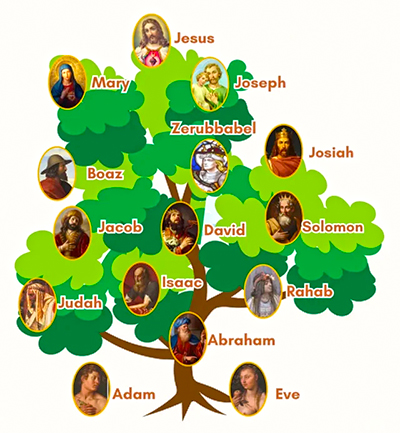
The full story of how Jesus Christ came to be born includes elements that we do not easily imagine when we sing our Christmas hymns. Jesus’ family tree and bloodline were far from perfect, and this, according to the great biblical scholar Raymond Brown, needs to be kept in mind whenever we are tempted to believe in Jesus but want to reject the church because of its imperfections, scandals, and bad history. Jesus may have been immaculately conceived, but there is much in his origins, as the gospels make clear, that’s as un-immaculate as any contemporary church scandal.
For example, in giving us the origins of Jesus, the gospels point to as many sinners, liars, and schemers in his genetic and historical lineage as they do to saints, honest people, and men and women of faith.
We see, for example, in Jesus’ genealogy a number of men who didn’t exactly incarnate the love, justice, and purity of Jesus: Abraham unfairly banished Ishmael and his mother, Hagar, rationalizing that God favours some people over others; Jacob, by scheming and dishonesty, stole his brother Esau’s birthright; and David, to whom Jesus explicitly connects himself, committed adultery and then had the husband of his mistress murdered to cover-up an unwanted pregnancy and in order to marry her.
And the women mentioned in Jesus background aren’t much better. It’s interesting to note, as Raymond Brown does, which women don’t get mentioned in reference to Jesus’ origins. The gospels don’t mention Sarah, Rebekeh, or Rachel, all of whom were regarded as holy women. Whom do they mention?
They mention Tamar, a Canaanite woman, someone outside the Jewish faith, who seduces her father-in-law, Judah, so that she can have a child; Rahab, also a Canaanite woman, and an outsider, who is in fact a prostitute; Ruth, a Moabite woman who is also outside the official religion of the time; and Bathsheba, a Hittite woman, an outsider who commits adultery with David and then schemes to make sure one of her own offspring inherits the throne.
What’s to be learned for all of this? Perhaps Raymond Brown captures it the best. What all this tells us, he says, is that God writes straight with crooked lines, that we shouldn’t accept an overly-idealized Jesus Christ, and that our own lives, even if they are marked by weakness and insignificance, are important too in continuing the story of the incarnation.
Christianity isn’t just for the pure, the talented, the good, the humble, and the honest. The story of Jesus Christ was also written and keeps getting written too by the impure, by sinners, by calculating schemers, by the proud, by the dishonest, and by those without worldly talents. Nobody is so bad, so insignificant, so devoid of talent, or so outside the circle of faith, that he or she is outside the story of Christ.[Excerpt from Ron Rolheiser’s “Jesus’ Dysfunctional Family Tree” December 2004]
