
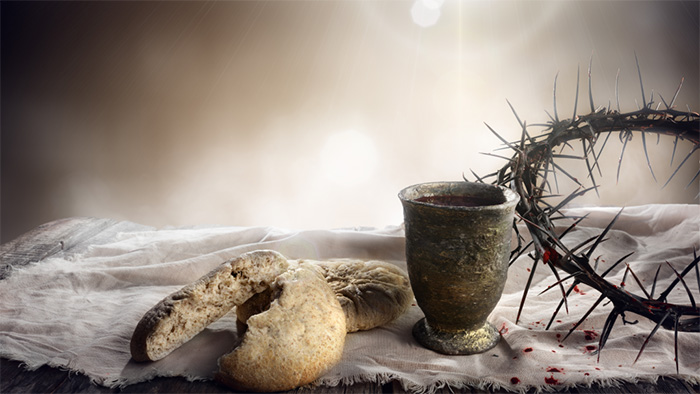
Christians argue a lot about the Eucharist. What does it mean? What should it be called? How often should it be celebrated? Who should be allowed to fully participate? There are lots of views on the Eucharist:
- For some it is a meal, for others it is a sacrifice
- For some it is a ritual act, sacred and set apart, for others it is a community gathering, the more mess and kids there the better.
- For some it is a deep personal prayer, for others it is a communal worship for the world.
- For some its very essence is a coming together, a communion, of those united in a single denominational faith, while for others part of its essence is its reaching out, its innate imperative to wash the feet of those who are different from ourselves.
- For some it is a celebration of sorrow, a making present of Christ’s suffering and the thus place where we can break down, for others it is the place to celebrate joy and sing alleluia.
- For some it is a ritual remembrance, a making present of the historical events of Jesus’ dying, rising, ascending, and sending the Holy Spirit, for others it is a celebration of God’s presence with us today.
- For some it is a celebration of the Last Supper, something to be done less frequently, for others it is God’s daily feeding of his people with a new manna, Christ’s body, and is something to be done every day.
- For some it is a celebration of reconciliation, a ritual that forgives and unites, for others unity and reconciliation are pre-conditions for its proper celebration.
- For some it is a vigil act, a gathering that is essentially about waiting for something else or someone else to appear, for others it is a celebration of something that is already present that is asking to be received and recognized.
- For some it is understood to make present the real, physical body of Christ, for others it is understood to make Christ present in a real but spiritual way.
- Some call it the Lord’s Supper, others call it the Eucharist, others call it the Mass.
- Some celebrate it once a year, some celebrate it four times a year, some celebrate it every Sunday, and some celebrate it every day.
Who’s right? In truth, the Eucharist is all of these things and more. It is like a finely-cut diamond twirling in the sun, every turn giving off a different sparkle. It is multi-valent, carrying different layers of meaning, some of them in paradoxical tension with others. There is, even in scripture, no one theology of the Eucharist, but instead, there are various complementary theologies of the Eucharist. The fault, which is not a fault at all but a marvel, lies in the richness of the Eucharist itself. In the end, it defies not just theology professors, but metaphysics, phenomenology, and language itself.
For instance, we already see variations among the apostolic communities as to how they understood the Eucharist, what it should be called, and how often it should be celebrated. Some early communities called it the Lord’s Supper, connected its meaning very much to the commemoration of the Last Supper, and celebrated it less frequently. Whereas the apostolic community that formed around John connected its theology and practice very much to the concept of God feeding his people daily with manna, and they celebrated it every day, given that we need sustenance daily.
There is no adequate explanation of the Eucharist for the same reason that, in the end, there is no adequate explanation for love, for embrace, and for the reception of life and spirit through touch. Certain realities take us beyond language because that is their very purpose. They do what words cannot do. They are also beyond what we can neatly nail down in our understanding. And that is true of the Eucharist. Any attempt to nail down its full meaning will forever come up short because it will always eventually get up and walk away with the nail! [Excerpt from Ron Rolheiser’s “The Many Faces of the Eucharist,” May 2008]
