
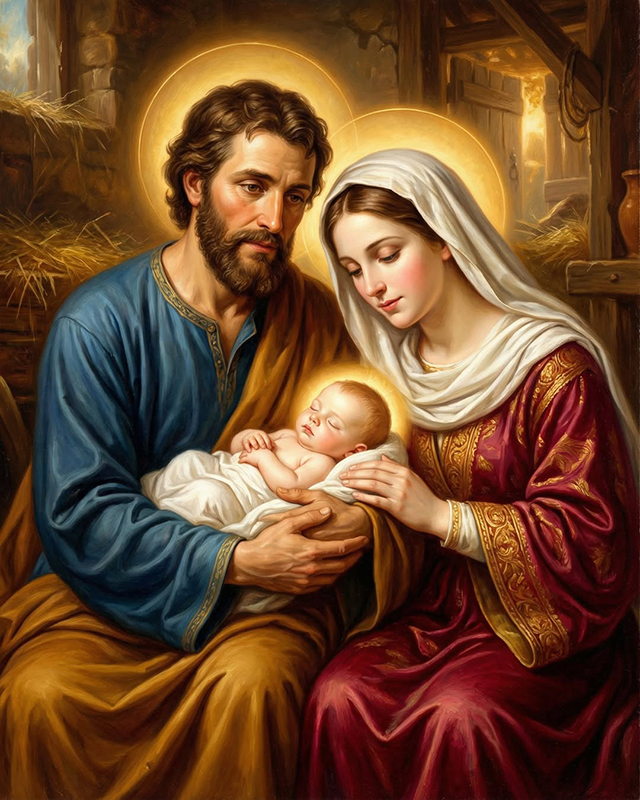
There are countless persons, basilicas, churches, shrines, seminaries, convents, and even towns and cities named after St. Joseph. My native country, Canada, has him as its patron.
Who exactly is this Joseph? He is that quiet figure prominently named in the Christmas story as the husband of Mary and the stepfather of Jesus, and then basically is never mentioned again. The pious conception of him is that of an older man, a safe protector to Mary, a carpenter by trade, chaste and holy, humble and quiet, the perfect patron for manual laborers and anonymous virtue, humility incarnate.
But what do we really know about him?
In the Gospel of Matthew the annunciation of Jesus’ conception is given to Joseph rather than to Mary: Before they came together, Mary was found to be with child by the Holy Spirit. Joseph, her husband, being an upright man and unwilling to shame her, had decided to divorce her quietly, when an angel appeared to him in a dream and told him not to be afraid to take Mary as his wife, that the child in her had been conceived through the Holy Spirit.
What can we learn from this text?
Partly it is symbolic: The Joseph of the Christmas story is clearly reminiscent of the Joseph of the Exodus story, he too has a dream, he too goes to Egypt, and he too saves the family. Likewise King Herod is clearly the counterpart of the Egyptian Pharaoh; both feel threatened and both kill the Hebrew male children only to have God protect the life of the one who is to save the people.
But, after that, the Joseph of the Christmas story writes his own history: He is presented to us as an “upright” man, a designation that scholars say implies that he has conformed himself to the Law of God, the supreme Jewish standard of holiness. In every way he is blameless, a paradigm of goodness, which he demonstrates in the Christmas story by refusing to expose Mary to shame, even as he decides to divorce her quietly.
What actually happened here?
Joseph does something else that is not so evident: He shows how a person can be a pious believer, deeply faithful to everything within his religious tradition, and yet at the same time be open to a mystery beyond both his human and religious understanding.
And this was exactly the problem for any Christians, including Matthew himself, at the time the Gospels were written: They were pious Jews who didn’t know how to integrate Christ into their religious framework. What does one do when God breaks into one’s life in new, previously unimaginable ways? How does one deal with an impossible conception? Here’s how Raymond Brown puts it: The hero of Matthew’s infancy story is Joseph, a very sensitive Jewish observer of the Law. … In Joseph, the evangelist was portraying what he thought a Jew [a true pious believer] should be and probably what he himself was.
In essence, what Joseph teaches us is how to live in loving fidelity to all that we cling to humanly and religiously, even as we are open to a mystery of God that takes us beyond all the categories of our religious practice and imagination.
Isn’t that one of the ongoing challenges of Christmas? [Excerpt from Ron Rolheiser’s “Joseph and Christmas” December 2009]
