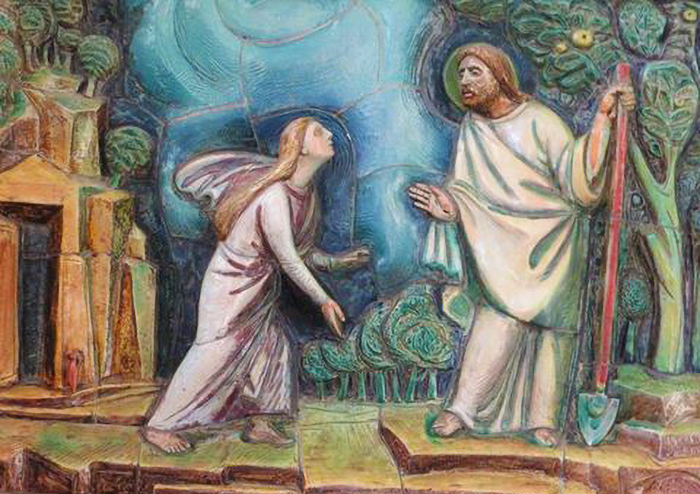
Mary of Magdala went and announced to the disciples, “I have seen the Lord,” and what he told her. John 20:18

Mary of Magdala’s Easter Prayer:
I never suspected Resurrection to be so painful… to leave me weeping
With joy to have met you, alive and smiling, outside an empty tomb.
With regret, not because I’ve lost you but because I’ve lost you in how I had you — in understandable, touchable, kissable, clingable flesh not as fully Lord, but as graspably human.

I want to cling, despite your protest cling to your body cling to your, and my, clingable humanity cling to what we had, our past.
But I know that…if I cling, you cannot ascend and
I will be left clinging to your former self …unable to receive your present spirit
.

On Easter Sunday morning, Mary Magdalene goes out to the tomb to anoint the body of Jesus. But she finds him in a garden (the typical place where lovers meet). But she doesn’t recognize him. Jesus turns to her and, repeating the question with which the gospel began, asking her: “What are you looking for?” Mary replies that she is looking for the body of the dead Jesus, and could he give her any information as to where that body is. And Jesus simply says: “Mary.” He pronounces her name in love. She falls at his feet.

In essence, that is the whole gospel: What are we ultimately looking for? What is the end of all desires? What drives us out into gardens to search for love? The desire to hear God pronounce our names in love. To hear God lovingly saying our name: Daniel! [Excerpt from Ron Rolheiser’s “Mary Magdala’s Easter Prayer,” April 1985]
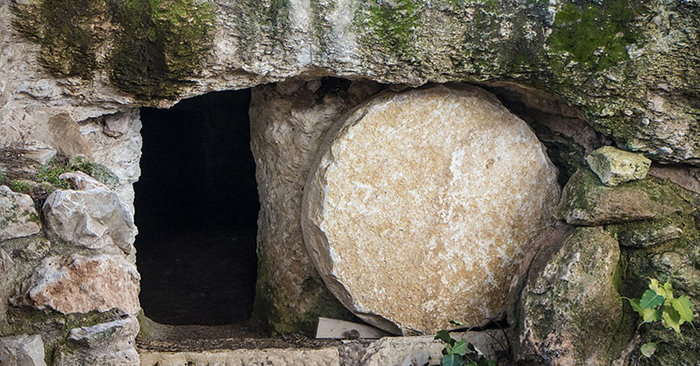
You are to say, “His disciples came by night and stole him while we were asleep”…The soldiers took the money and did as they were instructed. And this story has circulated among the Jews to the present day. Matthew 28:13, 15

The execution of Jesus had seemed final. Under the authority of Pontius Pilate, Roman soldiers had carried out the crucifixion with brutal efficiency. At the request of certain religious leaders, the tomb had even been secured, sealed, and guarded to prevent any tampering.

To them, this was necessary. Jesus had spoken of rising again, and rumors, they feared, could spread quickly during a crowded festival. So the stone was sealed. The guards were posted. The matter, it seemed, was closed. But something happened.

According to the account preserved in the Gospel of Matthew, the ground shook, and the tomb was found empty. The guards, trained, disciplined men, were shaken enough to report what they had experienced.

They did not go first to their Roman superiors, but to the chief priests. What followed, Matthew says, was a decision made in private. Money was brought out, and a story was agreed upon that the disciples stole the body of Jesus from the tomb.

Fr. Ron Rolheiser writes about the irony that the same religious and Roman authorities who sought to silence Jesus through death continued to use deception after his resurrection, specifically creating a false narrative that the disciples stole the body.

The Roman guards’ false testimony (that they slept while the body was stolen) was a desperate attempt by authorities to maintain control over the narrative and avoid the implications of Jesus rising from the dead. Despite this collusion between the soldiers and leaders to conceal the resurrection, God’s truth eventually triumphs, turning the darkness of their deception into the light of faith.

The very existence of the accusation that “the disciples stole the body” is significant. It suggests that something about the tomb required explanation. The complicity noted by Matthew is a classic human effort to hide behind “false stories” when confronted with undeniable facts that threaten their power.

Were not our hearts burning within us while he spoke to us on the way and opened the Scriptures to us? Luke 24:32

The disciples were filled with their own worries as they traveled along the Emmaus road—they were filled with anxiety, and disappointment about the future. A stranger joined them on the road and they repeated the recent events—the crucifixion, the empty tomb, the testimony of the women about the angel visitation saying that Jesus had risen. But these two were not buying any of that because disappointment and anxiety hung around them. “We had hoped he was the one who would redeem Israel.”

That’s one of the most melancholy statements in Scripture—”we had hoped he would be the one…We had hoped….” We know how that feels, don’t we?  We had hoped our finances worked out differently. We had hoped our health was better.  We had hoped our kids would go to church. We had hoped there would be no more war by now. We had hoped we would stop wondering about our faith by this age.

It’s funny how worry and anxiety and disappointment can blind us from seeing what is right in front of our eyes. When the mind doesn’t believe something possible, it is hard for the senses to receive the information. Cleopas and his friend on the road to Emmaus were so anxious, and so certain that Jesus was still dead, that the risen Lord appeared to them, walked along beside them, taught them all about the Hebrew scriptures and how Jesus was the fulfillment of that—and they still did not see him. The light of the world was right beside them, but to their eyes, the risen Lord just looked like a fellow traveler on the way to Emmaus.

But Jesus met the disciples where they were at—walking away from Jerusalem, not believing the testimony of the empty tomb, and full of disappointment and anxiety. That’s exactly where Jesus shows up in our lives, too. It is so easy to believe that fears, worries, doubts, anxieties separate us from God, drive God away from us, disappoint Jesus and mean that we are somehow outside the family of God and circle of faith—but that is precisely where Jesus meets us, walks with us, engages us, loves us.

A friend of mine had a plaque in her kitchen that said, “Before you go to bed at night, give your worries to God, he’ll be up all night anyway!” Rev. Ralph Abernathy during the Civil rights movement once said, “I don’t know what the future holds, but I know Who holds the future.” Lay your worries at the altar, for the Risen One who reveals himself in the breaking of the bread, holds the night, and our future secure. (Excerpt from Linda Little’s “The Road to Emmaus: The Walk of Worry and Revelation,” May 2019]

“I know that you are seeking Jesus the crucified. He is not here, for he has been raised just as he said.” Matthew 28:5-6

In celebrating the Easter Vigil on Saturday evening, it is interesting to compare how scripture describes God creating the new light of the resurrection with how God created the original light at the origins of creation. The Gospel of John has a wonderfully revealing passage that describes Jesus’ first appearance to the whole community after his resurrection. It tells us that on the evening of Easter Sunday the disciples (representing here the church) were gathered in a room with the doors locked because of fear. Jesus comes to them, passing right through their locked doors, and stands in the middle of their huddled fearful circle and says to them, “Peace be with you!” And after saying this, he breathes on them and says: “Receive the Holy Spirit.”

Note the parallels to the original creation story. For the writer of John’s Gospel, this huddling in fear behind locked doors is the darkness of Good Friday, a moral “formless void”. And Jesus brings light to that darkness in the same way light was brought to the original creation, through God’s word and God’s breath. Jesus’ words, “Peace be with you!” are the resurrected Jesus’ way of saying, “Let there be light!” Then, just as at the original creation God’s breath begins to order the physical chaos, Jesus’ breath, the Holy Spirit, begins to order the moral chaos, continually turning darkness into light – hatred into love, bitterness into graciousness, fear into trust, false religion into true worship, ideology into truth, and vengeance into forgiveness.

Good Friday was bad long before it was good. We crucified God and plunged the world into darkness at midday. But God created light a second time, a light that cannot be extinguished even if we crucify God – and we have never really stopped doing that! Good Friday still happens every day. But, beyond wishful thinking and natural optimism, we live in hope because we now know God’s response to any moral darkness, God can generate, resurrection, the creation of new light, life beyond death. [Excerpt from Ron Rolheiser’s “Easter Light,” April 2023]

When Jesus had taken the wine, he said, “It is finished.”And bowing his head, he handed over the spirit. John 19:30

“It is fulfilled!” The Greek word here is Tetelesti.  This was an expression used by artists to signify that a work was completely finished and that nothing more could be added to it. It was also used to express that something was complete.

When is our life fulfilled? At what point in our lives do we say: “That’s it! That’s the climax! Nothing I can do from now on will outdo this. I’ve given what I have to give.”

Henri Nouwen suggests that people will answer this very differently: “For some it is when they are enjoying the full light of popularity; for others, when they have been totally forgotten; for some, when they have reached the peak of their strength; for others, when they feel powerless and weak; for some it is when their creativity is in full bloom, for others, when they have lost all confidence in their potential.”

For Jesus, it wasn’t immediately after his miracles when the crowds stood in awe, and it wasn’t after he had just walked on water. It wasn’t when his popularity reached the point where his contemporaries wanted to make him king that he felt he had accomplished his purpose in life and that people began to be touched in their souls by his spirit. None of these. When did Jesus have nothing further to achieve?

Henri Nouwen again, in answering this question: “We know one thing, however, for the Son of Man the wheel stopped when he had lost everything: his power to speak and to heal, his sense of success and influence, his disciples and friends – even his God. When he was nailed against a tree, robbed of all human dignity, he knew that he had aged enough, and said: ‘It is fulfilled’”

On the cross, faithful to the end, to his God, to his word, to the love he preached, and to his own integrity, he stopped living and began dying, and that’s when he gave off his seed and that’s when his spirit began to permeate the world. He had reached his deepest center, his life was fulfilled. [Excerpt from Ron Rolheiser’s “When is our Life Fulfilled?” November 2018]

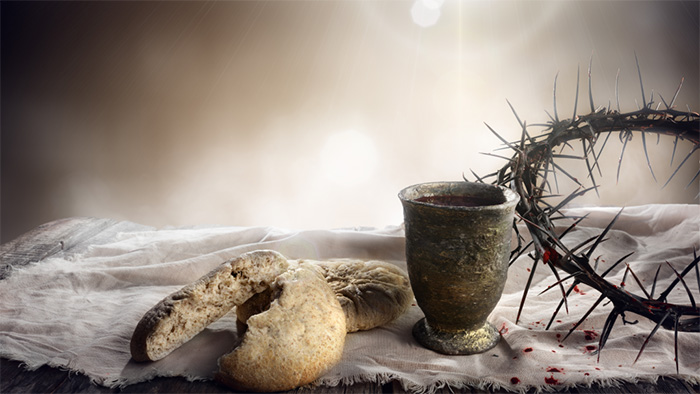
“This is my body that is for you. Do this in remembrance of me…This cup is the new covenant in my blood. Do this, as often as you drink it, in remembrance of me.” 1 Corinthians 11:24-25

Christians argue a lot about the Eucharist. What does it mean? What should it be called? How often should it be celebrated? Who should be allowed to fully participate? There are lots of views on the Eucharist:

  • For some it is a meal, for others it is a sacrifice
  • For some it is a ritual act, sacred and set apart, for others it is a community gathering, the more mess and kids there the better.
  • For some it is a deep personal prayer, for others it is a communal worship for the world. 
  • For some its very essence is a coming together, a communion, of those united in a single denominational faith, while for others part of its essence is its reaching out, its innate imperative to wash the feet of those who are different from ourselves.
  • For some it is a celebration of sorrow, a making present of Christ’s suffering and the thus place where we can break down, for others it is the place to celebrate joy and sing alleluia.
  • For some it is a ritual remembrance, a making present of the historical events of Jesus’ dying, rising, ascending, and sending the Holy Spirit, for others it is a celebration of God’s presence with us today.
  • For some it is a celebration of the Last Supper, something to be done less frequently, for others it is God’s daily feeding of his people with a new manna, Christ’s body, and is something to be done every day.
  • For some it is a celebration of reconciliation, a ritual that forgives and unites, for others unity and reconciliation are pre-conditions for its proper celebration.
  • For some it is a vigil act, a gathering that is essentially about waiting for something else or someone else to appear, for others it is a celebration of something that is already present that is asking to be received and recognized.
  • For some it is understood to make present the real, physical body of Christ, for others it is understood to make Christ present in a real but spiritual way.
  • Some call it the Lord’s Supper, others call it the Eucharist, others call it the Mass.
  • Some celebrate it once a year, some celebrate it four times a year, some celebrate it every Sunday, and some celebrate it every day.

Who’s right? In truth, the Eucharist is all of these things and more. It is like a finely-cut diamond twirling in the sun, every turn giving off a different sparkle. It is multi-valent, carrying different layers of meaning, some of them in paradoxical tension with others. There is, even in scripture, no one theology of the Eucharist, but instead, there are various complementary theologies of the Eucharist. The fault, which is not a fault at all but a marvel, lies in the richness of the Eucharist itself. In the end, it defies not just theology professors, but metaphysics, phenomenology, and language itself.  

For instance, we already see variations among the apostolic communities as to how they understood the Eucharist, what it should be called, and how often it should be celebrated. Some early communities called it the Lord’s Supper, connected its meaning very much to the commemoration of the Last Supper, and celebrated it less frequently. Whereas the apostolic community that formed around John connected its theology and practice very much to the concept of God feeding his people daily with manna, and they celebrated it every day, given that we need sustenance daily.

There is no adequate explanation of the Eucharist for the same reason that, in the end, there is no adequate explanation for love, for embrace, and for the reception of life and spirit through touch. Certain realities take us beyond language because that is their very purpose. They do what words cannot do. They are also beyond what we can neatly nail down in our understanding. And that is true of the Eucharist. Any attempt to nail down its full meaning will forever come up short because it will always eventually get up and walk away with the nail! [Excerpt from Ron Rolheiser’s “The Many Faces of the Eucharist,” May 2008]

The Lord GOD has given me a well-trained tongue, that I might know how to speak to the weary a word that will rouse them. Isaiah 50:4

Sand Opera began as a daily Lenten meditation, working with the testimonies of the tortured at Abu Ghraib, to witness to their suffering. My desire in Sand Opera is to make the Iraq War and the wider war on terror visible, to make a visible and audible map of it, a map that we would carry in our eyes and ears, in our bodies and hearts, to replace the maps of pundits and demagogues.

As Isaiah writes, “Morning after morning/ He opens my ear that I may hear.” Sand Opera is the sound of my listening. These poems carry forth voices that have opened me—an Arab-American living through the paranoid days after the terrorist attacks of Sept. 11, 2001, and my daughter’s coming to consciousness in a world where war leaks through the radio and television. The words of my daughter at the end of the poem “Hung Lyres” embody what I hope I can continue to open myself into:

What does it mean, I say. She says, it means 
to be quiet, just by yourself. She says, there’s 

a treasure chest inside. You get to dig it out. 
Somehow, it’s spring. Says, will it always 

rain? In some countries, I say, they are 
praying for rain. She asks, why do birds sing? 

In the dream, my notebook dipped in water, 
all the writing lost. Says, read the story again. 

But which one? That which diverts the mind 
is poetry. Says, you know those planes 

that hit those buildings? Asks, why do birds sing? 
When the storm ends, she stops, holds her hands 

together, closes her eyes. What are you doing? 
I’m praying for the dead worms. Says, listen:

– PHILIP METRES

HTML Snippets Powered By : XYZScripts.com