
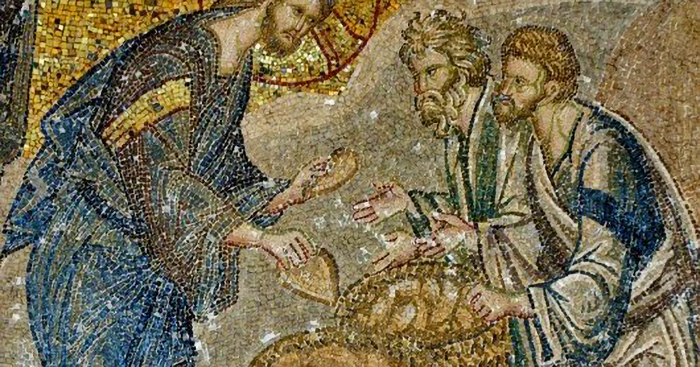
When reflecting on Jesus’ command after the feeding of the five thousand—“Gather the fragments left over, so that nothing will be wasted”—we see far more than a lesson in avoiding physical waste.
At one level, the instruction reveals something essential about God’s nature: divine generosity is never careless. God gives in abundance—far beyond immediate need—but that abundance is not meant to be ignored or discarded. Grace is extravagant, yet purposeful. Nothing given by God is meaningless or expendable.
Fr. Ron Rolheiser extends this to the spiritual and psychological dimensions of our lives, writing that the “fragments” symbolize the pieces of our own experience—moments, relationships, wounds, joys, failures, and even the parts of ourselves we are tempted to overlook or dismiss. We tend to discard what feels insignificant, broken, or incomplete. Yet Jesus’ command suggests that in the economy of God, nothing is wasted. Every fragment carries meaning and can be gathered into wholeness.
This has particular force in how we view our past. Regrets, missed opportunities, and suffering can feel like leftovers—unwanted remnants of a life we wish had gone differently. But Rolheiser’s insight points toward redemption: God gathers even these fragments and transforms them into something life-giving. What seems like excess or failure can become Eucharistic—taken, blessed, broken, and given again.
There is also a communal dimension. After the miracle, the disciples are instructed to gather what remains, not individually but together. This reflects the Church’s mission: to gather the scattered, to hold the pieces of human experience reverently, and to ensure that no person, no story, no suffering is lost or dismissed. The fragments are not just personal—they belong to the whole body.
Ultimately, the command speaks against a throwaway culture—not only materially, but spiritually and relationally. People are not disposable. Moments are not meaningless. Even the smallest acts of love, the faintest movements toward God, are worth gathering. In this light, Jesus’ words become a quiet but radical invitation: pay attention to what remains, honor what seems small or broken, and trust that in God’s hands, nothing—absolutely nothing—is wasted.
