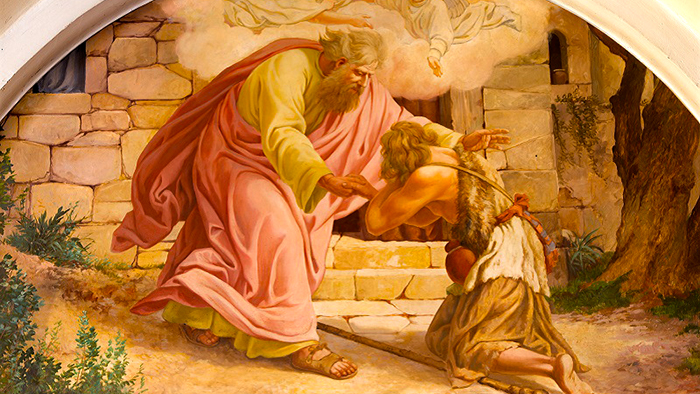

“O God, be merciful to me a sinner.” Luke 18:13

The phrase “O God, be merciful to me a sinner” is a famous Christian prayer that appears in the biblical parable of the Pharisee and the tax collector in the Gospel of Luke. Jesus highlights this prayer as one that God considered more righteous than the Pharisee’s self-congratulatory prayer.

The prayers power lies in its honest acknowledgment of human weakness and sinfulness. It is a recognition that we cannot achieve salvation through our own willpower but must rely on God’s mercy.

The prayer is a plea for mercy which is undeserved, by definition. It’s a surrender to God’s love, which is offered to us regardless of our imperfections. Admitting our sinfulness is not a path to despair, but rather the first step to receiving God’s grace, making us more humble, softer-hearted, and open to God’s love.

This prayer is a foundational plea within Christianity, seen as a way to pray “without ceasing” and as an antidote to despair. It’s also a core element of the sacrament of reconciliation (confession) and a prayer for stated in the Eucharistic celebration as a remembrance of Jesus Christ’s sacrifice, a symbol of union with him, and an act of worship for baptized followers of Jesus.

Lord, teach me your statutes. Psalm 119

“If you want peace, work for justice” Pope Paul VI

We must prioritize love and mercy over rigid adherence to law, especially when the law is interpreted in a way that causes injustice. Fr. Ron Rolheiser suggests that, like Jesus, we should focus on mercy, as true righteousness is found in recognizing our sinfulness and seeking God’s grace, not in strict adherence to rules. God’s quiet, hidden presence is within us, and is discovered through a silent, internal spirituality, similar to how the kingdom of God works subtly like yeast in dough. 

Mercy over rigid law: While statutes and law are important, they must always be interpreted through the lens of love and mercy, not used as a tool for judgment. Many historical actions of the Church have been driven by a pursuit of “correct doctrine” that, in practice, has led to horror and injustice. 

Humility and sinfulness: We are all sinners who fall short, and there is more joy in heaven over a repentant sinner than over those who believe they are already righteous. The emphasis is on acknowledging our sinfulness and accepting God’s grace, rather than on proving our own righteousness through adherence to the law. 

Quiet, internal presence: God’s presence is a subtle, hidden force within us, rather than a loud, dramatic one. It is like the way the kingdom of God grows, like a seed or yeast, and we need to look for it within our own spiritual lives. 

Social justice:  God is not neutral in the face of injustice and poverty. Instead, God wants action against everything and everyone who perpetuates injustice and oppression. This is the call to social justice.

Much will be required of the person entrusted with much, and still more will be demanded of the person entrusted with more. Luke 12:48

We are not to be anxious about many things. Jesus keeps telling us not to worry – about what we will eat, about what we will wear, and about tomorrow and the problems it will bring. We are in good hands, all the time. A gracious, all-powerful, loving God is solidly in charge and nothing will happen in the world and nothing will happen to us that this Lord is indifferent to.

Our faith, at its core, invites trust, and not just abstract trust, belief that good is stronger than evil. No. To say the creed, to say that I believe in God – and originally the Christian creed was only one line, Jesus is Lord – is to have a very particularized, concrete trust, a trust that God has not forgotten about me and my problems and that, despite whatever indications there are to the contrary, God is still in charge and is very concerned with my life and its concrete troubles.

When we anxiously worry, in essence, we are denying the Christian creed because we are, in effect, saying that God has either forgotten about us or that God does not have the power to do anything about what is troubling us. When it looks like God is asleep at the switch, God is still in charge, is still Lord of this universe, is still noticing everything, and is still fully in power and worthy of trust.

Our problem is that we project our limited, selective care onto this God. We feel that God is inadequate because often we are, that God falls asleep at the switch because we occasionally do, and that God forgets about us in our problems because we have a habit of letting certain persons and things slip off of our radar screens.

And so we fear that God sometimes forgets and does not notice us, that God, like us, is an inadequate Lord of the universe. That is why we get anxious and fret, because, like one without faith, we can feel that we are in an unfeeling universe. [Excerpt from Ron Rolheiser’s “The Way of Trust” September 1997]

Here I am, Lord; I come to do your will. Psalm 40

A GPS is limitless in its patience. It keeps ‘recalculating’, and keeps giving us a new instruction until we get to our destination. It never gives up on us. God is the same.

We have an intended destination and God gives us constant instructions along the way.  Religion and the church are an excellent GPS. However, they can be ignored and frequently are. But, God’s response is never one of anger nor of a final impatience. Like a trusted GPS, God is forever saying ‘recalculating’ and giving us new instructions predicated on our failure to accept the previous instruction. Eventually, no matter our number of wrong turns and dead ends, God will get us home.

One last thing. Ultimately, God is the only game in town, in that no matter how many false roads we take and how many good roads we ignore, we all end up on the one, same, last, final road. All of us: atheists, agnostics, nones, dones, searchers, procrastinators, those who don’t believe in institutionalized religion, the indifferent, the belligerent, the angry, the bitter, and the wounded, end up on the same road heading towards the same destination – death. However, the good news is that this last road, for all of us, the pious and the impious alike, leads to God. [Excerpt from Ron Rolheiser’s “One God, One Guidance System, and One Road for Us All” August 2022]

“one’s life does not consist of possessions” Luke 12:15

We need to give away some of our own possessions in order to be healthy. Wealth that is hoarded always corrupts those who possess it. Any gift that is not shared turns sour. If we are not generous with our gifts, we will be bitterly envied and will eventually turn bitter and envious ourselves. These are all axioms with the same warning; we can only be healthy if we are giving away some of our riches to others.

Among other things, this should remind us that we need to give to the poor, not simply because they need it, though they do, but because unless we give to the poor, we cannot be healthy ourselves. In the Gospel of Matthew, when Jesus reveals what will be great test for the final judgment, his single set of criteria have entirely to do with how we gave to the poor: Did you feed the hungry? Give drink to the thirsty? Cloth the naked?

Catholic social doctrine tells us too that the earth was given by God for everyone and that truth too limits how we define what is really ours as a possession. Properly speaking, we are stewards of our possessions rather than owners of them. Implicit in all of this, of course, is the implication that we can be moral and healthy only when we view private ownership in a larger picture that includes the poor.

We need, always, to be giving some of our possessions away in order to be healthy. The poor do need us, but we also need them. They are, as Jesus puts it so clearly when he tells us we will be judged by how we gave to the poor, our passports to heaven. And they are also our passports to health. Our health depends upon sharing our riches. [Excerpt from Ron Rolheiser’s “Our Need to Share Our Riches with the Poor” March 2014]

“when the Son of Man comes, will he find faith on earth?” Luke 18:8

The question above, taken from the Gospel of Luke is not necessarily a pessimistic prophecy but a sobering challenge to persist in faithfulness. Fr. Ron Rolheiser defines faithfulness as acting with respect and staying committed to your beliefs and relationships, even when emotional fervor is absent. It is a choice to persevere through difficulties, “staying with” people and principles rather than betraying them. For Rolheiser, faithfulness is less about consistent emotional passion and more about the steadfast practice of remaining morally aligned with your commitments, which he considers a profound gift to others. 

Faith and love are too easily identified with emotional feelings, passion, fervor, affectivity, and romantic fire. And those feelings are part of love’s mystery, a part we are meant to embrace and enjoy. But, wonderful as these feelings can be, they are, as experience shows, fragile and ephemeral. Our world can change in fifteen seconds because we can fall in or out of love in that time. Passionate and romantic feelings are part of love and faith, though not the deepest part, and not a part over which we have much emotional control.

Some of us might have to settle for a faith that says to God, to others, and to ourselves: I can’t guarantee how I will feel on any given day. I can’t promise I will always have emotional passion about my faith, but I can promise I’ll always be faithful, I’ll always act with respect, and I will always do everything in my power, as far as my human weakness allows, to help others and God.

Love and faith are shown more in fidelity than in feelings. We can’t guarantee how we will always feel, but we can live in the firm resolve to never betray what we believe in! [Excerpt from Ron Rolheiser’s “Love and Faith as Fidelity” February 2025]

There is no partiality with God. Romans 2:11

Why do we no longer get along with each other? Why is there such bitter polarization inside of our countries, our neighborhoods, our churches, and even in our families? In the Hebrew scriptures, the prophet Malachi offers us this insight on the origins of polarization, division, and hatred. Echoing the voice of God, he writes: “Therefore, I have made you contemptible and base before all the people, since you do not keep my ways, but show partiality in your decisions. Have we not all the one Father? Has not the one God created us? Why do we break faith with one another?” 

Isn’t this particularly apropos for us today, given all the polarization and hatred in our houses of government, our churches, our communities, and our families, where for the most part we no longer respect each other and struggle even to be civil with each other? We have broken faith with each other. Civility has left the building.

Someone once said, not everything can be fixed or cured, but it should be named properly. That’s the case here. We need to name this. We need to say out loud, this is wrong. We need to say out loud that none of this can be done in the name of love. And we need to say out loud that we may never rationalize hatred and disrespect in the name of God, the Bible, truth, moral cause, freedom, enlightenment, or anything else.

We are pathologically complex as human persons, and the quest for sincerity is the quest of a lifetime. The biblical prophet Malachi names one of them: “Do not show partiality in your decisions and do not break faith with each other”. When we parse that out, what is it saying? Among other things, this: You have a right to struggle, to disagree with others, to be passionate for truth, to be angry sometimes, and (yes) even to feel hateful occasionally (since hate is not the opposite of love, indifference is).

But you may never preach hatred and division or advocate for them in the name of goodness; instead, in that place inside you where sincerity resides, you need to nurse a congenital distrust of anyone who does proactively advocate for hatred and division. [Excerpt from Ron Rolheiser’s “Civility Has Left the Building” April 2024]

Ever since the creation of the world, his invisible attributes of eternal power and divinity have been able to be understood and perceived in what he has made. Romans 1:20

We are forever searching for God, though mostly without knowing it. What do we naturally search for in life? By nature, we search for meaning, love, a soulmate, friendship, emotional connection, sexual fulfillment, significance, recognition, knowledge, creativity, play, humor, and pleasure. However, we tend not to see these pursuits as searching for God. 

In pursuing these things, we rarely, if ever, see them in any conscious way as our way of searching for God. In our minds, we are simply looking for happiness, meaning, fulfillment, and pleasure, and our search for God is something we need to do in another way, more consciously through some explicit religious practices.

St. Augustine struggled with exactly this, until one day he realized something. Augustine spent the first thirty-four years of his life pursuing the things of this world: learning, meaning, love, sex, and a prestigious career. Before his conversion, there was a desire in him for God and the spiritual. However, like us, he saw that as a separate desire from what he was yearning for in the world. Only after his conversion did he realize something. Here is how he famously expressed it:

Late have I loved youO Beauty ever ancient, ever new, late have I loved you! You were within me, but I was outside, and it was there that I searched for you. In my unloveliness I plunged into the lovely things which you created. You were with me, but I was not with you. … You called, you shouted, and you broke through my deafness. You flashed, you shone, and you dispelled my blindness.”

Reading his confession we tend to focus on the first part of it, namely, on his realization that God was inside of him all the while, but that he was not inside of himself. This is a perennial struggle for us too. Less obvious in this confession and something that is also a perennial struggle for us, is his recognition that for all those years while he was searching for life in the world, a search he generally understood as having nothing to do with God, he was actually searching for God. What he was looking for in all those worldly things and pleasures was in fact the person of God. [Excerpt from Ron Rolheiser’s “Our Unconscious Search for God” February 2021]

And one of them, realizing he had been healed, returned, glorifying God in a loud voice. Luke 17:15

We all nurse a secret dream of glory. We daydream that in some way we will stand out and be recognized. And so, we fantasize about great achievements that will set us apart from others and make us famous. What we are chasing in all this is notice, appreciation, uniqueness, and adulation so that we can be duly recognized and loved. We want the light to be shining on us.

But, as we see from the Gospels, real glory doesn’t consist in outmuscling the bad, or anyone else. When Jesus was being crucified, he was offered precisely the challenge to prove that he was special by doing some spectacular gesture that would leave all of his detractors stunned and helpless: “If you are the Son of God, prove it, come down off the cross! Save yourself!”

The Gospels teach a very different lesson: On the cross, Jesus proves that he is powerful beyond measure, not by doing some spectacular physical act that leaves everyone around him helpless to make any protest, but in a spectacular act of the heart wherein he forgives those who are mocking and killing him. Divine kingship is manifest in forgiveness, not in muscle.

What Jesus is saying, in effect, is this: You will taste suffering, everyone will, and that suffering will make you deep. But it won’t necessarily make you deep in the right way. Suffering can make you deep in compassion and forgiveness, but it can also make you deep in bitterness and anger. However, only compassion and forgiveness bring glory into your lives.

Jesus defines glory very differently than we do. Real glory, for him, is not the glory of winning a gold medal, of being a champion, of winning an Oscar, or of being an object of envy because of our looks or our achievements. Glory consists in being deep in compassion, forgiveness, and graciousness – and these are not often spawned by worldly success, by being better-looking, brighter, richer, or better muscled than those around us.

We all nurse the secret dream of glory. Partly this is healthy, a sign that we are emotionally well. However, this is something that needs to grow and mature inside of us. Our secret dream of glory is meant to mature so that eventually we will begin, more and more, to envision ourselves as standing out, not by talent, looks, muscles, and speed, but by the depth of our compassion and the quality of our forgiveness. [Excerpt from Ron Rolheiser’s “Different Kinds of Glory” November 2007]

He replied, “Rather, blessed are those who hear the word of God and observe it.” Luke 11:28

What would Jesus do? For some Christians, that’s the easy answer to every question.  In every situation all we need to ask is: What would Jesus do? At a deep level, that’s actually true. Jesus is the ultimate criterion. He is the way, the truth, and the life and anything that contradicts him is not a way to God. But Jesus’ life presented complexities. We see that sometimes he did things one way, sometimes another way, and sometimes he started out doing something one way and ended up changing his mind and doing it in a different way, as we see in his interaction with the Syro-Phoenician woman.

That’s why, I suspect, within Christianity there are so many different denominations, spiritualities, and ways of worship, each with its own interpretation of Jesus. Jesus is complex. So where does this leave us?

Well, the way of most Christian denominations, is where we submit our private interpretation to the canonical (“dogmatic”) tradition of our particular church and accept, though not in blind, uncritical, obedience, the interpretation of that larger community, its longer history, and its wider experience, humbly accepting that it can be naïve (and arrogant) to bracket 2000 years of Christian experience so as to believe that our insight into Jesus is a needed corrective to a vision that has inspired so many millions of people through so many centuries.

Still, we’re not meant to park the dictates of our private conscience, our critical questions, our unease with certain things, and the wounds we carry, at our church door either. What would Jesus do? We need to answer that for ourselves by faithfully holding and carrying within us the tension between being obedient to our churches and not betraying the critical voices within our own conscience. If we do that honestly, one thing will eventually constellate inside us as an absolute: God is good!  Everything Jesus taught and incarnated was predicated on that truth. Anything that jeopardizes or belies that, be it a church, a theology, a liturgical practice, or a spirituality is wrong.

What would Jesus do? Admittedly the question is complex. However we know we have the wrong answer whenever we make God anything less than fully good, whenever we set conditions for unconditional love, and whenever, however subtly, we block access to God and God’s mercy. [Excerpt from Ron Rolheiser’s “Anchoring Ourselves Within God’s Goodness” December 2019]

HTML Snippets Powered By : XYZScripts.com