
Daily Virtue Post

“Jesus went up the mountain and summoned those whom he wanted and they came to him.” Mark 3:13

“We may say that the gospels, especially Mark, are aware of a great variety of forms of participation in Jesus’ cause. There were the Twelve. There was a broader circle of disciples. There were those who participated in Jesus’ life. There were localized resident adherents who made their houses available. There were people who helped in particular situations, if only by offering a cup of water. Finally, there were the beneficiaries who profited from Jesus’ cause and for that reason did not speak against it.” The above words from German scripture scholar Gerhard Lohfink describe, as Fr. Ron Rolheiser writes, how people in the gospels relate to Jesus in different ways. Not everyone was an apostle, not everyone was a disciple, and not everyone who contributed to Jesus’ cause even followed him. When we look at church life today, especially as we see it lived out concretely within parishes, it is evident that it is made up of much more than only the core, committed congregation, namely, those who regularly participate in church life and accept (at least for the central part) the dogmatic and moral teachings their churches. The church also contains a wide variety of the less-engaged: people who practice occasionally, people who accept some of its teachings, guests who visit our churches, people who don’t explicitly commit but are sympathetic to the church and offer it various kinds of support, and, not least, people who link themselves to God in more-privatized ways, those who are spiritual but not religious. There were some centuries in church history where Christian spirituality suffered from precisely this misunderstanding, where it was common to think that monks, nuns, contemplatives, priests, and other such people were called to live the full gospel while others were exempt from the more demanding of Jesus’ invitations. No such exemptions. The church may never be divided into the perfect and less perfect, the better and the half-baked, full-participation and partial-participation. The full gospel applies to everyone, as does Jesus’ invitation to intimacy with him. Jesus doesn’t call people according to more or less. Each individual chooses how deep he or she will go, and some go deeper than others, though ideally, everyone is meant to go its full depth. There will always be a great variation in both depth and participation. And Jesus, it seemed, was okay with that.

“He warned them sternly not to make him known” Mark 3:12

In the centuries leading up to the birth of Jesus and among Jesus’ contemporaries there were numerous notions of what the Christ would look like. Like virtually all of his contemporaries and not unlike our own fantasies of what a Savior should look like, Peter no doubt pictured the Savior who was to come as a Superman, a Superstar who would vanquish evil through a worldly triumph within which he would simply overpower everything that’s wrong by miraculous powers. Such a Savior would not be subject to any weakness, humiliation, suffering, or death and his superiority and glory would have to be acknowledged by everyone, willing or begrudgingly. There would be no holdouts; his demonstration of power would leave no room for doubt or opposition. He would triumph over everything and would reign in a glory such as the world conceives of glory, that is, as the Ultimate Winner, as the Ultimate Champion – the winner of the Olympic medal, the World Cup, the Super Bowl, the Academy Award, the Nobel Prize, the winner of the great trophy or accolade that definitively sets one above others. Who is he? Jesus is the Savior. He’s not a Superman or Superstar in this world or a miracle worker who will prove his power through spectacular deeds. The Messiah is a dying and rising Messiah, someone who in his own life and body will demonstrate that evil is not overcome by miracles but by forgiveness, magnanimity, and nobility of soul and that these are attained not through crushing an enemy but through loving him or her more fully. And the route to this is paradoxical: The glory of the Messiah is not demonstrated by overpowering us with spectacular deeds.  Rather it is demonstrated in Jesus letting himself be transformed through accepting with proper love and graciousness the unavoidable passivity, humiliation, diminishment, and dying that eventually found him. That’s the dying part. But when one dies like that or accepts any humiliation or diminishment in this way there’s always a subsequent rising to real glory, that is, to the glory of a heart so stretched and enlarged that it is now able to transform evil into good, hatred into love, bitterness into forgiveness, humiliation into glory. That’s the proper work of a Messiah. How do we imagine the Messiah?  How do we imagine triumph? Imagine Glory?  If Jesus looked us square in the eye and asked, as he asked Peter: “How do you understand me?” Would he laud us for our answer or would he tell us: “Don’t tell anyone about that!”

“Is it lawful to do good on the sabbath rather than to do evil, to save life rather than to destroy it?” Mark 1:4

Today is the Day of Prayer for the Legal Protection of Unborn Children. John of the Cross teaches that there are no exempt areas within spirituality and morality. Simply put, you cannot be a saint or a highly moral person if you allow yourself a moral exemption or two. Thus, I may not allow myself to split off one moral flaw or sinful habit and see it as unimportant in the light of my positive qualities and the overall good that I do. Fr. Ron Rolheiser writes that the same is true for our efforts to protect life and foster justice. The protection of life and the promotion of justice are all of one piece. Cardinal Bernardin says: “The success of any one of the issues concerning life requires a concern for the broader attitude in society about the respect for human life.” That’s a strong challenge for all of us on all sides of the ideological spectrum. Thus, those of us who are concerned about abortion need to accept that the problem of abortion cannot be effectively addressed without at the same time addressing issues of poverty, access to health care, sexual morality, and even capital punishment. The interconnection here is not wholly mystical. It’s real. Abortion is driven more by poverty and lack of adequate support than by any liberal ideology. Hence, the struggle against abortion must also focus on the issues of poverty and support for pregnant women. As well, to morally accept killing in one area (capital punishment) helps sanction its acceptance in another area (abortion). Sexual morality must also be addressed since abortion is the inevitable byproduct of a society within which two people who are not married to each other have sex with each other. It’s all one piece, and any opposition to abortion that fails to adequately recognize the broader perspective that more fully defines Pro-life leaves many sincere people unable to support anti-abortion groups. Conversely, those of us who are concerned with the issues of poverty, healthcare, capital punishment, ecology, war, racism, sexism, and LGBT rights need to accept that these issues cannot be effectively addressed without also addressing the issue of abortion. Again, the interconnection isn’t just mystical; it’s empirical: Failure to be sensitive to who is weak and vulnerable in one area deeply compromises one’s moral standing on other issues that deal with the weak and the vulnerable.  We must advocate for and strive to protect everyone who falls victim within our present way of living, and that includes the unborn.

“We who have taken refuge might be strongly encouraged to hold fast to the hope that lies before us. This we have as an anchor of the soul” Hebrews 6:18-19

Mary Ann Evans, known by her pen name George Eliot, was an English novelist, poet, journalist, translator, and one of the leading writers of her time. Eliot points out in her novel Middlemarch that we don’t need to do great things that leave a significant mark on human history because “the growing good of the world is partly dependent on unhistoric acts, and that things are not so ill with you and me as they might have been is half owing to the number who lived faithfully a hidden life and rest in unvisited tombs.” Fr. Rolheiser writes that history bears this out. “I think, for instance, of Therese of Lisieux who lived out her life in obscurity in a little convent tucked away in rural France, who when she died at age twenty-four, was probably known by fewer than one hundred people. In terms of how we assess things in this world she accomplished very little, nothing in terms of outstanding achievement or visible contribution. She entered the convent at age fifteen and spent the years until her early death doing menial things in the laundry, kitchen, and garden inside her obscure convent. The only tangible possession she left behind was a diary, a personal journal with bad spelling, which told the story of her family, her upbringing, and what she experienced during her last months in palliative care as she faced death. But what she did leave behind is something that has made her a figure now renowned worldwide, both inside and outside of faith circles. Her little private journal, The Story of a Soul, has touched millions of lives, despite its bad spelling. What she records in the story of her soul is that she, fully aware of her own uniqueness and preciousness, could unbegrudgingly give that all over in faith because she trusted that her gifts and talents were working silently and powerfully inside a mystical (though real, organic) body, the Body of Christ and of humanity. She understood herself as a cell inside a living body, giving over what was precious and unique inside her for the good of the world. Anonymity offers us this invitation. There is no greater work of art that one can give to the world.” 

“You are a priest forever according to the order of Melchizedek” Hebrews 5:6

Throughout salvation history, the People of God have always had priests to mediate between God and man. The priests offered sacrifices to atone for the people’s sins and officiated over the liturgy. The priests of the Old Covenant offered sheep, goats, and bulls. In the New Covenant, Jesus, who is simultaneously the high priest and the sacrifice, offers Himself on the Cross to the Father in heaven. By our Baptism, each Christian shares, to a certain degree, in Christ’s priesthood. This priesthood of all believers is known as the common priesthood of the faithful. We offer the sacrifices of our lives to the Father in union with the sacrifice of Christ, which the priest presents to Our Heavenly Father at the Mass. Out of this common priesthood of all believers, certain men are called to the ministerial priesthood, which was instituted by Christ and has been passed down from the apostles. These New Covenant priests, ordained by the laying on of hands, participate in the priesthood of Christ by offering to the Father in the Mass the sacrifice of Jesus on Calvary. “Thou art a priest forever, after the order of Melchizedek.” The Messiah is said to be a priest, not after the order of Aaron and the Levites, but according to the order of Melchizedek. Melchizedek is the priest-king of Salem who blesses Abraham and offers up bread and wine to God. Jewish tradition and the early Church Fathers believed that Melchizedek (“king of righteousness”) was the throne name of the first-born son of Noah: Shem. According to Shem’s genealogy, he outlives Abraham, which would explain the passing of the blessing from Noah to Shem to Abraham. As God’s eternal first-born son, Jesus is the eternal high priest of God. The role of the priest is to offer sacrifices for the atonement of sin. Jesus does not offer up the blood of bulls and goats, but rather, He offers His own body and blood on the Cross. In the sacrifice of the Mass, the one perfect sacrifice of Christ on the Cross is re-presented to the Father for the sanctification of the Church.  Everything that the priesthood of the Old Covenant prefigured finds its fulfillment in Christ Jesus, the “one mediator between God and men.”

“On the third day there was a wedding in Cana in Galilee, and the mother of Jesus was there. Jesus and his disciples were also invited to the wedding.” John 2:1-2

Today’s reflection verse from the Gospel of John recounts the Wedding at Cana and the first miracle of Jesus’ ministry. This naturally draws us into the nature of two people coming together in the sacrament of marriage, where we see them as a sacred sign, a hint, a sacrament of Christ’s love for the Church. Bishop Robert Barron writes that it is a peculiarity of Catholic theology that a couple exchanging vows at their wedding Mass do not so much receive a sacrament as they become a sacrament. Everyone gathered in the church that day believed that these two people coming together was not a function of dumb chance; rather, it was the consequence of God’s active providence. God wanted them to find their salvation in each other’s company, which is to imply that God wanted them, as a couple, to carry out his salvific will. When the authors of the Old Testament wanted to express the faithful, life-giving, and intense love of God for the world, they rather naturally turned to the trope of marriage. The manner in which married partners give themselves to one another completely, passionately, procreatively, in season, and out is the supreme metaphor for God’s gracious manner of being present to his people. Thus, the prophet Isaiah, in a statement of breathtaking audacity, says to the people of Israel, “Your builder (God) wants to marry you.” Every religion or religious philosophy will talk about obeying God, honoring God, and seeking after God, but it is a unique conviction of Biblical religion that God is seeking us, even to the point of wanting to marry us, to pour out his life for us without restriction. At a first-century Jewish wedding, it was the responsibility of the bridegroom to provide the wine. This explains why, upon tasting the water-made wine, the steward came directly to the groom with his puzzled observation: “Usually people serve the best wine first and then later a lesser vintage, but you have saved the best wine for last.” In changing water into wine, Jesus was, in fact, acting as the definitive bridegroom, fulfilling the prophecy of Isaiah that Yahweh would indeed come to marry his people. This is why St. Paul could speak of the love of husband and wife as a great “mystery,” that is to say, a sacred sign that speaks of Christ’s love for his body, the Church. Brides and grooms in the ordinary sense symbolically evoke the Groom and the Bride, and the great wedding banquet is re-presented sacramentally at every Mass when Christ provides not ordinary wine but his very blood to drink. So when two wonderful young people are in love, that’s reason enough to rejoice. But they are also living symbols of the Bridegroom’s ecstatic love for his Bride, the Church, that is a reason, in the very deepest sense, to give thanks.

“The word of God is living and effective, sharper than any two-edged sword, penetrating even between soul and spirit, joints and marrow, and able to discern reflections and thoughts of the heart” Hebrews 4:12

Thomas Aquinas writes that God is in all things by essence, presence, and power.  “Where is God?” The correct answer is everywhere.  When you let that sink in, everything changes. Thomas Aquinas also said that God delights in drawing us into his causality, meaning we can participate in what God wants to accomplish. So those two options—God as the almighty Father overseeing my choices and God as Holy Spirit working through my choices – actually dovetail.  Bishop Robert Barron writes that he becomes much more of himself in the measure that he surrenders to God. We’re not two wills competing on the same plane, but instead, we can say with the prophet Isaiah, “Lord, it is you who have accomplished all that I have done.” I’ve used the image before of my Waze GPS app, which gives traffic directions. When you make a wrong turn or, in my case, when I think I know better and choose to ignore the directions (which I’ve learned never benefits me), the Waze voice doesn’t scold me or upbraid me. Instead, it simply recognizes I made a wrong choice and immediately shows me how to get on the right track again.  To me, that’s a great image of the grace of God.  We are making wrong turns all the time. It’s that stubborn thing in all of us where we say, “Lord, I’ve heard your voice in Scripture, in the liturgy, in the sacraments, in the counsel of my spiritual director and confession.  I’ve heard your voice; I know it’s the right way… but no, no, no, I’m going to make this wrong turn.” God allows us to make this mistake, reshuffles the deck, and finds a way to get back on the right track. So, part of casting away fear is learning to trust the voice of God, which comes to us in a hundred different ways every day. And as the scripture reflection verse says today, God speaks to us through the very words he imparted to the prophets that we have access to today in the holy scriptures. He speaks to us through the people he brings into our lives. And he speaks to us in the quiet stillness of our hearts. “Be still and know that I am God.”

“And God rested on the seventh day from all his works” Hebrews 4:4

We have a commandment from God: Remember to keep the Sabbath day holy. We can all agree that this commandment has fallen on hard times today. It is not just that fewer and fewer people are going to their churches on Sunday, or that more and more shops and businesses are open on Sunday, or that sporting events now take up much of the Sabbath space once reserved for religion. Fr. Ron Rolheiser writes that the deeper issue is that more and more of us can no longer slow down our lives, shut down the communication machines, get away from the stress and preoccupations in our lives, and simply stop and rest. With this in mind, he offers Ten Councils for practicing Sabbath today.

  1. Practice Sabbath with the discipline demanded of a commandment, even as you practice the discipline of life and duty.
  2. Have at least one “Sabbath” moment every day. 
  3. Go somewhere every week where you can’t be reached and have a “cyber-Sabbath.
  4. Honor the “wisdom of dormancy.” Do something regularly that is non-pragmatic. 
  5. Pray and meditate regularly in some way. 
  6. Be attentive to little children, old people, and the weather. 
  7. Live by axiom: “If not now, when? If not here, where? If not with these people, with whom? If not for God, why? 
  8. Let your body also know that it is Sabbath. 
  9. Make family and relationships the priority. 
  10. Don’t nurse grudges and obsessions. 
    God gave us the Sabbath for our health and our enjoyment.

“If today you hear his voice, harden not your hearts” Psalm 95

All of us will get hurt. That is a given. However, and this was his challenge, how we handle that hurt, with either bitterness or forgiveness, will color the rest of our lives and determine what kind of person we will be. Fr. Rolheiser writes that suffering and humiliation will find us all and in full measure, but how we respond to them will determine our maturity level and what kind of person we are. Suffering and humiliation will either soften our hearts or harden our souls. There is no depth of soul without suffering. There is no depth of soul without suffering. Human experience has long ago taught us this. We attain depth primarily through suffering, especially through the kind of suffering that is also humiliating. If any of us were to ask ourselves the question: What has given me depth? What has opened me to deeper perception and deeper understanding? Almost invariably, the answer would be one of which we would be ashamed to speak: we were bullied as a child, we were abused in some way, something within our physical appearance makes us feel inferior, we speak with an accent, we are always somehow the outsider, we have a weight problem, we are socially awkward, the list goes on, but the truth is always the same: To the extent that we have depth we have also been humiliated, the two are inextricably connected. Humiliation makes us deep, but it can make us deep in very different ways: It can make us deep in understanding, empathy, and forgiveness, or it can make us deep in resentment, bitterness, and vengeance. As Jesus prepares to face his crucifixion and the shameful humiliation within it, he cringes before the challenge, and he asks God whether there is another way of getting to the depth of Easter Sunday without having to undergo the humiliation of Good Friday. The issue was not whether to die or not die. It was about how to die. Jesus’ choice was this: Do I die in bitterness or in love? Do I die in hardness of heart or softness of soul? Do I die in resentment or in forgiveness? We know which way he chose. His humiliation drove him to extreme depths, but these were depths of empathy, love, and forgiveness. And, ultimately, for all of us, as was the case with Jesus, we will have to face this choice on the ultimate playing field: In the face of our earthly diminishment and death, will we choose to let go and die with a cold heart or a warm soul?

“He left and went off to a deserted place, where he prayed” Mark 1:35

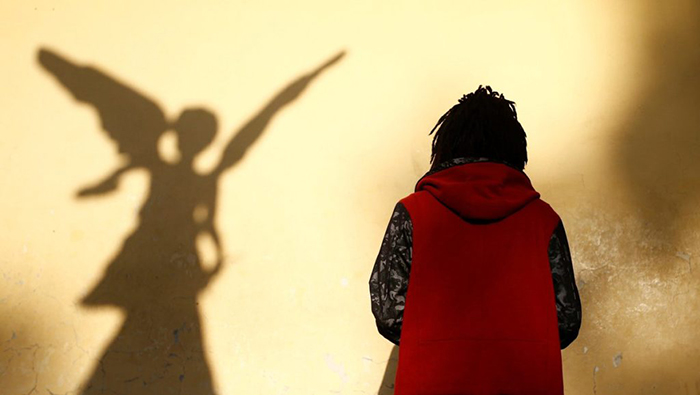
Scripture details how Jesus often went into the desert to places where he could be alone with the Father. The desert, scripture assures us, is where God is especially near. God sends his angels to minister to us when we are in the desert and the garden of Gethsemane. The desert, as we know, is a place that is stripped of everything that generally nourishes and supports us. We are exposed to chaos, raw fear, and demons of every kind. In the desert, we are exposed, body and soul, made vulnerable to be overwhelmed by chaos and temptations of every kind. But precisely because we are so stripped of everything we usually rely on, this is also a privileged moment for grace. Why? Because all the defense mechanisms, support systems, and distractions that we usually surround ourselves with to keep chaos and fear at bay work at the same time to keep much of God’s grace at bay. What we use to buoy us upwards off both chaos and grace, demons and the divine alike. Conversely, when we are helpless, we are open. That is why the desert is both the place of chaos and the place of God’s closeness. It is no accident that while feeling all is lost, God’s presence shows up. Just at that point in our lives, when we have lost everything that can support us, we find ourselves in the desert of life. And scripture assures us that it is there that God can send angels to minister to us.

HTML Snippets Powered By : XYZScripts.com