
In the beginning was the Word, and the Word was with God, and the Word was God. John 1:1

For some, Christmas is for the children, a feast where we let their delight and freshness challenge our cynicism. For others, it’s the opposite: we insist rather that Christmas is an adult feast, something kids don’t ultimately understand, something that celebrates the greatest intellectual mystery of all time, God taking on flesh to bring justice to the earth.

And so some of us send Christmas greetings urging delight, celebration, gifts, lights, and joyous song, while some of us send more stark greetings that say: “May the peace of Christ disturb you!” What is Christmas?

Christmas is about all of these things, and more. Like a diamond turning in the sun, it gives off many sparkles. Christmas is about the monumental challenge to reform our lives, our adult lives, and become women and men of justice; but it is also about a baby being born, innocent and powerless in the straw, whose vulnerability is God’s invitation and judgment. It is too, as Karl Rahner once said, God giving us permission to be happy. Thus, Christmas is a both something to be delighted in and a peace that should disturb us, something for children and for adults.

Christmas is about much deeper things than Santa, and the birth of Jesus is not just some delightful fairy tale meant to warm the heart. We measure time by this event. Christmas is about God being born physically and historically into this world and, among many other things, we have some stunning lessons to learn from the manner in which this happened.

As virtually all of our iconography around Christmas makes clear, God is born, not as some superstar whose earthly power, beauty, and muscle dwarf us. No. God is born as helpless, vulnerable, thoroughly under-whelming baby who looks out at us quietly even as we look back at him and he judges us in that way that vulnerability judges false strength, forever, transparency judges lies, generosity judges selfishness, innocence judges over-sophistication, and a baby, gently and helplessly and disarmingly, calls forth what’s best in us.

Christmas is meant to bring us back to the crib so that our hearts can feel that freshness that wants to make us start living over again. [Excerpt from Ron Rolheiser’s “An Invitation Inside of Christmas” December 2022]

He has raised up a horn for our salvation within the house of David, his servant. Luke 1:69

One morning, King David was returning from battle with some of his soldiers. When he arrived at the temple, he was tired and hungry, but the only food available consisted of consecrated loaves of bread in the temple, which by Jewish religious law, were to be eaten only by the priests in sacred ritual. David asked the high priest for the loaves and was met by the objection that these loaves were not to be eaten as ordinary food. David replied that he was aware of that, but, given the situation and given that as King he was empowered to make decisions for God on earth, he ordered the priest to give him the loaves.

Biblical tradition commends David for that. He is praised for doing a good thing, for knowing God well enough to know that God would want that bread to be used for exceptional purposes in that situation. He is praised for having a mature faith, for not being unduly legalistic, for not abdicating sound judgment because of fear and piety, and for knowing God well enough to know that God is not a law to be obeyed but rather a loving presence that counsels us and imbues us with life and energy.

Jesus, too, praises David for this action when his own disciples are chastised for shelling corn on the Sabbath.  He refers to David’s action of feeding his hungry soldiers with the consecrated loaves as an act of deeper understanding, that is, in doing this seemingly sacrilegious act, David was in fact demonstrating an intimacy with God that his critics, because of fear, betrayed themselves as lacking.

One of the things that characterizes mature friendship is a familiarity and intimacy that makes for a robust relationship rather than a fearful one. In a mature relationship there is no place for fearful piety or false reverence. Rather with a close friend we are bold because we know the other’s mind, fully trust the other, and are at a level of relationship where we are unafraid to ask for things, can be shamelessly self-disclosing, are given to playfulness and teasing, and are (like King David) able to responsibly interpret the other’s mind.  When we are in a mature relationship with someone we are comfortable and at ease with that person.

According to John of the Cross, the deeper we move into a relationship with God and the more mature our faith becomes, the bolder we will become with God. Like King David and like the young boy just described, fearful piety will be replaced by a healthy familiarity.  And this will not be the kind of familiarity that breeds contempt; that takes the other for granted. Rather, it will be the kind of familiarity that is grounded in intimacy, which, while remaining respectful and never taking the other for granted, is more at ease and playful than fearful and pious in that other’s presence.

But, if that is true, then what are we to make of the fact that scripture tells us “the fear of God is the beginning of wisdom” and the fact that religious tradition has always deemed piety a virtue? Do fear and piety militate against “boldness” with God? Was King David wrong in his bold interpretation of God’s will.

We should not let ourselves be fooled by fear and piety. Fear easily masks itself as religious reverence. Piety can easily pass itself off as religious depth. But genuine intimacy unmasks both. A healthy relationship is robust, bold, and is characterized by lack of fear, ease, playfulness, and humor. And that is particularly true of our relationship with God. [Excerpt from Ron Rolheiser’s “Boldness with God” May 2013]

Lo, I am sending my messenger to prepare the way before me. Malachi 3:1

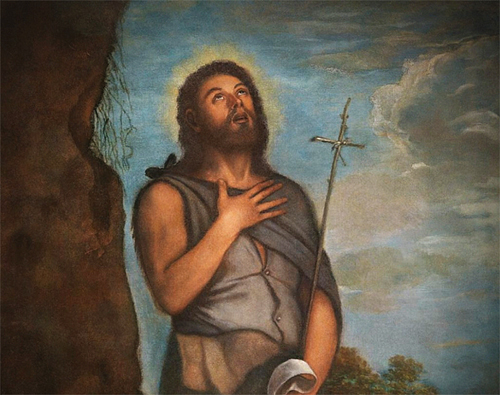
John the Baptist tries to prepare the way for Jesus by calling people to repentance: “Repent for the kingdom if heaven is near.” Whatever else that means, it includes the idea that one of the best ways we can prepare for Christmas is by making a good, honest, searing confession. To repent means to confess our sins.

This notion has fallen out of favor. The idea of confession is very much challenged today. Arguments against it take many forms: “I don’t find it meaningful!” “It’s too privatized!” “There isn’t any need to do this to have one’s sins forgiven! God doesn’t need our mediation.” “It gives undue power to the priest!” “This is an affair between God and myself.” “It’s adolescent!” “The priests don’t have time to do it properly.” Whatever the objection, and there are many, less and less people are going to confession.

This is an unfortunate development because private confession is one of the pillars of the spiritual life. At a certain point in one’s growth, there is no progress without it. Why? Why confession? Simply put, confession is the sacrament of the mature and one grows mature by confessing one’s sins. Mature people face themselves and apologize explicitly – and people grow mature by apologizing.

You are as sick as your sickest secret!” That’s an axiom popular among people working in 12-step programs. They know the truth of that through personal experience. They also know that until one faces oneself, in searing honesty, before another human being and there acknowledges openly his or her sins, there will always be addictions, rationalization, and lack of real transparency.

Confession is not so much about having one’s sins forgiven as it is about coming to maturity within the community and being able to live a transparent life, free of dark secrets, addictions, and rationalization.

The Baptist’s message is as true today as it was 2000 years ago. To make straight the path for the coming of the Savior, to make a proper advent, to prepare ourselves to have Christ born in our lives, we need to undergo a baptism for the remission of sin. In simple talk, that means, among other things, making a searing, honest, open, confession. [Excerpt from Ron Rolheiser’s “Readying Ourselves For Christmas” December 1999]

He has filled the hungry with good things, and the rich he has sent away empty. Luke 1:53

There are many things that we can celebrate with the Blessed Virgin Mary in her Magnificat we read in today’s gospel reading. Anne Dillard, in her recent book, For the Time Being, asks why we celebrate it when, as she writes, “He has cast down the mighty from their thrones, and has lifted up the lowly. He has filled the hungry with good things, and the rich he has sent away empty!… [Yes, but] I have seen the rich sit secure on their thrones and send the hungry away empty.

Dillard herself, as is evident from the rest of this book and her writings in general, does not have a problem in understanding or accepting that God’s blessings flow into us mainly through our poverty. Her protest is precisely in view of, as she says, putting “things on a solid footing.”  We believe that all God’s actions show forth wisdom and love, but that is not, as she points out, immediately and everywhere evident, which is not quite the same thing as saying that it is not everywhere true. It is.

How so? If, in fact, we do see people who are materially comfortable and also spiritually rich (and the reverse), then how is God sending the rich away empty and filling the hungry?

The first thing that needs to be said is that this cannot be understood except through faith, and real faith does not share the shallow, cynical view that spiritual riches are in fact a feeble compensation for the goods of this world. The promise of a spiritual inheritance is not poor pittance when stacked against actual material comfort, the enjoyment of luxury, good looks, sexual attractiveness, achievement, fame, and admiration by the world; though from Marx, through Freud, through millions of people today, the view is out there that what the gospel promises is, if one has the courage to face it, a huge rationalization for missing out in life, a poor excuse for living. Dillard does not share that view. Neither do I.

Even outside of faith, simply with the eyes of this world, ultimately this truth already makes itself plain. The poor do get fed and the rich do go away empty. How?

What becomes more evident every day as one grows older is that, already in this life, happiness, meaning, family, love, and joy are dependent upon the acceptance of a certain vulnerability, an emptiness in the biblical sense. Whenever we have the sense that we are not poor and hungry – when we feel self-sufficient, rich, in possession of what we need, satiated, and in control – then, whether we want to or not, we begin to push people away and many of those closest to us, all on their own, simply begin to move away from us. That is why it is so often the case that after years of sweat and effort, when we finally arrive at where we have wanted to be for so long, we find ourselves frighteningly alone and surrounded by the wrong kind of people. At the summit of our successes, at our proudest worldly moments, we look around for real family, for old friends, and for the type of simple joys we once took for granted and find that these aren’t there any more as they once were. If we’re honest, we soon realize that we have, even if we didn’t want to, jettisoned these along the way because, in the illusion of strength, we began to travel alone.

It’s no secret that we admire the rich and the strong, but we hate them too, unless we sense in them a poverty and a vulnerability that lets us be close to them. At the end of the day, we can only get close to each other when we are vulnerable. It is no accident too, but rather a testimony to a deep truth at the heart of the gospel and at the centre of life itself, that material comfort, money, good looks, worldly success, and being admired by the world, do not translate automatically nor easily into happy family, reliable friends, peace of heart, and a sense of security.

When we are rich, we do go away hungry and mostly alone – unless, of course, our poverty, vulnerability, and emptiness remain the true ground of who we really are. [Excerpt from Ron Rolheiser’s “God Sends The Rich Away Empty!” May 1999]

When Joseph awoke, he did as the angel of the Lord had commanded him and took his wife into his home. Matthew 1:24

There are countless persons, basilicas, churches, shrines, seminaries, convents, and even towns and cities named after St. Joseph. My native country, Canada, has him as its patron.

Who exactly is this Joseph? He is that quiet figure prominently named in the Christmas story as the husband of Mary and the stepfather of Jesus, and then basically is never mentioned again. The pious conception of him is that of an older man, a safe protector to Mary, a carpenter by trade, chaste and holy, humble and quiet, the perfect patron for manual laborers and anonymous virtue, humility incarnate.

But what do we really know about him?

In the Gospel of Matthew the annunciation of Jesus’ conception is given to Joseph rather than to Mary: Before they came together, Mary was found to be with child by the Holy Spirit. Joseph, her husband, being an upright man and unwilling to shame her, had decided to divorce her quietly, when an angel appeared to him in a dream and told him not to be afraid to take Mary as his wife, that the child in her had been conceived through the Holy Spirit.

What can we learn from this text?

Partly it is symbolic: The Joseph of the Christmas story is clearly reminiscent of the Joseph of the Exodus story, he too has a dream, he too goes to Egypt, and he too saves the family. Likewise King Herod is clearly the counterpart of the Egyptian Pharaoh; both feel threatened and both kill the Hebrew male children only to have God protect the life of the one who is to save the people.

But, after that, the Joseph of the Christmas story writes his own history: He is presented to us as an “upright” man, a designation that scholars say implies that he has conformed himself to the Law of God, the supreme Jewish standard of holiness. In every way he is blameless, a paradigm of goodness, which he demonstrates in the Christmas story by refusing to expose Mary to shame, even as he decides to divorce her quietly.

What actually happened here?

Joseph does something else that is not so evident: He shows how a person can be a pious believer, deeply faithful to everything within his religious tradition, and yet at the same time be open to a mystery beyond both his human and religious understanding.

And this was exactly the problem for any Christians, including Matthew himself, at the time the Gospels were written: They were pious Jews who didn’t know how to integrate Christ into their religious framework. What does one do when God breaks into one’s life in new, previously unimaginable ways? How does one deal with an impossible conception? Here’s how Raymond Brown puts it: The hero of Matthew’s infancy story is Joseph, a very sensitive Jewish observer of the Law. … In Joseph, the evangelist was portraying what he thought a Jew [a true pious believer] should be and probably what he himself was.

In essence, what Joseph teaches us is how to live in loving fidelity to all that we cling to humanly and religiously, even as we are open to a mystery of God that takes us beyond all the categories of our religious practice and imagination.

Isn’t that one of the ongoing challenges of Christmas? [Excerpt from Ron Rolheiser’s “Joseph and Christmas” December 2009]

I will not tempt the LORD! Isaiah 7:12

T.S. Eliot suggests in Murder in the Cathedral, a temptation can present itself as a grace, and that can be the case in terms of being virtuous. He illustrates this through the struggles of his main character, Thomas a Beckett. Beckett was the Archbishop of Canterbury from 1162 until he was murdered in his own Cathedral in 1170. As Eliot presents him, Beckett does all the right things. He is altruistic, radically faithful, resists all compromise, and is ready to accept martyrdom. However, as Eliot highlights, these can be “the temptations of the good person”, and it can take some time (and a deeper maturity) to distinguish certain temptations from grace. Hence, Eliot coined these now-famous lines:

Now is my way clear; now is the meaning plain:
Temptation shall not come in this kind again.
The last temptation is the greatest treason:
To do the right deed for the wrong reason.
For those who serve the greater cause
Make the cause serve them.

 Those who serve the greater cause can easily make the cause serve them, blind to their own motivation. Don’t we all know it! Those of us who work in ministry, in teaching, in administration, in the media, in the arts, and those of us who are habitual good Samaritans helping out everywhere, what ultimately drives our energy as we do all this good?

T.S. Eliot’s main character in Murder in the Cathedral is a man who does all the right things, is recognized for his goodness, but is someone who still has to examine himself as to his real motivation for doing what he does. What Eliot highlights is something which should give all of us who are trying to be good, virtuous, faithful persons, pause for reflection, scrutiny, and prayer. What’s our real motivation? How much is this about helping others and how much is about ourselves, about gaining respect, admiration, a good name – and having a good feeling about ourselves?

This is a hard question and perhaps not even a fair one, but a necessary one which, if asked, can aid us in our quest for a deeper level of maturity. In the end, are we doing good things because of what it does for others or because of what it does for us? This side of eternity our motivations are pathologically complex and mixed.

And behold, you will be silent and unable to speak until the day that these things take place, because you did not believe my words. Luke 1:20

Sometimes you want a trusted companion who meets you where you are and helps you find your way; a spiritual guide who listens deeply to your life, empowers you to explore a deeper relationship with the Holy, and helps you to be human.

I am noticing some unanswered prayers that need my attention.

In the Gospel of Luke, the archangel Gabriel delivered a stunning message to Zechariah: “For I have come to tell you that your prayer for a child has been answered. Your wife, Elizabeth, will bear you a son and you are to name him John.” Zechariah responded, “How can you expect me to believe this?” A legitimate question—Elizabeth’s barrenness had followed her all of her life and she was now too old to have children, and Zechariah was an old man.

As I read, I noticed a footnote in the Passion Translation I had previously overlooked: “I (the angel Gabriel) have come to tell you your prayer (the prayer you no longer pray anymore) has been answered.” The first time I read that, I gasped.

What prayers have I given up on?

Zechariah went mute for at least nine months because he failed to believe the angel. During that time, the Holy re-shaped Zechariah’s mind and heart by unsettling, disturbing, challenging, and pushing Zechariah’s faith to the malleable edges of who God was, God’s movement and activity in the world, and in Zechariah himself.

Unsettling, disturbing, challenging, pushing, re-tunneling, re-drawing… these are not easy words. There is no “comfortableness” in this process. Yet, this is how the Divine re-shapes the vision of the Godself and who I am as a human. It is uncomfortable, and it is hard.

I asked myself why I abandoned praying “those” prayers? Did I doubt Spirit’s intervention in my life and in the lives of those I love? Did I get lazy? What will it cost me to begin praying those prayers again? The present reality of the Incarnation calls for concrete involvement in real life, here and now.

In his book The Holy Longing, Ronald Rolheiser states that I now bear some responsibility for being the answer to prayers prayed. Because of the reality of the Incarnation, God’s power is now partially dependent upon my actions. I am not sure if I completely believe this but there is something there that rings true. There may be a comfort that is needed to be set down to fully embrace praying the prayers I no longer pray. There could be a need for a value shift or a different perspective.

Zechariah has helped me notice the invitation to begin praying prayers long abandoned and to acknowledge those abandoned prayers God has answered. He has helped me to be brave as God re-tunnels and disrupts my faith. Zechariah is a good companion on my journey of being human and helps me to be courageous as I begin praying prayers I abandoned long ago.[Excerpt from Becky Grisell’s “Unanswered Prayer” November 2021]

Behold, the virgin shall be with child and bear a son, and they shall name him Emmanuel, which means God is with us. Matthew 1:23

For many of us, I suspect, it gets harder each year to capture the mood of Christmas. About the only thing that still warms are hearts are memories, memories of younger, more naïve, days when the lights and carols, Christmas trees and gifts, still excited us.  But we’re adult now and so too, it seems, is our world.

Much of our joy in anticipating Christmas is blunted by many things, not least by the commercialism that today is characterized by excess. By late October we already see Christmas decorations, Santa is around in November, and December greets us with series of Christmas parties which exhaust us long before December 25th. So how can we rally some spirit for Christmas day?

The incarnate God is called Emmanuel, a name which means God-is-with-us. That fact does not mean immediate festive joy. Our world remains wounded, and wars, strikes, selfishness, and bitterness linger. Our hearts too remain wounded. Pain lingers. For a Christian, just as for everyone else, there will be incompleteness, illness, death, senseless hurt, broken dreams, cold, hungry, lonely days of bitterness and a lifetime of inconsummation. Reality can be harsh and Christmas does not ask us to make make-believe.

The incarnation does not promise heaven on earth. It promises heaven in heaven. Here, on earth, it promises us something else – God’s presence in our lives. This presence redeems because knowing that God is with us is what ultimately empowers us to give up bitterness, to forgive, and to move beyond cynicism and bitterness. When God is with us then pain and happiness are not mutually exclusive and the agonies and riddles of life do not exclude deep meaning and deep joy.

In the words of Avery Dulles: “The incarnation does not provide us with a ladder by which to escape from the ambiguities of life and scale the heights of heaven. Rather, it enables us to burrow deep into the heart of planet earth and find it shimmering with divinity.”  George Orwell prophesied that our world would eventually be taken over by tyranny, torture, double-think, and a broken human spirit. To some extent this is true. We’re a long ways from being whole and happy, still deeply in exile.

But something more important is still available, namely, the sense that God is with us in our lives, in our joys as well as in our shortcomings. The word was made flesh. That’s an incredible thing, something that should be celebrated with tinsel, lights, and songs of joy. If we understand Christmas, the carols will still flow naturally from our lips.[Excerpt from Ron Rolheiser’s “Incarnation – God is with Us” December 2016]

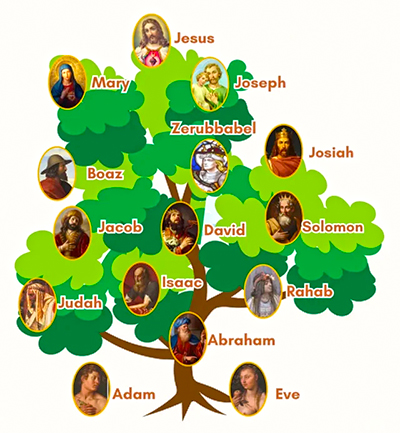
The book of the genealogy of Jesus Christ, the son of David, the son of Abraham. Matthew 1:1

The full story of how Jesus Christ came to be born includes elements that we do not easily imagine when we sing our Christmas hymns. Jesus’ family tree and bloodline were far from perfect, and this, according to the great biblical scholar Raymond Brown, needs to be kept in mind whenever we are tempted to believe in Jesus but want to reject the church because of its imperfections, scandals, and bad history. Jesus may have been immaculately conceived, but there is much in his origins, as the gospels make clear, that’s as un-immaculate as any contemporary church scandal.

For example, in giving us the origins of Jesus, the gospels point to as many sinners, liars, and schemers in his genetic and historical lineage as they do to saints, honest people, and men and women of faith.

We see, for example, in Jesus’ genealogy a number of men who didn’t exactly incarnate the love, justice, and purity of Jesus: Abraham unfairly banished Ishmael and his mother, Hagar, rationalizing that God favours some people over others; Jacob, by scheming and dishonesty, stole his brother Esau’s birthright; and David, to whom Jesus explicitly connects himself, committed adultery and then had the husband of his mistress murdered to cover-up an unwanted pregnancy and in order to marry her.

And the women mentioned in Jesus background aren’t much better. It’s interesting to note, as Raymond Brown does, which women don’t get mentioned in reference to Jesus’ origins. The gospels don’t mention Sarah, Rebekeh, or Rachel, all of whom were regarded as holy women. Whom do they mention?

They mention Tamar, a Canaanite woman, someone outside the Jewish faith, who seduces her father-in-law, Judah, so that she can have a child; Rahab, also a Canaanite woman, and an outsider, who is in fact a prostitute; Ruth, a Moabite woman who is also outside the official religion of the time; and Bathsheba, a Hittite woman, an outsider who commits adultery with David and then schemes to make sure one of her own offspring inherits the throne.

What’s to be learned for all of this? Perhaps Raymond Brown captures it the best. What all this tells us, he says, is that God writes straight with crooked lines, that we shouldn’t accept an overly-idealized Jesus Christ, and that our own lives, even if they are marked by weakness and insignificance, are important too in continuing the story of the incarnation.

Christianity isn’t just for the pure, the talented, the good, the humble, and the honest. The story of Jesus Christ was also written and keeps getting written too by the impure, by sinners, by calculating schemers, by the proud, by the dishonest, and by those without worldly talents. Nobody is so bad, so insignificant, so devoid of talent, or so outside the circle of faith, that he or she is outside the story of Christ.[Excerpt from Ron Rolheiser’s “Jesus’ Dysfunctional Family Tree” December 2004]

…but afterwards he changed his mind and went. Matthew 21:29

There’s an axiom which says: Nothing feels better than virtue. There’s a deep truth here, but it has an underside. When we do good things we feel good about ourselves. Virtue is indeed its own reward, and that’s good. However, feeling righteous can soon enough turn into feeling self-righteous. Nothing feels better than virtue; but self-righteousness feels pretty good too.

We are never free from struggle with sin. As we mature, sin simply takes on ever more subtle modalities inside us. We sometimes nurse the romantic notion that sinners are humble, aware of their need for forgiveness, and open to God.  In fact, as a generalization, this is true for the gospels. As Jesus was preaching, it was the Pharisees that struggled more with his person and message, whereas the sinners, the tax collectors and prostitutes, were more open to him. So this can pose a question: Does sin, more than virtue, make us aware of our need for God?

Yes, when the sin is honest, humble, admitted, and contrite or when our wrong actions are the result of being wounded, taken advantage of, or exploited.  Not all sin is born morally equal: There’s honest sin and dishonest sin. As human beings, we’re weak and lack the moral strength to always act according to what’s best in us. Sometimes we just succumb to temptation, to weakness. Sin needs no explanation beyond this: We’re human! Sometimes too, people are caught in sinful situations which are really not of their own making.

In situations like this, wrong action is a question of survival, not of free choice. As one woman described it to me: “I was simply a dog, biting in order not to be bitten.” In these cases, generally, beneath an understandably hardened, calloused surface lies a still innocent heart that clearly knows its need for God’s mercy. There’s such a thing as honest sin.

But there’s also sin that’s not honest, that’s rationalized, that’s forever buffered by a pride that cannot admit its own sinfulness. The result then, most often, is a hardened, bitter, judgmental soul. Finding ourselves as weak and sinful can soften our hearts, make us humble, and open us to receive God’s mercy. It can also harden our souls and make us bitter and judgmental.

Virtue makes us grateful. Sin makes us humble. That’s true. Sometimes. [Excerpt from Ron Rolheiser’s “Of Virtue and Sin” February 2017]

HTML Snippets Powered By : XYZScripts.com