Cast all your worries upon him because he cares for you. 1 Peter 5:6

St. Augustine writes that we are made for God, yet we cling to lesser securities. Our worries often expose disordered loves—attachments that we fear losing. To cast them onto God is not to deny their importance, but to place them in right relationship. Augustine would remind us that peace comes not from possessing or controlling, but from rightly trusting.

The words of 1 Peter—“Cast all your worries upon him because he cares for you”—sound simple, almost effortless. Yet the lived reality is far more complex: we are invited to release our burdens, and still we clutch them tightly, rehearsing them, carrying them, even identifying ourselves by them. The gap between invitation and response reveals something essential about the human heart.

Ron Rolheiser notes that much of our “baggage” consists of unresolved tensions we refuse to surrender. We say we trust God, but then continue to carry what we have already symbolically “given” to Him. For Rolheiser, this reveals that surrender is not a one-time gesture but a discipline. Like returning again and again to the altar, we must repeatedly place our burdens before God, knowing that we will be tempted to pick them back up as soon as we walk away.

Similarly, Henri Nouwen often observed that our worries are not just external pressures but interior habits. We carry them because they give us a strange sense of control, even identity. To let them go can feel like losing a part of ourselves. Nouwen would say that entrusting our burdens to God requires not just a decision, but a slow conversion of the heart—a repeated act of trust in the face of our instinct to hold on. We do not cling to worry because it works, but because it is familiar.

Richard Rohr frames this struggle as part of the deeper journey from the false self to the true self. The false self thrives on anxiety—it feeds on the illusion that everything depends on us. So even when we hear the invitation to “cast” our worries onto God, something in us resists, because letting go feels like losing control. Rohr would argue that this resistance is precisely where transformation happens. Each time we release our grip, even imperfectly, we participate in a kind of inner dying that opens us to a larger life in God.

The irony, then, is striking: we are offered freedom, yet we often choose burden. Not consciously, but habitually. We carry what God is willing to carry for us. And yet the invitation of 1 Peter remains patient and unchanging. It does not demand perfect surrender all at once. It simply asks us, again and again, to loosen our grip—to place one worry, then another, into the care of a God who does not grow weary of receiving them.

In the end, the spiritual life may look less like a single act of casting everything away, and more like a daily, even hourly, decision: to notice what we are holding, and to dare—however imperfectly—to let it go.

“Whoever eats my Flesh and drinks my Blood remains in me and I in him.” John 6:54

Ronald Rolheiser, OMI, interprets Jesus’ words in John 6, “Whoever eats my Flesh and drinks my Blood remains in me and I in him,” as a call to radical intimacy, where the Eucharist functions as God’s physical embrace, allowing Christ to become part of the believer’s very being. Rolheiser emphasizes that this teaching means we are meant to be nourished by Jesus’ life, ultimately becoming what we consume.

The Eucharist is a Divine Embrace more than simply a theological concept. It is a physical, affectionate embrace from God, comparable to a mother holding a child. This allows us to “remain” in Jesus and shows how he desires to be fully integrated into our lives—body, psyche, and spirit—just as food is integrated into our bodies to provide life.

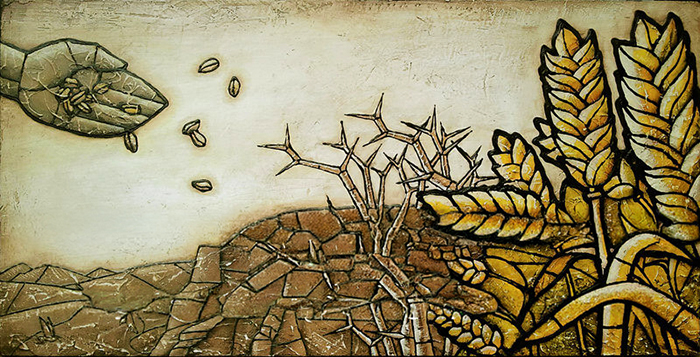
There is a popular t-shirt that reads “You Are What You Eat”. Rolheiser writes that we are called to become the body of Christ for the world. Just as grain is ground to make bread and grapes are crushed to make wine, eating his flesh means entering into a life of sacrifice, self-renunciation, and service to the marginalized.

Our reflection verse today from John’s Gospel underscores the Catholic understanding of the Real Presence, in which Jesus offers his actual life as food, serving as “new manna” that provides daily sustenance for our journey.

When Jesus tells the gathered disciples, “Whoever eats my Flesh and drinks my Blood remains in me and I in him,” any first-century Jew would see this statement as referring to cannibalism, and appropriately said back to the Lord, “This is a hard teaching.”

This doubt has continued into the twenty-first century, as more than half of self-professed Catholics do not believe in the Church’s teaching of Christ being literally present (spiritually, of course) in the bread and wine.

Rolheiser writes that we don’t have to fully comprehend this teaching. What the Church does ask of us is to be faithful in participating in it, trusting that the reception of the precious Body and Blood of Christ heals our personal loneliness and connects us to the “global loneliness” of a divided world.

“They shall all be taught by God.” John 6:45

The line “They shall all be taught by God” sits at the heart of the Gospel of John’s theology of grace: faith is not merely acquired—it is received. Jesus echoes the promise of the Book of Isaiah, where God himself becomes the interior teacher of His people. Across the centuries, theologians have returned to this verse to describe the mysterious way God forms the human heart from within.

Among the early Fathers, Augustine of Hippo saw this teaching as essential to understanding grace. In his reflections, he insists that no one truly comes to Christ unless they are inwardly drawn by God. External preaching, Scripture, and sacraments are necessary—but they remain incomplete without what Augustine calls the “interior illumination.”

Similarly, Thomas Aquinas teaches that God is the primary cause of all knowledge of divine truth. Human teachers can propose ideas, but only God can move the intellect to assent.

In the modern era, Henri Nouwen interprets this verse pastorally and personally. He often speaks of the “inner voice of love,” the gentle yet persistent presence of God speaking within the human heart. For Nouwen, being taught by God means learning to listen beneath the noise of the world to the deeper truth of one’s belovedness. It is less about acquiring doctrines and more about being formed in relationship—learning, slowly, to trust the voice that calls us “chosen” and “beloved.”

Ron Rolheiser suggests that God teaches us not only in moments of prayer but through restlessness, longing, and even struggle. The human heart’s ache for meaning becomes a classroom where God is the teacher. To be “taught by God” is to allow our desires to be purified and directed toward what truly satisfies—ultimately, communion with God.

“They shall all be taught by God” is not simply a promise of instruction, but of intimacy. God is not a distant lecturer but an indwelling teacher—forming, drawing, and awakening the soul. The verse ultimately invites a posture of receptivity: to be taught by God is to become attentive, humble, and open, trusting that beneath every authentic movement toward truth and love, God himself is already at work.

“For this is the will of my Father, that everyone who sees the Son and believes in him may have eternal life, and I shall raise him on the last day.” John 6:40

Jesus is the sole mediator who reveals and unites us to the Father. As theologians like Karl Rahner emphasize, we encounter the Father “through, with, and in Christ,” and eternal life is communion with God made possible through him.

Henri Nouwen writes that eternal life begins now as intimacy with God. In works like The Return of the Prodigal Son, he describes salvation as “coming home” to the Father—a movement from alienation to belonging. Belief in Jesus reveals the Father’s unconditional love and invites us into it. Eternal life is not just a future reward but participation in divine love here and now. It is the experience of being the “beloved,” reconciled not by our worthiness but by God’s initiative.

Richard Rohr writes that reconciliation with the Father is awakening to a union that has always been offered, and eternal life is participation in that divine life—what he calls living in the “Christ reality.” Belief is less about intellectual assent and more about entrusting oneself to this transformative relationship. Rohr emphasizes that Jesus reveals the universal pattern of divine love and union, seeing Christ as the “gateway” into experiencing God, not merely as a doctrinal requirement but as an invitation into transformation. Following Jesus leads us from the “false self” into our “true self” in God, a movement symbolized in death and resurrection. 

Ron Rolheiser frames reconciliation not merely as a juridical act (sins forgiven), but as a healing of a relationship that continues even beyond death. He suggests that in Christ, broken relationships are ultimately purified and brought into clarity—“it washes clean,” as he reflects on how death and grace reveal truth and restore communion. For Rolheiser, belief in Jesus opens us to a love that refuses to let estrangement have the final word. Reconciliation with the Father is an ongoing, embodied experience, primarily found through the Eucharist and the “hidden” surrender of loving others, which heals our alienation.

Reconciliation is thus deeply relational: it is being brought back into right relationship with God the Father, others, and even our own past. Eternal life, then, is not simply endless duration, but the fullness of reconciled communion.

The witnesses laid down their cloaks at the feet of a young man named Saul. Acts 7:58

The scene of Saul (later called Paul) consenting to the death of Stephen is one of the most unsettling—and ultimately hope-filled—moments in the New Testament. It places us face-to-face with the mystery of how zeal for God can become distorted, and how grace can transform even the most hardened heart.

Saul is not portrayed as a shallow villain; rather, he is deeply committed, convinced he is defending God’s honor. Ron Rolheiser frequently notes that some of the worst injustices in history have been carried out by people who believed they were doing right. In this light, Saul, standing by, approving the stoning of Stephen, reveals a sobering truth: religious passion, without humility and openness, can justify violence. Yet Rolheiser would also point out that this very zeal becomes, after conversion, the raw material God reshapes for mission. Nothing is wasted—not even our darkest moments.

Before condemning Saul, Henri Nouwen writes that we must acknowledge how often we fail to stand with the “Stephens” in our own lives. God’s gaze is never condemning but always calling—just as Saul, the persecutor, is later called by name and transformed. Saul’s rigid certainty had to collapse before he could encounter the risen Christ. The stoning of Stephen becomes, paradoxically, a moment that exposes the limits of legalistic religion and opens the possibility for grace. God uses even our wrong turns to lead us toward deeper truth; Saul’s fall is not the end of his story but the beginning of his awakening.

In the end, the martyrdom of Stephen and Saul’s consent to it reveal a profound Christian mystery: the same event that manifests human violence also becomes the seedbed of grace. Stephen’s forgiveness (“Lord, do not hold this sin against them”) echoes Christ’s own words and may well have lingered in Saul’s memory, preparing the soil for his encounter with Jesus on the road to Damascus. What appears as a triumph of hatred becomes, in God’s providence, the beginning of redemption.

This passage challenges us not only to condemn injustice but to examine our own certainties, our silences, and our capacity for transformation. It also offers a difficult hope: no life is beyond conversion, and no sin—however grave—lies outside the reach of grace.

Do not work for food that perishes but for the food that endures for eternal life, which the Son of Man will give you. John 6:27

Today’s verse has been a rich well for modern Catholic spirituality, especially among voices like Henri Nouwen, Ronald Rolheiser, and Richard Rohr. Each, in his own way, sees this teaching as a radical reorientation of human desire—away from anxiety-driven striving for what is temporary, and toward a deeper hunger that only God can satisfy.

In Life of the Beloved, Nouwen writes that much of our “work” in life is spent chasing emotional and spiritual substitutes—approval, success, productivity—that ultimately perish because they cannot ground our identity. For Nouwen, the “food that endures” is the experience of being loved by God, a love revealed and given in Christ, not earned. The shift Jesus calls for is not laziness but trust: to live and act from belovedness rather than for it.

Rolheiser, in works like The Holy Longing, notes that we are “aching bundles of infinite desire,” often misdirecting that desire into finite things—pleasure, achievement, control. In this sense, “working for food that perishes” is not just about materialism but about trying to make anything less than God carry the weight of ultimate meaning. The invitation of Christ is to allow our hunger to deepen rather than prematurely satisfy it, because that deeper hunger is itself the pathway to God. The Eucharist, for Rolheiser, becomes the concrete expression of this enduring food—where ordinary bread and wine become participation in divine life.

Rohr broadens the reflection by placing it within the pattern of transformation. In Everything Belongs, he frames “perishable food” as the ego’s projects—our attempts to construct a secure identity through accumulation, status, or even religious performance. These cannot last because they are rooted in a false self. The “food that endures,” by contrast, is participation in the life of God, which comes through surrender, contemplation, and union rather than acquisition. Rohr would say that Jesus is not merely offering better nourishment but inviting us into an entirely different way of being—one grounded in grace rather than grasping.

Taken together, these theologians and spirituality writers suggest that Jesus’ command is less about rejecting the material world and more about seeing it rightly. Work, success, and daily bread all have their place, but they cannot bear the weight of our deepest longing. The enduring food is ultimately Christ himself—received in faith, deepened in prayer, and, in Catholic life, encountered sacramentally. To live this teaching is to gradually shift the center of gravity in one’s life: from striving to receiving, from consumption to communion, and from the temporary to the eternal.

But God raised him up, releasing him from the throes of death, because it was impossible for him to be held by it. Acts 2:24

The words of King David echo across the centuries into the proclamation of the early Church in the Acts of the Apostles, where the mystery of Christ’s resurrection is revealed as the fulfillment of David’s deepest hope. David, who knew both the heights of intimacy with God and the depths of human frailty, spoke prophetically of one whose body would not see corruption, one who would not be abandoned to the realm of the dead. In him, the longing of Israel takes poetic form—a trust that God’s fidelity is stronger than death itself.

When the apostles declare that “God raised him up, releasing him from the throes of death, because it was impossible for him to be held by it,” they are not merely describing an event, but unveiling a divine necessity rooted in God’s own nature. Death, which holds all humanity in its grip, could not contain the Author of life.

In Jesus Christ, the promises glimpsed by David are brought to completion: the grave is not denied, but it is defeated from within. What David intuited in faith becomes, in Christ, a reality that reshapes the destiny of all creation. The resurrection is thus not only a victory over death, but a revelation that life—God’s life—is ultimately unconquerable, and that those who are united to Christ share in a hope that cannot be sealed in any tomb.

Fr. Ron Rolheiser often reflects on King David not simply as a historical king, but as a deeply human voice through whom God plants seeds of hope that only later come to full clarity. When David speaks in the Psalms of one who will not be abandoned to the grave, Rolheiser suggests that David himself did not grasp the full theological weight of his words. Rather, like much of Scripture, these lines are inspired longings—prayers that stretch beyond the consciousness of the one who utters them. They express a trust in God’s fidelity so radical that it dares to hope that death itself cannot have the final word.

In this light, when the early Church, as recorded in the Acts of the Apostles, proclaims that God raised Jesus Christ because it was “impossible” for death to hold him, Rolheiser sees a profound continuity. What David prayed in hope becomes, in Christ, a fulfilled reality. The “impossibility” is not about physical limits, but about the nature of God. A God who is pure love, communion, and life cannot ultimately be overcome by death.

Thus, the resurrection is not a reversal of Good Friday so much as the inevitable flowering of who God is. For Rolheiser, David’s ancient words become a kind of unconscious prophecy—an echo of divine life already at work in human longing—pointing toward a future in which death would be entered into but not allowed to reign.

They saw Jesus walking on the sea. John 6:19 

Our reflection verse on Jesus walking on water has long been understood as not simply a display of miraculous power, but as a profound revelation of God’s presence amid the chaos of human life. 

Fr. Ron Rolheiser emphasizes that the sea represents the turbulence, fear, and uncertainty we all face, while the disciples’ struggle mirrors our own experience of feeling overwhelmed and alone; yet Christ comes not after the storm has passed, but directly into it, revealing that faith does not eliminate life’s difficulties but enables us to encounter God within them.

In this light, Peter’s attempt to walk on the water becomes a vivid image of the spiritual life: when his gaze is fixed on Jesus, he transcends fear, but when he focuses on the wind and waves, he begins to sink—illustrating the fragile yet relational nature of faith, which depends not on our strength but on trust in Christ. 

St. Augustine deepens this understanding by describing the boat as the Church, the sea as the world, and the storm as the trials and persecutions believers endure, reminding us that even when Christ seems absent, he remains near and sovereign over all things. Thomas Aquinas highlights that this event also reveals Jesus’ divine authority, especially in his words, “It is I,” echoing the very name of God, and serving to strengthen the disciples’ faith for what lies ahead. 

Taken together, these reflections reveal a consistent theme: the story is not about escaping the storms of life, but about recognizing that Christ is already present within them, inviting us to trust him, to call out in our need, and to discover that his saving hand is always near.

“Gather the fragments left over, so that nothing will be wasted.” John 6:12

When reflecting on Jesus’ command after the feeding of the five thousand—“Gather the fragments left over, so that nothing will be wasted”—we see far more than a lesson in avoiding physical waste.

At one level, the instruction reveals something essential about God’s nature: divine generosity is never careless. God gives in abundance—far beyond immediate need—but that abundance is not meant to be ignored or discarded. Grace is extravagant, yet purposeful. Nothing given by God is meaningless or expendable.

Fr. Ron Rolheiser extends this to the spiritual and psychological dimensions of our lives, writing that the “fragments” symbolize the pieces of our own experience—moments, relationships, wounds, joys, failures, and even the parts of ourselves we are tempted to overlook or dismiss. We tend to discard what feels insignificant, broken, or incomplete. Yet Jesus’ command suggests that in the economy of God, nothing is wasted. Every fragment carries meaning and can be gathered into wholeness.

This has particular force in how we view our past. Regrets, missed opportunities, and suffering can feel like leftovers—unwanted remnants of a life we wish had gone differently. But Rolheiser’s insight points toward redemption: God gathers even these fragments and transforms them into something life-giving. What seems like excess or failure can become Eucharistic—taken, blessed, broken, and given again.

There is also a communal dimension. After the miracle, the disciples are instructed to gather what remains, not individually but together. This reflects the Church’s mission: to gather the scattered, to hold the pieces of human experience reverently, and to ensure that no person, no story, no suffering is lost or dismissed. The fragments are not just personal—they belong to the whole body.

Ultimately, the command speaks against a throwaway culture—not only materially, but spiritually and relationally. People are not disposable. Moments are not meaningless. Even the smallest acts of love, the faintest movements toward God, are worth gathering. In this light, Jesus’ words become a quiet but radical invitation: pay attention to what remains, honor what seems small or broken, and trust that in God’s hands, nothing—absolutely nothing—is wasted.

For the one whom God sent speaks the words of God. John 3:34

Our reflection verse from John’s Gospel tells us that when Jesus speaks, he speaks the words of the Father. If these are truly the words of God, and they are, how should we live differently today?

Fr. Ron Rolheiser writes that when Jesus speaks the words of God the Father, he is drawing us into the profound mystery at the heart of Christianity: that in Jesus Christ, God is not distant or abstract, but personally revealed. Jesus does not merely offer teachings about God; he embodies and communicates the very voice, will, and heart of the Father. As echoed in the Gospel of John—“Whoever has seen me has seen the Father”—Jesus becomes the living Word, not just a messenger but the message itself.

This insight should reshape how we listen to Jesus. His words are not simply moral guidance or spiritual poetry; they carry divine authority and intimacy. When he speaks of love, forgiveness, mercy, and sacrifice, he is unveiling the inner life of God. The command to “love one another as I have loved you” is not an abstract ethic but a direct participation in the love that flows eternally between Father and Son. To hear Jesus, then, is to hear God addressing us personally—calling, correcting, consoling, and inviting.

Rolheiser’s writing also challenges the tendency to domesticate or selectively interpret Jesus’ words. If Jesus speaks the Father’s words, then his teachings carry a weight that resists our preferences. His call to forgive enemies, embrace humility, and surrender self-interest is not optional spirituality but the very pattern of divine life. This can be unsettling, even demanding, because it confronts our instincts for control, comfort, and self-protection.

At the same time, there is deep consolation in this truth. If Jesus speaks the Father’s words, then every word he speaks is trustworthy. His promises—of rest for the weary, of mercy for sinners, of life beyond death—are not wishful thinking but grounded in God’s own fidelity. In moments of doubt or suffering, we are not left guessing what God is like; we can return to the words of Jesus and know we are hearing the voice of the Father who loves us.

To read the Gospels is not simply to study a text but to enter into a living encounter. It calls for a posture of listening—slow, prayerful, and open—where we allow Jesus’ words to shape not only our beliefs but our actions. If we take seriously that Jesus speaks the Father’s words, then our response cannot remain intellectual alone; it must become incarnational, lived out in love, just as his was.

HTML Snippets Powered By : XYZScripts.com