
“We do not know.” Matthew 21:27

One of the most famous mystics in history suggests that as we enter into deeper intimacy we concomitantly enter into a “cloud of unknowing”, namely, into a knowing so deep that it can no longer be conceptualized.  What does this mean?

First, imagine a baby in its mother’s womb.  In the womb, the baby is so totally enveloped and surrounded by the mother that, paradoxically, it cannot see the mother and cannot have any concept of the mother. Its inability to see or picture its mother is caused by the mother’s omnipresence, not by her absence. The mother is too present, too all enveloping, to be seen or conceptualized. The baby has to be born to see its mother. So too for us and God. Scripture tells us that we live, and move, and breathe, and have our being in God. We are in God’s womb, enveloped by God, and, like a baby, we must first be born (death as our second birth) to see God face to face. That’s faith’s darkness.

Next, looking at excessive light as being a darkness: If you stare straight into the sun with an unshielded eye, what do you see? Nothing. The very excess of light renders you as blind as if you were in pitch darkness. And that’s also the reason why we have difficulty in seeing God and why, generally, the deeper we journey into intimacy with God, the deeper we are journeying into Light, the more God seems to disappear and become harder and harder to picture or imagine.  We’re being blinded, not by God’s absence, but by a blinding light to the unshielded eye. The darkness of faith is the darkness of excessive light.

Lastly, knowing that deep intimacy is iconoclastic. The deeper our intimacy with anyone the more our pictures and images of that person begin to break down. Imagine this: A friend says to you: “I understand you perfectly: I know your family, your background, your ethnicity, your psychological and emotional temperaments, your strengths, your weakness, and your habits. I understand you.” Would you feel understood? I suspect not. Now imagine a very different scenario: A friend says to you: “You’re a mystery to me! I’ve known you for years, but you’ve a depth that’s somehow beyond me. The longer I know you, the more I know that you are your own mystery.”  In this non-understanding, in being allowed to be the full mystery of your own person in that friend’s understanding, you would, paradoxically, feel much better understood.

Saint John of the Cross submits that the deeper we journey into intimacy, the more we will begin to understand by not understanding than by understanding. Our relationship to God works in the same way. Initially, when our intimacy is not so deep, we feel that we understand things and we have firm feelings and ideas about God. But the deeper we journey, the more those feelings and ideas will begin to feel false and empty because our growing intimacy is opening us to the fuller mystery of God. Paradoxically this feels like God is disappearing and becoming non-existent.

Faith, by definition, implies a paradoxical darkness, the closer we get to God in this life, the more God seems to disappear because His overpowering light can seem like darkness.[Excerpt from Ron Rolheiser’s “The Hiddenness of God and the Darkness of Faith” November 2015]

Be patient, brothers and sisters, until the coming of the Lord. James 5:7

Thomas Halik, the Czech writer, would suggest that an atheist is someone who cannot be patient enough with God. There is a lot of truth in that. Patience with God is perhaps our greatest faith struggle. God, it would seem, is never in a hurry and because of that we live with an impatience that can test the strongest faith and the stoutest heart.

Life, as we can all attest to, is not without its bitter frustrations and crushing heartaches. We all live with a lot of pain and unresolved tensions…In this life, there’s no such a thing as a clear cut, pure joy; rather everything comes with shadow. We do in fact live inside a certain valley of tears.

When Jesus was dying on the cross, some onlookers were taunting him with the words: If you are the Son of God, let him rescue you! In essence:  God is real and your message is true, prove it right now! And God let Jesus die! The same held true for Jesus himself in the face of the death of Lazarus. In essence, he was being challenged:  If you possess God’s power in this world and you love this man, why don’t you save him from dying? Jesus let Lazarus die! And the first community of disciples, immediately after the Ascension, painfully struggled with the same question:  Jesus is God and he loves us – so why does he let us die?

And so we live with a lot of expressed and unexpressed impatience with God. Atheists, it would seem, at a certain point just give up on playing the game and, in essence, say the words: I’ve seen enough; I’ve waited enough; and it’s not enough! I will no longer wait for God! But if atheism is just another way of saying I will no longer wait for God then the opposite is also true: Faith is just another way of saying: I will wait for God. If atheism is impatience, faith is patience.

Why the need for such great patience?  Does God want to test us? Does God want to see if we indeed have a faith that is worthy of a great reward? No. God has no need to play such a game, and neither do we. It’s not that God wants to test our patience. The need for patience arises out of the rhythms innate within life itself and within love itself. They need to unfold, as do flowers and pregnancies, according to their own innate rhythms and within their own good time. They cannot be rushed, no matter how great our impatience or how great our discomfort.[Excerpt from Ron Rolheiser’s “Patience with God” July 2012]

“But I tell you that Elijah has already come, and they did not recognize him but did to him whatever they pleased.” Matthew 17:12

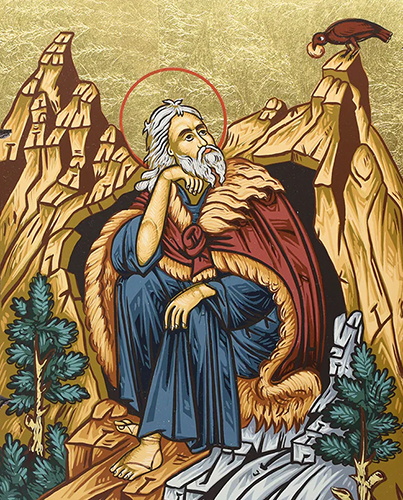
Many theologians view John the Baptist as fulfilling the role of Elijah—coming in his “spirit and power” (Luke 1:17) to prepare the way for the Messiah—rather than being a literal reincarnation, emphasizing John’s prophetic ministry of calling Israel to repentance and purification, much like Elijah confronted idolatry in his time to ready a remnant for God’s coming. Both figures served as radical, wilderness-dwelling prophets challenging the status quo, clearing the path for the Lord’s presence, though John’s “half-job” of denunciation needed Jesus’s empowerment for true salvation.

John the Baptist was aware of both his strength and his impotency. He could point out what’s wrong and what should be done, but after that, he was helpless, with nothing to offer in terms of the strength needed to correct the wrong.

In essence, that’s what we bring to any situation when we criticize something. We are able, often with brilliance and clarity, to show what’s wrong. That contribution, like John the Baptist’s, is not to be undervalued. The gospels tell us that, next to Jesus, there isn’t anyone more important than John the Baptist. But, like John, criticism too is only a half-job, a half-prophecy: It can denounce a king, by showing what’s wrong, and it can wash the soul in sand, by blasting off layers of accumulated rust and dirt, but ultimately it can’t empower us to correct anything. Something else is needed. What

At one point in the gospels, Jesus tells his disciples that it is easier for a camel to pass through the eye of needle than for a rich person to enter the kingdom of heaven. The disciples are stunned and Peter responds by saying: If that is the case than it is impossible! Jesus appreciates that response and adds: It is impossible for humans, but not for God. Anybody who is in recovery from an addiction knows exactly what Jesus means by that. They’ve experienced it: They know that is impossible for them to give up the object of their addiction – and yet they are giving it up, not by their own willpower, but by some higher power, grace.

The gospels speak of this as a baptism and they speak of two kinds of baptisms: the baptism of John and the baptism of Jesus, adding that John’s baptism is only a preparation for Jesus’ baptism. What’s John’s baptism? It’s a baptism of repentance, a realization of what we are doing wrong and a clear resolution to correct our bad behavior. What’s Jesus’ baptism? It’s an entry into grace and community in such a way that it empowers us internally to do what is impossible for us to do by our willpower alone.

Sadly, many of us, who are solid believers, still haven’t grasped the lesson. We’re still trying to live out our lives by John’s baptism alone, that is, by own willpower. That makes us wonderful critics but leaves us mostly powerless to actually change our own lives. What we are looking for, and desperately need, is a deeper immersion into the baptism of Jesus, that is, into community and grace. [Excerpt from Ron Rolheiser’s “Willpower Alone is Not EnoughSeptember 2012]

A great sign appeared in the sky, a woman clothed with the sun, with the moon under her feet, and on her head a crown of twelve stars. Revelation 12:1

There’s an axiom that says: Roman Catholics tend to adore Mary while Protestants and Evangelicals tend to ignore Mary. Neither is ideal. Mary is pre-eminently the Mother of the poor. Karl Rahner once pointed out that when you look at all the apparitions of Mary that have been officially approved by the church you will notice that she has always appeared to a poor person – a child, an illiterate peasant, a group of children, someone without social standing. She’s never appeared to a theologian in his study, to a pope, or to a millionaire banker. She’s always been the person to whom the poor look.

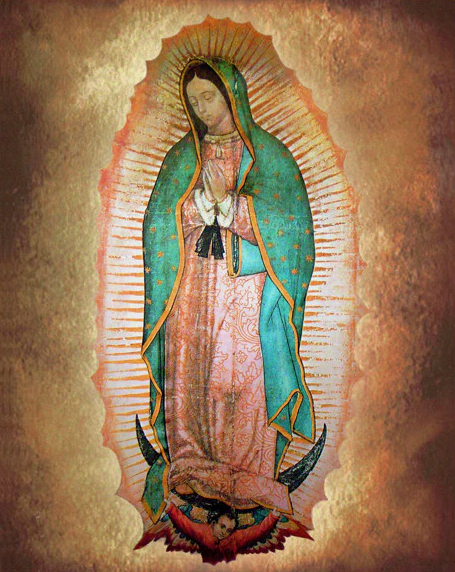
We see this, for example, very powerfully in the effect that Our Lady of Guadalupe has had on much of Latin America. In all of the Americas, most of the indigenous peoples are now Christian. However, in North America, while most of the indigenous peoples are Christian, Christianity itself is not seen as a native religion, but rather as a religion brought to the native peoples from elsewhere. In Latin America, in every place where Our Lady of Guadalupe is popular, Christianity is seen to be a native religion.

At the wedding feast of Cana, Mary tells her son (who is always divine in John’s Gospel) that “they have no wine”.  In John’s Gospel, this is not just a conversation between Mary and Jesus; but also a conversation between the Mother of Humanity and God. Secondly, as Eve, as universal mother, and as our mother, she stands in helplessness under human pain and within human pain when she stands under the cross. In this, she shows herself as universal mother but also as an example of how injustice must be handled, namely, by standing within it in a way that does not replicate its hatred and violence so as to give it back in kind. Mary offers us a wonderful example, not to be adored or ignored. [Excerpt from Ron Rolheiser’s “The Mary of Scripture and the Mary of Devotions” June 2018]

Whoever has ears ought to hear. Matthew 11:15

Where does God speak in our world? How does God speak?

Whenever you hear a voice that sounds coercive, threatening, overbearing, that is somehow loud and in your face, you can be sure that, no matter how religious and holy it might claim to be, it is not God’s voice. God’s voice in this world is never coercive or overbearing in any way, but is always an invitation and a beckoning that respects you and your freedom in a way that no human institution or person ever does. God’s voice is thoroughly underwhelming, like a baby’s presence.

God’s voice does judge and it does condemn, but it judges and condemns not by coercive force, but in the same way that the innocence of a baby judges false sophistication, in the way that generosity exposes selfishness, in the way that big-heartedness reveals pettiness, in the way that light makes darkness flee, and in the way that the truth shames lies. God’s voice judges us not by overpowering us but by shining love and light into all those places were we find ourselves huddled in fear, shame, bitterness, hostility, and sin.

We need to view God, always, as non-coercive, as an invitation. This has immense implications for everything to do with church and religion, from how we preach, to how we catechize, to how we do liturgy, to how we reach out to those who don’t share our beliefs, to how we approach divisive moral issues, to how loud we turn up the sound system in our churches. God’s voice is not a loud, coercive, overbearing, threatening voice, one that gets into your face whether you like it or not. Rather, God’s voice invites in, beckons, leaves you free, and is as non-threatening as the innocence and powerlessness of a baby – or a saint. [Excerpt from Ron Rolheiser’s “God’s Voice as Invitation” April 2007]

For my yoke is easy, and my burden light. Matthew 11:30

“…inside each of us there’s a deep place, a virginal center, where all that’s tender, sacred, cherished, and precious is held and guarded. …It’s where we unconsciously remember that once, long before consciousness, we were caressed by hands far gentler than our own. It’s where we still sense the primordial kiss of God.” (“Coping with our own Souls”, Father Ron Rolheiser).

Once in a dream I experienced what could have been that beginning of consciousness. I seemed to come from an unbounded existence like God’s energy. Suddenly I  was confined to a moment, a movement. I rebelled. And I knew sin.

Innocence and sin are a human experience. As a child I remember one hot day in a hay slough when two of my brothers and I stripped off our clothes and climbed a fallen tree that leaned slightly above ground. This was like Adam and Eve before the fall, the innocence of Eden. As Christians we can return to that childhood innocence. Jesus redeems our fallen nature as we pray in the Eucharistic prayer, “Unite us to your Son in his sacrifice, that we may be made acceptable through him, being sanctified by the Holy Spirit.”

Jesus wants to walk with us. “Come to me, all you who labor and are burdened, and I will give you rest. Take my yoke upon you and learn from me, for I am meek and humble of heart, and you will find rest for yourselves. For my yoke is easy, and my burden light.” (Matthew 11:28-30). “Walk with me,” Jesus is saying. Learn from me. Be humble as the God who wants to walk with us. Jesus promises us rest and an easier burden. Even our hardest burdens become bearable with Christ’s shoulders taking some of the weight.

We can live in the presence of the Lord, loving others and sharing God’s grace. That is our mandate every Sunday morning as we go forth from our churches to love and serve the Lord. We can choose to accept Jesus as a companion in life. We can share our burdens and our joys with the one who suffered for us. “Come to me,” he invites.[Exceprt from Ken Rolheiser’s “Walking with Jesus”]

It is not the will of your heavenly Father that one of these little ones be lost. Matthew 18:14

One of the marks of a Christian heart is the desire for inclusivity, the desire to ultimately be in communion with as many people as possible, to have everyone in heaven with you without demanding that they become just like you to get there. Sadly, we tend to harbor the opposite attitude, though we are slow to admit this.

Too often we have an unconscious mantra which says: I can only be good, if someone else is bad. I can only be right, if someone else is wrong. My dogma can only be true, if someone else’s is false. My religion can only be right, if someone else’s is wrong. My Eucharist can only be valid, if someone else’s is invalid. And I can only be in heaven, if someone else is in hell.

However, scriptures make it clear that God’s salvific will is universal and that God’s deep, constant, passionate longing is that everyone, absolutely everyone, regardless of their attitude and actions, be somehow brought into the house. God, it seems, does not want to rest until everyone is home, eating at the same table.

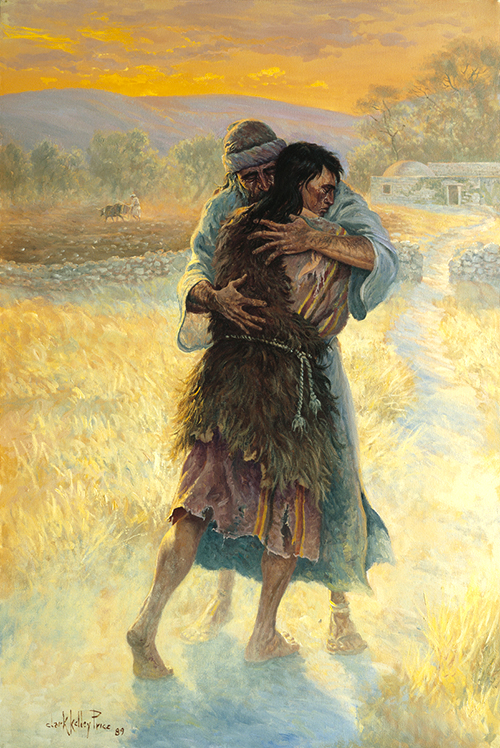
This same dynamic holds true for the shepherd who leaves the 99 sheep to search for the lost sheep. For a Hebrew at that time, the number 99 did not designate wholeness, but the number 100 did. The shepherd is like the mother with the alienated daughter, he cannot rest until his family is once again made whole. We see the same longing, passion, and sadness in the Father of the prodigal son and older brother. He cannot rest, nor be at peace, until both his sons are back in the house. He is overjoyed when his wayward son returns but the story ends with him still outside the house, trying to coax his other son, outside because of anger, to also come inside. His heaven includes both his sons.

Our heaven too must be a wide one. Like the the shepherd who has lost a sheep, and like the father of the prodigal son and older brother, we too shouldn’t rest easy when others are separated from us. The family is only happy when everyone is home.

What ultimately characterizes a genuine faith and a big heart is not how pure our churches, doctrines, and morals might be, but how wide is the embrace of our hearts. [Excerpt from Ron Rolheiser’s “How Large is your Heaven?” December 2010]

“Hail, full of grace! The Lord is with you.” Luke 1:28

“Blessed is the womb that bore you and the breasts that nursed you!” Picture the scene: Jesus has just impressed a crowd and a woman, probably a mother, shouts out: “You must of had a wonderful mother!” Jesus responds something to this effect: “Yes, I had a wonderful mother, though in ways you don’t imagine. She was wonderful not because she gave me biological birth, all mothers do that. What made her a great mother is that she gave me birth in the faith.”

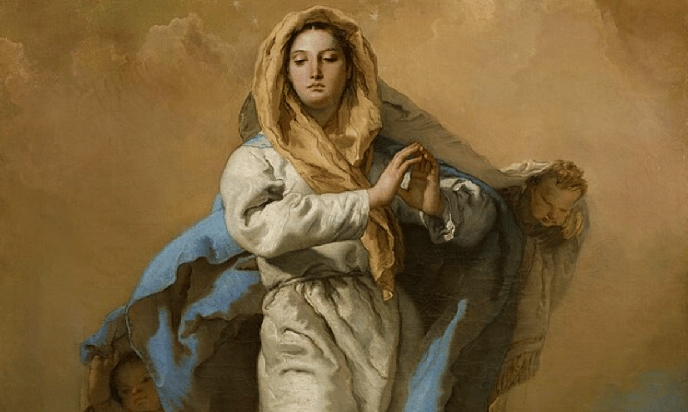
Today the Church celebrates the Solemnity of the Immaculate Conception of the Blessed Virgin Mary which acknowledges the long-held belief that Mary was preserved from original sin from the moment of her conception, a foundational mystery of salvation.

Pope Pius IX in 1854 defined the dogma of the “Immaculate Conception of Mary” to codify the centuries of belief, from scripture passage like “Hail, full of grace” and writings from the early Church Fathers who called Mary “spotless” and “immaculate.”

Mary is the ultimate disciple, one who fully cooperated with God’s grace, and whose life helps us understand our own calling to give flesh to faith. Mary, too, needed Jesus as her Savior, but her preservation from sin from the first instant (the Immaculate Conception) was a unique work of God’s grace, not something she merited.

The Immaculate Conception isn’t just about Mary; it’s a sign for us that God wants us to be holy, to be filled with His grace, and to overcome the “immaculate deceptions” of our own pride and ego.

Mary’s Immaculate Conception provides profound hope and a vision of what God intends for humanity—a pure vessel to bring Christ into the world, echoing the Church’s universal hope in salvation.{Excerpt from Ron Rolheiser’s “Mary as a Model of Faith” December 2003]

By endurance and by the encouragement of the Scriptures we might have hope. Romans 15:4

There is a Norwegian proverb that reads: Heroism consists of hanging on one minute longer. Scripture teaches much the same thing about moral heroism: In the Second Letter to the Thessalonians, Paul ends a long, challenging admonition by stating: You must never grow weary of doing what is right. And in his letter to the Galatians, Paul virtually repeats the Norwegian proverb: Let us not become weary of doing good, for at the proper time we will reap a harvest if we do not give up.

Mature Christians put up with a lot of tension in helping to absorb the immaturities and sins of their churches. Men and women are noble of character precisely when they can walk with patience, respect, graciousness, and forbearance amid crushing and unfair tensions, when they never grow weary of doing what is right.

Of course this comes with a caveat: Carrying tension does not mean carrying abuse. Those of noble character and sanctity of soul challenge abuse rather than enable it through well-intentioned acquiescence. Sometimes, in the name of virtue and loyalty, we are encouraged to absorb abuse, but that is antithetical to what Jesus did. He loved, challenged, and absorbed tension in a way that took away the sins of the world. We know now, thanks to long bitter experience, that, no matter how noble our intention, when we absorb abuse as opposed to challenging it, we don’t take away the sin, we enable it.

But all of this will not be easy. It’s the way of long loneliness, with many temptations to let go and slip away. But, if you persevere and never grown weary of doing what is right, at your funeral, those who knew you will be blessed and grateful that you continued to believe in them even when for a time they had stopped believing in themselves.

Endurance is the ability to keep going when everything in you wants to give up. It’s not just about speed—it’s about stamina. In the Kingdom, finishing matters more than starting. Many begin strong, but few endure until the end. That’s where the power lies. Endurance doesn’t mean you never get tired—it means you don’t quit. It’s powered by grace. Fueled by vision. Encouraged and strengthened by scripture.

The LORD is our Judge, our Lawgiver, our King; he it is who will save us. Isaiah 33:22

There’s a question about God’s goodness as old as religion itself: How can an all-good God send someone to hell for all eternity? How can God be all-merciful and all-loving if there is eternal punishment? It’s a false question. God doesn’t send anyone to hell and God doesn’t deal out eternal punishment. God offers us life and the choice is ours as to whether we accept that or not.

God, Jesus tells us, doesn’t judge anyone. We judge ourselves. God doesn’t create hell and God doesn’t send anyone to hell. But that doesn’t mean that hell doesn’t exist and that it isn’t a possibility for us. Here, in essence, is how Jesus explains this – God sends his life into the world and we can choose that life or reject it. We judge ourselves in making that choice. If we choose life, we are ultimately choosing heaven. If we reject life, we end up living outside of life and that ultimately is hell. But we make that choice, God doesn’t send us anywhere. Moreover, hell is not a positive punishment created by God to make us suffer. Hell is the absence of something, namely, living inside of the life that’s offered to us.

To say all of this is not to say that hell isn’t real or that it isn’t a real possibility for every person. Hell is real, but it isn’t a positive punishment created by God to deal out justice or vengeance or to prove to the hard-hearted and unrepentant that they made a mistake. Hell is the absence of life, of love, of forgiveness, of community, and God doesn’t send anyone there. We can end up there, outside of love and community, but that’s a choice we make if we, culpably, reject these as they are offered to us during our lifetime.

As Jesus tells us in John’s Gospel: “God did not send the Son into the world to condemn the world, but in order that the world might be saved through him. Those who believe in him are not condemned; but those who do not believe are condemned already, because they have not believed in the name of the only Son of God. And this is the judgment, the light has come into the world, and the people loved darkness rather than light….I judge no one.”

Hell is the pain and bitterness, the fire, we experience when we culpably put ourselves outside of the community of life. And it is always self-inflicted. It is never imposed by God. God doesn’t deal death and God sends nobody to hell – He doesn’t need to.[Excerpt from Ron Rolheiser’s “God Judges No One” September 2009]

HTML Snippets Powered By : XYZScripts.com