
So I tell you, her many sins have been forgiven; hence, she has shown great love. But the one to whom little is forgiven, loves little.” Luke 7:47

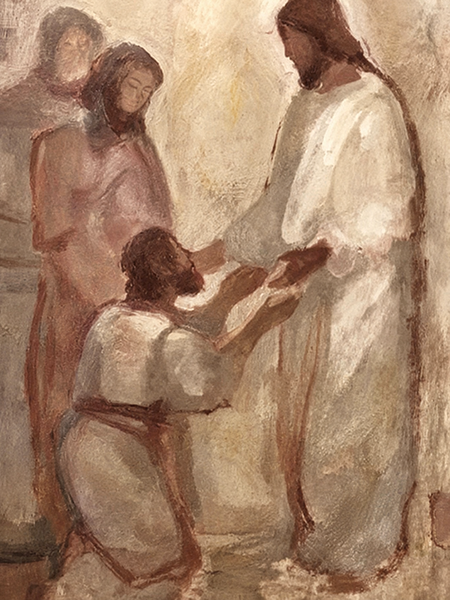
Jesus is dining in the home of Simon, a Pharisee, when a woman known in the city as a sinner enters carrying an alabaster flask of ointment. She stands behind Jesus, weeping. Her tears fall upon his feet; she wipes them with her hair, kisses them, and anoints them with the ointment.

Luke does not tell us what her sins were. We should therefore resist the long-standing tendency to identify her sins or assume that they were sexual. What matters to the Gospel is not the particular history of her sin, but the depth of her repentance and the extravagance of her love.

She says nothing. Her tears become her confession. Her humility becomes her prayer. Her tenderness toward Jesus reveals what has already taken place within her heart: she has encountered mercy.

Simon sees a sinner who should not be there. Jesus sees a daughter who has come home.

The woman in Simon’s house knows that she needs mercy. Simon believes that he needs very little. This is why she responds to Jesus with tears, tenderness, and extravagant love, while Simon remains distant and restrained.

Her love does not purchase forgiveness. Her love reveals that forgiveness has already reached her heart. Grace comes first; gratitude follows. She loves greatly because she has discovered that her many sins do not place her beyond the mercy of God.

Simon’s real poverty is that he does not recognize his poverty. He can see the woman’s sins but cannot see his own pride and lack of compassion. Jesus therefore challenges not only those burdened by obvious failure, but also those who believe they have little need of forgiveness.

The passage asks us to stop comparing our debt with someone else’s. Before God, none of us can repay what we owe. We all stand in need of the mercy offered through Christ’s Cross and Resurrection.

When we truly understand how much we have been forgiven, gratitude begins to reshape us. We become less judgmental, more compassionate, and more willing to forgive. Mercy received becomes mercy given.

(If I) do not have love, I am nothing. 1 Corinthians 13:2

The word Paul uses for love is agapē: a love that seeks the good of another. This love is more than affection, attraction, politeness, or emotional warmth. It is the decision to give oneself for another, even when doing so is difficult, inconvenient, or costly.

Christian love does not begin with the worthiness of the person being loved. It begins with the love of God poured into us. As Saint John writes: “We love because he first loved us.”

We do not create this love by our own strength. We receive it from God and then allow it to pass through us. Love is therefore both God’s gift and our response. Grace gives us the capacity to love, but we must consent to that grace through concrete choices.

This is why love cannot remain merely an idea. It becomes real through patience with a difficult person, forgiveness of someone who has wounded us, attention to the lonely, mercy toward the sinner, protection of the vulnerable, and faithfulness when no recognition is offered.

Love is not simply something we feel. It is the form that the life of Christ takes within us. Paul is exposing the illusion that knowledge, influence, religious activity, or spiritual gifts can substitute for conversion of heart.

– We may know the teachings of the Church and still fail to love.
– We may defend the truth and use it as a weapon.
– We may serve in ministry while secretly craving recognition.
– We may speak about mercy while refusing to forgive.
– We may receive the Eucharist while remaining indifferent to the suffering
person beside us.

Paul’s words invite us to examine not only what we do, but the spirit in which we do it. This is why love is powerful. It is not passive sentimentality. Love can cross divisions, interrupt cycles of anger, restore dignity, create forgiveness, and bring hope into places where despair seemed final. Love possesses this power because it participates in the life of God, for “God is love.”

Jesus is the fullest revelation of the love Paul describes. On the Cross, Christ shows us that love is more than affection: it is the gift of oneself for the life of another. In the Eucharist celebration, we receive this self-giving Christ so that his love may take flesh in us. We are nourished by the Body of Christ so that we may become his loving presence in the world by freely giving that love away as we have freely received it.

“Behold, your mother.” John 19:27

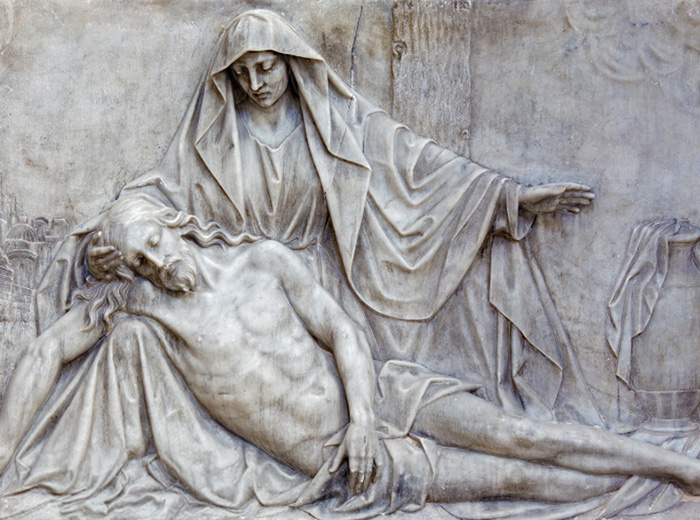
The Memorial of Our Lady of Sorrows brings us to Calvary, where Mary stands beneath the Cross of her Son. She cannot stop his suffering. She cannot remove the nails, silence the mockery, or prevent his death. She can only remain—and her remaining is itself an extraordinary act of faith and love.

John tells us that Mary was “standing by the cross of Jesus”. She is not described as collapsing in despair or fleeing from what she cannot bear. She stands. Her sorrow is real, but it does not extinguish her faithfulness. The mother who once said, “May it be done to me according to your word,” now lives that surrender in its most painful form.

When Mary and Joseph presented the infant Jesus in the Temple, Simeon warned her: “You yourself a sword will pierce.” At the Cross, that prophecy reaches its terrible fulfillment. Mary is not physically crucified, yet she suffers spiritually with her Son. The sword piercing Christ’s body also pierces the heart of his mother.

Her sorrow is more than the natural grief of a mother losing her child. Mary watches the innocent Son of God bear humanity’s rejection, violence, and sin. She sees the One whom she carried, nursed, protected, and followed surrender his life for the very world that crucifies him.

Even as he suffers, Jesus sees his mother and the beloved disciple standing near her. He says to Mary:

“Woman, behold, your son.”

Then he says to the disciple:

“Behold, your mother.”

These words certainly express Jesus’ tender concern for Mary. He entrusts her to someone who will care for her after his death. But within John’s Gospel, the scene carries a deeper meaning.

Jesus does not call her “Mother” but “Woman,” just as he did at the wedding feast of Cana. This title reaches back toward the woman of Genesis and points forward to the woman of Revelation. Mary appears as the New Eve: the woman whose faithful obedience stands in contrast to humanity’s disobedience. Beside the New Adam, she participates through faith in the birth of a new humanity.

To behold Mary as our mother is to welcome the woman who first welcomed Christ. It is to learn from her how to ponder God’s Word, surrender to his will, carry Christ into the world, and remain faithful when God’s purposes pass beyond our understanding.

Who, though he was in the form of God, did not regard equality with God something to be grasped. Philippians 2:6

As we celebrate today the Feast of the Exaltation of the Holy Cross, our reflection turns to two verses from today’s readings, one from Philippians and the other from John’s Gospel, as they bring into focus the very nature of his mission.

St. Paul proclaims that Christ existed “in the form of God,” yet did not treat his divine equality as something to be exploited for his own advantage. Instead, he emptied himself, assumed the condition of a servant, entered fully into human life, and became obedient even to death on a cross.

Jesus did not cease to be God. Rather, he revealed what God is truly like. The self-emptying of Christ is not the temporary abandonment of divinity; it is the visible expression of divine love. In Jesus, we discover that God’s power is not the power to dominate, possess, or condemn. It is the power to give himself completely so that others may live.

Philippians 2:6 explains how God fulfills the saving purpose proclaimed in John 3:17. God did not send his Son to stand above the world in judgmental separation. The Son entered the world, took upon himself our humanity, and descended into the depths of human sin, suffering, rejection, and death.

The cross is sometimes understood only as something done to Jesus by sinful humanity. Philippians shows us that it is also the freely chosen culmination of his self-giving mission. Jesus does not grasp power; he gives himself. He does not answer violence with greater violence. He enters into the violence of the world and absorbs it without allowing it to extinguish his love.

God saves the world through the Son’s refusal to use divine power for self-preservation. The crucified Christ reveals that God would rather bear the wounds of the world than abandon the world to its wounds.

When divine light enters the world, it reveals what is hidden. We may receive that light and allow ourselves to be transformed, or we may retreat into the darkness of selfishness and fear. Christ does not come seeking our destruction; he comes offering the life we were created to receive.

Jesus does not merely tell us that God wishes to save the world. Through his Incarnation, service, suffering, death, and resurrection, he shows us what saving love looks like. It is love that descends, love that serves, love that bears wounds, and love that never ceases to seek the lost.

Could anyone nourish anger against another and expect healing from the LORD? Sirach 28:3

Sirach places before us a searching spiritual question. It does not merely ask whether we sometimes feel anger. Anger is a natural human response to injury, injustice, betrayal, or loss. Even Jesus experienced righteous anger when human dignity and the holiness of God were violated.

The danger appears in the word “nourish.” To nourish something is to feed it, protect it, return to it, and allow it to grow. Sirach is therefore describing more than a passing emotion. He is speaking of anger that has been welcomed into the heart and given a permanent home.

We nourish anger when we repeatedly rehearse the injury, imagine revenge, assume the worst about the offender, or allow what another person did to define how we see them. The original wound may have been inflicted upon us, but the anger we continue to feed gradually becomes an additional wound within us.

The healing in Sirach is not a “quid pro quo” –  If I forgive, God must cure my illness or remove all my suffering. Scripture does not promise that every act of forgiveness will produce immediate physical healing.

The healing envisioned here is deeper and more comprehensive. It includes the restoration of the person’s relationship with God, the liberation of the heart from resentment, and the gradual recovery of the capacity to love.

Jesus makes the connection between receiving mercy and extending mercy especially clear in the parable of the unforgiving servant. The servant received mercy externally, but mercy never entered deeply enough to transform his heart. He wanted to be released from his own debt while continuing to hold another person captive.

Yet in refusing mercy, he also remained captive.

This is the spiritual paradox identified by Sirach: we cannot fully receive healing while continually feeding the very resentment that resists healing. The mercy of God must not merely reach us; it must also begin to pass through us.

When we release hatred, surrender vengeance, and begin to desire another’s true good, the hold of the injury begins to weaken, and the pathway to forgiveness and reconciliation becomes clearer.

“Why do you call me, ‘Lord, Lord,’ but not do what I command?” Luke 6:46

It is possible to speak the language of faith without allowing faith to transform us. We may call Jesus “Lord,” attend Mass, receive the sacraments, pray regularly, and affirm the teachings of the Church—yet continue to be ruled by resentment, pride, fear, selfishness, or indifference. Our lips may confess Christ while our choices reveal that something else governs our lives.

Jesus is exposing the distance that can develop between profession and practice. His question is not directed only toward obvious hypocrisy; it confronts the quiet contradictions present in every disciple. We call him Lord, yet withhold forgiveness. We praise his mercy, yet judge another person harshly. We ask him to provide for us, yet refuse to share with those in need. We pray for his will to be done, yet cling tightly to our own.

To call Jesus “Lord” is more than using a religious title. It is to acknowledge that he has authority over our desires, relationships, possessions, decisions, and manner of life. In the biblical sense, obedience is not blind submission to an arbitrary ruler. It is the trusting response of someone who believes that the Lord’s commands lead to freedom, communion, and life.

Jesus’ question is not meant to drive us into shame but to awaken us from spiritual complacency. He invites us to examine honestly where our confession and our conduct have become separated:

Where do I call Jesus “Lord” while still insisting upon having my own way? Whom has he commanded me to forgive, love, welcome, or serve? What teaching of Christ do I admire in principle but resist in practice?

The credibility of Christian faith depends not simply upon how clearly we proclaim Jesus as Lord, but upon whether others can encounter his mercy, humility, justice, and love through us. The world has heard Christians say, “Lord, Lord.” What it longs to see is a people whose lives demonstrate what those words mean.

An obligation has been imposed on me. 1 Corinthians 9:16b

When Paul says that an obligation has been imposed upon him, he is not describing Christianity as a burdensome set of religious duties. His obligation comes from grace. Because he has encountered Christ’s mercy, he can no longer live as though that encounter never happened.

Paul’s “obligation,” therefore, is the responsibility created by love. When we have received something capable of giving life to others, remaining silent or refusing to live differently becomes a denial of the gift itself.

Through Baptism, each Christian is joined to Christ and incorporated into his Body. Through Confirmation, the baptized are strengthened by the Holy Spirit to bear witness to Christ. Every disciple therefore participates in the Church’s mission.

Not every Christian is called to preach publicly as Paul did. Not everyone will become a missionary, theologian, catechist, or ordained minister. But every Christian is called to make the Gospel visible.

We preach the Gospel whenever:

– we forgive rather than seek revenge;
– we protect the dignity of another person;
– we remain honest when dishonesty would benefit us;
– we care for the poor, forgotten, lonely, or suffering;
– we speak about our faith with humility and courage;
– we bring reconciliation into divided relationships;
– we allow Christ’s mercy to shape our judgments;
– we place love of God and neighbor above personal convenience.

here is a difference between knowing the teachings of Jesus and allowing those teachings to govern our lives. We may know that Christ commands forgiveness while continuing to nurture resentment. We may profess concern for the poor while protecting ourselves from their suffering. We may receive the Eucharist while refusing communion with people whom God has placed in our lives.

To “live out the Gospel” means allowing the life of Christ to take visible form within us. It means that our choices, relationships, use of money, treatment of others, exercise of authority, and response to suffering gradually reveal whom we belong to.

Do to others as you would have them do to you. Luke 6:31

Our reflection verse today comes from Luke’s Gospel and Jesus’ teaching on loving our enemies. He gives this teaching within his command to bless those who curse us, and pray for those who mistreat us. Therefore, the “other” is not limited to our family, friends, fellow Christians, or people who treat us well.

The other is every person placed before us: the stranger, the poor, the forgotten, the irritating coworker, the person who disagrees with us, and even the one who has wounded us. Jesus removes the boundaries we often place around love.

This command is sometimes called the Golden Rule, but Jesus means more than simple fairness or reciprocity. He does not say, “Treat people well because they may treat you well in return.” Christian love does not wait to see what another person deserves. It takes the initiative because God has already loved us with mercy. We are asked to give others the patience, forgiveness, dignity, understanding, and compassion that we ourselves hope to receive.

Recognizing this call in everyday life requires us to pause and look beyond our first reaction. Before speaking, deciding, judging, posting, purchasing, leading, or correcting, we might ask: If I were in this person’s situation, how would I hope to be treated? Am I protecting this person’s dignity? Does my response reveal the mercy of Christ? The “other” often appears disguised as an interruption, an inconvenience, a disagreement, or someone whose story we do not yet understand.

Doing to others what we would want done to us does not mean approving harmful behavior, abandoning healthy boundaries, or allowing ourselves to be abused. We may need to confront wrongdoing, say no, or step away from a dangerous situation. Yet even correction can be offered without hatred, humiliation, or revenge. Christian love seeks both truth and the genuine good of the person.

Jesus asks us to see every human encounter as an opportunity to make God’s love visible. The other is not merely someone standing outside of us; the other is our neighbor, bearing the image of God and sharing our need for mercy. Each day Christ asks us to become for someone else what we ourselves most need: a patient listener, a forgiving heart, a truthful companion, a defender of dignity, and a living sign that no person is beyond the reach of God’s love.

And he came down with them and stood on a stretch of level ground. Luke 6:17

Luke introduces Jesus teaching on the “Sermon on the Plain” with an easily overlooked detail: the Lord “came down” from the mountain and stood on “a stretch of level ground.” Jesus had spent the night on the mountain in prayer and had chosen the Twelve. But he did not remain above the people. He descended to where they were gathered—among the sick, the poor, the troubled, and those tormented by unclean spirits.

This movement reveals something fundamental about the Incarnation. God does not remain distant from the suffering of humanity. In Jesus Christ, God comes down and stands on our level ground. He enters the ordinary places of hunger, rejection, conflict, grief, and human need. Before Jesus teaches the crowd, he allows them to approach him, touch him, and receive healing.

Jesus then announces that the poor, hungry, grieving, and rejected are blessed—not because suffering is good, but because suffering will not have the final word. God sees those whom the world overlooks. The corresponding woes warn those who are comfortable not to build their lives upon possessions, satisfaction, amusement, or human approval.

At the center of the sermon is Jesus’ command to love our enemies. This does not require us to approve of wrongdoing or abandon justice. It means refusing to allow hatred to shape our hearts. Jesus will fulfill this teaching upon the Cross when he prays for those who crucify him. His Resurrection reveals that merciful love is stronger than hatred and death.

Jesus calls us to examine ourselves before condemning others, to recognize a tree by its fruit, and to build our lives upon his words. Hearing the Gospel is not enough. The teaching of Christ must become visible in the way we forgive, speak, serve, give, and love. The person who hears his words and lives them builds upon rock. The storms may still come, but the foundation will remain.

Joseph, son of David. Matthew 1:20

When the angel calls Joseph “son of David,” he is doing more than identifying Joseph’s ancestry. He is reminding Joseph that he belongs to the covenantal family through which God promised to bring the Messiah. Joseph may appear to be an ordinary craftsman, but God sees him as an essential participant in salvation history.

Joseph is asked to take Mary into his home and to name her child Jesus. By naming him, Joseph accepts the child as his own and gives him legal standing within the house of David. Joseph is not Jesus’ biological father, but his faithful fatherhood enables Jesus to be publicly recognized as the promised Davidic Messiah.

The angel’s command, “Do not be afraid,” does not remove every mystery from Joseph’s life. Instead, it invites him to trust God beyond what he can understand. Joseph responds without recorded words: he awakens and does what God commands. His faith becomes obedience, protection, responsibility, and loving presence.

“Joseph, son of David” reminds us that God knows who we are even when we have forgotten the deeper meaning of our lives. Like Joseph, we belong to a story larger than ourselves. God may ask us to welcome what we did not plan, protect what is vulnerable, and take the next faithful step without seeing the entire road.

Joseph teaches us that when we make room for Christ in faithful obedience, even the quietest life can become part of God’s saving work.

HTML Snippets Powered By : XYZScripts.com