
Owe nothing to anyone, except to love one another; for the one who loves another has fulfilled the law. Romans 13:8

You can safely assume you’ve created God in your own image when it turns out that God hates all the same people you do” – Anne Lamott.

Those are words worth contemplating, on all sides of the political and religious divide today. We live in a time of bitter division. From our government offices down to our kitchen tables there are tensions and divisions about politics, religion, and versions of truth that seem irreparable.  Sadly, these divisions have brought out the worst in us, in all of us.

Where do we go with that? I am a theologian and not a politician or social analyst so what I say here has more to do with living out Christian discipleship and basic human maturity than with any political response. So, what does it mean to love in a time like this?

Fyodor Dostoevsky famously wrote that love is a harsh and fearful thing, and our first response should be to accept that. Love’s harshness is felt most acutely in the (almost indigestible) self-righteousness we have to swallow in order to rise to a higher level of maturity where we can accept that God loves those we hate just as much as God loves us – and those we hate are just as precious and important in God’s eyes as we are.

Once we accept this, then we can speak for truth and justice. One of our contemporary prophetic figures, Daniel Berrigan, despite numerous arrests for civil disobedience, steadfastly affirmed that a prophet makes a vow of love, not of alienation. Hence, in our every attempt to defend truth, to speak for justice, and to speak truth to power, our dominant tone must be one of love, not anger or hatred.

Moreover, whether we are acting in love or alienation will always be manifest – in our civility or lack of it. No matter our anger, love still has some non-negotiables, civility and respect. Whenever we find ourselves descending to adolescent name-calling, we can be sure we have fallen out of discipleship, out of prophecy, and out of what is best inside us. [Excerpt from Ron Rolheiser’s “What is Love Asking of Us Now?” January 2021]

We, though many, are one Body in Christ and individually parts of one another. Romans 12:5

Gabriel Marcel once famously stated, To say to someone ‘I love you’ is to say, ‘you will never be lost’. As Christians, we understand this in terms of our unity inside the Body of Christ. Our love for someone links him or her to us, and since we are part of the Body of Christ, he or she too is linked to the Body of Christ, and to touch Christ is to touch grace. Thanks to the marvels of the Incarnation, every sincere Christian can say, ‘my heaven includes this or that particular person whom I love.’ We used to call this “baptism by desire”, except that in this instance the desire for “baptism” is on our part, but still equally efficacious.

A GPS, limitless in its patience, keeps ‘recalculating’, and keeps giving us a new instruction until we get to our destination. It never gives up on us. God is the same. We have an intended destination and God gives us constant instructions along the way.  Religion and the church are an excellent GPS. However, they can be ignored and frequently are. But, God’s response is never one of anger nor of a final impatience. Like a trusted GPS, God is forever saying ‘recalculating’ and giving us new instructions predicated on our failure to accept the previous instruction. Eventually, no matter our number of wrong turns and dead ends, God will get us home.

Ultimately, God is the only game in town, in that no matter how many false roads we take and how many good roads we ignore, we all end up on the one, same, last, final road. All of us: atheists, agnostics, nones, dones, searchers, procrastinators, those who don’t believe in institutionalized religion, the indifferent, the belligerent, the angry, the bitter, and the wounded, end up on the same road heading towards the same destination – death. However, the good news is that this last road, for all of us, the pious and the impious alike, leads to God. [Excerpt from Ron Rolheiser’s “One God, One Guidance System, and One Road for Us All” August 2022]

If you remain in my word, you will truly be my disciples, and you will know the truth, and the truth will set you free. John 8:31-32

In scripture, Satan is called “the prince of lies”, not the prince of sex or the prince of greed. More than anything else, it’s lying that corrupts the soul, destroys relationships, and sets itself against light. Lying is darkness, the worst form of it. Jesus tells us that all sins can be forgiven, except one: If someone should blaspheme the Holy Spirit, he says, that would constitute an “unforgivable sin”. How does one blaspheme against the Holy Spirit? Why is this unforgivable?

The unforgivable sin against the Holy Spirit begins with lying, with rationalization, with the refusal to acknowledge the truth. But we don’t commit this sin easily, overnight, the first time we tell a lie. We commit it down the line, through a sustained series of lies, long after we first told a lie to our loved ones and began to hide important parts of our lives from them. The soul warps slowly, like an old board soaked too often in the rain. It’s not the first time it gets wet that makes the warp.

We commit the sin against the Holy Spirit when we lie for so long that we believe our own lies. If we lie long enough, eventually light begins to look like darkness and darkness begins to look like light. That’s especially true of the lie of a double life, when we are no longer honest with our loved ones. If we do that long enough, eventually our betrayals begin to look like virtue, our lies like the truth, and what our families, faith, and churches stand for begins to look like falsehood, death, darkness.

Our sin then becomes unforgivable because we no longer want to be forgiven or deem any need to be forgiven. When a sin is unforgivable it’s because we don’t want to be forgiven, not because we’ve crossed some moral line in the sand beyond which God will no longer tolerate our behavior. The blockage is rather that what we once saw as truth (honesty, faith, family, fidelity, health through transparency) now looks like falsehood and the behavior we once had to hide from others and lie about now seems as virtue.

In the film, Sex, Lies, and Videotapes, which is rather simplistic and crass at times, is a lesson that could be taken from John’s gospel: The hero of the story, a young man with a bad history in the area of sexuality, resolves to make himself better by making a vow to never again tell a lie, even a very small one. Like the man who’s born blind in John’s gospel, that vow brings him to health. He gets better, much better. He then sets up a video camera and invites people to come and tell their stories. Those who tell the truth also get better, healthier, and those who lie and hide their infidelities continue to deteriorate in both health and happiness. The truth does set us free.[Excerpt from Ron Rolheiser’s “The Truth Sets Us Free” July 2005]

The souls of the just are in the hand of God, and no torment shall touch them. Wisdom 3:1

The gospels emphasize that what Jesus suffered most deeply in his crucifixion was not the pain of being scourged and having nails driven through his hands, but a deep loneliness of soul that dwarfs even the most intense physical pain. Jesus wasn’t a physical athlete, but a moral one, doing battle in the arena with soul.

In the writings of Robert Coles, he suggests that inside each of us there’s a deep place, a virginal center, where all that’s tender, sacred, cherished, and precious is held and guarded. It’s there that we are most genuinely ourselves, most genuinely sincere, most genuinely innocent. It’s where we unconsciously remember that once, long before consciousness, we were caressed by hands far gentler than our own. It’s where we still sense the primordial kiss of God.

In this place, more than any other, we fear harshness, disrespect, being shamed, ridiculed, violated, lied to. In this place we are deeply vulnerable and so we are scrupulously careful as to whom we admit into this space, even as our deepest longing is precisely for someone to share that place with us. More than we yearn for someone to sleep with sexually, we yearn for someone to sleep with there, morally, a soulmate. Our deepest yearning is for moral consummation.

But this isn’t easy to find. Rare is the perfect moral partner, even inside of a good marriage or friendship. And so we perennially face a double temptation: Resolve the tension by settling for certain compensations, tonics, that help us make it through the night or, perhaps worse, because the pain is too much to live with, giving ourselves over to bitterness, anger, and cynicism, thus denigrating the great dream. Either way, we sell ourselves short and settle for second best.

What’s to be learned from Jesus’ struggle with moral loneliness? This: he refused both the road of compensatory tonics and that of soul-hardening cynicism. He stayed the course and carried the tension to term.

Our own moral loneliness can be tyrannical. However, that’s not a license or invitation to begin jettisoning commitments, responsibilities, morals, and whatever else it takes to try to find that elusive soulmate for whom we yearn so deeply. What Jesus (and persons like Therese of Lisieux and Simone Weil) model is how to carry that tension ideally, how to carry our solitude at a high level, and how to resist, no matter the pain, calling second-best by any other name than second-best.[Excerpt from Ron Rolheiser’s “Coping with our own Souls” July 2022]

Blessed are they who are persecuted for the sake of righteousness, for theirs is the Kingdom of heaven. Matthew 5:10

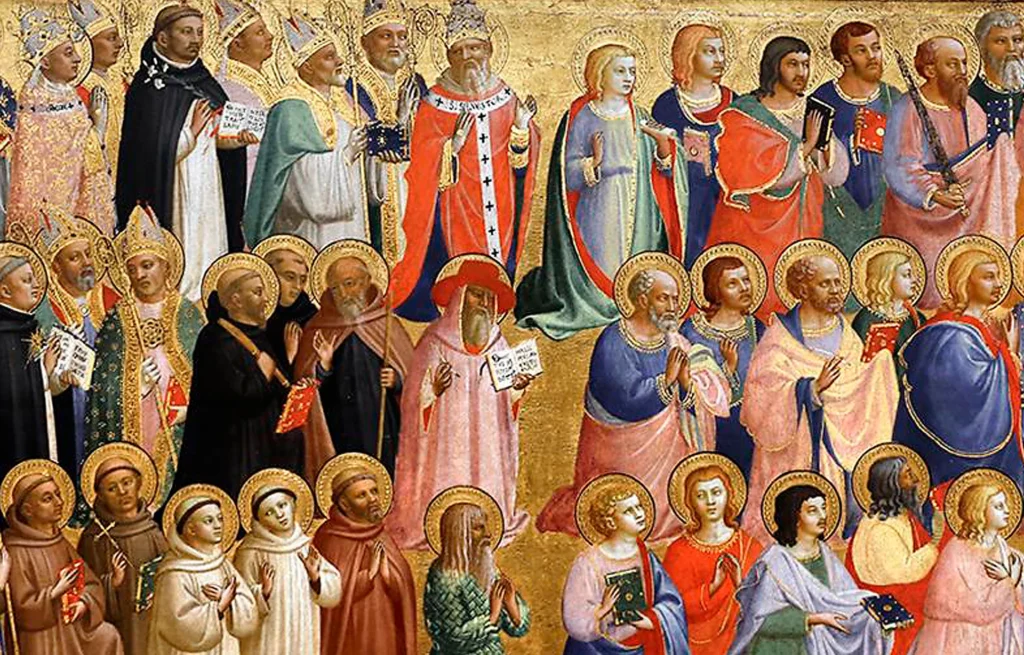
Robert Ellsberg’s new book, A Living Gospel – Reading God’s Story in Holy Lives continues his work as someone who writes up the lives of various saints so that they may serve as inspirations for the rest of us. It seems appropriate on All Saints Day to reflect on this new work.

When I was young, the lives of the saints were one of the major ways within which spirituality was taught. We each had a patron saint, every city had a patron saint, every parish had a patron saint, we all read the lives of the saints and were inspired to higher ideals by the likes of saints such as Tarcisius, stoned to death for protecting the Blessed Sacrament; Marie Goretti, willing to die rather than sacrifice her personal integrity; St. George, who by the power of faith could slay dragons; and St. Christopher, whose providential eye could you keep you safe while traveling.

Of course, looking back, one can see now where those who wrote up these stories often took liberties with historical fact to highlight essence. Indeed, both St. George and St. Christopher are now relegated more to the realm of fable than fact.  No matter, their stories, like those of the other saints we read, lifted our eyes a little higher, put a bit more courage in our hearts, gave us real life examples of Christian discipleship, and helped fix our eyes on what’s more noble.

Today we have a different version of the lives of the saints. The rich, famous, and successful have effectively replaced the saints of old. Butler’s Lives of the Saints has been replaced by People Magazine, biographies, television programs, and websites that picture and detail for us the lives of the rich and the famous. And these lives, notwithstanding the goodness you often see there, don’t exactly focus our eyes and hearts in the same direction as do the lives of Tarcisius, Marie Goretti, St. George, or St. Christopher.  In a culture which deifies celebrity, we need some different celebrities to envy. Robert Ellsberg is pointing them out.

In this book, among other things, Ellsberg chronicles the lives of four contemporary “saints”, Dorothy Day, Thomas Merton, Henri Nouwen, and Charles de Foucault (none of whom are yet canonized or might ever be.)  But, their lives, he believes, can help us define what following Jesus might mean inside the complexities of our own generation.

And this is true too for the Church as a whole. Commenting on the life of Charles de Foucauld, Ellsberg writes: “In an age when Christianity is no longer synonymous with the outreach of Western civilization and colonial power, the witness of Foucauld – poor, unarmed, stripped of everything, relying on no greater authority than the power of love – may well represent the future of the church, a church rooted in the memory of its origins and of its poor founder.” The saints have something for everyone! [Excerpt from Ron Rolheiser’s “An Important New Book” July 2019]

But they were unable to answer his question. Luke 14:6

Sam Keen holds both a master’s degree in divinity and a doctorate in the philosophy of religion. He calls himself a “trustful agnostic,” a “recovering Presbyterian” and wears a question mark rather than a cross around his neck. He sees himself as a searcher on a spiritual quest. He writes that in the spiritual quest you never, in this life, really arrive. For him, once a person settles into the practice of a religion, he or she can no longer claim to be on a spiritual quest. Spirituality has been traded in for religion.

In saying this, Keen speaks for our age. Spirituality is in, religion is out. Typical today is the person who wants faith but not the church, the questions but not the answers, the religious but not the ecclesial, truth but not obedience.

The churches are dying right in the middle of a spiritual renaissance. More and more typical too is the person who understands himself or herself as a “recovering Christian,” as someone whose quest for God has taken them out of the church. Why are so many people who are sincerely searching for God not turning to the churches? Why is there so much disillusionment with organized religion?

It is futile to argue that the world should perceive us, the churches, more kindly. You can’t argue with a perception! Better to admit our shortcomings. We are, right now, far from being the community we should be: We are intellectually slovenly, we don’t live adequately enough what we preach, we close off questions prematurely, and we radiate too little of the charity, forgiveness and joy of God.

Bluntly put, I don’t see a lot of people with question marks around their necks being crucified. There is too much glamor and too little commitment in it. Moreover there is also some intellectual dishonesty in it. The pure quest that does not want a hard answer is ultimately trying to avoid something, actual commitment. As C.S. Lewis puts it: “Thirst is made for water; inquiry for truth.” Sometimes what we “call the free play of inquiry has neither more or less to do with the ends for which intelligence was given than masturbation has to do with marriage.” The spiritual quest is about questions—and it is also about answers. [Excerpt from Ron Rolheiser’s “Questions Without Answers” September 1994]

When day came, he called his disciples to himself, and from them he chose Twelve, whom he also named apostles. Luke 6:13

“We may say that the gospels, especially Mark, are aware of a great variety of forms of participation in Jesus’ cause. There were the Twelve. There was a broader circle of disciples. There were those who participated in Jesus’ life. There were localized, resident adherents who made their houses available. There were people who helped in particular situations, if only by offering a cup of water. Finally, there were the beneficiaries who profited from Jesus’ cause and for that reason did not speak against it. These structural lines that run through the gospels are not accidental. In today’s church, because it is a shapeless mass, we can find all these forms expressed. It is a complex pattern, as complex as the human body. The openness of the gospels, the openness of Jesus must warn us against regarding people as lacking in faith if they are unable to adopt a disciple’s way of life or if it is something completely alien to them. In any event, Jesus never did.” [Excerpt from “Jesus of Nazareth” Gerhard Lohfink]

The similarity to Jesus’ time is obvious. When we look at church life today, especially as we see it lived out concretely within parishes, it is obvious that it is made up of much more than only the core, committed congregation, namely, those who participate regularly in church life and accept (at least for the main part) the dogmatic and moral teachings their churches. The church also contains a wide variety of the less-engaged: people who practice occasionally, people who accept some of its teachings, guests who visit our churches, people who don’t explicitly commit but are sympathetic to the church and offer it various kinds of support, and, not least, people who link themselves to God in more-privatized ways, those who are spiritual but not religious. As Lohfink points out, these people were already around Jesus and “they were not unimportant” to his mission.

This does not mean that there are tiers within discipleship, where some are called to a higher holiness and others to a lower one, as if the full gospel applies only to some. The full gospel applies to everyone, as does Jesus’ invitation to intimacy with him. Jesus doesn’t call people according to more or less.  Christian discipleship doesn’t ideally admit of levels, notches, layers, and different tiers of participation … but something akin to this does forever happen, analogous to what happens in a love relationship. Each individual chooses how deep he or she will go and some go deeper than others, though ideally everyone is meant to go its full depth.

There will always be a great variation in both depth and participation. Each of us has his or her own history of being graced and wounded, formed and deformed, and so we all come to adulthood with very different capacities to see, understand, love, accept love, and give ourselves over to someone or something beyond us. None of us is whole and none of us is fully mature. All of us are limited in what we can do, and all are around Jesus in different ways and we must be careful not to judge each other, given that Donatism and her adopted children are forever on the prowl. [Excerpt from Ron Rolheiser’s “Disciples with Many Faces” July 2014]

The Spirit itself bears witness with our spirit that we are children of God, and if children, then heirs, heirs of God and joint heirs with Christ, if only we suffer with him so that we may also be glorified with him. Romans 8:16-17

How can there be an all-loving and an all-powerful God if there is so much suffering and evil in our world? Christians believe that what is ultimately at stake is human freedom and God’s respect for it. God gives us freedom and (unlike most everyone else) refuses to violate it, even when it would seem beneficial to do so. That leaves us in a lot of pain at times, but, as Jesus reveals, God is not so much a rescuing God as a redeeming one. God does not protect us from pain, but instead enters it and ultimately redeems it.

The sisters of Lazarus, Martha and Mary, send a message to Jesus telling him that “the man you love” is gravely ill. Curiously though Jesus does not immediately rush off to see Lazarus. Instead he stays where he is for two more days, until Lazarus is dead, and then sets off to see him. When he arrives near the house, he is met by Martha who says to him: “If you had been here, my brother would not have died!” Basically her question is: “Where were you? Why didn’t you come and heal him?” Jesus does not answer her question but instead assures her that Lazarus will live in some deeper way.

Jesus does not engage the question in theory; instead he becomes distressed and asks: “Where have you put him?” And when they offer to show him, he begins to weep. His answer to suffering: He enters into peoples’ helplessness and pain. Afterwards, he raises Lazarus from the dead. And what we see here will occur in the same way between Jesus and his Father. The Father does not save Jesus from death on the cross even when he is jeered and mocked there. Instead the Father allows him to die on the cross and then raises him up afterwards.

God’s seeming indifference to suffering is not so much a mystery that leaves the mind befuddled as a mystery that makes sense only if you give yourself over in a certain level of trust. Forgiveness and faith work the same. You have to roll the dice in trust. Nothing else can give you an answer. Sometimes the only answer to the question of suffering and evil is the one Jesus gave to Mary and Martha – shared helplessness, shared distress, and shared tears, with no attempt to try to explain God’s seeming absence, but rather a trusting that, because God is all-loving and all-powerful, in the end all will be well and our pain will someday be redeemed in God’s embrace.

“O God, be merciful to me a sinner.” Luke 18:13

The phrase “O God, be merciful to me a sinner” is a famous Christian prayer that appears in the biblical parable of the Pharisee and the tax collector in the Gospel of Luke. Jesus highlights this prayer as one that God considered more righteous than the Pharisee’s self-congratulatory prayer.

The prayers power lies in its honest acknowledgment of human weakness and sinfulness. It is a recognition that we cannot achieve salvation through our own willpower but must rely on God’s mercy.

The prayer is a plea for mercy which is undeserved, by definition. It’s a surrender to God’s love, which is offered to us regardless of our imperfections. Admitting our sinfulness is not a path to despair, but rather the first step to receiving God’s grace, making us more humble, softer-hearted, and open to God’s love.

This prayer is a foundational plea within Christianity, seen as a way to pray “without ceasing” and as an antidote to despair. It’s also a core element of the sacrament of reconciliation (confession) and a prayer for stated in the Eucharistic celebration as a remembrance of Jesus Christ’s sacrifice, a symbol of union with him, and an act of worship for baptized followers of Jesus.

But I tell you, if you do not repent, you will all perish as they did! Luke 13:3

It’s significant that the first word out of Jesus’ mouth in the Synoptic Gospels is the word, metanoia. Jesus begins his ministry with these words: “Repent [metanoia] and believe in the good news” and that, in capsule, is a summary of his entire message. But how does one repent?

In English, repentance implies that we have done something wrong and must regretfully disavow ourselves of that action and begin to live in a new way. The biblical word, metanoia, has much wider connotations.

The word, metanoia, comes from two Greek words: Meta, meaning above; and Nous, meaning mind. Metanoia invites us to move above our normal instincts, into a bigger mind, into a mind which rises above the proclivity for self-interest and self-protection which so frequently trigger feelings of bitterness, negativity, and lack of empathy inside us.

Henri Nouwen describes wonderfully the difference between metanoia and paranoia. He suggests that there are two fundamental postures with which we can go through life. We can go through life in the posture of paranoia, which is symbolized by a closed fist, by a protective stance, by habitual suspicion and distrust.

The posture of metanoia, on the other hand, is seen in Jesus on the cross. There, on the cross, we see him exposed and vulnerable, his arms spread in a gesture of embrace, and his hands open, with nails through them. That’s the antithesis of paranoia, wherein our inner doors of warmth, empathy, and trust spontaneous slam shut whenever we perceive a threat. Metanoia, the meta mind, the bigger heart, never closes those doors.

Metanoia and paranoia vie for our hearts. Jesus, in his message and his person, invites us to metanoia, to move towards and stay within our big minds and big hearts, so that in the face of a stinging remark our inner doors of warmth and trust do not close. [Excerpt from Ron Rolheiser’s “From Paranoia to Metanoia” September 2016]

HTML Snippets Powered By : XYZScripts.com