The LORD God formed man out of the clay of the ground and blew into his nostrils the breath of life, and so man became a living being. Genesis 2:7

The ancients believed that there was a soul in everything and that soul, which was God’s breath, held everything together and gave it meaning. They did not understand, as we do today, the workings of the infra-atomic world, how the tiniest particles and energy waves themselves possess erotic, electrical charges, how hydrogen seeks out oxygen, and how at its most elemental level physical reality is bursting with energies that attract and repulse each other just as people do. They could not explain these things scientifically the way we can, but they recognized, just as we do, that there is already some form of love inside all things, however inanimate. They attributed all of this to God’s breath, the wind that comes from God’s mouth and ultimately animates rocks, water, animals, and human beings. 

But they also understood that this same breath that animates and orders physical creation is also the source of all wisdom, harmony, peace, creativity, morality , and fidelity . God’s breath,  was understood to be as moral as it is physical , as harmonious as it is creative, and as wise as it is fertile. For them, the breath of God was one force and it did not contradict itself. The physical and the spiritual world were not set against each other. One spirit was understood to be the source of both. We need to understand things in that same way. We need to let the Holy Spirit, in all his and her fullness, animate our lives. What this means concretely is that we must not let ourselves be energized and driven too much by one part of the Spirit to the detriment of other parts of that same Spirit. 

Thus, there should not be in our lives creativity in the absence of morality, education in the absence of wisdom, sex in the absence of commitment, pleasure in the absence of conscience, and artistic or professional achievement in the absence of personal fidelity. Especially there should not be a good life for us in the absence of justice for everyone. Conversely though we should be suspicious of ourselves when we have morality without creativity, when our wisdom spurns education, when our commitments are sterile, when our conscience has a problem with pleasure, and when our personal fidelity is defensive in the face of art and achievement. One Spirit is the author of all of these. Hence there must be equal attention paid to each of them. 

Someone once said that a heresy is something that is nine-tenths true. That is also our problem with the Holy Spirit. We tend to be heretics, living out some truths to the detriment of others. [Except from Ron Rolheiser’s “One Spirit – One Source of All” September 1998]

I have not come to call the righteous to repentance but sinners. Luke 5:32

It was Henri Nouwen who first commented with sadness that many of the bitter and ideologically driven people he knew, he had met inside of church circles and places of ministry. Within church circles, it sometimes seems, almost everyone is angry about something. Moreover, within church circles, it is all too easy to rationalize that in the name of prophecy, as a righteous passion for truth and morals.

The algebra works this way: Because I am sincerely concerned about an important moral, ecclesial, or justice issue, I can excuse a certain amount of anger, elitism, and negative judgment, because I can rationalize that my cause, dogmatic or moral, is so important that it justifies my mean spirit, that is, I have a right to be cold and harsh because this is such an important truth.

And so we justify a mean spirit by giving it a prophetic cloak, believing that we are warriors for God, truth, and morals when, in fact, we are struggling equally with our own wounds, insecurities, and fears. We seldom look at what this kind of judgment is saying about us, about our own health of soul and our own following of Jesus.

Don’t get me wrong: Truth is not relative, moral issues are important, and right truth and proper morals, like all kingdoms, are under perpetual siege and need to be defended. Not all moral judgments are created equal, and neither are all churches. But the truth of that doesn’t override everything else and give us an excuse to rationalize a mean spirit.

T.S. Eliot once said: “The last temptation is the greatest treason: To do the right deed for the wrong reason.” Our anger and harsh judgments toward those who don’t share our truth and morals may well have us standing outside the Father’s house, like the older brother of the prodigal son, bitter both at God’s mercy and at those who are seemingly receiving it without merit. [Excerpt from Ron Rolheiser’s “Getting mean-spirited when we defend our morals,” May 2024]

A heart contrite and humbled, O God, you will not spurn. Psalm 51:19

In his book, The Return of the Prodigal Son, Henri Nouwen suggests that one of the main things that has to happen in order for us to come to conversion and purity of heart is that we must move from being judge to being repentant sinner.

From judge to repentant sinner, what is being suggested here? Psalm 50 haunts the heart with the refrain: “A humbled and contrite heart you (God) will not spurn.” Our problem is that, despite considerable sincerity, our hearts are rarely humble and contrite. The norm is judgment of others, anger at them, and a certain moral smugness and self-righteousness.

Rarely are we on our knees with our heads against the breast of a forgiving God, contrite about what we’ve done and left undone—our betrayals, our sins, our inadequacies. Most of the time our posture is that of the judge. Our own faults are rarely at issue as we adjudicate others’ need for contrition and pronounce judgment on their faults.

Our own judgmental attitude and self-righteousness is, most of the time, hidden from us. In our own eyes we are never the hypocrite, the one sitting in judgment on somebody else’s life. No. We are the honest ones, the compassionate ones, the humble ones.

Strange how each of us so clearly sees the judgmental attitude in the other and yet is so unaware of how brutally judgmental we ourselves are. One man’s prophet is another man’s fanatic; one woman’s freedom fighter is another woman’s terrorist; and one person’s pro-life struggle is, for another person, the dealing of death!

What is true here in terms of the self-righteousness and self-blindness that exists within our ideological circles is perhaps even more true within the ordinary give and take of our daily lives. We are invariably judge, never repentant sinner.

Conversion begins when we stop standing as judge in order to kneel as sinner. When we are humble and contrite of heart we will not be spurned by God—nor by each other. [Excerpt from Ron Rolheiser’s “A Humbled Heart” November 1993]

“If anyone wishes to come after me, he must deny himself and take up his cross daily and follow me.” Luke 9:23

There can be no spiritual health without social justice. To be a healthy Christian means to pray, to live a good moral life, and to be involved with the poor. All three of these are non-negotiable. But this is not so easily conceded by all, as recent tensions within the church show. 

Too many people who both pray and do social justice are angry, bitter, lacking in gratitude and joy, and full of hate. What is lacking? In a word, friendship. A healthy spiritual life is anchored on three pillars, prayer, social justice, and friendship. The latter is as critical and non-negotiable as the former. Without the warming and mellowing that good friendship brings into life, we invariably lose gratitude and joy.

To pray and to do social justice is to be prophetic. But that’s a lonely and hard business. Prophets are persecuted, are powerless and are rejected. Because of this, it is all too easy to get angry, to feel self-righteous, to fill with bitterness, to become selective in our prophecy and to hate the very people we are trying to save. When this happens, gratitude and joy disappear from our lives and we are unable to live without the need to be angry. Invariably, then, both our prayer and social action become perverse. We become recognized not for our joy and love, but for our anger and bitterness. Our prophetic words are spoken not out of love and grief, but out of indignation. We turn poverty into an ideology by losing sight of the end of the struggle – namely, celebration, joy, play, embrace, and forgiveness.

Only friendship can save us. Loving, challenging friends who can melt our bitterness and free us from the need to be angry are as critical within the spiritual life as are prayer and social justice. To neglect friendship is to court bitterness and perversion.

There are three key questions to ask ourselves when we are evaluating spiritual health:

– Do I pray every day?

– Am I involved with the struggle of the poor?

– Do I have the kinds of friendships in my life that move me beyond bitterness and anger?

[Excerpt from Ron Rolheiser’s “Friendship Is Liberating, Too” July 1986]

We are ambassadors for Christ. 2 Corinthians 5:20

To be an ambassador for Christ involves embodying compassionate, transformative love that transcends oneself to reach others. Key themes regarding this perspective include:

Compassion as Core Identity: Compassion is the ultimate goal of Christian life—a way of being in the world that mirrors God’s love, moving beyond simple charity to active, empathetic engagement.

Vulnerability and Power: The cross signifies God’s nonviolent, vulnerable love. Being an ambassador means accepting that true power is found in this vulnerability, rather than in coercion or worldly success.

Passivity as Action: In moments of helplessness, individuals can still give profoundly through their “passivity” and surrender, which acts as a powerful witness to faith.

Idealism and Joy: We must remain idealistic, not get caught up in superficial definitions of success, and maintain a good sense of humor.

Active Presence: Christianity is a “marathon relationship” with God, requiring followers to act with justice, kindness, and unwavering faith.

So living as an Ambassador for Christ defines one as living with compassion. This means mirroring God’s unconditional, non-discriminating love by embracing everyone, even enemies, rather than just those we like or who are deemed worthy. It requires moving past personal bitterness, exercising vulnerability, and making compassion the ultimate goal of discipleship.

Each person is tempted when he is lured and enticed by his own desire. James 1:14

Faith tells us that what ultimately defines us and gives us our identity and energy is the image and likeness of God in us. We are God’s blessed ones, masters of creation, special to God and special within creation.

And we know this long before religion tells it. Deep down, whether we admit it or not, we each nurse the secret of being special. And this is not just ego or narcissism but a congenital imprint inside our very souls. Imprinted in the core of our being is the sense that we are not just an accidental, anonymous chips of dust, almost invisible on the evolutionary conveyer-belt, destined to flicker for an instant and then disappear forever. We know we are more. We, literally, feel timelessness, eternity, and immortal meaning inside of ourselves.

In our daily lives that often causes more heartaches than it solves. It is not easy to live out our blessed, special status when, most of the time, everything around us belies that we are special. As much as we experience ourselves as special, we also experience emptiness, anonymity, and dour ordinariness. And so it can be easy, in the end, to believe that we aren’t special at all, but are precisely small, petty spirits, haunted by over-inflated egos.

But, while over-inflated egos do cause their share of heartaches, it is a still an unhealthy temptation to believe that we are not blessed simply because life finds us one-among-six-billion-others, struggling, and seemingly not special in any way. Faith tells the true story: We are, all of us, made in God’s image and likeness, blessed, and our private secret that we are special is in fact the deepest truth.

However, that isn’t always easy to believe. Life and circumstance often tire us in ways that tempt us to believe its opposite. During his baptism, he had heard his Father say: “You are my blessed son, in whom I take delight!” Those words then formed and defined his self-consciousness. Knowing that he was blessed, Jesus could then look out at the world and say: “Blessed are you when you are poor… and meek … and persecuted.”

But throughout his life Jesus struggled to always believe that. For instance, immediately after his baptism, we are told, the spirit drove him into the desert where he fasted for forty days and forty nights – and afterwards “he was hungry”. Obviously what scripture is describing here is not simply physical hunger.

It is good to remember, namely, that we are God’s special, blessed sons and daughters, even when we lives seem empty, anonymous, and devoid of any special privileges because then we won’t forever be putting God and our restless hearts to the test, demanding more than ordinary life can give us. [Excerpt from Ron Rolheiser’s “Our Three Temptations” July 2007]

For you know that the testing of your faith produces perseverance. James 1:3

There is a Norwegian proverb that reads: Heroism consists of hanging on one minute longer.

When I was a child in elementary school one of the stories assigned to us in our textbook for literature had that title and It told the story of a young boy who had fallen through the ice while skating and was left clinging, cold and alone, to the edge of the ice with no help in sight. As he hung on in this seemingly hopeless situation he was tempted many times to simply let go since no one was going to come along to rescue him. But he held on, despite all odds. Finally, when everything seemed beyond hope, he clung on one minute longer and after that extra minute help arrived. The story was simple and its moral was simple: This young boy lived because he had the courage and strength to hang on one minute longer. Rescue comes just after you have given up on it, so extend your courage and waiting one minute longer.

In the Second Letter to the Thessalonians, Paul ends a long, challenging admonition by stating: You must never grow weary of doing what is right. And in his letter to the Galatians, Paul virtually repeats the Norwegian proverb: Let us not become weary of doing good, for at the proper time we will reap a harvest if we do not give up. This sounds so simple, and yet it cuts to the heart of many of our moral struggles. We give up too soon, give in too soon, and don’t carry our solitude to its highest level. We simply don’t carry tension long enough.

But all of this will not be easy. It’s the way of long loneliness, with many temptations to let go and slip away. But, if you persevere and never grow weary of doing what is right, at your funeral, those who knew you will be blessed and grateful that you continued to believe in them even when, for a time, they had stopped believing in themselves. [Excerpt from Ron Rolheiser’s “Never Grow Weary” October 2012]

“I have come not to abolish but to fulfill.” Matthew 5:17

Jesus says, “Do not think that I have come to abolish the Law and the prophets; I have come to fulfill them.” What he is saying here is basically this: I have not come to do away with the Ten Commandments; I have come to invite you to something higher.

Unfortunately, we tend to think of living a moral life mostly in terms of keeping the Commandments and avoiding sin. What we call “moral theology” has classically been focused on ethical issues, what’s right and what’s wrong? But that’s not what we hear from Jesus as a moral teacher. His Sermon on the Mount (perhaps the greatest moral code ever written) focuses instead on an invitation to do what’s higher. It assumes we are already living the elementary essentials of morality, the Ten Commandments, and instead invites us to something beyond those essentials, namely, to be the adult in the room who helps the world carry its tension.

Jesus invites us to a “virtue that goes deeper than that of the scribes and the Pharisees.” It’s easy to miss the point here because, almost without exception, we tend to think that Jesus is referring to the hypocrisy of some of the scribes and Pharisees. He isn’t. Most of the scribes and Pharisees were good, honest, sincere people who practiced a high virtue. For them, living a good moral and religious life meant keeping the Ten Commandments (all of them!) and being a man or woman who was scrupulously fair to everyone. It meant being a just person.

So, what’s lacking here? If I am a person who keeps all the Commandments and am fair and just in all my dealings with others, what is lacking in me morally? Why isn’t that enough?

He points out that the demands of justice still permit us to hate our enemies, to curse those who curse us, and to execute murderers (an eye for an eye). He invites us to something beyond that, namely, to love those who hate us, to bless those who curse us, and to forgive those who kill us. That is the essence of moral theology. And note that it comes to us as an invitation, inviting us always to something higher. It’s not concerned about what’s a sin and what isn’t (thou shalt not). Rather, it’s a positive invitation beckoning us to reach higher, to transcend our natural impulses, to be more than someone who just keeps the commandments and avoids sin. [Excerpt from Ron Rolheiser’s “An Invitation to Something Higher” January 2025]

“How many loaves do you have?” Mark 8:5

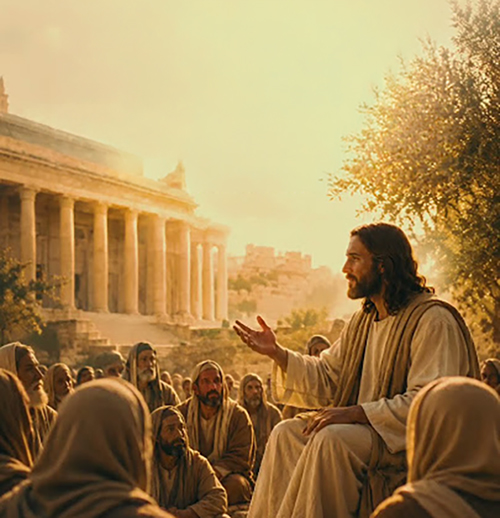
This is the story: Jesus had been preaching to a large crowd, several thousand people. But they were in a remote place and, after a time, the people had been without food for a long time. They were hungry, so famished in fact that they lacked the strength to return to their own towns and villages. The disciples approached Jesus and asked him whether they should go into the neighboring towns and buy food for the crowd. Jesus told them instead to feed the people themselves.  They protested that they had too little food, almost none. Jesus asked them what they in fact did have. Their answer: “Only five barley loaves and two fish.”  And this came with a question: What good is that among so many? The equation is hopeless: so little food, so many people.

And so Jesus asked them to bring the loaves and fish to him. He blessed the food and asked the disciples to distribute it among the hungry thousands. We know the rest of the story: They set out the food; everyone ate as much as he or she wanted, and they gathered up twelve baskets of scraps left over afterwards. And the crowd was impressed, so much in fact that the next day they followed Jesus around the lake, hoping for another such feeding. Jesus, for his part, was saddened by their lack of understanding: They hadn’t understood about the loaves.  

What do we need to understand about the loaves? We need to understand that we are with the bread of life, everything we need to feed the world we already have. We don’t need to go anywhere to buy anything. We have the resources already; though on the surface those resources will always look over-matched, hopeless, dwarfed, nonsensical, wishful thinking. On the surface, invariably, we will look like David before Goliath, puny and pathetic, not up to the task of defeating a giant or feeding a hungry, greedy world.
 
The challenge is to roll the dice on the reality of the Gospel. The Gospel works! It is adequate to the task, both of feeding the world and defeating the giant. It only needs to be trusted. [Excerpt from Ron Rolheiser’s “Rolling the Dice on the Gospel” January 2011]

“Ephphatha!” Mark 7:34

“Ephphatha” (Be opened), spoken by Jesus in Mark 7:34, is a powerful, ongoing invitation to spiritual, emotional, and relational openness. It signifies healing the inner deafness and silence that isolates individuals, urging a receptive heart towards God, others, and oneself. 

There is a need in our faith journey to move beyond fear, prejudice, or apathy that restricts our hearing of God’s word and our ability to connect with the world. This aspect of “being open” is not merely a passive state but a command to actively open oneself—mind, heart, and soul—to grace, love, and the needs of others.

The miracle of Christ healing the deaf man demonstrates His desire to break down barriers, allowing “deaf and dumb” aspects of our lives—where we fail to listen or speak the truth—to be restored to wholeness. 

There’s a need for silence. What the great spiritual writers of all ages tried to teach on this subject can perhaps be captured in a single line from Meister Eckhart: Nothing resembles the language of God as much as silence. In essence, Eckhart is saying that silence is a privileged entry into the divine realm. There’s a huge silence inside each of us that beckons us into itself and can help us learn the language of heaven. What’s meant by this?

Silence is a language that’s deeper, more far-reaching, more understanding, more compassionate, and more eternal than any other language. In heaven, it seems, there will be no languages, no words. Silence will speak. We will wholly, intimately, and ecstatically understand each other and hold each other in silence. Ironically, for all their importance, words are part of the reason we can’t fully do this already. Words unite, but they also divide. There’s a deeper connection available in silence.

John of the Cross expresses this in a wonderfully cryptic line: “Learn to understand more by not understanding than by understanding.” Silence can speak louder than words, and more deeply. We experience this already in different ways: when we are separated by distance or death from loved ones, we can still be with them in silence; when we are divided from other sincere persons through misunderstanding, silence can provide the place where we can be together; when we stand helpless before another’s suffering, silence can be the best way of expressing our empathy; and when we have sinned and have no words to restore things to their previous wholeness, in silence a deeper word can speak and let us know that, in the end, all will be well and every manner of being will be well.

Nothing resembles the language of God as much as silence. It’s the language of heaven, already deep inside of us, beckoning us, inviting us into deeper intimacy with everything, even as we still need the therapy of a public life. [Excerpt from Ron Rolheiser’s “The Place of Silence” February 2026]

HTML Snippets Powered By : XYZScripts.com