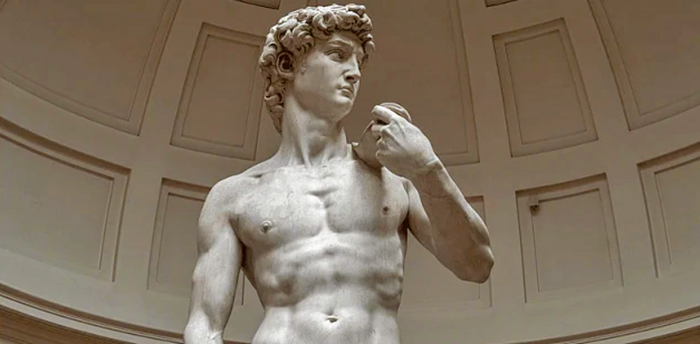
“I have found David, son of Jesse, a man after my own heart; he will carry out my every wish.” Acts 13:22

The verse we reflect on today from the Acts of the Apostles originally comes from the prophet Samuel and has always unsettled the minds and hearts of readers. Why?

How can God speak this way about David, whose life includes grave moral failure: adultery with Bathsheba; orchestrating the death of Bathsheba’s husband Uriah; his violence and ruthlessness in his rise to power; his practice of complicity and deception.

St. Augustine writes that the verse “a man after God’s own heart” does not mean sinlessness, but that the heart of that person is aligned with God’s heart. The “heart” here is the center of love and will. David’s life reveals disordered acts but a fundamentally ordered desire: he ultimately wants God (a story very similar to St. Augustine’s own faith journey of moral failure and desire for God).

There is a famous line that says, “God writes with crooked lines.” The meaning of this is captured by Hans Urs von Balthasar, who emphasized that God does not choose the morally flawless; He chooses, calls, and transforms. David’s life becomes a stage on which grace is shown to be before and greater than human achievement. In this light, “after my own heart” suggests a heart that is responsive—one that can be summoned, corrected, and restored. David resists at times, but he does not ultimately close himself off from God.

Henri Nouwen viewed King David as a profound example of the “wounded healer” and a testament to the idea that having a heart for God does not mean moral perfection, but rather a persistent, honest return to God in the midst of brokenness. Richard Rohr continues this thought by saying that King David is an example of a “mixed” or “imperfect” vessel, showing that having a heart for God does not require moral perfection. Rohr suggests that, like David, our own failures, when met with honest repentance, actually break down our “hardened hearts” and lead us to a necessary reliance on divine mercy rather than our own goodness.

God calls David “a man after my own heart,” not because David lacked frailty, but because his life reveals three decisive qualities:

– a fundamental orientation toward God
– a genuine and repeated repentance
– a lived relationship marked by prayer and trust

In other words, God sees in David not the absence of sin, but the presence of a heart that can be claimed, broken, and remade. That can be unsettling, but also deeply hopeful: it suggests that what most aligns a person with God is not moral flawlessness, but a heart that, despite everything, keeps turning back toward Him – which is the beauty and power of reconciliation that is available to all of us who fall and desire to be renewed.

“I came into the world as light, so that everyone who believes in me might not remain in darkness.” John 12:46

Jesus’ declaration in the Gospel of John—“I came into the world as light, so that everyone who believes in me might not remain in darkness” stands as one of the most concentrated revelations of His identity and mission. It is not merely metaphorical language; it is a claim about reality itself: that apart from Him, the human condition is one of obscurity, confusion, and estrangement, and that in Him, illumination is not partial but total—touching mind, heart, and destiny.

St. Augustine notes that Christ does not simply show the way as a teacher might illuminate a path from the outside; rather, He becomes the interior light by which we can see at all. For Augustine, the tragedy of darkness is not only ignorance but misdirected love—loving lesser goods as ultimate. Christ, as light, reorders vision itself: “The eye of the heart must be healed to see that light.” 

Ron Rolheiser writes that when darkness enveloped the earth a second time, God made light a second time, and that light, unlike the physical light created at the dawn of time, can never be extinguished. That’s the difference between the resuscitation of Lazarus and the resurrection of Jesus, between physical light and the light of the resurrection. Lazarus was restored to his self-same body from which he had to die again. Jesus was given a radically new body, which would never die again.

The renowned biblical scholar Raymond E. Brown tells us that the darkness that beset the world as Jesus hung dying would last until we believe in the resurrection. Until we believe that God has a life-giving response for all death and until we believe God will roll back the stone from any grave, no matter how deeply goodness is buried under hatred and violence, the darkness of Good Friday will continue to darken our planet.

Mohandas K. Gandhi once observed that we can see the truth of God always creating new light, simply by looking at history: “When I despair, I remember that all through history, the way of truth and love has always won. There have been murderers and tyrants, and for a time, they can seem invincible. But in the end, they always fall. Think of it, always.”

Darkness is not merely the absence of information, but a condition of the soul, a turning away from truth and love. To believe in Christ is to step into a new mode of existence, where one sees differently, loves differently, and ultimately lives in communion with God.

And yet, this light does not coerce. As the Gospel of John repeatedly emphasizes, the light shines, but it must be received. The tragedy of remaining in darkness is not that the light is absent, but that it is refused. Thus, Christ’s proclamation is both a promise and an invitation: the light has come, and no one need remain in darkness, but each must choose whether to walk in it.

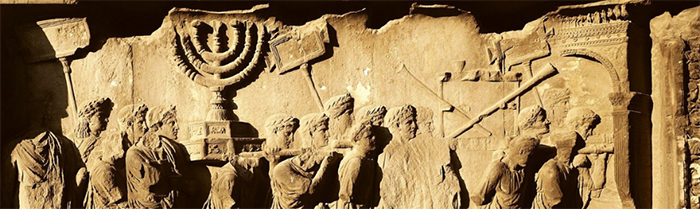
The feast of the Dedication was then taking place in Jerusalem. It was winter. John 10:22

The “Feast of Dedication” refers to what is now known as Hanukkah, commemorating the purification and rededication of the Temple after its desecration in the time of the Maccabees. It is striking that Jesus chooses this moment—when Israel celebrates the restoration of sacred space—to reveal something deeper: that the true dwelling of God is no longer confined to stone, but is present in His very person.

The ancient Fathers saw profound symbolism here. Saint Augustine writes that the Temple, once defiled and then purified, prefigures both Christ and the human soul. Christ is the true Temple, consecrated by the Father, yet rejected and misunderstood. At the same time, Augustine turns the image inward: each believer is also a temple in need of cleansing and rededication. The feast, then, is not merely historical remembrance but an invitation—God continually seeks to reclaim and consecrate what has been profaned within us.

Saint John Chrysostom emphasizes the irony of the moment. While the people celebrate the restoration of the Temple, they stand before the One who is its fulfillment and yet fail to recognize Him. The question posed to Jesus—“How long will you keep us in suspense?” reveals a deeper blindness. The light they celebrate externally has already come into the world, yet it is not received. Dedication, in this sense, is not only about sacred spaces but about perception: whether the heart can recognize God when He stands before it.

Modern Catholic voices echo and deepen this theme. Henri Nouwen often wrote about the human struggle to “make a home” for God amid the noise and fragmentation of life. Nouwen suggests that true dedication is not achieved through force, but through gentle, faithful return—again and again—to the presence of Christ who stands at the door and knocks. Ron Rolheiser suggests that in a fragmented modern world, the Feast of Dedication challenges us to rediscover spaces—both physical and relational—where God’s presence is honored together. The Church herself becomes a living temple, continually in need of renewal, repentance, and re-consecration.

To close this reflection, we must recognize that the winter setting in John’s Gospel is not incidental. It evokes a spiritual barrenness, a coldness of heart, even as the Feast proclaims light and renewal. Into this tension, Christ walks in the Temple precincts, quietly revealing that the true Dedication is not merely a past event but a present reality. God is always at work reclaiming, purifying, and inhabiting His people.

To celebrate the Feast of Dedication, then, is to enter into this ongoing mystery: to allow Christ to cleanse what is defiled, to recognize Him as the true Temple, and to become, both individually and communally, a place where God delights to dwell.

God has then granted life-giving repentance to the Gentiles too. Acts 11:18

The declaration in Acts of the Apostles 11:18—“God has then granted life-giving repentance to the Gentiles too”—arrives as a moment of holy surprise. The early Christian community, formed within the expectations of Israel’s covenant, suddenly realizes that God is moving beyond the boundaries they had assumed were fixed. Their response is telling: they fall silent, and then they glorify God. It is the silence of awe, the recognition that grace has exceeded human imagination. What they witness is not a change in God’s plan, but a deeper unveiling of it.

At the heart of this verse lies a profound theological truth: repentance itself is a gift. St. Augustine teaches that even the turning of the human heart toward God is initiated by grace. We do not first decide for God and then receive His help; rather, God moves within us so that we may even desire to turn. In this light, the Gentiles’ repentance is not an achievement but a sign that God has already begun His saving work in them. John Chrysostom reflects on the astonishment of the Jewish believers, noting that what shocks them is not simply that Gentiles repent, but that God has already welcomed them into His life.

This moment also opens the horizon of salvation in a decisive way. The promise long hidden in Israel—that all nations would be blessed—now takes visible form. Modern theologians like Karl Rahner see here a powerful witness to God’s universal desire to save. Grace is not confined to visible boundaries or human expectations; it moves freely, often ahead of the Church’s awareness. Hans Urs von Balthasar deepens this insight by reminding us that the Church must remain receptive to the surprising freedom of God. Acts 11 is a quiet correction against any temptation to “possess” grace, as though it belonged to one people or one structure alone.

Ron Rolheiser writes that this verse acts as a “second Pentecost,” where the apostles realize that God’s desire for conversion and life is not limited by religious, cultural, or social boundaries. God’s grace is now extended beyond what the Jewish community understood to include all nations. Repentance is a gift: it is a “life-giving” movement enabled by God. It is not about self-help; it is a profound shift of heart that God grants (or opens) for everyone.

The phrase “life-giving repentance” speaks not merely of sorrow for sin, but of transformation into new life. For Thomas Aquinas, grace does not destroy human nature but perfects it, drawing the whole person toward communion with God. Repentance, then, is not a narrowing of life but its expansion—a turning that opens into participation in divine life. In a more pastoral tone, Henri Nouwen describes repentance as a return to the heart of God, a movement from distance into intimacy. In Acts 11, that return is extended to those once considered far off, revealing that no one lies beyond the reach of this invitation.

There is also a humbling lesson here for the Church itself. The apostles do not orchestrate this inclusion; they discern it after it has already begun. Yves Congar emphasizes that the Church grows in understanding over time, guided by the Holy Spirit who continues to unfold the meaning of Christ’s work. Acts 11 shows a Church learning to recognize God’s action rather than controlling it. It is a reminder that fidelity is not rigidity, but attentiveness to where God is leading.

In the end, this verse reveals a God who is always ahead of us—granting even the grace to turn toward Him. Repentance is not a condition we fulfill to earn life; it is already the beginning of life within us. The proper response, then as now, is the same: a reverent silence that yields to praise. Wherever we see hearts turning, especially in unexpected places, we are invited to recognize the quiet work of God and to glorify Him, who continues to draw all people into His life.

The shepherd and guardian of your souls. 1 Peter 2:25

The line from First Epistle of Peter 2:25 is both tender and unsettling: “For you were straying like sheep, but have now returned to the shepherd and guardian of your souls.” It names something fundamental about the human condition—not simply that we make mistakes, but that we drift.

The image of wandering sheep is not accidental. Sheep do not rebel dramatically; they meander. They follow distractions, move toward what seems immediately appealing, and only later discover they are lost. In that sense, the verse suggests that our deepest problem is not always defiance but disorientation. We lose our center. We forget who we are and whose we are.

This is why the return is so important. The verse does not say we have found our way back, but that we have returned—implying relationship, memory, and grace. The “shepherd and guardian” is not merely a guide but one who both leads and protects, who knows the terrain of the soul better than we do ourselves.

For many spiritual writers, this wandering reflects what Augustine of Hippo famously described as the restless heart—“our heart is restless until it rests in you.” The restlessness is not incidental; it is a sign that we are made for communion but attempt to satisfy ourselves with lesser goods. Left to ourselves, we construct meaning from fragments—success, control, pleasure, identity—but these cannot hold the weight of the soul’s longing.

Similarly, Henri Nouwen often described the human experience as one of “homelessness”—not primarily physical, but spiritual. We move through life seeking belonging, affirmation, and peace, yet feel perpetually displaced. The image of returning to the shepherd speaks directly into that ache: we are not creating a home from scratch; we are being led back to one.

Theologically, the verse also carries a Christological depth. The “shepherd and guardian” points to Jesus Christ, who embodies both care and authority. He is not simply a teacher offering advice, but the one who reorients the entire direction of a life. Without that reorientation, meaning itself becomes unstable. We may still function, achieve, and even appear fulfilled, but there is a subtle fragmentation—a life lived outwardly coherent yet inwardly scattered.

Thomas Merton wrote that much of our suffering comes from living “out of touch with our true self.” In biblical language, this “true self” is not self-created but received—discovered in relationship with God. The shepherd does not erase individuality; he gathers it. He draws the scattered pieces of the self into unity.

So the verse is not merely a statement about past conversion; it is an ongoing pattern. We wander repeatedly—through distraction, anxiety, self-reliance, or forgetfulness. And we are continually invited to return. The Christian life, then, is less a straight line of progress and more a rhythm of drifting and being gathered again.

Without the shepherd’s guidance, meaning becomes something we must constantly invent and defend. With the shepherd, meaning is received as part of a relationship—something stable enough to hold suffering, uncertainty, and even failure.

In the end, 1 Peter 2:25 is both diagnosis and promise. It tells the truth about our tendency to lose our way, but more importantly, it reveals that we are not left to find our own path back. The shepherd is already seeking, already guarding, already calling us home.

Cast all your worries upon him because he cares for you. 1 Peter 5:6

St. Augustine writes that we are made for God, yet we cling to lesser securities. Our worries often expose disordered loves—attachments that we fear losing. To cast them onto God is not to deny their importance, but to place them in right relationship. Augustine would remind us that peace comes not from possessing or controlling, but from rightly trusting.

The words of 1 Peter—“Cast all your worries upon him because he cares for you”—sound simple, almost effortless. Yet the lived reality is far more complex: we are invited to release our burdens, and still we clutch them tightly, rehearsing them, carrying them, even identifying ourselves by them. The gap between invitation and response reveals something essential about the human heart.

Ron Rolheiser notes that much of our “baggage” consists of unresolved tensions we refuse to surrender. We say we trust God, but then continue to carry what we have already symbolically “given” to Him. For Rolheiser, this reveals that surrender is not a one-time gesture but a discipline. Like returning again and again to the altar, we must repeatedly place our burdens before God, knowing that we will be tempted to pick them back up as soon as we walk away.

Similarly, Henri Nouwen often observed that our worries are not just external pressures but interior habits. We carry them because they give us a strange sense of control, even identity. To let them go can feel like losing a part of ourselves. Nouwen would say that entrusting our burdens to God requires not just a decision, but a slow conversion of the heart—a repeated act of trust in the face of our instinct to hold on. We do not cling to worry because it works, but because it is familiar.

Richard Rohr frames this struggle as part of the deeper journey from the false self to the true self. The false self thrives on anxiety—it feeds on the illusion that everything depends on us. So even when we hear the invitation to “cast” our worries onto God, something in us resists, because letting go feels like losing control. Rohr would argue that this resistance is precisely where transformation happens. Each time we release our grip, even imperfectly, we participate in a kind of inner dying that opens us to a larger life in God.

The irony, then, is striking: we are offered freedom, yet we often choose burden. Not consciously, but habitually. We carry what God is willing to carry for us. And yet the invitation of 1 Peter remains patient and unchanging. It does not demand perfect surrender all at once. It simply asks us, again and again, to loosen our grip—to place one worry, then another, into the care of a God who does not grow weary of receiving them.

In the end, the spiritual life may look less like a single act of casting everything away, and more like a daily, even hourly, decision: to notice what we are holding, and to dare—however imperfectly—to let it go.

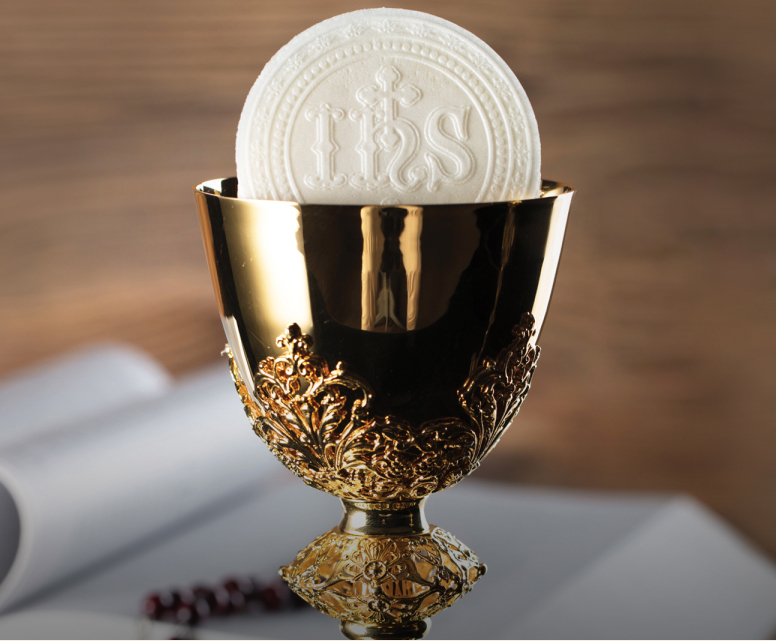
“Whoever eats my Flesh and drinks my Blood remains in me and I in him.” John 6:54

Ronald Rolheiser, OMI, interprets Jesus’ words in John 6, “Whoever eats my Flesh and drinks my Blood remains in me and I in him,” as a call to radical intimacy, where the Eucharist functions as God’s physical embrace, allowing Christ to become part of the believer’s very being. Rolheiser emphasizes that this teaching means we are meant to be nourished by Jesus’ life, ultimately becoming what we consume.

The Eucharist is a Divine Embrace more than simply a theological concept. It is a physical, affectionate embrace from God, comparable to a mother holding a child. This allows us to “remain” in Jesus and shows how he desires to be fully integrated into our lives—body, psyche, and spirit—just as food is integrated into our bodies to provide life.

There is a popular t-shirt that reads “You Are What You Eat”. Rolheiser writes that we are called to become the body of Christ for the world. Just as grain is ground to make bread and grapes are crushed to make wine, eating his flesh means entering into a life of sacrifice, self-renunciation, and service to the marginalized.

Our reflection verse today from John’s Gospel underscores the Catholic understanding of the Real Presence, in which Jesus offers his actual life as food, serving as “new manna” that provides daily sustenance for our journey.

When Jesus tells the gathered disciples, “Whoever eats my Flesh and drinks my Blood remains in me and I in him,” any first-century Jew would see this statement as referring to cannibalism, and appropriately said back to the Lord, “This is a hard teaching.”

This doubt has continued into the twenty-first century, as more than half of self-professed Catholics do not believe in the Church’s teaching of Christ being literally present (spiritually, of course) in the bread and wine.

Rolheiser writes that we don’t have to fully comprehend this teaching. What the Church does ask of us is to be faithful in participating in it, trusting that the reception of the precious Body and Blood of Christ heals our personal loneliness and connects us to the “global loneliness” of a divided world.

“They shall all be taught by God.” John 6:45

The line “They shall all be taught by God” sits at the heart of the Gospel of John’s theology of grace: faith is not merely acquired—it is received. Jesus echoes the promise of the Book of Isaiah, where God himself becomes the interior teacher of His people. Across the centuries, theologians have returned to this verse to describe the mysterious way God forms the human heart from within.

Among the early Fathers, Augustine of Hippo saw this teaching as essential to understanding grace. In his reflections, he insists that no one truly comes to Christ unless they are inwardly drawn by God. External preaching, Scripture, and sacraments are necessary—but they remain incomplete without what Augustine calls the “interior illumination.”

Similarly, Thomas Aquinas teaches that God is the primary cause of all knowledge of divine truth. Human teachers can propose ideas, but only God can move the intellect to assent.

In the modern era, Henri Nouwen interprets this verse pastorally and personally. He often speaks of the “inner voice of love,” the gentle yet persistent presence of God speaking within the human heart. For Nouwen, being taught by God means learning to listen beneath the noise of the world to the deeper truth of one’s belovedness. It is less about acquiring doctrines and more about being formed in relationship—learning, slowly, to trust the voice that calls us “chosen” and “beloved.”

Ron Rolheiser suggests that God teaches us not only in moments of prayer but through restlessness, longing, and even struggle. The human heart’s ache for meaning becomes a classroom where God is the teacher. To be “taught by God” is to allow our desires to be purified and directed toward what truly satisfies—ultimately, communion with God.

“They shall all be taught by God” is not simply a promise of instruction, but of intimacy. God is not a distant lecturer but an indwelling teacher—forming, drawing, and awakening the soul. The verse ultimately invites a posture of receptivity: to be taught by God is to become attentive, humble, and open, trusting that beneath every authentic movement toward truth and love, God himself is already at work.

“For this is the will of my Father, that everyone who sees the Son and believes in him may have eternal life, and I shall raise him on the last day.” John 6:40

Jesus is the sole mediator who reveals and unites us to the Father. As theologians like Karl Rahner emphasize, we encounter the Father “through, with, and in Christ,” and eternal life is communion with God made possible through him.

Henri Nouwen writes that eternal life begins now as intimacy with God. In works like The Return of the Prodigal Son, he describes salvation as “coming home” to the Father—a movement from alienation to belonging. Belief in Jesus reveals the Father’s unconditional love and invites us into it. Eternal life is not just a future reward but participation in divine love here and now. It is the experience of being the “beloved,” reconciled not by our worthiness but by God’s initiative.

Richard Rohr writes that reconciliation with the Father is awakening to a union that has always been offered, and eternal life is participation in that divine life—what he calls living in the “Christ reality.” Belief is less about intellectual assent and more about entrusting oneself to this transformative relationship. Rohr emphasizes that Jesus reveals the universal pattern of divine love and union, seeing Christ as the “gateway” into experiencing God, not merely as a doctrinal requirement but as an invitation into transformation. Following Jesus leads us from the “false self” into our “true self” in God, a movement symbolized in death and resurrection. 

Ron Rolheiser frames reconciliation not merely as a juridical act (sins forgiven), but as a healing of a relationship that continues even beyond death. He suggests that in Christ, broken relationships are ultimately purified and brought into clarity—“it washes clean,” as he reflects on how death and grace reveal truth and restore communion. For Rolheiser, belief in Jesus opens us to a love that refuses to let estrangement have the final word. Reconciliation with the Father is an ongoing, embodied experience, primarily found through the Eucharist and the “hidden” surrender of loving others, which heals our alienation.

Reconciliation is thus deeply relational: it is being brought back into right relationship with God the Father, others, and even our own past. Eternal life, then, is not simply endless duration, but the fullness of reconciled communion.

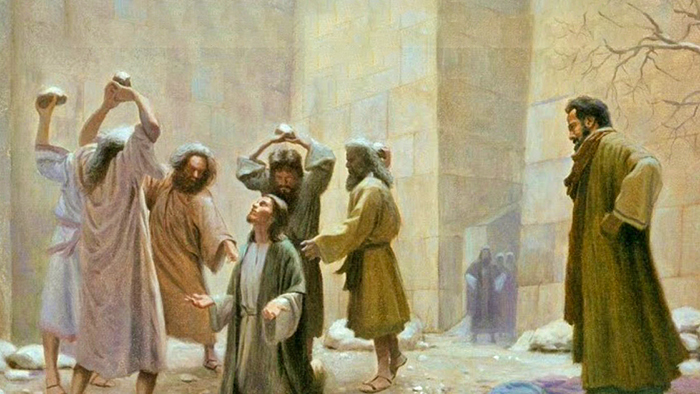
The witnesses laid down their cloaks at the feet of a young man named Saul. Acts 7:58

The scene of Saul (later called Paul) consenting to the death of Stephen is one of the most unsettling—and ultimately hope-filled—moments in the New Testament. It places us face-to-face with the mystery of how zeal for God can become distorted, and how grace can transform even the most hardened heart.

Saul is not portrayed as a shallow villain; rather, he is deeply committed, convinced he is defending God’s honor. Ron Rolheiser frequently notes that some of the worst injustices in history have been carried out by people who believed they were doing right. In this light, Saul, standing by, approving the stoning of Stephen, reveals a sobering truth: religious passion, without humility and openness, can justify violence. Yet Rolheiser would also point out that this very zeal becomes, after conversion, the raw material God reshapes for mission. Nothing is wasted—not even our darkest moments.

Before condemning Saul, Henri Nouwen writes that we must acknowledge how often we fail to stand with the “Stephens” in our own lives. God’s gaze is never condemning but always calling—just as Saul, the persecutor, is later called by name and transformed. Saul’s rigid certainty had to collapse before he could encounter the risen Christ. The stoning of Stephen becomes, paradoxically, a moment that exposes the limits of legalistic religion and opens the possibility for grace. God uses even our wrong turns to lead us toward deeper truth; Saul’s fall is not the end of his story but the beginning of his awakening.

In the end, the martyrdom of Stephen and Saul’s consent to it reveal a profound Christian mystery: the same event that manifests human violence also becomes the seedbed of grace. Stephen’s forgiveness (“Lord, do not hold this sin against them”) echoes Christ’s own words and may well have lingered in Saul’s memory, preparing the soil for his encounter with Jesus on the road to Damascus. What appears as a triumph of hatred becomes, in God’s providence, the beginning of redemption.

This passage challenges us not only to condemn injustice but to examine our own certainties, our silences, and our capacity for transformation. It also offers a difficult hope: no life is beyond conversion, and no sin—however grave—lies outside the reach of grace.

HTML Snippets Powered By : XYZScripts.com