"Always be prepared to make a defense to anyone who asks you for a reason for the hope that is in you" 1 Peter 3:15
Author: DV Dan
A lifelong seeker of truth and oneness with God, Daniel has journeyed through the rich and varied landscape of Christian denominations in search of a deeper understanding of what it truly means to be one with Christ. This search has been one of both heart and intellect—guided by a desire to know Christ more deeply and to live in communion with Him. Through a transformative study of the Gospel of John, particularly Chapter Six, which illuminated the mystery of the Paschal Sacrifice of Christ and revealed its living expression in the Catholic Church’s liturgical celebration of the Holy Eucharist, led to his movement from decades of Evangelical Christianity to full communion with the Catholic Church, where faith and worship converge in the sacrament of the altar. Daniel holds a Master’s Degree in Theological Studies from the University of Dallas.
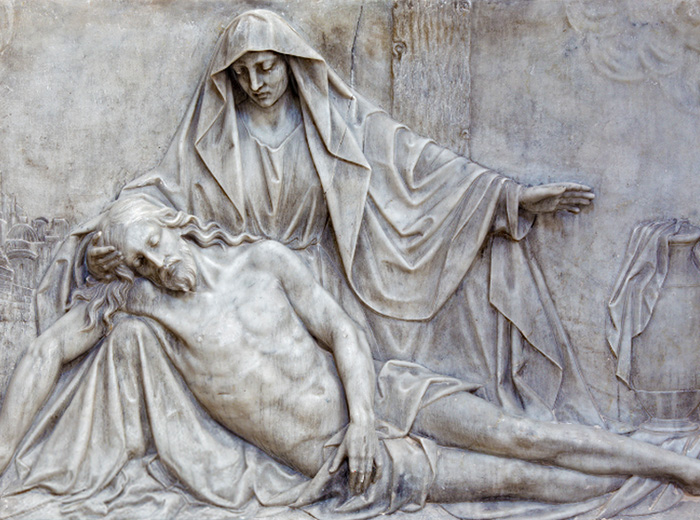
The Memorial of Our Lady of Sorrows brings us to Calvary, where Mary stands beneath the Cross of her Son. She cannot stop his suffering. She cannot remove the nails, silence the mockery, or prevent his death. She can only remain—and her remaining is itself an extraordinary act of faith and love.
John tells us that Mary was “standing by the cross of Jesus”. She is not described as collapsing in despair or fleeing from what she cannot bear. She stands. Her sorrow is real, but it does not extinguish her faithfulness. The mother who once said, “May it be done to me according to your word,” now lives that surrender in its most painful form.
When Mary and Joseph presented the infant Jesus in the Temple, Simeon warned her: “You yourself a sword will pierce.” At the Cross, that prophecy reaches its terrible fulfillment. Mary is not physically crucified, yet she suffers spiritually with her Son. The sword piercing Christ’s body also pierces the heart of his mother.
Her sorrow is more than the natural grief of a mother losing her child. Mary watches the innocent Son of God bear humanity’s rejection, violence, and sin. She sees the One whom she carried, nursed, protected, and followed surrender his life for the very world that crucifies him.
Even as he suffers, Jesus sees his mother and the beloved disciple standing near her. He says to Mary:
“Woman, behold, your son.”
Then he says to the disciple:
“Behold, your mother.”
These words certainly express Jesus’ tender concern for Mary. He entrusts her to someone who will care for her after his death. But within John’s Gospel, the scene carries a deeper meaning.
Jesus does not call her “Mother” but “Woman,” just as he did at the wedding feast of Cana. This title reaches back toward the woman of Genesis and points forward to the woman of Revelation. Mary appears as the New Eve: the woman whose faithful obedience stands in contrast to humanity’s disobedience. Beside the New Adam, she participates through faith in the birth of a new humanity.
To behold Mary as our mother is to welcome the woman who first welcomed Christ. It is to learn from her how to ponder God’s Word, surrender to his will, carry Christ into the world, and remain faithful when God’s purposes pass beyond our understanding.
As we celebrate today the Feast of the Exaltation of the Holy Cross, our reflection turns to two verses from today’s readings, one from Philippians and the other from John’s Gospel, as they bring into focus the very nature of his mission.
St. Paul proclaims that Christ existed “in the form of God,” yet did not treat his divine equality as something to be exploited for his own advantage. Instead, he emptied himself, assumed the condition of a servant, entered fully into human life, and became obedient even to death on a cross.
Jesus did not cease to be God. Rather, he revealed what God is truly like. The self-emptying of Christ is not the temporary abandonment of divinity; it is the visible expression of divine love. In Jesus, we discover that God’s power is not the power to dominate, possess, or condemn. It is the power to give himself completely so that others may live.
Philippians 2:6 explains how God fulfills the saving purpose proclaimed in John 3:17. God did not send his Son to stand above the world in judgmental separation. The Son entered the world, took upon himself our humanity, and descended into the depths of human sin, suffering, rejection, and death.
The cross is sometimes understood only as something done to Jesus by sinful humanity. Philippians shows us that it is also the freely chosen culmination of his self-giving mission. Jesus does not grasp power; he gives himself. He does not answer violence with greater violence. He enters into the violence of the world and absorbs it without allowing it to extinguish his love.
God saves the world through the Son’s refusal to use divine power for self-preservation. The crucified Christ reveals that God would rather bear the wounds of the world than abandon the world to its wounds.
When divine light enters the world, it reveals what is hidden. We may receive that light and allow ourselves to be transformed, or we may retreat into the darkness of selfishness and fear. Christ does not come seeking our destruction; he comes offering the life we were created to receive.
Jesus does not merely tell us that God wishes to save the world. Through his Incarnation, service, suffering, death, and resurrection, he shows us what saving love looks like. It is love that descends, love that serves, love that bears wounds, and love that never ceases to seek the lost.
When Paul says that an obligation has been imposed upon him, he is not describing Christianity as a burdensome set of religious duties. His obligation comes from grace. Because he has encountered Christ’s mercy, he can no longer live as though that encounter never happened.
Paul’s “obligation,” therefore, is the responsibility created by love. When we have received something capable of giving life to others, remaining silent or refusing to live differently becomes a denial of the gift itself.
Through Baptism, each Christian is joined to Christ and incorporated into his Body. Through Confirmation, the baptized are strengthened by the Holy Spirit to bear witness to Christ. Every disciple therefore participates in the Church’s mission.
Not every Christian is called to preach publicly as Paul did. Not everyone will become a missionary, theologian, catechist, or ordained minister. But every Christian is called to make the Gospel visible.
We preach the Gospel whenever:
– we forgive rather than seek revenge; – we protect the dignity of another person; – we remain honest when dishonesty would benefit us; – we care for the poor, forgotten, lonely, or suffering; – we speak about our faith with humility and courage; – we bring reconciliation into divided relationships; – we allow Christ’s mercy to shape our judgments; – we place love of God and neighbor above personal convenience.
here is a difference between knowing the teachings of Jesus and allowing those teachings to govern our lives. We may know that Christ commands forgiveness while continuing to nurture resentment. We may profess concern for the poor while protecting ourselves from their suffering. We may receive the Eucharist while refusing communion with people whom God has placed in our lives.
To “live out the Gospel” means allowing the life of Christ to take visible form within us. It means that our choices, relationships, use of money, treatment of others, exercise of authority, and response to suffering gradually reveal whom we belong to.
Our reflection verse today comes from Luke’s Gospel and Jesus’ teaching on loving our enemies. He gives this teaching within his command to bless those who curse us, and pray for those who mistreat us. Therefore, the “other” is not limited to our family, friends, fellow Christians, or people who treat us well.
The other is every person placed before us: the stranger, the poor, the forgotten, the irritating coworker, the person who disagrees with us, and even the one who has wounded us. Jesus removes the boundaries we often place around love.
This command is sometimes called the Golden Rule, but Jesus means more than simple fairness or reciprocity. He does not say, “Treat people well because they may treat you well in return.” Christian love does not wait to see what another person deserves. It takes the initiative because God has already loved us with mercy. We are asked to give others the patience, forgiveness, dignity, understanding, and compassion that we ourselves hope to receive.
Recognizing this call in everyday life requires us to pause and look beyond our first reaction. Before speaking, deciding, judging, posting, purchasing, leading, or correcting, we might ask: If I were in this person’s situation, how would I hope to be treated? Am I protecting this person’s dignity? Does my response reveal the mercy of Christ? The “other” often appears disguised as an interruption, an inconvenience, a disagreement, or someone whose story we do not yet understand.
Doing to others what we would want done to us does not mean approving harmful behavior, abandoning healthy boundaries, or allowing ourselves to be abused. We may need to confront wrongdoing, say no, or step away from a dangerous situation. Yet even correction can be offered without hatred, humiliation, or revenge. Christian love seeks both truth and the genuine good of the person.
Jesus asks us to see every human encounter as an opportunity to make God’s love visible. The other is not merely someone standing outside of us; the other is our neighbor, bearing the image of God and sharing our need for mercy. Each day Christ asks us to become for someone else what we ourselves most need: a patient listener, a forgiving heart, a truthful companion, a defender of dignity, and a living sign that no person is beyond the reach of God’s love.
Luke introduces Jesus teaching on the “Sermon on the Plain” with an easily overlooked detail: the Lord “came down” from the mountain and stood on “a stretch of level ground.” Jesus had spent the night on the mountain in prayer and had chosen the Twelve. But he did not remain above the people. He descended to where they were gathered—among the sick, the poor, the troubled, and those tormented by unclean spirits.
This movement reveals something fundamental about the Incarnation. God does not remain distant from the suffering of humanity. In Jesus Christ, God comes down and stands on our level ground. He enters the ordinary places of hunger, rejection, conflict, grief, and human need. Before Jesus teaches the crowd, he allows them to approach him, touch him, and receive healing.
Jesus then announces that the poor, hungry, grieving, and rejected are blessed—not because suffering is good, but because suffering will not have the final word. God sees those whom the world overlooks. The corresponding woes warn those who are comfortable not to build their lives upon possessions, satisfaction, amusement, or human approval.
At the center of the sermon is Jesus’ command to love our enemies. This does not require us to approve of wrongdoing or abandon justice. It means refusing to allow hatred to shape our hearts. Jesus will fulfill this teaching upon the Cross when he prays for those who crucify him. His Resurrection reveals that merciful love is stronger than hatred and death.
Jesus calls us to examine ourselves before condemning others, to recognize a tree by its fruit, and to build our lives upon his words. Hearing the Gospel is not enough. The teaching of Christ must become visible in the way we forgive, speak, serve, give, and love. The person who hears his words and lives them builds upon rock. The storms may still come, but the foundation will remain.
When Jesus asks whether it is lawful “to do good on the sabbath rather than to do evil, to save life rather than to destroy it,” he is not abolishing the commandment to honor the Sabbath. He is revealing its deepest meaning. The Sabbath was given as a celebration of creation, freedom, rest, and communion with God. Because God is the giver and restorer of life, healing a suffering person fulfills the Sabbath rather than violating it.
By placing the man with the withered hand in the center of the synagogue, Jesus also places human suffering at the center of religious discernment. The question is no longer merely, “What am I forbidden to do?” It becomes, “What good is God asking me to do?” When mercy is possible, refusing to act is not always morally neutral. The good left undone can permit suffering to continue.
For Christians, Sunday celebrates the Resurrection and the beginning of the new creation. We honor it through Eucharistic worship and rest, but also by allowing that worship to make us instruments of Christ’s healing. Care for the sick, attention to the lonely, reconciliation, and service to those in need do not interrupt the holiness of the Lord’s Day; they reveal it.
Jesus therefore does not make the Sabbath less sacred. He shows us why it is sacred: the day belongs to the God who creates life, liberates the oppressed, heals what is broken, and invites his people to do the same.
The Church must honestly acknowledge that inadequate formation has often left Catholics spiritually undernourished. Many were taught enough to receive the Sacraments but not always enough to understand that the Sacraments begin and sustain a lifelong transformation. They may have been told what the Church teaches without being helped to encounter the Person at the center of that teaching—Jesus Christ. They may know that they “have a soul” without realizing that their deepest identity and destiny are spiritual: they were created by God, for communion with God, and for eternal life in God.
The “milk” of faith gives us the essential truths: God loves us; Christ saves us; the Church gathers us; the Sacraments strengthen us; and we are called to love God and neighbor. The “solid food” of mature faith does not replace these truths. It takes us more deeply into them and requires us to live their consequences.
Solid food means moving from merely knowing about Christ to consciously living in communion with Christ. It means progressing:
from attending Mass to entering into Christ’s sacrifice;
from reciting prayers to developing a genuine life of prayer;
from receiving the Eucharist routinely to recognizing and reverencing Christ’s Real Presence;
from memorizing teachings to understanding the wisdom and love within them;
from asking only, “What must I do?” to asking, “Who is Christ forming me to become?”;
from treating faith as one part of life to allowing the Holy Spirit to shape the whole of life.
Perhaps the deepest challenge in Paul’s words is that many Christians do not truly recognize themselves as spiritual beings. Modern culture frequently defines the person through productivity, possessions, emotions, political identity, physical appearance, or social status. Paul reminds us that none of these reaches the deepest truth of who we are.
We are embodied spiritual persons, created in the image of God. Through Baptism, we have been joined to Christ and made dwelling places of the Holy Spirit. Our spiritual life is therefore not an optional religious addition to our “real” life. It is the deepest dimension of reality—the place where we encounter God, discern truth, receive grace, and gradually become the persons we were created to be.
Spiritual maturity is not something we achieve once and possess permanently. It is a lifelong surrender to grace. Christ continually invites us beyond familiarity, routine, and shallow understanding into the inexhaustible depths of his life. The tragedy is not that we begin with milk; every disciple does. The tragedy would be refusing the solid food Christ continues to offer.
Paul’s message, therefore, remains a call to the whole Church: Grow into what you have received. Become who Baptism says you are. Allow the Eucharist you consume to transform you into the Body of Christ. And let the Holy Spirit lead you from merely belonging to the Church into mature, conscious, and fruitful life in Christ.
Jesus begins his public ministry by declaring that the promises spoken through Isaiah are now being fulfilled: “The Spirit of the Lord is upon me.” He does not present himself merely as another teacher offering better religious ideas. He announces that God has acted decisively in him. The Spirit has anointed him to bring good news, freedom, healing, and restoration to a people who have been waiting for God’s deliverance.
His mission begins among “the lost sheep of the house of Israel” (Matthew 15:24). Israel had been chosen to live in covenant with God and to become a light to the nations, yet many of its people had become spiritually scattered. Some were burdened by poverty, illness, oppression, sin, social exclusion, or the belief that they had been forgotten by God. Jesus comes as Israel’s promised Shepherd, seeking those who are lost and gathering them back into the Father’s covenantal embrace.
The “poor” therefore include those lacking material necessities, but the expression reaches further. They are those who know they cannot save themselves. The “captives” include those imprisoned by injustice, but also those held by sin, fear, shame, resentment, or despair. The “blind” are those who cannot yet perceive God’s presence and saving work. The “oppressed” are all whose dignity and freedom have been diminished by forces within themselves or imposed upon them by others. Jesus announces that God has come near precisely to such people.
The proclamation of “a year acceptable to the Lord” recalls Israel’s Jubilee tradition, when debts were released, slaves were freed, and families were restored to their inheritance. Jesus announces a greater Jubilee: God is restoring his people, forgiving sin, releasing humanity from bondage, and returning the lost to communion with himself. This liberation will not be accomplished through political dominance or human strength, but through the self-giving love of the Messiah.
This is where Paul’s words in the first reading today to the Corinthians illuminate the Gospel. Paul confesses that he came “in weakness and fear and much trembling.” His proclamation did not depend upon eloquence, social prestige, or “persuasive words of wisdom.” Like the ministry of Jesus, Paul’s preaching reveals that salvation originates in the power of God rather than in human achievement. The messenger may appear weak, but the Spirit working through the message is powerful.
This pattern reaches its fullest expression in the Cross. Jesus rescues Israel—and ultimately all humanity—not by displaying the kind of power the world expects, but by entering human weakness, rejection, suffering, and death. The crucified Messiah appears powerless, yet through that apparent weakness God defeats sin and death. Paul therefore refuses to make faith dependent upon his own personality or rhetorical ability. He wants the Corinthians’ faith to rest upon the same divine power revealed in the crucified and risen Christ.
The connection between these readings is the work of the Holy Spirit. The Spirit anoints Jesus to proclaim and accomplish liberation; that same Spirit empowers Paul to proclaim Christ in humility. Jesus is the saving message, while Paul becomes its vulnerable servant. Neither passage permits the messenger to become the center. The true center is God, who acts through human weakness to reach the poor, gather the lost, open blinded hearts, and set captives free.
Although Jesus’ earthly mission begins with Israel, it does not end there. God gathers Israel so that the covenantal blessing promised to Abraham may reach all nations. The rescue of the lost sheep is therefore the beginning of a worldwide restoration. Paul’s mission to the Gentiles does not replace Israel’s calling; it demonstrates how Israel’s Messiah brings God’s promised mercy beyond Israel, welcoming the nations into the saving work first proclaimed among God’s covenant people.
For the Church today, these readings offer both a message and a model. We are sent to proclaim Christ to those who feel lost, overlooked, burdened, or spiritually imprisoned. Yet we are not called to rely primarily upon polished arguments, impressive programs, or personal influence. Such things may serve the Gospel, but they cannot replace the Spirit. Authentic evangelization begins when we acknowledge our dependence upon God and allow Christ to work through our humility, compassion, and faithful presence.
The essential message is this: Christ comes searching for those who are lost, but he often reaches them through servants who know their own weakness. The Gospel does not depend upon the strength of its messengers. Its power rests in the Spirit of God, who continues through Christ and his Church to bring glad tidings to the poor, freedom to captives, sight to the blind, and hope to all who fear they have been forgotten.
Jesus speaks these words immediately after telling His disciples that following Him requires self-denial, taking up one’s cross, and being willing to lose one’s life for His sake. He asks, “What profit would there be for one to gain the whole world and forfeit his life?” The verse therefore presents a choice between living for temporary gain and living according to the way of Christ.
Human freedom and moral responsibility truly matter. God’s judgment considers not merely what we claimed to believe, but how our beliefs shaped the way we lived. Our treatment of others, response to grace, willingness to forgive, care for those in need, and faithfulness to God all reveal the actual orientation of the heart.
This verse invites us to ask not only, “Do I believe in Christ?” but also, “What is my life becoming because I believe in Christ?” The final judgment will reveal the truth of our choices; the loves we cultivated, the responsibilities we accepted or avoided, and the ways we responded to Christ’s presence in others.
The judgment of Christ should awaken reverence and responsibility, but not despair. The Judge who comes in glory is the same Savior who carried our sins upon the Cross. He desires our conversion rather than our condemnation and continually offers mercy, forgiveness, and the grace to begin again. Nevertheless, His mercy calls for a genuine response. We cannot claim to receive Christ while persistently refusing the way of life He teaches.
Every act of love, mercy, sacrifice, truthfulness, and faithfulness becomes evidence that God’s grace is alive within us. When Christ returns in His Father’s glory, what has been formed quietly within the heart will be brought fully into the light.
Our reflection verse today comes from St. Paul’s discussion with the Corinthians. The problem Paul is addressing is the human tendency to make our own understanding the measure of what is true, possible, and worthy of belief. Human wisdom becomes dangerous when it convinces us that we have God figured out.
We begin to assume that if something does not make sense according to our expectations, it cannot possibly be God’s way. We want a God who conforms to our categories; a God who rewards according to our definition of success, acts according to our definition of justice, and reveals himself according to our definition of power.
We live in an age that places tremendous confidence in information. We can access more knowledge in seconds than previous generations could accumulate in a lifetime. We can analyze, calculate, predict, categorize, and explain. And yet knowledge does not necessarily produce wisdom.
We can know how something works without knowing why it matters.
We can know what something costs without knowing its value.
We can understand how to extend life without necessarily understanding how to live.
We can possess enormous amounts of information while remaining spiritually confused about who we are and what our life is ultimately for.
Perhaps this is the invitation Paul gives us today: to become humble enough to admit that we do not see the whole picture. There will be moments when we do not understand what God is doing, why a prayer seems unanswered, or why the path before us is not the path we would have chosen. Faith does not mean having every answer. Sometimes faith means saying, “Lord, I don’t understand, but I trust you.”
The wisdom of God begins where our certainty ends. And sometimes God must set aside our carefully constructed understanding, not because He wants us to know less, but because He wants to teach us to see more.