
Cast away from you all the crimes you have committed, says the LORD, and make for yourselves a new heart and a new spirit. Ezekiel 18:31

During the last year of her life, Therese of Lisieux corresponded regularly with a young man named Maurice who was preparing to become a missionary. This man, despite being very sincere and quite pious, had some rather serious moral struggles. While he greatly admired Therese, eagerly awaited her advice on things, and relied upon her prayers to help him, he was always afraid to tell her about his moral failures. Thus, for a long time, he would share with her only about the good things in his life, but never about his sins and failings. He feared that if he told her the real truth she would be shocked, lose respect for him, and turn away.      

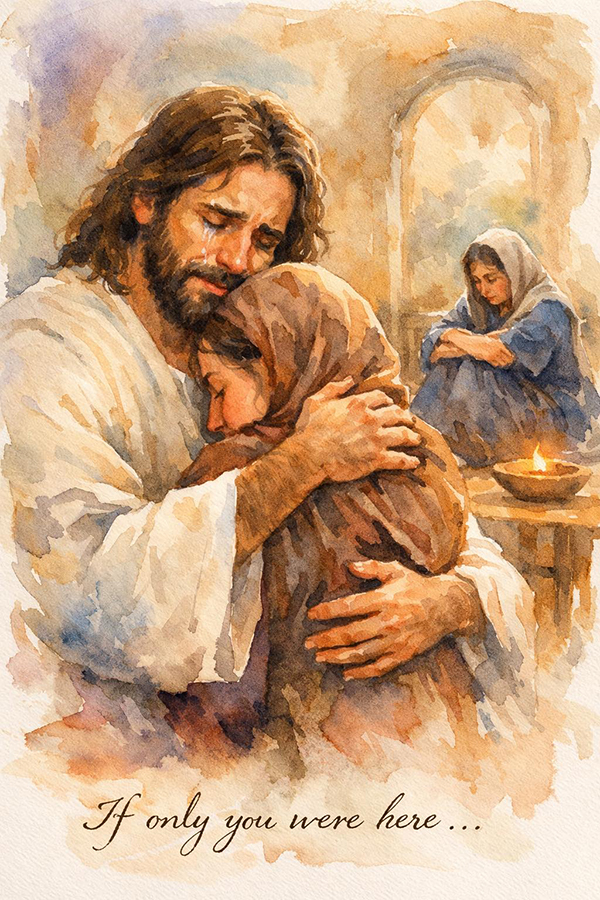
“I was afraid that in love you would take on the prerogative of justice and holiness and that everything that is sullied would then become an object of horror for you.” Therese’s response to this comment is most noteworthy: “It must be that you don’t know me well at all, if you are afraid that a detailed account of your faults would lessen the tenderness that I feel for your soul.”

God should get more press like this. The fear that this young man experienced in his relationship to Therese is the exact one that all of us perennially have in our relationship with God. We are afraid that in the sight of goodness and holiness all that is sullied in us will be an object of horror. Simply put, we are afraid that God’s good opinion of us might change should all of our darkest secrets be laid bare. Thus Therese’s words could have come right from God’s own mouth: “You don’t know me very well, if you are afraid that baring your faults before me will lessen the tenderness I feel towards you.”

We treat God as we would a visiting dignitary, namely, we show God what we think God wants to see in us, tell God what we think God would want to hear about us, and hide all those things that we feel will lessen God’s affection. We try to hide our faults from God, worrying that if we really bared our souls God would be displeased.

After Adam and Eve sinned, they too did what comes naturally, they hid and tried to camouflage their shame by their own efforts at clothing themselves. But their shame remained until God found them and gave them real clothing with which to cover their guilt.

We do not know God very well at all when we fear coming into God’s presence, replete with all that is within us, weaknesses as well as strengths. Nothing we do can ever lessen God’s tenderness towards us. [Excerpt from Ron Rolheiser’s “On Not Hiding From God,” August 1999]

All those who were my friends are on the watch for any misstep of mine. Jeremiah 20:10

It’s dishonesty, living a double life, that kills the soul and kills families.”

The unforgivable sin against the Holy Spirit begins with lying, with rationalization, with the refusal to acknowledge the truth. But we don’t commit this sin easily, overnight, the first time we tell a lie. The soul warps slowly, like an old board soaked too often in the rain. It’s not the first time it gets wet that makes the warp. We commit the sin against the Holy Spirit when we lie for so long that we believe our own lies. If we lie long enough, eventually light begins to look like darkness and darkness begins to look like light.

That’s especially true of the lie of a double life, when we are no longer honest with our loved ones. If we do that long enough, eventually our betrayals begin to look like virtue, our lies like the truth, and what our families, faith, and churches stand for begins to look like falsehood, death, darkness.

About 15 years ago, a young man, still in his twenties, produced an award-winning movie, Sex, Lies, and Videotapes. The story is rather simplistic and crass at times, but overall teaches the a lesson that could be from John’s gospel: The hero of the story, a young man with a bad history in the area of sexuality, resolves to make himself better by making a vow to never again tell a lie, even a very small one. Like the man who’s born blind in John’s gospel, that vow brings him to health. He gets better, much better. He then sets up a video camera and invites people to come and tell their stories. Those who tell the truth also get better, healthier, and those who lie and hide their infidelities continue to deteriorate in both health and happiness. The truth does set us free.

In her book, Guidelines for Mystical Prayer, Ruth Burrows describes what it means to die a “happy death”. To die in a good way, she states, is not a question of whether or not death catches us in a morally good moment or a morally bad one (dying drunk in a bar as opposed to dying in a church). Rather, to die a happy death is to die in honesty, without pretence, without the need to lie about our lives. [Excerpt from Ron Rolhiser’s “The Truth Sets Us Free,” July 2005]

“Amen, amen, I say to you, before Abraham came to be, I AM.” John 8:58

Our reflection verse today from John’s Gospel speaks of the original covenant of God and Abraham, and the profound revelation of Christ’s eternal nature and his identity as the “Great I AM” who transcends time. 

Msgr. John J. McIlhon, in his work, Forty Days Plus Three, writes that Jesus represents the final covenant God made with humankind. “The sign of this covenant bore no mark of earthly distinctiveness—no tree of good and evil, no rainbow, no circumcision, no Passover lamb. The mark of the new covenant was Jesus Christ and his new way of living, distinguishing God’s chosen people from all others. Christ’s way of living was a new kind of circumcision, marked on the hearts of Christ’s followers by “the two-edged sword of God’s Word.” God designed that a divinely chosen people should be distinguished from all others by the kind of love Jesus generously displayed.”

While Jesus was a flesh-and-blood individual, the “I AM” statement points to the eternal Christ who predates all creation and continues to be present through the Word, the Eucharist, and the community of believers. 

Fr. Ron Rolheiser writes that just as Abram had to become Abraham, we are called to expand our hearts and identities. Jesus’ claim of being “before Abraham” underscores a divine authority that calls us out of our “comfortable and secure” boundaries into a larger, more inclusive faith. This statement is one of Jesus’ most powerful declarations of divinity, directly echoing God’s self-revelation to Moses at the burning bush (“I AM WHO I AM”). It signifies that Jesus is not merely a prophet but the eternal Son of God, uncreated and self-existent.

And the Word became flesh and made his dwelling among us. John 1:14

The word “Christ” is not Jesus’ second name (like Jack Smith, Susan Dolenski, or Jesus Christ). Christ is a title, not a name. Literally, in Greek, it means: the anointed one. Jesus Christ equals Jesus, the anointed one. Part of the meaning of that, however, is that the anointed one is the one who is God-in-the-flesh, God-in-carnus. This means God-in-the-physical just as it also means that the-physical-contains-God. 

Nikos Kazantzakis, the author of Zorba the Greek, once told this parable: A man came up to Jesus and complained to him about the hiddenness of God. “Rabbi,” he said, “I am an old man. During my whole life, I have always kept the commandments. Every year of my adult life, I went to Jerusalem and offered the prescribed sacrifices.

“Every night of my life, I have not retired to my bed without first saying my prayers. But . . . I look at stars and sometimes the mountains—and wait, wait for God to come so that I might see him. I have waited for years and years, but in vain. Why, Why? Mine is a great grievance, Rabbi? Why doesn’t God show himself?

Jesus, in response, smiled gently and said, “Once upon a time, there was a marble throne at the eastern gate of a great city. On this throne sat 3,000 kings. All of them called upon God to appear so that they might see him, but all of them went to their graves with their wishes unfulfilled.”

“Then, when these kings had died, a pauper, barefooted and hungry, came and sat upon that throne. ‘God,’ he whispered, ‘the eyes of a human being cannot look directly at the sun, for they would be blinded. How then, Omnipotent, can they look directly at you?”

“Have pity, Lord, temper your strength, turn down your splendor so that I, who am poor and afflicted, may see you! “Then—listen, old man—God became a piece of bread, a cup of cool water, a warm tunic, a hut and, in the front of the hut, a woman giving suck to an infant.”

“Thank you, Lord,’ he whispered. ‘You humbled yourself for my sake. You became bread, water, a warm tunic and my wife and son in order that I might see you. And I did see you. I bow down and worship your beloved many-faced face!’”

In the words of Avery Dulles: “The Christ of the incarnation does not provide us with a ladder by which to escape from the ambiguities of life and scale the heights of heaven. Rather, it enables us to burrow deep into the heart of planet earth and find it shimmering with divinity.” [Excerpt from Ron Rolheiser’s “The Incarnation Means God is in the Ordinary,” December 2016] 

“I always do what is pleasing to him.” John 8:29

The words of Jesus in today’s reflection from John’s Gospel challenge us to “always” try to please God by doing His will in our lives. But life at times seems to get in the way.

God understands the human condition and gives us sacred permission to be human, even in the face of our most important human and spiritual commitments. Being able always to do what pleases God is less about achieving perfection and more about surrender, mercy, and consistent, loving fidelity amidst human weakness.

Our lives are a marathon, not a sprint. That’s why it is good sometimes to have lengthy banquets and sometimes to simply grab a hot dog and run. God and nature permit us to sometimes say, “Let’s get it over with,” and sometimes to rush things to not miss the beginning of the game.

The same holds true for a family meal together. You don’t necessarily go to dinner with your family each night with enthusiasm. You go because this is how families sustain their common life. There will be times when you do come with high energy and appreciate both the preciousness of the moment and the length of the dinner. But there will be other times when, despite a deeper awareness that being together in this way is important, you will be wanting to get this over with, or sneaking glances at your watch and calculating what time the game starts.

So, scripture advises, avoid Job’s friends. For spiritual advice in this area, avoid the spiritual novice, the over-pious, the anthropologically naïve, the couple on their honeymoon, the recent convert, and at least half of all liturgists and worship leaders. The true manual on marriage is never written by a couple on their honeymoon, and the true manual on prayer is never written by someone who believes that we should be on a high all the time. Find a spiritual mentor who challenges you enough to keep you from selfishness and laziness, even as she or he gives you divine permission to be tired sometimes. A woman or man at prayer is equally pleasing to God, enthusiastic or tired – perhaps even more when tired.

God is often experienced as a “quiet, gentle nudge” beneath the surface of our lives. Following this call—even when there is “affective resistance”—is a deeply life-giving decision. We please God by bringing our weak, messy selves before him to be loved, rather than trying to perfect ourselves first. [Excerpt from Ron Rolheiser’s “Divine Permission for Human Fatigue,” September 2023]

Even though I walk in the dark valley, I fear no evil, for you are at my side. Psalm 23

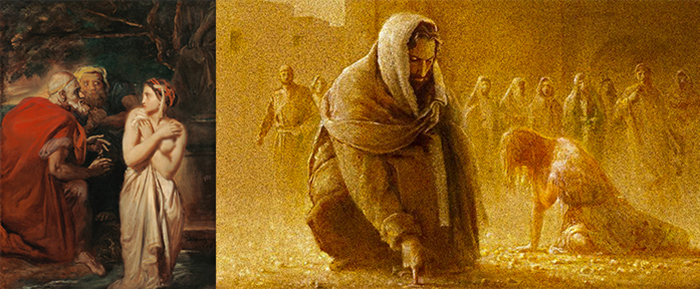
In today’s reflection, we look at two stories. The first comes from the Book of Daniel and the story of Susanna, who is unjustly accused. The second story comes from the Gospel of John with the woman caught in adultery. In the tradition of the Church, these two accounts are often told as two sides of the same coin—one representing perfect justice and the other perfect mercy.

In ancient Babylon, a beautiful and devout woman named Susanna is cornered in her private garden by two “elders”—judges who were supposed to be the moral backbone of the community. They give her a horrific choice: submit to them, or they will testify that they caught her with a young lover.

Susanna chooses death over sin. As she is led to execution, the young Daniel stops the crowd. He uses sharp, human wisdom to cross-examine the elders separately. When their stories about which tree they saw her under don’t match, their lie is exposed. Susanna is saved because she is innocent, and the corrupt elders are punished.

Centuries later, another group of religious leaders—the Scribes and Pharisees—drag a woman before Jesus. This time, there is no question of a false accusation as she is “caught in the very act” of adultery. The leaders aren’t interested in her; they are focused on using her as a trap to see whether Jesus will contradict the Law of Moses.

Jesus doesn’t look for a legal loophole or for a conflicting testimony. Instead of examining the woman’s case, he examines the accusers’ hearts. He stoops to write in the dust and says, “Let him who is without sin cast the first stone.” One by one, the elders walk away.

The two stories meet at the feet of the “Judges.” Daniel saves the woman by proving the world is wrong (the law was being misapplied on an innocent person). Jesus saves the woman by proving the world is hypocritical (the law was being used as a weapon by fellow sinners).

In the first story, God saves a saint from a lie. In the second, God saves a sinner from the truth. Together, they show a God who protects the righteous but also offers a way out to the fallen; the first receives God’s perfect justice, and the second receives God’s perfect mercy.

I am the resurrection and the life; whoever believes in me, even if he dies, will live, and everyone who lives and believes in me will never die. John 11:25-26

What is a meta-narrative, a bigger story, within which we need to understand our own story? And how is that the basis for hope in this earthly life?

Pierre Teilhard de Chardin was both a world-class scientist and a Christian mystic. He articulated a vision in which a Christian could bring together in one harmonious vision, the scientific theories regarding the origins of the universe, the unfolding of evolution through 15 million years, the purpose and role of Christ in history, and how cosmic and faith history will eventually culminate in the fullness of time, where, through Christ, God will bring all things into one in him. And on that day, goodness will forever triumph over evil, love will triumph over division, peace over chaos, empathy over selfishness, gentleness over cruelty, and forgiveness over vengeance. 

Except for the resurrection, we have no guarantees about anything. Lies, injustice, and violence may triumph in the end. Chaos, cruelty, and death may well be the last word. That’s certainly how it looked the day Jesus died.

However, the resurrection of Jesus is God’s last word on this. In the resurrection, God assures us that no matter how things look, no matter how much evil seems to have the upper hand, no matter how powerless innocence, goodness, and gentleness may look sometimes, no matter how many times our world crucifies Christ, no matter how many times we might blow up the world with an atomic bomb, no matter hopeless it all looks, the ending of our story has been written, and it is a happy ending, an ecstatic one. [Excerpt from Ron Rolheiser’s “The Resurrection: The Ultimate Meta-Narrative,” April 2025]

“You are not from Galilee also, are you? Look and see that no prophet arises from Galilee.” John 7:52


What’s good, what’s of God, will always at some point be misunderstood, envied, hated, pursued, falsely accused, and eventually nailed to some cross. Every body of Christ inevitably suffers the same fate as Jesus: death through misunderstanding, ignorance, and jealousy. 

But there’s a flipside as well: Resurrection always eventually trumps crucifixion. What’s good eventually triumphs. Thus, while nothing that’s of God will avoid crucifixion, no body of Christ stays in the tomb for long. Resurrection invariably follows crucifixion. Every crucified body will rise again. Our hope takes its root in that.

On the morning of the resurrection, the women-followers of Jesus set out for the tomb of Jesus, carrying spices, expecting to anoint and embalm a dead body. Well-intentioned but misguided, what they find is not a dead body, but an empty tomb and an angel challenging them with these words: “Why are you looking for the living among the dead? Go instead into Galilee and you will find him there!”

Go instead into Galilee. Why Galilee? What’s Galilee? And how do we get there?In the gospels, Galilee is not simply a geographical location, a place on a map. It is first of all a place in the heart. Galilee refers to the dream and to the road of discipleship that the disciples once walked with Jesus and to that place and time when their hearts most burned with hope and enthusiasm.

They are told to go back to the place where it all began: “Go back to Galilee. He will meet you there!” And just as promised, Jesus appears to them. He doesn’t appear exactly as he was before. The Christ that appears to them after the resurrection is in a different modality,

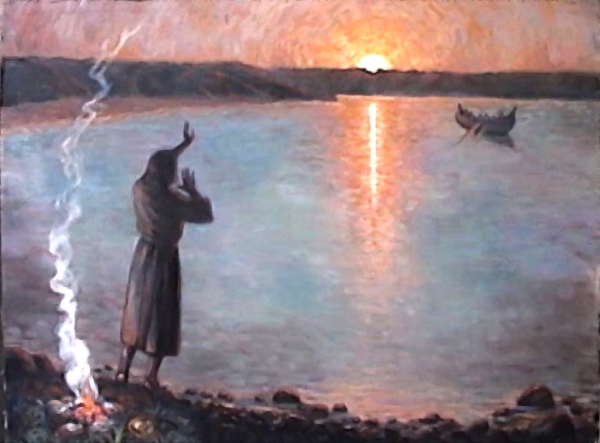
And they do go back to Galilee, both to the geographical location and to that special place in their hearts where once burned the dream of discipleship. And just as promised, Jesus appears to them. He doesn’t appear exactly as he was before, or as frequently as they would like him to, but he does appear as more than a ghost and a memory. The Christ that appears to them after the resurrection is in a different modality, but he’s physical enough to eat fish in their presence, real enough to be touched as a human being, and powerful enough to change their lives forever.

Ultimately, the resurrection asks us to go back to Galilee, to return to the dream, hope, and discipleship that had once inflamed us but has now been lost through disillusionment. That is one of the essential messages of Easter: Whenever we are discouraged in our faith, whenever our hopes seem to be crucified, we need to go back to Galilee and Jerusalem, that is, back to the dream and the road of discipleship that we had embarked upon before things went wrong. [Excerpt from Ron Rolheiser’s “Where to Find Resurrection,” April 2015]

I know him because I am from him, and he sent me. John 7:29

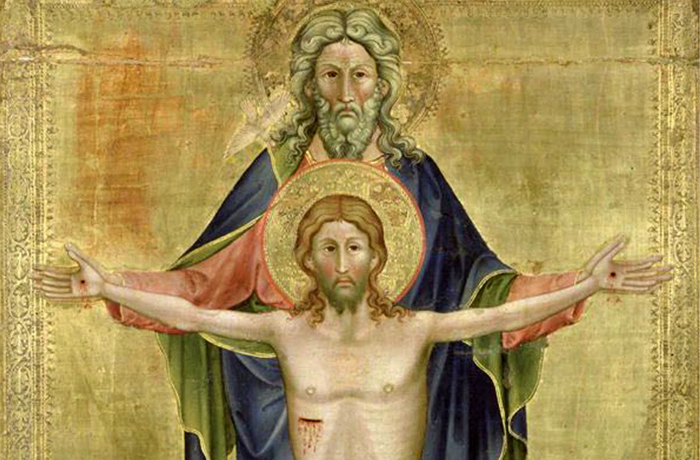
Our reflection verse today highlights the deep, intimate connection between Jesus and the Father, as well as the believer’s identity as a “sent” being. This phrase grounds Jesus’ authority in his origin, not just his actions. 

Ron Rolheiser notes that, like Jesus, our deepest identity comes from God. He emphasizes that by virtue of Baptism, we are sons and daughters of God, sent to bring his compassion to the world.

Because Jesus came from God and was sent, he knows the Father’s heart completely. This allowed Jesus to be in full solidarity with human suffering, taking on our condition and bringing the Divine face to it.

Just as Jesus was sent by the Father, Rolheiser writes that Christians are also “sent ones.” He emphasizes that our lives have purpose when they are aligned with this “sent” reality, which, for him, means carrying the spirit and mission of Jesus, even after his ascension.

As Christian’s, we must live within the divine energy (from which Jesus came), which is creative, loving, and a source of gratitude. Our lives are deeply rooted in God. Realizing that, like Jesus, we have a divine origin and a purposeful, “sent” mission in life.

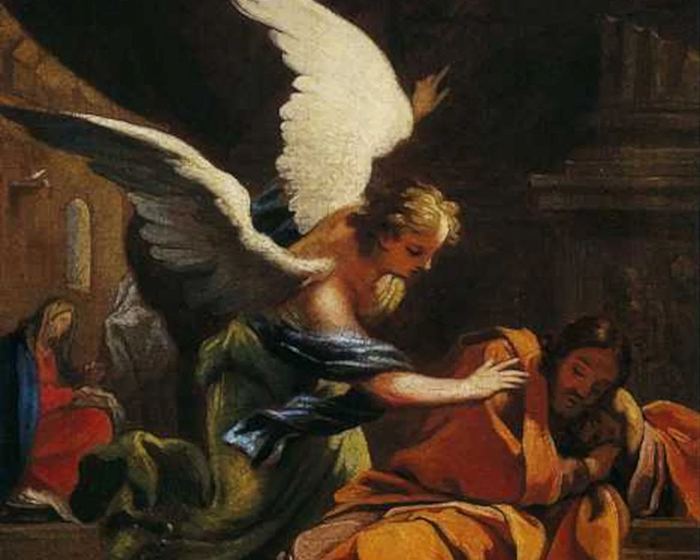
When Joseph awoke, he did as the angel of the Lord had commanded him and took his wife into his home. Matthew 1:24

Who exactly is this Joseph? He is that quiet figure named in the Christmas story as the husband of Mary and the stepfather of Jesus, and then basically is never mentioned again. The pious conception we have of him is that of an older man, a safe protector to Mary, a carpenter by trade, chaste, holy, humble, quiet, the perfect patron for manual laborers and anonymous virtue, humility incarnate.

Joseph and Mary were at this stage of their relationship, legally married but not yet living together when Mary became pregnant. Joseph, knowing that the child was not his, had a problem. If he wasn’t the father, who was? In order to save his own reputation, he could have demanded a public inquiry and, indeed, had Mary been accused of adultery, it might have meant her death. However, he decided to “divorce her quietly”, that is, to avoid a public inquiry which would leave her in an awkward and vulnerable situation.

Then, after receiving a revelation in a dream, he agrees to take her home as his wife and to name the child as his own, thus claiming that he is the father. By doing this, he spares Mary embarrassment, perhaps even saves her life, and he provides an accepted physical, social, and religious place for the child to be born and raised. But he does something else that is not as evident. He shows how a person can be a committed believer, deeply faithful to everything within his religious tradition, and yet at the same time be open to a mystery beyond both his human and religious understanding.

And this was exactly the problem for many Christians, including Matthew himself, at the time the Gospels were written. They were committed Jews who did not know how to integrate Christ into their religious framework. What does one do when God breaks into one’s life in new, previously unimaginable ways? How does one deal with an impossible conception? Joseph is the paradigm. As Raymond Brown puts it: “The hero of Matthew’s infancy story is Joseph, a very sensitive Jewish observer of the Law. In Joseph, the evangelist was portraying what he thought a Jew [a true pious believer] should be and probably what he himself was.”

In essence, Joseph teaches us how to live in loving fidelity to all that we cling to humanly and religiously, even as we are open to a mystery of God that takes us beyond all the categories of our religious practice and imagination. And isn’t that one of the real challenges of Christmas? [Excerpt from Ron Rolheiser’s “Joseph and the Christmas Story,” December 2023]

HTML Snippets Powered By : XYZScripts.com