
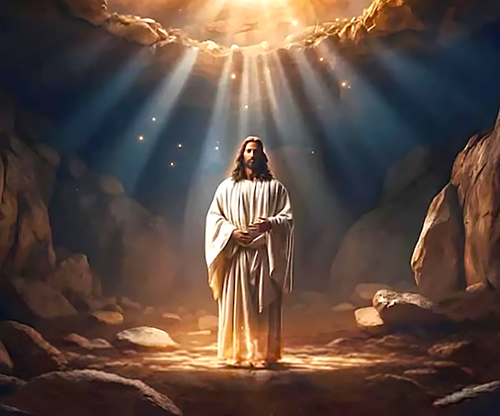
Our Savior Jesus Christ has destroyed death and brought life to light through the Gospel. 2 Timothy 1:10

At the heart of the Christian faith stands this astonishing proclamation: death no longer has the final word. Through His Passion, Death, and Resurrection, Jesus Christ entered into humanity’s greatest enemy—not to escape it, but to conquer it from within. The cross, once a symbol of shame and defeat, became the very instrument of victory. By rising from the dead, Christ shattered the power of sin and death, opening the way to eternal life for all who believe in Him.

When St. Paul says that Christ has “destroyed death,” he does not mean that physical death has disappeared. Christians still experience the sorrow of death, but its meaning has been transformed. Death is no longer an impassable wall separating humanity from God; instead, because of Christ, it has become a doorway into the fullness of life. As the Church proclaims in the funeral liturgy, “Indeed for your faithful, Lord, life is changed, not ended.”

Paul also tells us that Christ has “brought life and immortality to light through the Gospel.” The Gospel is not merely a collection of teachings or moral principles; it is the joyful announcement that God has acted decisively in history to save His people. Through the life, death, and resurrection of Jesus, the hidden mystery of God’s eternal plan has been revealed. Humanity now sees clearly what was once only hoped for: that we are created not for the grave, but for communion with God forever.

This promise reshapes the way Christians live in the present. If Christ has conquered death, then fear no longer governs our lives. We are free to love generously, forgive completely, sacrifice courageously, and persevere through suffering with hope. Every act of faith, every work of charity, and every moment of faithful endurance thus participates in the victory Christ has already won.

This verse also reminds us that eternal life begins now. Through Baptism, we already share in Christ’s risen life. Through the Eucharist, we receive the Bread of Life, a foretaste of the heavenly banquet. Through the Holy Spirit, we are continually transformed into the likeness of Christ. Therefore, the Gospel is not simply a promise for the future—it is the power of God at work in the present, illuminating our lives with the hope of resurrection.

As followers of Christ, we are called to become witnesses of this hope. In a world often marked by fear, despair, and uncertainty, Christians proclaim with confidence that life has triumphed over death because Jesus Christ lives. Our mission is to reflect His light through lives of faith, hope, and love, and to invite others to discover the same victory revealed in the Gospel.

Blessed are the poor in spirit, for theirs is the Kingdom of heaven. Matthew 5:3

“Sermon On The Mount” by Laura James, 2010

The world often proposes a very different path to happiness. It tells us that fulfillment comes through power, wealth, recognition, self-sufficiency, and the avoidance of suffering. In his Sermon on the Mount, Jesus turns these assumptions upside down in what has come to be known as “The Beatitudes.” He calls blessed the poor in spirit, the meek, the merciful, the peacemakers, and those who hunger and thirst for righteousness. He even calls blessed those who mourn and those who are persecuted for the sake of the Kingdom. At first hearing, these words can seem paradoxical. How can poverty, grief, or persecution be signs of blessedness?

The answer is found in the person of Christ. Jesus does not merely teach the Beatitudes; he lives them. He is poor in spirit because he depends entirely on the Father. He mourns over the suffering caused by sin. He is meek and humble of heart. He shows mercy to sinners and becomes the supreme peacemaker by reconciling humanity with God through the Cross. In following the Beatitudes, we are not embracing misery; we are embracing a way of life that conforms us to Christ.

The challenge of the Beatitudes is that they require us to trust God more than ourselves. To be poor in spirit means recognizing our need for God in a culture that prizes independence. To be merciful means forgiving when we would rather seek revenge. To hunger and thirst for righteousness means desiring God’s will more than personal comfort. To be a peacemaker means entering difficult situations with courage and charity rather than standing safely on the sidelines. None of these paths is easy. They often involve sacrifice, misunderstanding, and even rejection.

The blessedness of the Beatitudes is the blessedness of belonging to Christ.
We do not strive to live the Beatitudes because they are easy. We strive to live them because they reveal the face of Jesus and lead us into the happiness for which every human heart longs. Their challenge is real because they call us to die to ourselves. Their joy is even greater because they open our hearts to the very life of God. When we live the Beatitudes, we discover that holiness is not the loss of happiness but its fulfillment. The closer we draw to Christ, the more we become the people we were created to be, and the more we experience the deep and lasting joy that no circumstance can take away.

HTML Snippets Powered By : XYZScripts.com