
“You will be hated by all because of my name.” Matthew 10:22

Jesus’ warning in Matthew’s Gospel is a sober reminder that the values of the Kingdom of God will inevitably come into conflict with the values of a fallen world. The first disciples experienced this reality firsthand. They proclaimed a crucified and risen Messiah in a world shaped by political power, religious rivalry, and cultural divisions. Their faithfulness often led to rejection, persecution, imprisonment, and even martyrdom. Jesus prepared them not to be discouraged by opposition, but to remain steadfast in trusting that God’s truth would ultimately prevail.

This warning speaks just as powerfully to our own time. We live in a society increasingly marked by polarization, suspicion, violence, and a readiness to define people by political, racial, religious, or ideological labels. Hatred has become easier to express and easier to spread. Yet Jesus does not call His followers to respond with fear, resentment, or retaliation. Instead, He calls them to witness through love, patience, forgiveness, and unwavering fidelity to the Gospel. The disciple’s task is to remain faithful to Christ while treating every person with the dignity that comes from being created in the image of God.

Jesus’ words also invite us to examine our own hearts. The greatest danger is not only that we may be hated by others, but that we ourselves may begin to hate. The Gospel leaves no room for contempt, prejudice, or dehumanization. Whenever Christians allow anger, tribalism, or bitterness to replace charity, they cease to reflect the One who prayed from the Cross, “Father, forgive them.” Fidelity to Christ is measured not merely by enduring opposition, but by loving even those who oppose us.

Throughout history, the Church has flourished most when her members have answered hatred with holiness. The blood of the martyrs became the seed of the Church because they chose forgiveness over vengeance. Saints throughout every age have shown that authentic Christian witness is not the loudest voice in the public square but the quiet strength of lives transformed by Christ. Their courage reminds us that the Gospel’s power is revealed most clearly when love overcomes hatred.

Jesus’ warning is both realistic and hopeful. We should not be surprised when Christian values are misunderstood or when discipleship carries a personal cost. At the same time, we must never allow the world’s hostility to shape our own hearts. Instead, we are called to become peacemakers, bridge-builders, and ambassadors of reconciliation. The Christian response to a world marked by violence and division is neither withdrawal nor aggression, but courageous love rooted in the Cross.

“The Kingdom of heaven is at hand.” Matthew 10:7

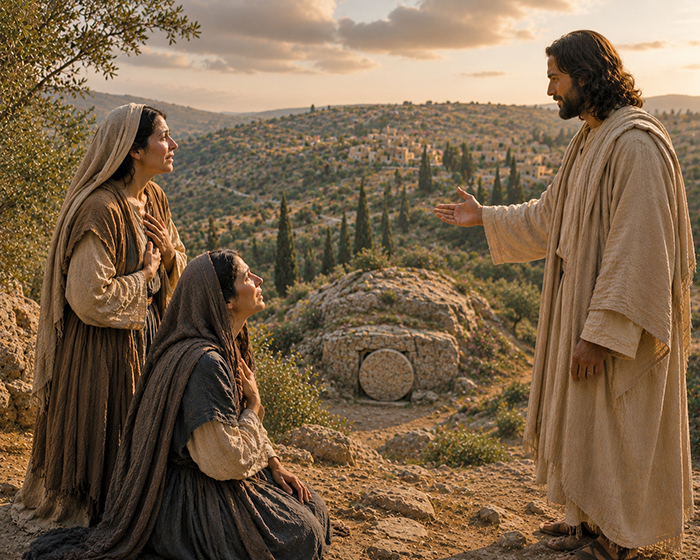
Jesus’ proclamation, “The Kingdom of heaven is at hand”, as depicted in the image today, which is taken from the series “The Chosen“, is the central announcement of Jesus’ earthly ministry. It is not simply a prediction of a future reality, nor merely a promise of heaven after death. It is the declaration that, in the person of Jesus Christ, God has drawn near to His people. The long-awaited reign of God has entered human history. The King Himself has come.

For the Jewish people who first heard these words, the “Kingdom of heaven” carried deep expectations. The prophets had foretold a day when God would restore Israel, defeat evil, establish justice, and gather His people into covenant communion. Yet Jesus reveals that the Kingdom arrives in an unexpected way—not first through military power or political revolution, but through conversion of heart, mercy, healing, forgiveness, and self-giving love. Wherever Christ is welcomed, the Kingdom begins to take root.

The phrase “is at hand” conveys both nearness and urgency. God’s invitation is not distant or postponed. The Kingdom is already breaking into the present through Christ’s preaching, miracles, and ultimately through His death and resurrection. It is a Kingdom that is “already” present, yet “not yet” fully realized. We experience it now in the life of the Church, especially through the proclamation of the Word, the celebration of the sacraments, and lives transformed by grace, while we still await its fullness when Christ returns in glory.

This proclamation also becomes the mission entrusted to the disciples. Jesus sends them to announce the same message because they are to become visible signs of the Kingdom. Their healing of the sick, cleansing of lepers, casting out of demons, and proclaiming peace reveal that God’s reign restores what sin has broken. The Church continues this mission today whenever she brings Christ’s mercy into a wounded world through evangelization, charity, justice, and the celebration of the Eucharist.

For each of us, these words are a personal invitation. The Kingdom is not merely a place we hope to enter someday; it is a life we are called to embrace today. Every act of faith, every work of mercy, every moment of forgiveness, every surrender to God’s will makes His Kingdom more visible in our lives. When we pray, “Thy Kingdom come,” we ask not only for Christ’s glorious return, but that His reign may first transform our own hearts.

“Go rather to the lost sheep of the house of Israel.” Matthew 10:6

Jesus’ instruction to the Twelve, “Go rather to the lost sheep of the house of Israel”, can seem surprising at first. Yet this opening mission is not a limitation of His love, but the first step in God’s unfolding plan of salvation. Jesus was not excluding the nations; He was fulfilling the promises God had made to Israel so that, through Israel, salvation could be offered to every nation.

Throughout the Old Testament, God chose Israel to be His covenant people, not because He intended to save only one nation, but because He intended to bless all nations through them. From God’s promise to Abraham as recorded in Genesis, “in you all the families of the earth shall be blessed”, Israel was called to be a light to the nations. Jesus, the promised Messiah and the Son of David, first gathered the “lost sheep of the house of Israel” because He came to fulfill the Law, the Prophets, and the covenants made with their ancestors. His ministry showed that God is faithful to His promises and that Israel’s calling serves a larger purpose.

Throughout Matthew’s Gospel, there are signs that God’s mercy extends beyond Israel. Jesus praises the faith of the Roman centurion, heals the daughter of the Canaanite woman, and speaks of many who will come from east and west to sit at the banquet in the Kingdom of Heaven. Following His Resurrection, the mission expands dramatically: “Go, therefore, and make disciples of all nations”. What begins with Israel opens outward to the entire world.

The verse reminds us that God’s salvation unfolds according to His wisdom and faithfulness. Jesus’ initial focus on Israel was not a limitation of His love but the first step in a divine plan that would culminate in the Gospel reaching every corner of the earth. Through His death and Resurrection, the covenant was opened to all humanity, and today every person is invited to share in the life of God through Christ. What began with the lost sheep of Israel has now become the joyful invitation extended to the whole world: to enter into full communion with the Father through the Son, in the power of the Holy Spirit.

“The harvest is abundant, but the laborers are few; so ask the master of the harvest to send out laborers for his harvest.” Matthew 9:37-38


Jean-François Millet – L’Angélus

As Jesus looked upon the crowds, He did not see strangers or statistics; He saw people who were “troubled and abandoned, like sheep without a shepherd.” His heart was moved with compassion, and from that compassion came this enduring invitation to His disciples. The problem was not that God had failed to prepare the harvest. The fields were already ripe. What was needed was faithful men and women willing to enter those fields in His name.

The image of the harvest is deeply rooted in Scripture. In the Old Testament, harvest represented God’s blessing and the gathering of His people. Jesus now reveals that the true harvest is humanity itself—people longing, often unknowingly, for the truth, mercy, and saving love of God. The harvest remains abundant because the human heart still hungers for God.

This passage reminds us that every baptized Christian shares in Christ’s mission. While some are called to ordained or consecrated life, every disciple is called to labor in the Lord’s vineyard. Parents form their children in the faith. Teachers lead others to truth. Parish volunteers serve through hidden acts of charity. Friends and neighbors bear witness to Christ through lives of charity, mercy, and hope.

The scarcity of laborers is therefore not simply a shortage of clergy; it is a reminder that every Christian must discern how God is calling them to participate in His work. The Church flourishes when each member recognizes that faith is not merely something to receive but something to share and live with urgency.

These words challenge us to look upon our own communities through the compassionate eyes of Christ. Where do we see people searching for hope? Who has drifted from the Church? Who has never encountered the Gospel in a personal way? These are the fields waiting to be harvested. Our first response is prayer, asking the Lord to raise up holy vocations and courageous disciples. Our second response is to listen carefully, for the laborer God desires to send may very well be us—here, now.

For if you live according to the flesh, you will die, but if by the Spirit you put to death the deeds of the body, you will live. Romans 8:13

In Paul’s Letter to the Romans, he is not condemning the human body, nor is he teaching that Christians should despise physical life. Rather, he is describing two fundamentally different ways of living—one centered on the self and one centered on God.

To live according to the flesh is to make oneself the ultimate reference point for life. In Paul’s language, “the flesh” refers not simply to our physical bodies but to our fallen human nature apart from God’s grace. It is life governed by self-interest, pride, fear, pleasure, power, resentment, or the endless pursuit of control. A person living according to the flesh may appear outwardly successful, moral, or even religious, but inwardly remains centered on “my will” rather than God’s will. Such a life gradually closes the heart to God and others. It promises freedom but often leads to anxiety, addiction, loneliness, and spiritual death because the soul was created for communion with God, not independence from Him.

To live according to the Spirit, on the other hand, is to allow the Holy Spirit to shape one’s thoughts, desires, decisions, and relationships. This does not mean becoming perfect overnight or never experiencing temptation. It means allowing God’s grace to transform the heart little by little. The Christian begins asking different questions: What is God asking of me? How can I love more faithfully? How can I forgive? Where is Christ leading me today? Life in the Spirit is characterized by humility, trust, charity, self-control, mercy, and hope. It is not merely about avoiding sin but about becoming more like Christ.

The difficulty is that living by the flesh feels natural, while living by the Spirit requires conversion. From our earliest years, we instinctively protect ourselves, seek comfort, compare ourselves with others, and satisfy immediate desires. Our culture often reinforces these instincts, celebrating self-expression and self-gratification as the highest goods. Because of this, many people mistake the impulses of the flesh for genuine freedom. They assume that following every desire is authentic living, when in reality it often becomes a new form of slavery.

Living by the Spirit, on the other hand, is also difficult to understand because God’s way often appears contrary to ordinary human logic. The Spirit teaches that greatness comes through service, that strength is found in humility, that forgiveness is more powerful than revenge, that generosity enriches more than accumulation, and that surrender to God brings deeper freedom than self-rule. These truths are not easily grasped because they must be learned through experience, prayer, and grace. The Spirit forms us gradually, often through trials, disappointments, and acts of daily fidelity rather than dramatic moments.

This transformation from living in the flesh to living in the Spirit is rarely instantaneous. It is the lifelong work traditionally called sanctification. Every act of repentance, every sincere confession, every choice to forgive instead of resent, every hidden act of charity, and every moment of faithful prayer is another step away from life according to the flesh and toward life in the Spirit. We discover that holiness is not simply avoiding evil but allowing Christ to live more fully within us.

Paul’s words today offer encouragement as much as challenge. Most believers recognize both realities within themselves. We know the attraction of selfishness, comfort, and pride, yet we also experience the quiet prompting of the Holy Spirit calling us toward something greater. The Christian life is lived in that tension. The measure of holiness is not that we never struggle with the flesh, but that we increasingly choose to cooperate with the Spirit. Each day presents countless opportunities to die a little to self so that the life of Christ may become more visible in us.

Can the wedding guests mourn as long as the bridegroom is with them? Matthew 9:15

In our reflection verse today from Matthew’s Gospel, Jesus draws on one of the Old Testament’s most beloved images. Throughout the Hebrew Scriptures, God is portrayed as the Bridegroom of Israel. By identifying Himself as the Bridegroom, Jesus is making a remarkable claim: God has come personally to dwell among His people. A wedding feast is not a time for mourning but for celebration, joy, abundance, and communion. As long as the Bridegroom is physically present, fasting would contradict the reality of the moment. God’s kingdom has arrived in the person of Jesus.

In the Jewish tradition, fasting often accompanied grief, repentance, longing, or earnest prayer. People fasted when mourning the dead, seeking God’s mercy, repenting of sin, or pleading for divine intervention. Fasting became the outward expression of an inward hunger. The emptiness of the stomach symbolized the deeper emptiness of the soul yearning for God.

Every Christian fast contains an element of holy mourning. It is not mourning born of despair, but mourning born of love. We grieve our sins because they separate us from the One we love. We mourn the brokenness of the world because creation still groans for redemption. We lament suffering, injustice, and death because they are reminders that God’s work of restoration is not yet complete.

One of the greatest gifts of reflecting prayerfully on Scripture is that it allows us to discover not only what Jesus teaches, but why He teaches it. Without understanding the Jewish practice of fasting as an expression of mourning, repentance, and longing for God’s intervention, Jesus’ words may seem little more than a discussion of religious regulations.

However, when we recognize the tradition behind His statement, His teaching takes on profound depth. We begin to see that Christian fasting is not merely giving something up but expressing a heart that longs for communion with the Bridegroom. The practice of fasting becomes an outward sign of an inward desire for God.

As we ponder Scripture, we begin to recognize our own lives within its pages. The disciples’ fears become our fears. Their doubts become our doubts. Their encounters with Christ become invitations for us to meet Him in our own circumstances. Scripture becomes not simply a record of God’s work in the past but a conversation with God in the present. Every passage invites us to know Christ more deeply, to recognize His presence more clearly, and to conform our lives more closely to His.

Unless I see the mark of the nails in his hands and put my finger into the nail marks and put my hand into his side, I will not believe. John 20:25

The words of Saint Thomas that we reflect upon today are among the most honest in all of Scripture. Thomas gives voice to a struggle that has echoed through every generation. He is not simply doubting a fact; he is wrestling with a reality that seems impossible. The one he had loved, followed, and watched die was now being proclaimed alive. His heart had been wounded by grief, and grief often makes trust difficult. His words reveal the tension between hope and disappointment, between faith and experience.

Thomas’ doubt reminds us that doubt itself is not the opposite of faith. Rather, doubt is often the place where faith is purified and deepened. The opposite of faith is not honest questioning but the refusal to seek the truth. Thomas did not abandon the community of believers. Although he struggled to believe the testimony of the other apostles, he remained among them. This is significant. Even in his uncertainty, he stayed close to the Church, and it was there, in the gathered community, that the risen Christ came to meet him.

The doubts of Christians today often resemble those of Thomas. Believers may ask why God seems silent in suffering, why prayers appear unanswered, or why evil persists in a world created by a loving God. Some struggle when confronted by scientific discoveries, historical questions, or the failures and sins of members of the Church. Others wonder whether God is truly present in the ordinary moments of life. These questions do not necessarily indicate weak faith; they often arise because people desire a genuine faith rather than a superficial one. Like Thomas, they long for a faith that can withstand the realities of suffering, disappointment, and uncertainty.

Non-Christians frequently wrestle with similar questions but from a different starting point. They may ask whether God exists at all, whether Jesus truly rose from the dead, whether miracles are possible, or whether Christianity offers a trustworthy understanding of reality. Many have never encountered Christ in a personal way, while others have been wounded by negative experiences with Christians or by distorted images of God. Their doubts deserve neither ridicule nor dismissal but patient listening and thoughtful conversation. Throughout the Gospels, Jesus consistently welcomed sincere seekers, inviting them not into blind belief but into a relationship grounded in truth.

The remarkable aspect of this Gospel is how Jesus responds to Thomas. He does not shame him or reject him for his doubts. Instead, Jesus invites Thomas to do exactly what Thomas had said he needed: “Put your finger here and see my hands, and bring your hand and put it into my side.” Thomas’ response is equally significant. Once he encounters the risen Christ, he no longer speaks of evidence or proof. Instead, he makes one of the clearest professions of faith found anywhere in Scripture: “My Lord and my God!” His journey moves beyond intellectual certainty to personal surrender.

The Church has long understood this passage as a source of hope for those who struggle with belief. This reflects the ancient insight often summarized by Saint Anselm of Canterbury as fides quaerens intellectum—”faith seeking understanding.” We all carry questions, disappointments, and moments of uncertainty. Yet the Gospel assures us that the risen Christ is not afraid of our questions. He comes to us through His Word, His Church, and especially in the Eucharist, inviting us to encounter Him in the most intimate and personal way this side of heaven.

But that you may know that the Son of Man has authority on earth to forgive sins. Matthew 9:6

The words “on earth” in today’s reflection verse from Matthew’s Gospel are not incidental; they point to the remarkable truth that God’s heavenly authority has entered human history through Jesus Christ. The forgiveness of sins is no longer something that humanity merely hopes to receive at the end of time or seeks only through the Temple sacrifices. In Jesus, God’s mercy has become present and active within the ordinary realities of human life. Heaven has come to earth.

The phrase “on earth” also emphasizes the Incarnation. Jesus is not simply announcing God’s forgiveness from a distance; he is exercising divine authority among ordinary people. Throughout the Old Testament, it was understood that only God could forgive sins. This is why the scribes accuse Jesus of blasphemy. They understand the implication of his words: if he truly forgives sins by his own authority, then he is claiming a prerogative that belongs to God alone. Jesus does not correct their understanding; instead, he confirms it by healing the paralytic.

The emphasis on “on earth” also reveals an essential aspect of the Kingdom of God. Jesus came not merely to promise forgiveness after death but to restore communion with God here and now. Humanity need not wait until heaven to experience reconciliation. Through Christ, God’s mercy becomes accessible in this life, transforming people so they can begin living as citizens of the Kingdom while still on earth.

This passage also provides an important foundation for the Church’s understanding of the Sacrament of Reconciliation. Catholics do not believe that priests forgive sins by their own power. Rather, Christ, who possesses divine authority, chose to share his ministry of reconciliation with his apostles and their successors. After his Resurrection, Jesus breathed on the apostles and declared, “Receive the Holy Spirit. Whose sins you forgive are forgiven them, and whose sins you retain are retained”. Likewise, he entrusted the apostles with the authority of “binding and loosing”, language the Jewish community understood to include authoritative judgments on reconciliation within God’s covenant community.

Many people imagine God’s forgiveness as distant or abstract, something reserved for the next life. Jesus insists otherwise. His forgiveness is meant to be encountered concretely in this world. He knows that human beings need more than the private hope that they are forgiven; they often need to hear the words, “I absolve you from your sins,” just as the paralytic needed to hear, “Take heart, son; your sins are forgiven.” God’s mercy is not intended to remain an invisible idea but to become a lived experience that restores both soul and community.

Thereupon, the whole town came out to meet Jesus, and when they saw him, they begged him to leave their district. Matthew 8:34

Jesus’ encounter with the people of the Gadarene region, which forms our reflection verse today, is one of the more surprising moments in the Gospel. Jesus has just accomplished what should have been received as an extraordinary act of mercy. Two men who had lived in torment, isolated from society and possessed by demons, are restored to freedom. Yet instead of rejoicing, the people of the town “begged him to leave their district.” Their response seems irrational until we recognize that the Gospel is revealing something profoundly true about the human heart.

God’s presence is never merely comforting; it is also disruptive. Whenever Christ enters a life, He challenges habits, attachments, and priorities that keep us from the freedom He desires for us. We often pray for God to transform us, yet when that transformation begins to affect our routines, possessions, ambitions, or relationships, we may quietly resist. Like the villagers, we sometimes prefer the predictability of our brokenness to the uncertainty of true freedom. Familiar chains can seem safer than unfamiliar liberty.

This pattern appears throughout Scripture. The people of Israel frequently longed to return to Egypt despite their liberation because slavery had become familiar. The rich young man walked away saddened because following Jesus required surrendering what he treasured most. The religious leaders often opposed Jesus because His presence threatened the structures upon which they had built their identity. In every case, the obstacle was not a lack of evidence for God’s power but an unwillingness to let that power reorder their lives.

This passage then invites us to examine how we respond when God answers our prayers in unexpected ways. Divine grace rarely leaves our lives untouched. It may lead us to difficult conversations, painful forgiveness, new responsibilities, or the courage to leave unhealthy patterns behind. At first, these changes can feel unsettling. Yet what seems like disruption is often the beginning of true healing. Christ never removes something from us without desiring to give us something infinitely greater.

Perhaps the most searching question this Gospel asks is not, “Why did the villagers send Jesus away?” but “Where am I tempted to do the same?” Are there areas of my life where I welcome Christ only so long as He does not ask too much of me? Are there attachments I protect more fiercely than I desire His transforming grace? The tragedy of the Gadarenes was not simply that they lost a herd of swine; it was that they asked the Savior of the world to leave rather than remain among them.

Every day we are given the same choice as the people of that village: to ask Him to leave because His presence disrupts our comfort, or to invite Him to remain because His presence alone brings the freedom, healing, and abundant life for which we were created. The Christian life begins when we stop protecting our familiar fears and instead allow Christ to stay, trusting that whatever He asks us to surrender can never compare with the joy of becoming the people God created us to be.

HTML Snippets Powered By : XYZScripts.com