

Do not worry about tomorrow; tomorrow will take care of itself. Matthew 6:34

Jesus’ words are often misunderstood as a prohibition against planning. Yet throughout Scripture, prudent planning is presented as a virtue. The farmer prepares the field before planting, the builder estimates the cost before construction, and even Jesus speaks of a king considering the resources needed before going to war. What Christ condemns is not planning for tomorrow but allowing tomorrow to dominate today’s trust in God.

There is a profound difference between planning and worrying. Planning is an act of stewardship; worrying is an attempt to control what ultimately belongs to God. Planning says, “I will do my part and prepare responsibly.” Worry says, “Everything depends on me, and I must carry the burden of the future alone.” The disciple is called to the first and warned against the second.

In everyday life, this means Christians should save for retirement, prepare for emergencies, schedule medical appointments, plan family events, and make thoughtful decisions about education, careers, and finances. Such actions are expressions of prudence, one of the cardinal virtues. However, as they make those plans, believers are invited to hold them with open hands, recognizing that circumstances may change and that God’s providence is greater than any strategy or forecast.

Jesus’ teaching is therefore an invitation to live fully in the present moment. Much of our anxiety comes from borrowing troubles that have not yet arrived. We replay possible failures, losses, disappointments, and crises that may never occur. Christ redirects our attention to the grace available today. God gives strength for today’s challenges; He does not promise tomorrow’s grace in advance because tomorrow has not yet come. When tomorrow arrives, so too will the grace needed to meet it.

Imagine a parent preparing for a child’s future. A loving parent plans, saves, teaches, and sacrifices for what lies ahead. Yet if that parent spends every waking hour consumed by fears about what might happen years from now, they lose the joy of the child standing before them today. Jesus invites us to do what responsible love requires while refusing to surrender our peace to imagined futures.

The life of a Christian should be lived one day at a time, trusting that the God who has provided for today will also be present tomorrow. As many spiritual writers have observed, the future belongs to God; our task is to be faithful in the present moment where His grace is already at work.

But store up treasures in heaven…For where your treasure is, there also will your heart be. Matthew 6:20a-21

Jesus’ words invite us to examine not simply what we possess, but what possesses us. In the Sermon on the Mount, Jesus contrasts earthly treasures, which are temporary, vulnerable, and ultimately unable to satisfy the deepest longings of the human heart, with heavenly treasures, which endure eternally because they are rooted in God Himself.

Consider a young couple welcoming their first child. Before the child is born, they begin to rearrange their home, purchase a crib, read books, discuss names, and imagine the future. Their time, energy, money, and attention increasingly revolve around this new life. Why? Because their treasure is there. Their hearts follow their investment. The more they give themselves to the child, the deeper their love grows.

The same principle applies in our relationship with God. Many people wait until they “feel” closer to God before committing more time to prayer, worship, or service. Yet Jesus suggests the opposite. When we intentionally invest ourselves in the things of God—attending Mass faithfully, spending time in prayer, serving those in need, studying Scripture, or participating in the life of the Church—our hearts gradually follow. We begin to desire God more because we are placing our treasure in Him.

A parishioner once shared that after retirement, he intended to spend more time with God. Yet he found himself filling every day with hobbies, television, travel, and household projects. None of these things were wrong, but he noticed that God continually received whatever time was left over. One day, he decided to begin each morning with fifteen minutes of prayer before doing anything else. At first, it felt like an obligation. Months later, he realized something had changed. His prayer time had become the most important part of his day. His treasure had shifted, and his heart had followed.

Perhaps the most moving example is found at the end of many lives. Rarely does someone say, “I wish I had spent more time at the office” or “I wish I had accumulated more possessions.” Instead, people often speak of relationships, faith, forgiveness, love, and the moments they encountered God. In those final reflections, the true treasures of the heart become clear.

Jesus’ words are therefore not so much a warning as an invitation. He is gently asking us to place our treasure where it will last forever. Every prayer, every act of kindness, every moment spent loving God and neighbor is like placing another coin in the treasury of heaven. As we do so, our hearts are gradually drawn toward God Himself, until one day we discover that He was the treasure we were seeking all along.

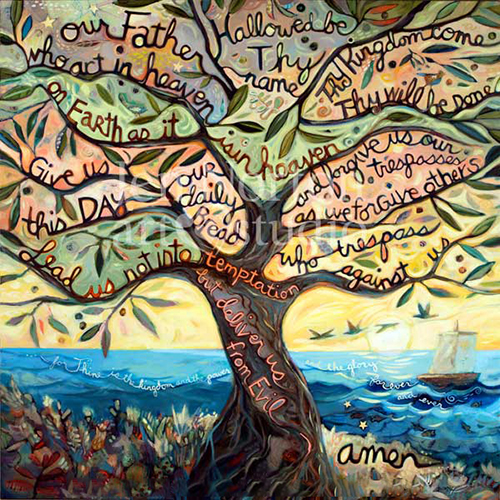
“Our Father who art in heaven, hallowed be thy name…” Matthew 6:9

Our Father (The Lord’s Prayer) by Jen Norton

Among all the prayers of the Christian tradition, the Lord’s Prayer occupies a unique and singular place because it is the only prayer that Jesus Himself explicitly taught His disciples. When the disciples asked, “Lord, teach us to pray”, Jesus did not merely offer advice about prayer; He gave them the very words by which they should approach God. For this reason, the Church has always regarded the Lord’s Prayer as the perfect prayer, the model against which all other prayers are measured. Every authentic Christian prayer is, in some way, an unfolding of the petitions contained within the “Our Father.”

At the heart of the prayer are its opening words: “Our Father.” These words reveal something profound about who God is and who we are. Jesus invites us to come before God not as strangers, servants, or petitioners standing at a distance, but as beloved sons and daughters. Every time we pray these words, we are reminded that we are never alone. We belong to God, and we belong to one another. In a world where many people experience loneliness, uncertainty, and division, the Lord’s Prayer gently calls us back to the truth that we are part of a family gathered around the same loving Father.

The beauty of the Lord’s Prayer is that it teaches us what matters most. Before we bring our own concerns and needs before God, Jesus directs our hearts toward the Father: “Hallowed be thy name. Thy kingdom come. Thy will be done.” These petitions remind us that life is not ultimately about our plans, achievements, or desires. True peace comes when our hearts are aligned with God’s purposes. As we pray these words each day, we learn to trust that God’s wisdom is greater than our own and that His will, even when difficult to understand, is always directed toward our good.

Only then do we ask for what we need. We pray for daily bread, for forgiveness, for strength in temptation, and for protection from evil. There is great comfort in this. Jesus understands the realities of human life. He knows our worries, our struggles, our weaknesses, and our fears. He teaches us that we need not carry these burdens alone. The Lord’s Prayer gives us permission to place every concern into the hands of the Father who knows our needs even before we ask Him. In doing so, we are reminded that faith is not self-reliance but trusting reliance upon God.

The prayer also stretches our hearts beyond ourselves. When we pray, “Forgive us our trespasses as we forgive those who trespass against us,” we encounter one of the most challenging and transformative dimensions of Christian life. The Lord’s Prayer reminds us that receiving God’s mercy and extending mercy to others are inseparable. It invites us to examine our hearts, release old wounds, and seek reconciliation where division has taken root. Though forgiveness is often difficult, it is also one of the ways God’s grace heals and frees us.

The petition, “Thy kingdom come, thy will be done on earth as it is in heaven,” broadens our vision even further. We are not praying only for ourselves, our families, or our parish communities. We are praying for the healing and restoration of the entire world. We pray for peace where there is conflict, justice where there is oppression, hope where there is despair, and faith where there is doubt. In this way, the Lord’s Prayer becomes a prayer for all creation, expressing humanity’s longing for the day when God will make all things new.

For modern Christians, the daily recitation of the Lord’s Prayer should be seen not as an obligation but as an invitation. It is an opportunity each day to pause, to remember whose we are, and to place our lives once again into God’s hands. Whether prayed slowly in the quiet of the morning, spoken with family before a meal, recited during Mass, or whispered before sleep, these sacred words have the power to reorient our hearts toward what truly matters.

The Lord’s Prayer is more than a prayer to be spoken; it is a way of life to be embraced. Each time we pray it with sincerity, we are allowing Jesus to teach us once again how to live as children of the Father. We learn to trust more deeply, forgive more generously, seek God’s will more faithfully, and hope more confidently in the coming of His Kingdom. The Lord’s Prayer endures at the center of Christian life because it not only leads us to God—it gradually forms our hearts to become more like the One who first taught it to us. Through its simple yet profound words, Christ continues to draw His disciples into the very life and love of the Father.

But when you give alms, do not let your left hand know what your right is doing, so that your almsgiving may be secret. Matthew 6:3-4

Jesus’ instruction, “But when you give alms, do not let your left hand know what your right is doing”, is not primarily about the mechanics of giving but about the disposition of the heart. In the context of the Sermon on the Mount, Jesus is addressing those who “sound a trumpet” before themselves in order to be seen and praised by others. His concern is not public giving itself, but giving that seeks recognition, admiration, or status.

The image of the left hand not knowing what the right hand is doing is a vivid Semitic exaggeration. Jesus is urging such humility and purity of intention that even the giver should not dwell on his own generosity. The act of charity should flow naturally from a heart transformed by God’s love rather than become a source of self-congratulation.

Viewed in this light, the modern practice of passing a collection basket during Mass is not necessarily contrary to Jesus’ teaching. The collection is a practical means of supporting the Church’s mission, maintaining its ministries, caring for the poor, and sustaining the parish community. The act itself is public, but the amount given and the motive behind it remain private. A person can place an offering in the basket with complete humility, seeking only to honor God. Conversely, someone could give anonymously yet still be motivated by pride. Jesus is concerned with the latter reality—the hidden intentions of the heart.

Jesus’ warning remains relevant in all ages. Whenever giving becomes a means of gaining influence, prestige, recognition, or social standing within the Church, the spirit of his teaching is compromised. This danger exists not only in financial giving but also in volunteer service, ministry leadership, theological knowledge, and even public displays of piety. The temptation to be seen is perennial.

Jesus invites a deeper examination of conscience. When we give—whether money, time, talent, or service—we might ask: Am I seeking God’s glory or my own? Would I still make this gift if no one ever knew about it? Am I attached to recognition, appreciation, or influence because of my generosity?

The disciple’s almsgiving, therefore, becomes an imitation of God’s own generosity: quiet, selfless, and freely offered. The goal is not secrecy for its own sake but freedom from the need to be noticed. In the Kingdom of God, the Father who “sees in secret” is the only audience that matters.

“You have heard that it was said, ‘You shall love your neighbor and hate your enemy.'” Matthew 5:43

A question came up recently from an individual who was participating in the Catholic Church’s Christian Initiation process: “How does a gentile, which I am, embrace the history of Jesus teaching that he came to the lost children of Israel when that is not my history or story?

It is important to understand that Jesus was a Jew speaking to Jews within the story of Israel when he says, “You have heard that it was said, ‘Love your neighbor and hate your enemy,'” and then commands them to love their enemies. Here he is engaging Israel’s Scriptures and traditions, speaking from within a particular covenant history. Yet the New Testament also presents Jesus as doing something that extends beyond ethnic Israel. The question for any non-Jewish person becomes: How do I receive a story that is not originally my story?

One answer comes from the imagery St. Paul uses in his Letter to the Romans. In chapter eleven, Paul describes Gentiles as wild olive branches grafted into Israel’s olive tree. The image is striking because Paul does not say that Gentiles replace Israel or create a new tree. Rather, they are welcomed into a story already underway.

Therefore, a Gentile does not embrace Jesus by pretending to be Jewish or by erasing the Jewish roots of the faith. Instead, the Gentile receives Israel’s story as an adopted member of God’s family. The history remains Israel’s history, but through Christ it becomes the history into which Gentiles are invited. Jesus teaching here is not detached from Israel’s history. Rather, it reveals what Christians believe was always God’s ultimate purpose for Israel: that through Israel’s Messiah, blessing would reach all nations.

The command to love enemies becomes universal because God’s mercy is universal, as we read at the end of the Gospels, how the risen Christ sends his disciples to “all nations.” The particular mission to Israel now becomes the means by which the universal mission emerges.

The God who gives sun and rain to all people creates a family larger than any one nation. The command to love enemies flows from that same divine generosity: God’s love reaches beyond the boundaries we naturally draw, including the boundary between Israel and the nations.

“But I say to you, offer no resistance to one who is evil. When someone strikes you on your right cheek, turn the other one to him as well.” Matthew 5:39

From the very beginning of creation, God did not create humanity for conflict, division, violence, or the endless need for laws to restrain human behavior. The Creator fashioned a world ordered by truth, harmony, justice, and love, where men and women lived in communion with Him, with one another, and with all creation. In that original design, there was no need for doctrines governing war, rules regulating justice, or commandments prohibiting hatred and revenge, because the human heart was fully aligned with the will of God. 

It is only because of the disorder introduced by sin that humanity now requires laws, moral guidelines, and doctrines to protect the innocent, restrain evil, and preserve the common good. The Church’s teachings on matters such as self-defense and just war are therefore not descriptions of God’s perfect plan, but responses to a fallen world that has drifted far from the harmony He intended. They serve as safeguards amid human brokenness while continually pointing us back toward the Kingdom of God, where peace, justice, and love will once again reign without opposition.

God incarnate in His Son Jesus taught humanity to “turn the other cheek”. This is one of the most radical and challenging commands in the Gospel. However, the Church has long understood that Christ addresses the human tendency toward personal revenge and retaliation rather than forbidding all forms of self-defense or the protection of others. In the cultural context of the time, a strike on the cheek was often an act of insult and humiliation. Jesus calls His followers to break the cycle of violence and resentment by responding to personal offenses with patience, mercy, and forgiveness rather than seeking revenge.

The Church distinguishes between personal vengeance, which is always contrary to the Gospel, and legitimate defense, which can be a moral obligation. Christians are called to surrender their desire to “get even” and to imitate Christ’s own response to suffering and injustice. Yet this does not mean standing idly by when innocent people are threatened. Parents, law enforcement officers, and public authorities have a responsibility to protect those entrusted to their care. Defending oneself or another person from unjust aggression, when done with the proper intention, is not an act of revenge but an act of charity and justice.

This distinction helps explain the Church’s Just War doctrine. The Church teaches that war is always a tragic consequence of sin and should never be sought for reasons of hatred, conquest, or revenge. Nevertheless, under very limited circumstances, the use of force may be morally justified when it is necessary to defend innocent life, preserve the common good, and restore a just peace. The purpose of such action must always be protection and reconciliation rather than punishment or vengeance.

Jesus’ command challenges Christians to examine the disposition of their hearts. Whether in personal conflicts or broader questions of justice and defense, disciples of Christ must resist the temptation to answer evil with evil. Even when force is legitimately employed to protect the innocent, the Christian is called to act without hatred and to desire the good, conversion, and reconciliation of all people. In this way, the teaching to “turn the other cheek” remains a powerful call to live according to the mercy and love exemplified by Christ on the Cross, who endured suffering without seeking revenge and prayed for the forgiveness of His persecutors.

Without cost you have received; without cost you are to give. Matthew 10:8

Today’s reflection verse raises an age-old question: why do some of the ordained take vows of poverty and others do not? The saints often distinguish between poverty and detachment, as a person may possess very little and still be consumed by envy, greed, and anxiety, while another may possess much yet hold everything lightly, ready to give it away if God asks. The ultimate Christian ideal is not merely external poverty but interior freedom, as St. Augustine stated: “Possess earthly things without being possessed by them.”

In the Church, our reflection verse has been seen through two main lenses. The first is exemplified in the religious orders: Benedictines, Franciscans, Dominicans, Jesuits, and others who differ in practice but generally emphasize a life governed by vows rather than personal accumulation of wealth: “Take no gold or silver… Without cost you have received; without cost you are to give” (Mt 10).

The second lens that most Catholics interact with is the diocesan model, where the ordained do not make vows of poverty. An ordained minister in a diocese promises obedience to his bishop and celibacy (in the Latin Church), but he may legally own property, inherit money, maintain personal bank accounts, and possess personal belongings.

Diocesan priests are not meant to live in monasteries as the religious orders, but in the world. They administer parishes, schools, cemeteries, charities, and diocesan institutions. Historically, the Church judged that it needed greater financial freedom to function effectively, as noted by St. Paul: “The laborer deserves his wages” and “those who proclaim the gospel should get their living by the gospel” (1 Cor 9). 

Yet we can see even in today’s disordered world that this policy can make diocesan priests appear more like managers, CEOs, or corporate employees rather than spiritual fathers. Many spiritual writers over the centuries have observed that in every age, the Church lives between two necessary realities:

Institution: structures, finances, property, administration, stability.
Charism: poverty, simplicity, prophetic witness, radical trust in God.

Without an institution, the Church cannot endure. Without charism, the Church loses credibility. Throughout history, whenever the institutional side became too dominant, God often raised up saints such as Francis, Benedict, Vincent de Paul, Charles Borromeo, John Vianney, and others to remind the Church that the priest is first a servant of Christ, not a religious executive.

Perhaps the most balanced conclusion comes from the Second Vatican Council, which taught that priests should use material goods “with simplicity and moderation” and avoid anything that carries “the appearance of vanity.” The issue is not whether a priest possesses resources, but whether his life visibly reflects the poor and humble Christ whom he serves. Our reflection verse, therefore, remains a standing examination of conscience, not only for bishops and priests but for the entire Church.

Every generation must ask whether its ministers look more like the apostles who were sent out with sandals and a staff, or more like the rulers whom Jesus warned His disciples not to imitate. The danger has always been and always will be the power of “things” to draw one away from the very spiritual center of life that the Church and its people are called to by the Lord.

Let your ‘Yes’ mean ‘Yes,’ and your ‘No’ mean ‘No.’

In the ancient world, people often strengthened their statements by swearing oaths upon heaven, earth, Jerusalem, or other sacred realities. Jesus challenges this practice because it can create the illusion that some promises are more binding than others. Instead, He teaches that every word spoken by a believer should carry the weight of truth. Whether one says “I promise,” “I swear,” or simply “yes,” the commitment should be equally reliable.

This teaching has profound implications for our own age. Many people have experienced broken promises—from family members, friends, employers, leaders, and even fellow Christians. Commitments are often made lightly and abandoned when they become inconvenient. Marriage vows are sometimes treated as temporary arrangements. Friendships dissolve over neglected commitments. Business agreements are broken when a better opportunity appears. In such an environment, words can become cheap, and trust becomes fragile.

The early Church recognized this connection between speech and holiness. St. John Chrysostom taught that Christ was forming disciples whose character would render oaths unnecessary, as their truthfulness would already be evident to all. Similarly, St. Augustine observed that the goal of Christian speech is such reliability that others naturally trust what is said.

Jesus is teaching that holiness is revealed not only in extraordinary acts of faith but also in ordinary faithfulness. Every kept promise, every fulfilled commitment, every truthful word becomes a witness to the God who never breaks His covenant.

Before giving your word, pause and consider whether you truly intend and are able to fulfill what you are promising. Then, once your word is given, treat it as sacred. In a culture where promises are often forgotten, a Christian whose “yes” truly means yes and whose “no” truly means no becomes a powerful sign of God’s unwavering faithfulness. Such a person reflects the character of Christ, whose every promise is trustworthy and whose word endures forever.

Yet, if we love one another, God remains in us, and his love is brought to perfection in us. 1 John 4:12

At first glance, the phrase “his love is brought to perfection in us” can seem puzzling. After all, God’s love is already perfect. How can it become more perfect? St. John is not saying that God’s love itself lacks anything. Rather, he means that God’s love reaches its intended goal or fulfillment when it is received by us and then expressed through us. Divine love becomes “perfected” in the sense that it completes its work in human hearts.

St. Augustine taught that God’s love is perfected in us when we love others with the very love we have first received from God. The movement is always from God to us and then from us to others. As Augustine observed, we cannot claim to love the God we do not see if we fail to love the neighbor whom we do see.

We participate in the perfection of God’s love by:

  • Receiving God’s love first. Through prayer, Scripture, the sacraments, and especially the Eucharist, we allow ourselves to be loved by God rather than trying to manufacture love by our own strength.
  • Practicing self-giving charity. Love matures when it moves beyond feelings into concrete acts of service and sacrifice.
  • Forgiving others. Nothing more closely imitates God’s love than extending mercy to those who have wounded us.
  • Seeing Christ in others. Every person becomes an opportunity to love God through loving the neighbor.
  • Persevering in love when it is difficult. Love reaches maturity not when it is easy but when it remains faithful amid disappointment, suffering, or misunderstanding.

The more we allow God to love through us, the more we become what we were created to be. Yet in this disordered world with a culture often marked by isolation, division, and self-interest, John reminds us that the most convincing evidence of God’s presence is not eloquent arguments or impressive programs but communities of genuine love. When families forgive, when parishioners care for one another, when Christians serve the poor, visit the lonely, and welcome the stranger, God’s love reaches its fulfillment before the eyes of the world.

God’s love is brought to perfection in us when we become what Christ commanded us to be: people who love as he loved. The measure of Christian maturity is not how much theology we know, how many prayers we recite, or how many ministries we join, but how fully the love of God has taken root in our hearts and overflowed into our relationships.

It was in Antioch that the disciples were first called Christians. Acts 11:26c

The city of Antioch was one of the largest and most influential cities in the Roman Empire, surpassed only by Rome and Alexandria in prominence. Located at a crossroads of trade, culture, and ideas, Antioch was a cosmopolitan city where Greeks, Romans, Syrians, Jews, and many others lived side by side.

This diversity made Antioch fertile ground for the spread of the Gospel. Following the persecution that erupted after the martyrdom of Saint Stephen, many believers fled Jerusalem and began preaching not only to Jews but also to Gentiles. This was a revolutionary development. The Church was beginning to realize that Christ’s salvation was intended for all peoples, not only for Israel.

For this reason, Antioch became the first truly multicultural Christian community. It was there that the Church began to visibly embrace its universal, or “catholic,” identity. The name “Christian” likely originated among the city’s inhabitants rather than among the disciples themselves. The term means “belonging to Christ” or “followers of Christ.”

Before this, believers were often called “disciples,” “saints,” or followers of “the Way.” The new name reflected something the wider society observed: these people spoke constantly about Christ, lived according to Christ’s teachings, and identified themselves by their relationship with Him.

What may have begun as a nickname became the Church’s most cherished title. For twenty-first-century Christians, Antioch offers several important lessons.

First, Christianity is fundamentally missionary. The Antioch church did not exist for its own sake. It prayed, formed disciples, discerned God’s will, and sent people out. Every parish and every Christian community should ask: Are we preserving ourselves, or are we helping bring Christ to others?

Second, Antioch reminds us that the Church is universal. The Gospel transcends race, nationality, politics, language, and culture. In a world often fractured by divisions, Christians are called to find their deepest identity not in earthly categories but in Christ.

Third, Barnabas teaches us the ministry of encouragement. The Church always needs men and women who can recognize God’s grace in others, nurture their gifts, and help them discover their vocation. Without Barnabas, the world might never have known Paul as the great Apostle to the Gentiles.

Finally, the title “Christian” should challenge us. In Antioch, outsiders looked at the disciples and immediately associated them with Christ. Could the same be said of us? If our neighbors, coworkers, and families observed our words, priorities, and actions, would they conclude that we truly belong to Christ?

HTML Snippets Powered By : XYZScripts.com