
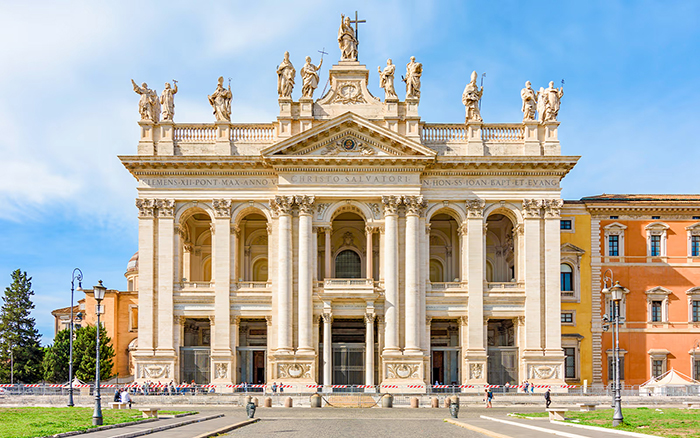
In today’s reflection, we see that Jesus and Paul both speak about the nature of being a temple. This takes place as the readings reference the Dedication of the Lateran Basilica, which is the cathedral of the Bishop of Rome – the Pope.
When Jesus says in the Gospel rreading from John, “Destroy this temple and in three days I will raise it up,” he was telling the religious autoorities that his body could be put to death, but death would not hold him. The decisive sign of his authority will be his rising on the third day. Through this saying, John directs us to Jesus himself as the place of encounter with the Father. The Temple’s significance finds its fulfillment in the person of Christ.
In Paul’s letter to the church in Corinth, he writes to a community troubled by jealousy, rivalry, and divisions. Some identify themselves with Paul, others with Apollos. Paul reminds them that their community belongs to God and that Jesus Christ is its foundation. His question, “Do you not know?, calls them to recognize the significance of something they have already received. God’s presence should shape how they live together.
An essential detail is that “you” is plural, while “temple” is singular. We might express his meaning this way: All of you together are God’s temple. Although Paul elsewhere speaks about the individual Christian’s body as a temple of the Holy Spirit, here his immediate concern is the whole community.
Benedict XVI explained this feast through precisely this relationship: the church of stone signifies the living Church, built from people whose foundation is Jesus Christ.
The connection does not make us divine in the way Jesus is divine. It means that, through belonging to him, we share in his life and become a people through whom his presence and love should be recognizable.
Fr. Ron Rolheiser writes that Christ continues to act through the members of his Body. Christian faith gives us the responsibility to make God’s care physically present through human action. Being God’s temple means allowing our hands, voices, time, and attention to serve Christ’s work.
Paul’s question invites us to become attentive to the Spirit before we speak or act. Awareness of God’s presence can change how we respond to frustration, disagreement, and another person’s need.