
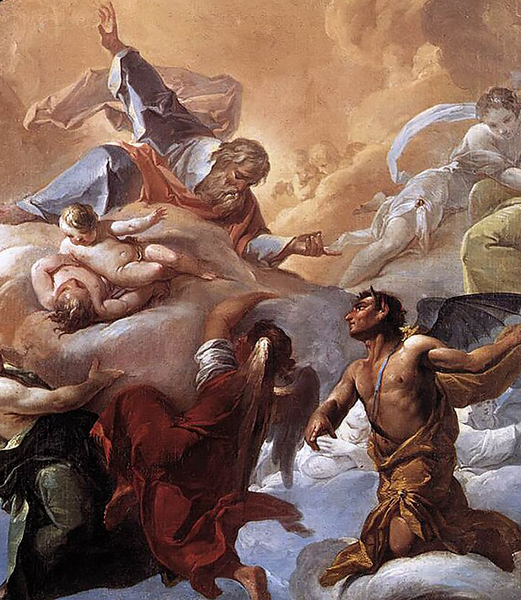
Job opens a window onto a heavenly scene. Among those appearing before the LORD is “the satan,” meaning “the adversary” or “the accuser.” He has been roaming the earth, and he challenges God’s judgment of Job: Does Job love God freely, or only because God has protected and blessed him?
That challenge drives the story. The accuser cannot simply take whatever he wants. In Job 1, God sets a boundary around what he may do; in Job 2, God sets another. Job is truly harmed, and the book never asks us to call that harm good. It asks the more painful question of whether faith can endure when the reasons for suffering remain hidden.
Church teaching notes that while Job presents “the satan” as an accuser in the heavenly court, later scriptural tradition develops this figure as the devil. Job itself does not narrate the angel’s fall.
Satan and the other fallen angels became evil through their own free and irrevocable rejection of God and his reign. Evil was not something God created within them. Their fall arose from a choice against the good for which they were made.
Satan can tempt, deceive, accuse, and work against human beings and God’s kingdom. His action can cause grave spiritual injury and, indirectly, physical harm. Yet he remains a creature: his power is neither infinite nor equal to God’s, and he cannot prevent God’s kingdom from being built. Why divine providence permits such activity remains a profound mystery.
That mystery calls for humility in the face of suffering. Job’s heavenly scene is given to the reader, but Job himself is never told its cause while he suffers. Job’s suffering exposes how cruel that question can become when spoken about someone else.
Christ answers it from within human suffering. He remains faithful to the Father through abandonment and death, and in his Resurrection reveals that suffering and death cannot finally sever the communion God offers us.
When we suffer, we may lament as Job did. We may ask God why. Christ’s victory does not require us to pretend that evil is harmless; it gives us grounds to bring our wounds to the One whose love has proved stronger than death.
Job leaves us with a mystery, not a formula for explaining another person’s pain. Christ enters that mystery himself. Temptation and suffering remain real, but neither the accuser nor death has the final word. The final word belongs to the risen Christ, who calls us into communion with God.
