
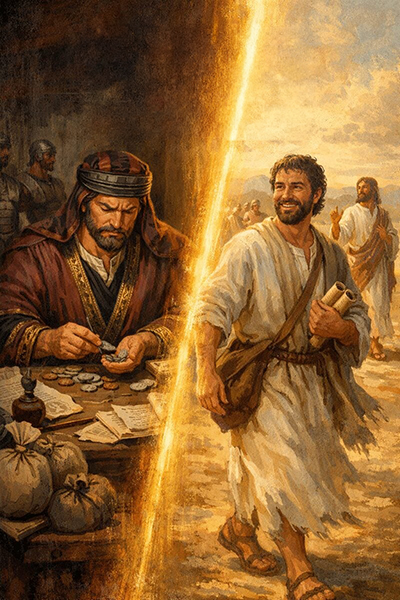
Today we will look at the relationship between the first reading from Ephesians and Matthew’s Gospel: specifically through the verse in Ephesians: “But grace was given to each of us according to the measure of Christ’s gift.” as it related to the verse in Matthew: “I desire mercy, not sacrifice.”
The Church is one body, but its members are not identical. Each person receives grace from Christ, and each receives that grace for a particular place within the life and mission of the Church.
When Paul speaks of grace being given “according to the measure of Christ’s gift,” he does not mean that Christ loves some people more and others less. The “measure” is not a ranking of human worth. It describes the particular way Christ shares his life and entrusts a vocation to each person.
Grace is always gift. It is not something we earn through religious achievement, moral perfection, or outward observance. It begins in Christ’s generosity rather than in our worthiness.
Matthew’s calling provides a living illustration of Paul’s teaching. Jesus does not wait until Matthew has repaired his reputation, demonstrated his righteousness, or proven himself worthy. The call itself is an act of grace.
Matthew’s life becomes evidence of what grace can accomplish. The tax collector will become a disciple. The man once associated with exploitation will become a witness to the Gospel. The one excluded by the religiously respectable will be given a place among the Apostles.
When Jesus says, “I desire mercy, not sacrifice,” he is not rejecting prayer, worship, sacrifice, or religious observance. He is rejecting worship that does not transform the heart. Sacrifice offered to God becomes empty when the worshiper remains indifferent to the wounded, contemptuous toward sinners, or unwilling to forgive.
To “know God” is therefore more than possessing correct religious information. It is to become merciful because God is merciful. If our worship does not move us toward compassion, reconciliation, generosity, and care for the excluded, then we have not yet allowed grace to accomplish its full work within us.
The reading from Ephesians tells us that Christ gives grace. Matthew’s Gospel shows us what that grace looks like when it enters a human life: it looks like mercy.