
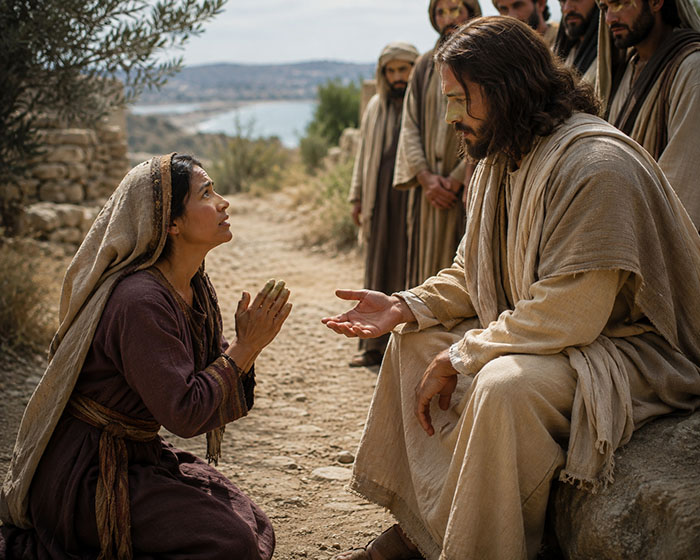
Jesus enters Gentile territory where a desperate Canaanite mother begs Him to heal her daughter. She calls Him “Son of David,” recognizing Israel’s Messiah, yet Jesus first remains silent and then says that He has come for “the lost sheep of the house of Israel.” Finally, He declares that it is not right to take the children’s bread and give it to the dogs.
At first, His words sound harsh. But Jesus is revealing the order of God’s saving plan, not denying God’s love. Israel received the covenant first because God is faithful to His promises. Through Israel, salvation would then be offered to the whole world. Using the image of children at a family table and household pets waiting nearby, Jesus illustrates that God’s blessings come first to Israel, but are never meant to stop there.
The woman understands. She does not argue or demand. Instead, she replies, “Even the dogs eat the scraps that fall from their masters’ table.” Her answer reveals extraordinary humility and complete confidence that even the smallest expression of Christ’s mercy is enough to heal. She believes that God’s grace is abundant beyond measure.
Jesus’ conversation is also directed to His disciples. They are about to become apostles to all nations, yet they still think in terms of insiders and outsiders. By praising this Gentile woman, “Great is your faith!”, Jesus teaches them that faith, not ancestry, opens the door to God’s Kingdom. The covenant remains faithful to Israel, but its fulfillment reaches every nation.
Only twice in Matthew’s Gospel does Jesus explicitly praise someone for having “great faith.” Both are Gentiles. The Roman centurion and the Canaanite woman. Meanwhile, the disciples are repeatedly described as having “little faith.” Matthew clearly wants his readers to notice this contrast. Faith is not inherited. Faith is received.
The apparent harshness of Jesus’ words in this story is not meant to exclude, but to reveal. It uncovers the faith of a humble woman, teaches the disciples that God’s mercy extends beyond every human boundary, and proclaims that all who come to Christ with persevering faith will find a place at His table.