

Do to others as you would have them do to you. Luke 6:31

Our reflection verse today comes from Luke’s Gospel and Jesus’ teaching on loving our enemies. He gives this teaching within his command to bless those who curse us, and pray for those who mistreat us. Therefore, the “other” is not limited to our family, friends, fellow Christians, or people who treat us well.

The other is every person placed before us: the stranger, the poor, the forgotten, the irritating coworker, the person who disagrees with us, and even the one who has wounded us. Jesus removes the boundaries we often place around love.

This command is sometimes called the Golden Rule, but Jesus means more than simple fairness or reciprocity. He does not say, “Treat people well because they may treat you well in return.” Christian love does not wait to see what another person deserves. It takes the initiative because God has already loved us with mercy. We are asked to give others the patience, forgiveness, dignity, understanding, and compassion that we ourselves hope to receive.

Recognizing this call in everyday life requires us to pause and look beyond our first reaction. Before speaking, deciding, judging, posting, purchasing, leading, or correcting, we might ask: If I were in this person’s situation, how would I hope to be treated? Am I protecting this person’s dignity? Does my response reveal the mercy of Christ? The “other” often appears disguised as an interruption, an inconvenience, a disagreement, or someone whose story we do not yet understand.

Doing to others what we would want done to us does not mean approving harmful behavior, abandoning healthy boundaries, or allowing ourselves to be abused. We may need to confront wrongdoing, say no, or step away from a dangerous situation. Yet even correction can be offered without hatred, humiliation, or revenge. Christian love seeks both truth and the genuine good of the person.

Jesus asks us to see every human encounter as an opportunity to make God’s love visible. The other is not merely someone standing outside of us; the other is our neighbor, bearing the image of God and sharing our need for mercy. Each day Christ asks us to become for someone else what we ourselves most need: a patient listener, a forgiving heart, a truthful companion, a defender of dignity, and a living sign that no person is beyond the reach of God’s love.
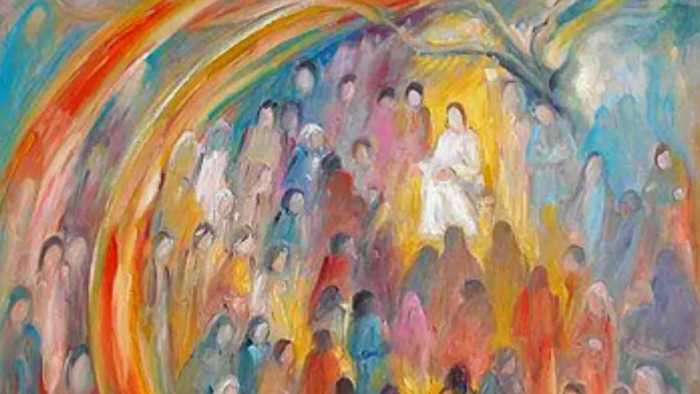

And he came down with them and stood on a stretch of level ground. Luke 6:17

Luke introduces Jesus teaching on the “Sermon on the Plain” with an easily overlooked detail: the Lord “came down” from the mountain and stood on “a stretch of level ground.” Jesus had spent the night on the mountain in prayer and had chosen the Twelve. But he did not remain above the people. He descended to where they were gathered—among the sick, the poor, the troubled, and those tormented by unclean spirits.

This movement reveals something fundamental about the Incarnation. God does not remain distant from the suffering of humanity. In Jesus Christ, God comes down and stands on our level ground. He enters the ordinary places of hunger, rejection, conflict, grief, and human need. Before Jesus teaches the crowd, he allows them to approach him, touch him, and receive healing.

Jesus then announces that the poor, hungry, grieving, and rejected are blessed—not because suffering is good, but because suffering will not have the final word. God sees those whom the world overlooks. The corresponding woes warn those who are comfortable not to build their lives upon possessions, satisfaction, amusement, or human approval.

At the center of the sermon is Jesus’ command to love our enemies. This does not require us to approve of wrongdoing or abandon justice. It means refusing to allow hatred to shape our hearts. Jesus will fulfill this teaching upon the Cross when he prays for those who crucify him. His Resurrection reveals that merciful love is stronger than hatred and death.

Jesus calls us to examine ourselves before condemning others, to recognize a tree by its fruit, and to build our lives upon his words. Hearing the Gospel is not enough. The teaching of Christ must become visible in the way we forgive, speak, serve, give, and love. The person who hears his words and lives them builds upon rock. The storms may still come, but the foundation will remain.

Joseph, son of David. Matthew 1:20

When the angel calls Joseph “son of David,” he is doing more than identifying Joseph’s ancestry. He is reminding Joseph that he belongs to the covenantal family through which God promised to bring the Messiah. Joseph may appear to be an ordinary craftsman, but God sees him as an essential participant in salvation history.

Joseph is asked to take Mary into his home and to name her child Jesus. By naming him, Joseph accepts the child as his own and gives him legal standing within the house of David. Joseph is not Jesus’ biological father, but his faithful fatherhood enables Jesus to be publicly recognized as the promised Davidic Messiah.

The angel’s command, “Do not be afraid,” does not remove every mystery from Joseph’s life. Instead, it invites him to trust God beyond what he can understand. Joseph responds without recorded words: he awakens and does what God commands. His faith becomes obedience, protection, responsibility, and loving presence.

“Joseph, son of David” reminds us that God knows who we are even when we have forgotten the deeper meaning of our lives. Like Joseph, we belong to a story larger than ourselves. God may ask us to welcome what we did not plan, protect what is vulnerable, and take the next faithful step without seeing the entire road.

Joseph teaches us that when we make room for Christ in faithful obedience, even the quietest life can become part of God’s saving work.

I ask you, is it lawful to do good on the sabbath rather than to do evil, to save life rather than to destroy it? Luke 6:9

When Jesus asks whether it is lawful “to do good on the sabbath rather than to do evil, to save life rather than to destroy it,” he is not abolishing the commandment to honor the Sabbath. He is revealing its deepest meaning. The Sabbath was given as a celebration of creation, freedom, rest, and communion with God. Because God is the giver and restorer of life, healing a suffering person fulfills the Sabbath rather than violating it.

By placing the man with the withered hand in the center of the synagogue, Jesus also places human suffering at the center of religious discernment. The question is no longer merely, “What am I forbidden to do?” It becomes, “What good is God asking me to do?” When mercy is possible, refusing to act is not always morally neutral. The good left undone can permit suffering to continue.

For Christians, Sunday celebrates the Resurrection and the beginning of the new creation. We honor it through Eucharistic worship and rest, but also by allowing that worship to make us instruments of Christ’s healing. Care for the sick, attention to the lonely, reconciliation, and service to those in need do not interrupt the holiness of the Lord’s Day; they reveal it.

Jesus therefore does not make the Sabbath less sacred. He shows us why it is sacred: the day belongs to the God who creates life, liberates the oppressed, heals what is broken, and invites his people to do the same.

If your brother sins against you,go and tell him his fault between you and him alone. If he listens to you, you have won over your brother. Matthew 18:15

Our reflection verse today from Matthew 18:15 is part of what is often called “The Discourse on the Church” because Jesus is teaching his disciples how a community formed in his name should respond when relationships are wounded by sin.

The passage’s governing purpose is found in Jesus’ phrase, “If he listens to you, you have won over your brother.” Correction is therefore not primarily about winning an argument, proving oneself right, exposing another’s sin, or protecting one’s superiority. Its purpose is to recover a brother or sister and restore communion. In this sense, the passage teaches that Christian correction serves reconciliation, not victory.

Yet the concern of correction must first turn to where our heart and mind are coming from in relation to the perceived “sin” that has occurred. Henri Nouwen would remind us that correction is an act of spiritual hospitality: creating a safe but truthful space in which another person can face what has happened without being reduced to the offense. His teaching on forgiveness stresses precisely this movement from accusation toward shared human vulnerability and restored relationship.

Ronald Roheiser notes that Christians can become very skilled at identifying what is wrong while remaining unable to produce healing or conversion. Knowing another person’s fault does not necessarily give us the spiritual authority to correct it. That authority comes from personal integrity, humility, compassion, and the willingness to carry some of the other person’s weakness.

Jesus used his energies toward unity, patience, forgiveness, and reconciliation. Richard Rohr would caution that we must understand that we often react most strongly to faults in others that we have not recognized or reconciled within ourselves. Jesus tells us that “where two or three are gathered in my name, there am I in the midst of them.” This means that Christ must be the true center of the encounter. If the correcting group becomes a coalition against the accused, it is no longer gathering authentically in Christ’s name.

Jesus recognized real boundaries and never pretended that sin was harmless. Yet he also ate with tax collectors, called Matthew to discipleship, praised the faith of Gentiles, and continued inviting outsiders into relationship. Therefore, exclusion from the community may sometimes become necessary—particularly when someone remains abusive, destructive, or unrepentant—but it must never become permission to hate, humiliate, or abandon concern for that person’s salvation.

Christian correction is not the righteous correcting the unrighteous from above. It is one wounded and forgiven disciple approaching another in humility, truth, and hope for restored communion. Its thesis is simple: correction serves recovery, not superiority.

It is Christ’s protection against two opposite failures: ignoring destructive behavior on the one hand and condemning people without mercy on the other. Its deepest purpose is expressed in Jesus’ own words: to win back one’s brother or sister.

‘Amen, I say to you, whatever you did for one of these least brothers of mine, you did for me.’ Matthew 25:40

Today we celebrate the Memorial of Saint Teresa of Calcutta.

St. Teresa reminds us that love for God becomes visible in the way we love the person directly before us. Jesus identifies Himself with the hungry, the sick, the lonely, the rejected, and the forgotten: “Whatever you did for one of these least brothers of mine, you did for me.”

Teresa recognized Christ beneath His “distressing disguise.” She understood that poverty includes not only hunger and homelessness but also the painful experience of being unwanted or forgotten. She therefore approached each person not as a problem to be solved, but as someone possessing sacred and eternal dignity.

Her life also teaches us that faithfulness does not depend upon spiritual feelings. Even during years of interior darkness, she continued to pray, serve, and love. She remained faithful to Christ even when she could not feel His presence. Holiness, she shows us, is sometimes the quiet decision to keep loving in the darkness.

We may not be called to accomplish something dramatic, but every disciple is called to notice the suffering nearby. Our “Calcutta” may be found in our family, parish, neighborhood, workplace, or within the heart of someone who simply needs to know that they have not been forgotten.

The person before us may be Christ in disguise. We need only the faith to recognize Him and the love to respond.

No one who has been drinking old wine desires new, for he says, ‘The old is good.’ Luke 5:39

Jesus’ observation that those accustomed to old wine do not immediately desire the new reveals His deep understanding of the human heart. We naturally prefer what is familiar because it feels dependable and safe. The religious leaders had inherited practices meant to lead Israel toward God, but some had become so attached to those familiar forms that they could not recognize the fulfillment of God’s promises standing before them.

The new wine is the life of the Kingdom revealed in Jesus Christ. It does not reject Israel’s covenantal story but brings that story to fulfillment. Yet receiving Christ requires new wineskins—hearts made humble, receptive, and willing to change. The danger is not tradition itself, but allowing familiarity to become resistance to the living movement of God.

We face the same temptation whenever we confuse being accustomed to the faith with being transformed by it. We may know the prayers, teachings, and practices of the Church while resisting the deeper conversion they seek to bring about. Christ invites us to treasure everything God has given while remaining open to where the Holy Spirit is leading.

Faithfulness is not merely holding tightly to what we have always known; it is allowing the unchanging truth of Christ to make our hearts continually new.

For the wisdom of this world is foolishness in the eyes of God. 1 Corinthians 3:19

The wisdom of the world teaches us to pursue power, recognition, comfort, control, and personal success. It encourages us to measure life by what we possess, accomplish, or appear to be before others. Yet God sees beyond appearances. What the world calls success may leave the soul empty, while what the world considers weakness—humility, mercy, sacrifice, forgiveness, and dependence upon God—may reveal the deepest spiritual strength.

The Cross is the clearest expression of this divine reversal. To the world, the crucified Christ appeared defeated, powerless, and abandoned. In the wisdom of God, however, the Cross became the place where sin was conquered, love was revealed, and humanity was reconciled to God.

God’s wisdom does not merely improve worldly wisdom; it overturns it. Christ shows us that life is found by giving ourselves away, greatness is found in serving, and victory comes through faithful, self-giving love.

Paul’s warning also challenges everyone to know that religious knowledge, education, and even theological understanding can become sources of pride if they do not lead us into humility, conversion, and communion with God.

We may know many things about Christ while still resisting the way of Christ. True spiritual maturity begins when we allow God to question our assumptions, reorder our desires, and teach us to see ourselves and others through the eyes of divine love.

This verse therefore invites us to ask: Whose wisdom is guiding my life? Am I making decisions according to status, fear, convenience, and public approval, or according to the Gospel?

The wisdom of God may sometimes appear impractical or foolish to the world, but it leads us toward what is eternally real: faithfulness instead of popularity, mercy instead of judgment, service instead of power, and love instead of self-interest. What appears foolish in the eyes of the world may be the very path by which God leads us into freedom, holiness, and abundant life.

I could not talk to you as spiritual people, but as fleshly people, as infants in Christ. I fed you milk, not solid food, because you were unable to take it. 1 Corinthians 3:2-3

The Church must honestly acknowledge that inadequate formation has often left Catholics spiritually undernourished. Many were taught enough to receive the Sacraments but not always enough to understand that the Sacraments begin and sustain a lifelong transformation. They may have been told what the Church teaches without being helped to encounter the Person at the center of that teaching—Jesus Christ. They may know that they “have a soul” without realizing that their deepest identity and destiny are spiritual: they were created by God, for communion with God, and for eternal life in God.

The “milk” of faith gives us the essential truths: God loves us; Christ saves us; the Church gathers us; the Sacraments strengthen us; and we are called to love God and neighbor. The “solid food” of mature faith does not replace these truths. It takes us more deeply into them and requires us to live their consequences.

Solid food means moving from merely knowing about Christ to consciously living in communion with Christ. It means progressing:

  • from attending Mass to entering into Christ’s sacrifice;
  • from reciting prayers to developing a genuine life of prayer;
  • from receiving the Eucharist routinely to recognizing and reverencing Christ’s Real Presence;
  • from memorizing teachings to understanding the wisdom and love within them;
  • from asking only, “What must I do?” to asking, “Who is Christ forming me to become?”;
  • from treating faith as one part of life to allowing the Holy Spirit to shape the whole of life.

Perhaps the deepest challenge in Paul’s words is that many Christians do not truly recognize themselves as spiritual beings. Modern culture frequently defines the person through productivity, possessions, emotions, political identity, physical appearance, or social status. Paul reminds us that none of these reaches the deepest truth of who we are.

We are embodied spiritual persons, created in the image of God. Through Baptism, we have been joined to Christ and made dwelling places of the Holy Spirit. Our spiritual life is therefore not an optional religious addition to our “real” life. It is the deepest dimension of reality—the place where we encounter God, discern truth, receive grace, and gradually become the persons we were created to be.

Spiritual maturity is not something we achieve once and possess permanently. It is a lifelong surrender to grace. Christ continually invites us beyond familiarity, routine, and shallow understanding into the inexhaustible depths of his life. The tragedy is not that we begin with milk; every disciple does. The tragedy would be refusing the solid food Christ continues to offer.

Paul’s message, therefore, remains a call to the whole Church: Grow into what you have received. Become who Baptism says you are. Allow the Eucharist you consume to transform you into the Body of Christ. And let the Holy Spirit lead you from merely belonging to the Church into mature, conscious, and fruitful life in Christ.

“What is there about his word? For with authority and power he commands the unclean spirits, and they come out.” Luke 4:36

In our reflection today from Luke’s Gospel, Jesus drives out the demon from a man who was possessed. The demon recognizes what others have not yet fully understood: Jesus is “the Holy One of God”. With a direct command, “Be quiet! Come out of him!”, Jesus frees the man without harming him.

The people are astonished because Jesus’ word does more than communicate religious ideas. His word accomplishes what it declares. When Jesus speaks, darkness retreats, bondage is broken, and a human life is restored. His authority is not based upon eloquence, social position, or human learning; it flows from his identity as the Son of God and from the power of the Holy Spirit resting upon him.

In the first reading, Paul declares: “The Spirit scrutinizes everything, even the depths of God.” Paul is not suggesting that the Holy Spirit examines God as though God were unknown to him. The Spirit is God and knows the inner life, wisdom, and saving purposes of God. Just as the human spirit knows what is within a person, the Holy Spirit knows the depths of God and reveals God’s truth to us.

This provides an important connection to the Gospel. The unclean spirit recognizes Jesus’ identity, but recognition alone does not produce faith, communion, or obedience. The demon knows something about Jesus, yet remains opposed to him. The Holy Spirit, by contrast, does not merely provide information about Christ. He draws us into the life of Christ, opens our hearts to his word, and enables us to respond with faith.

Paul tells us that the Spirit searches even the depths of God; Luke shows us what happens when that divine power enters the depths of human suffering. The Spirit reveals the mind of God, exposes the works of darkness, and makes the liberating authority of Christ present among us.

The same Spirit who rested upon Jesus now dwells within the Church and within every baptized believer. The Spirit continues to speak Christ’s word into the places where fear, sin, deception, and despair attempt to take possession of the human heart. Our calling is not merely to be astonished by the authority of Jesus, but to surrender ourselves to it, allowing the Holy Spirit to search us, heal us, free us, and send us forth as instruments of Christ’s liberating presence in the world.

HTML Snippets Powered By : XYZScripts.com